
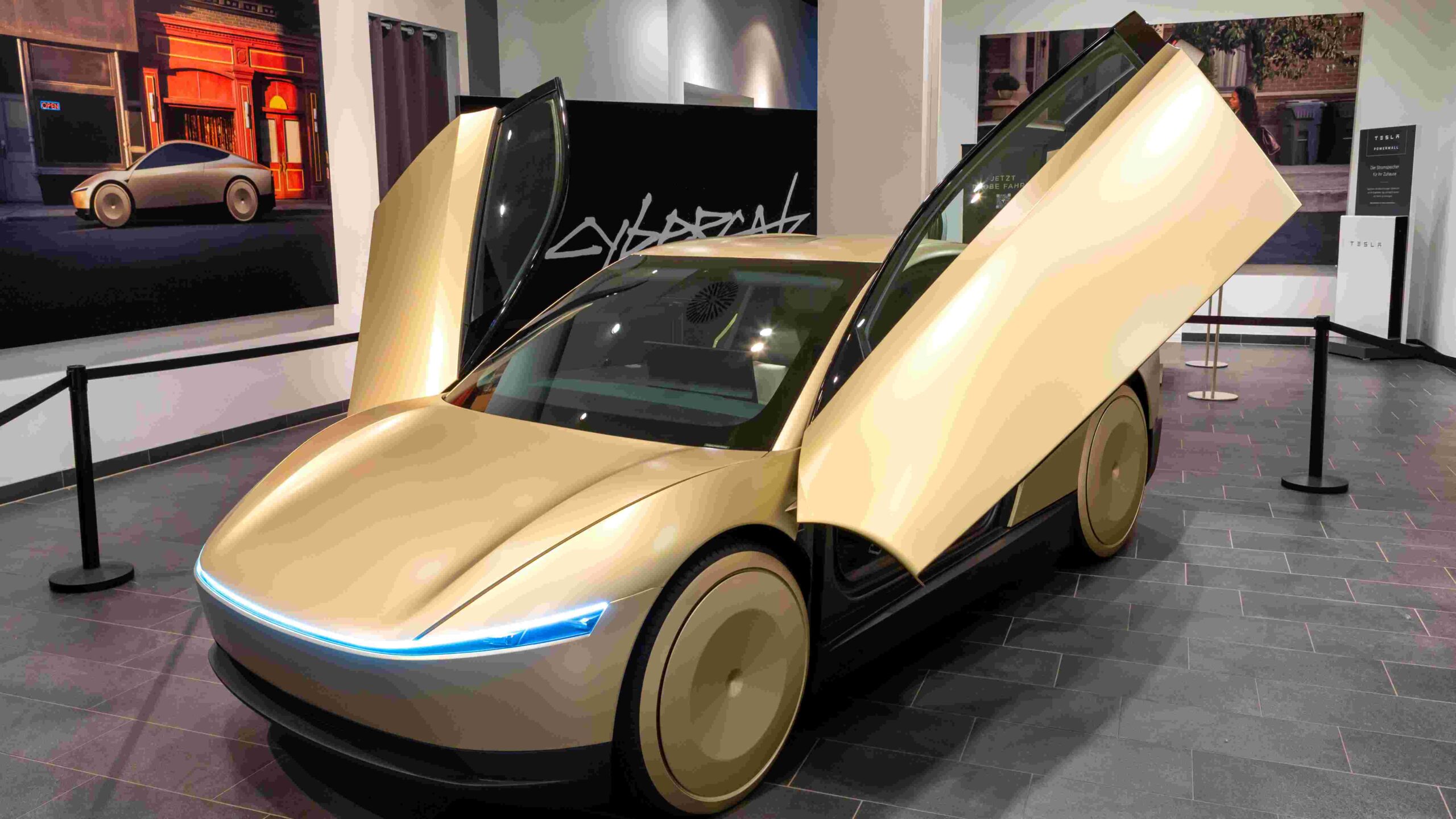
The future of transportation is no longer a distant vision. It is rapidly becoming reality as Tesla Cybercab mass deliveries begin moving from factory floors to public roads across the United States. For years, autonomous vehicles were viewed as experimental technology, limited to demonstrations and carefully controlled pilot programs. Today, however, Tesla is taking a massive leap forward by transforming autonomous transportation into a scalable commercial business.
With sightings of production-ready Cybercabs across major cities, aggressive hiring for robotaxi operations, breakthroughs in AI computing, and industry-leading operating economics, Tesla appears ready to redefine not only ridesharing but also personal vehicle ownership itself.
As Elon Musk continues pushing the boundaries of artificial intelligence and mobility, the Cybercab could become the most disruptive transportation product since the launch of the Model 3.
The Autonomous Transportation Revolution Has Arrived
The global transportation industry is experiencing a historic transition. Traditional human-driven vehicles are gradually being replaced by AI-powered autonomous fleets capable of operating around the clock without human intervention.
For many years, experts questioned whether fully autonomous ride-hailing could ever become commercially viable at scale. The challenges of safety, regulation, infrastructure, and cost seemed almost impossible to overcome.
However, Tesla’s latest developments suggest that the gap between autonomous vehicle technology and mass-market commercialization has finally closed.
The Tesla Cybercab represents the company’s most ambitious transportation project to date—a purpose-built autonomous vehicle designed specifically for robotaxi services.
Unlike traditional cars retrofitted with self-driving technology, the Cybercab was engineered from the ground up for autonomous operation.
Tesla Cybercab Sightings Confirm Massive Production Ramp
One of the strongest indicators that Tesla is entering full deployment mode is the increasing number of Cybercab sightings across the United States.
Production Vehicles Spotted Across Multiple States
During mid-2026, production-specification Cybercabs began appearing simultaneously across several major metropolitan regions, including:
These sightings are not isolated testing events. Instead, they indicate a coordinated deployment strategy designed to prepare Tesla’s autonomous fleet for commercial operation.
Industry observers have reported dozens of Cybercabs operating on public roads while collecting real-world driving data in increasingly complex environments.
Autonomous Vehicles Driving Themselves Off the Factory Line
Perhaps the most significant milestone came directly from Tesla CEO Elon Musk.
Tesla showcased a production Cybercab autonomously driving itself off the assembly line at Gigafactory Texas without any human involvement.
This achievement represents far more than a technological demonstration.
It introduces a revolutionary concept in automotive logistics where vehicles can:
- Navigate factory facilities autonomously
- Position themselves for inspection
- Move into staging areas
- Prepare for deployment without human drivers
The result is dramatically reduced operational costs and increased scalability.
Tesla Is Building a Nationwide Robotaxi Network
Technology alone does not create a transportation empire.
To successfully launch a nationwide autonomous ride-hailing platform, Tesla requires extensive operational infrastructure.
Tesla’s Strategic Hiring Surge
Tesla has opened dozens of new positions specifically focused on robotaxi operations.
The company is no longer concentrating exclusively on AI development. Instead, it is building the organizational framework necessary to manage a large-scale transportation network.
Key hiring categories include:
Fleet Operations Specialists
These professionals will oversee:
- Vehicle distribution
- Fleet monitoring
- Service optimization
- Operational efficiency
Their goal is to ensure Cybercabs remain available in high-demand areas while maximizing utilization rates.
Charging Infrastructure Managers
Tesla is also investing heavily in automated charging solutions.
These managers will supervise the rollout of:
- Wireless charging systems
- Inductive charging pads
- Fleet charging hubs
- Energy management infrastructure
The objective is to create a largely self-sustaining transportation ecosystem.
Incident Response Teams
Even highly advanced AI systems require human support for unusual scenarios.
Tesla is hiring teams responsible for:
- Vehicle recovery
- Traffic incident management
- System diagnostics
- Emergency response coordination
These teams will provide an essential safety layer as autonomous operations scale.
Pricing and Market Optimization Experts
Tesla plans to compete directly with established ridesharing giants.
Pricing specialists will develop algorithms that optimize:
- Ride fares
- Demand balancing
- Surge pricing
- Customer acquisition strategies
This demonstrates Tesla’s intention to operate as both a technology company and transportation network provider.
Vision-Only AI: Tesla’s Biggest Competitive Advantage
One of the most important factors separating Tesla from competitors is its radically different approach to autonomous driving technology.
How Waymo Builds Autonomous Vehicles
Competitors such as Waymo rely heavily on:
- LiDAR sensors
- Radar systems
- High-definition maps
- Extensive pre-mapping
This approach allows impressive autonomous performance but creates major scaling limitations.
Every city requires detailed mapping before deployment.
Every road must be continuously updated.
Every geographic expansion becomes costly and time-consuming.
Tesla’s Vision-Only Strategy
Tesla has chosen a completely different path.
The Cybercab relies primarily on:
- Cameras
- Neural networks
- Computer vision
- Real-time decision making
Instead of depending on pre-built maps, Tesla’s AI observes and interprets the environment dynamically.
This approach closely mirrors how humans drive.
Drivers do not require ultra-detailed digital maps to navigate unfamiliar streets.
They simply observe their surroundings and make decisions accordingly.
Tesla’s AI attempts to do exactly the same thing.
Why Vision-Only AI Enables Global Scalability
The biggest advantage of Tesla’s approach is scalability.
Because Cybercabs do not require extensive local mapping infrastructure, Tesla can theoretically deploy autonomous fleets across thousands of cities worldwide much faster than competitors.
This scalability could become one of Tesla’s most powerful competitive advantages in the autonomous transportation market.
AI4 and AI5: The Computing Power Behind Cybercab
Autonomous driving depends heavily on computational performance.
Tesla’s hardware evolution is a critical component of the Cybercab strategy.
Current AI4 Platform
Current Cybercab validation fleets utilize Tesla’s AI4 hardware system.
Key capabilities include:
- Real-time perception
- Multi-camera processing
- Object recognition
- Path planning
AI4 already powers millions of Tesla vehicles globally.
AI5: Tesla’s Next Generation AI Processor
The future of autonomous transportation may depend on Tesla’s upcoming AI5 chip.
Expected performance estimates suggest:
| Platform | Estimated Compute Power |
|---|---|
| AI4 | 300–500 TOPS |
| AI5 | 2,000–2,500 TOPS |
This represents a dramatic increase in computational capability.
Why AI5 Matters
The AI5 processor allows Tesla to run significantly larger neural networks.
Benefits include:
- Improved object detection
- Better traffic prediction
- Faster decision making
- Enhanced safety margins
Because Tesla does not rely on HD maps, nearly all processing resources can focus on real-time environmental understanding.
This gives the Cybercab a powerful foundation for large-scale autonomous operations.
The Incredible Economics of Tesla Cybercab
Technology may attract attention, but economics determine long-term success.
Tesla designed the Cybercab from scratch with efficiency as a primary objective.
Purpose-Built Autonomous Design
Unlike conventional vehicles, the Cybercab eliminates:
- Steering wheels
- Pedals
- Traditional control systems
This reduces weight, complexity, and manufacturing costs.
The result is a highly optimized autonomous vehicle built specifically for transportation services.
Industry-Leading Energy Efficiency
One of Cybercab’s most impressive achievements is its energy consumption.
The vehicle reportedly uses only:
165 Wh per mile
For comparison:
- Many premium EVs consume over 230 Wh per mile
- Larger electric SUVs consume significantly more
This efficiency translates directly into lower operating expenses.
The 2.6 Cents Per Mile Advantage
Tesla estimates Cybercab operating costs at approximately:
2.6 cents per mile
This figure has enormous implications.
Benefits include:
- Lower ride prices
- Higher profitability
- Increased fleet competitiveness
- Greater scalability
Over millions of annual miles, even small efficiency gains create substantial economic advantages.
Regulatory Progress Supports Rapid Expansion
Regulatory approval has historically slowed autonomous vehicle deployment.
Many autonomous companies relied on special exemptions limiting production volumes.
Tesla appears to be taking a different route.
FMVSS Compliance Strategy
The Cybercab was designed to comply with Federal Motor Vehicle Safety Standards (FMVSS) using alternative safety systems.
This strategy allows Tesla to:
- Scale production faster
- Avoid exemption bottlenecks
- Expand deployment more rapidly
Combined with favorable regulatory developments in Texas and California, Tesla’s path toward commercialization appears increasingly viable.
Can Tesla Cybercab Generate Passive Income?
One of the most exciting aspects of the Cybercab is its potential to function as an income-producing asset.
The Tesla Network Concept
Owners may eventually allow their Cybercabs to operate autonomously on Tesla’s transportation network.
When not being used personally, the vehicle could generate revenue by transporting passengers.
Conservative Revenue Model
Analysts have modeled Cybercab economics using realistic assumptions.
At approximately 30% utilization:
- Around 160 miles daily
- 18–19 trips per day
- Gross annual revenue near $50,000
Assuming Tesla retains 35% of revenue:
- Tesla share: $17,500
- Owner share: approximately $32,500
Even conservative projections suggest substantial earning potential.
Faster Return on Investment
Tesla has indicated a potential purchase price around:
$30,000
Under favorable operating conditions, owners could potentially recover their investment significantly faster than with traditional vehicle ownership.
This shifts the automobile from a depreciating asset into a potential cash-flow-generating investment.
Beyond Transportation: Additional Revenue Opportunities
Elon Musk’s vision extends far beyond passenger transportation.
The Cybercab could eventually become part of a broader AI-powered ecosystem.
Distributed AI Computing
When parked or charging, Cybercabs possess powerful onboard computing resources.
Tesla could potentially leverage idle processors for:
- AI inference workloads
- Cloud computing services
- Neural network processing
- Data analysis tasks
Optimus Robot Integration
Future Tesla ecosystems may include close integration with Tesla Optimus humanoid robots.
Cybercabs could serve as:
- Communication hubs
- Charging stations
- Mobile logistics nodes
In-Cabin Digital Services
Additional monetization opportunities may include:
- Entertainment subscriptions
- Advertising
- Local recommendations
- Food delivery partnerships
- Package logistics
These services could create multiple income streams beyond passenger rides.
Why Cybercab Could Become Tesla’s Biggest Product Ever
The Model 3 transformed the electric vehicle industry.
The Cybercab could potentially transform transportation itself.
Several factors contribute to its disruptive potential:
Massive Scalability
Tesla’s vision-only architecture supports rapid geographic expansion.
Exceptional Economics
Industry-leading efficiency lowers operating costs dramatically.
Advanced AI Hardware
AI5 provides the computational foundation necessary for large-scale autonomy.
Transportation Network Effects
As fleet size grows, network efficiency and profitability may improve further.
New Ownership Model
Vehicles may evolve from transportation tools into revenue-generating assets.
The Future of Transportation Is Being Written Today
Tesla’s Cybercab initiative marks one of the most significant developments in transportation history.
What was once viewed as science fiction is quickly becoming commercial reality.
Production vehicles are already emerging from Gigafactory Texas.
Operational teams are being assembled.
Autonomous software validation is accelerating.
And the economic advantages continue to attract attention from investors, consumers, and industry leaders alike.
If Tesla successfully executes its vision, the Cybercab may do more than challenge traditional ridesharing companies—it could fundamentally redefine how people think about mobility, transportation ownership, and urban infrastructure.
As 2026 progresses, one thing is becoming increasingly clear: Tesla Cybercab mass deliveries are finally here, and the autonomous transportation revolution has officially begun.
FAQs
1. What is the Tesla Cybercab?
The Tesla Cybercab is Tesla’s fully autonomous, purpose-built robotaxi designed without a steering wheel or pedals. It is engineered specifically for autonomous ride-hailing services and future transportation networks.
2. When will Tesla Cybercab mass deliveries begin?
Based on recent developments and production activity at Gigafactory Texas, Tesla has already started producing Cybercabs for validation fleets, with broader commercial deployment expected as regulatory approvals and operational testing continue.
3. How does the Tesla Cybercab drive without a human driver?
The Cybercab uses Tesla’s Full Self-Driving (FSD) technology powered by advanced AI systems, multiple cameras, neural networks, and real-time decision-making software to navigate roads autonomously.
4. Does the Cybercab use LiDAR or radar sensors?
No. Tesla has adopted a vision-only approach, meaning the Cybercab primarily relies on cameras and AI-based computer vision rather than LiDAR or traditional radar systems.
5. What makes Tesla’s vision-only system different from competitors like Waymo?
Unlike competitors that depend on expensive sensors and detailed HD maps, Tesla’s vision-based system can interpret road conditions in real time, allowing for easier scalability across cities and countries.
6. How energy-efficient is the Tesla Cybercab?
The Cybercab is designed to consume approximately 165 Wh per mile, making it one of the most energy-efficient electric vehicles ever developed for commercial transportation.
7. What is the estimated operating cost of the Cybercab?
Tesla estimates operating costs at roughly 2.6 cents per mile, giving it a significant cost advantage over traditional ride-hailing vehicles and many electric cars.
8. How much will the Tesla Cybercab cost?
Tesla has indicated a target purchase price of around $30,000, making it more affordable than many premium electric vehicles while offering potential income-generating capabilities.
9. Can owners earn money with their Cybercab?
Yes. Tesla plans to integrate Cybercabs into the Tesla Network, allowing owners to let their vehicles operate autonomously as robotaxis and potentially generate passive income.
10. How much income could a Cybercab generate?
Under conservative estimates, a Cybercab operating at approximately 30% utilization could generate around $50,000 in annual gross revenue, with owners retaining a significant portion after Tesla’s platform fees.
11. What is Tesla AI5, and why is it important?
Tesla AI5 is Tesla’s next-generation autonomous driving processor expected to deliver up to 2,500 TOPS (trillion operations per second), enabling more advanced neural networks and improved driving intelligence.
12. Where are Tesla Cybercabs currently being tested?
Cybercabs have been spotted and tested in several U.S. locations, including Austin, Dallas, Phoenix, Glendale, and Silicon Valley, as Tesla expands its real-world validation program.
13. Is the Tesla Cybercab legally approved for public roads?
Tesla is designing the Cybercab to comply with Federal Motor Vehicle Safety Standards (FMVSS) and is working within evolving autonomous vehicle regulations in states such as Texas and California.
14. How is the Cybercab different from a regular Tesla vehicle?
Unlike traditional Tesla models, the Cybercab is built exclusively for autonomous transportation, featuring a simplified design, no manual controls, greater efficiency, and optimized operating economics.
15. Can the Cybercab be used for services other than passenger transportation?
Yes. Tesla envisions future applications including package delivery, AI computing services, digital advertising, entertainment services, and support for Tesla Optimus robots.
16. Why is the Tesla Cybercab considered so important for the future?
The Cybercab combines artificial intelligence, autonomous driving, low operating costs, and scalable fleet deployment, potentially transforming transportation, vehicle ownership, and the global mobility industry for decades to come.
Read More:
- SpaceX just Did Something Impossible on Flight 13 Booster! Double Static Fire Tests Ready
- Tesla skeptics will hate what this new reliability study says
- SpaceX IPO set to provide massive $11.6B windfall for teacher pension plan
- Tesla Model 3’s cheapest trim just got a major accolade
- What SpaceX Did to Solve Starship Launch Pad Explosion Problem Totally Humiliated Blue Origin
- Elon Musk Shocked the Industry at Tesla’s 2026 New Product Showcase: Flying Cars & AI Robots