
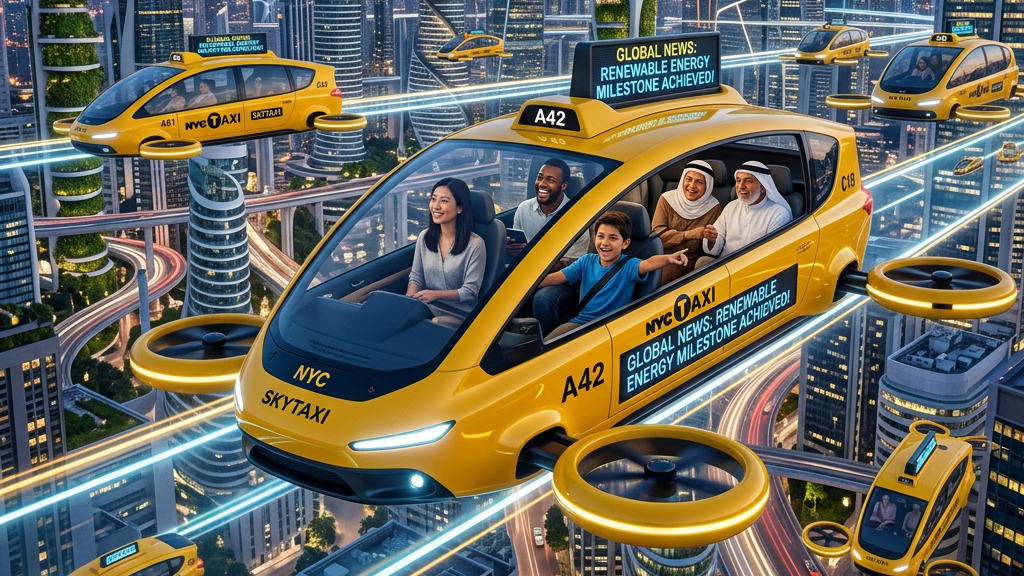
Elon Musk’s First Prototype of Flying Tesla Robotaxi “SkyCab” Shocked the Industry: The world has become accustomed to seeing Elon Musk dominate headlines with groundbreaking innovations. From electric vehicles and reusable rockets to artificial intelligence and brain-computer interfaces, Musk has consistently pushed the boundaries of technology. However, his latest revelation may be his most ambitious project yet.
During a recent appearance on The Joe Rogan Experience, Musk casually hinted at a revolutionary transportation concept that immediately captured global attention: Tesla’s development of a fully autonomous flying robotaxi, unofficially known as the SkyCab.
Unlike previous flying car concepts that remained confined to science fiction or niche aerospace experiments, Tesla’s SkyCab aims to combine the company’s strengths in electric vehicles, artificial intelligence, battery technology, and autonomous driving systems into a single transformative product.
The announcement sent shockwaves throughout the technology and aviation industries, causing investors, analysts, and competitors to reassess the future of urban mobility.
Tesla’s Vision for the Future of Transportation
For years, Tesla has pursued a mission to revolutionize transportation through sustainable energy and automation. The introduction of the Cybercab, Tesla’s steering-wheel-free autonomous vehicle, already signaled the company’s intention to redefine personal mobility.
Now, the proposed SkyCab takes that vision a step further.
Rather than building a conventional air taxi that only flies between designated landing zones, Tesla is reportedly developing a hybrid vehicle capable of operating both on roads and in the air. If successful, this would create an entirely new category of transportation.
Imagine leaving your driveway in a vehicle that functions like a regular car before seamlessly transitioning into flight mode to bypass traffic congestion and reach your destination in minutes.
This is the future Tesla appears to be building.
What Is Project SkyCab?
Tesla’s Secret Aerospace-Automotive Hybrid
According to reports and industry leaks, Tesla has spent more than two years developing an experimental platform that combines automotive engineering with aerospace technology.
Unlike many existing eVTOL (Electric Vertical Takeoff and Landing) aircraft, SkyCab is rumored to be designed for everyday consumers rather than specialized commercial operators.
The project seeks to eliminate the limitations of traditional urban transportation by creating a vehicle capable of:
- Driving on standard roads
- Vertical takeoff and landing
- Fully autonomous navigation
- Electric propulsion
- Seamless integration with Tesla’s mobility ecosystem
This hybrid approach could significantly differentiate Tesla from competitors in the rapidly growing air mobility sector.
Advanced Aerodynamics and Deployable Wings
Solving the Flying Car Design Challenge
One of the greatest engineering obstacles facing flying vehicles is balancing the requirements of road safety with the demands of aerodynamic flight.
Traditional aircraft require large wings and exposed propulsion systems, while automobiles must comply with crash regulations and practical road dimensions.
Tesla’s solution appears to involve a sophisticated deployable wing and propulsion system.
When operating on the ground, these components remain hidden inside the vehicle’s body. Upon entering flight mode, the aerodynamic structures automatically deploy to provide lift and stability.
This innovative design allows the SkyCab to maintain a futuristic automotive appearance while retaining full flight capability.
Industry insiders describe the vehicle’s appearance as a combination of the Cybertruck and a stealth fighter aircraft, featuring:
- Sharp geometric styling
- Hidden propulsion systems
- Panoramic glass cabin
- Continuous LED lighting elements
- Lightweight aerospace materials
Lightweight Materials Inspired by SpaceX
Aerospace Engineering Meets Automotive Manufacturing
Weight is one of the most critical factors in aviation.
To achieve efficient vertical takeoff, Tesla reportedly plans to utilize advanced carbon fiber composites, ultra-light structural materials, and aerospace-grade manufacturing techniques.
The company has reportedly expanded recruitment efforts targeting engineers from major aerospace organizations while leveraging expertise developed through SpaceX’s Falcon 9 and Starship programs.
The result could be a vehicle that combines:
- Aircraft-level structural efficiency
- Automobile crash safety standards
- Enhanced durability
- Reduced energy consumption
This unique combination may provide Tesla with a significant competitive advantage.
The 4680 Battery Revolution
The Key to Practical Flying Cars
Historically, battery limitations have prevented flying cars from becoming commercially viable.
Flight consumes significantly more energy than ground transportation, making battery density one of the most important factors in vehicle design.
Tesla plans to address this challenge through its proprietary 4680 battery technology.
Expected SkyCab Specifications
| Feature | Estimated SkyCab |
|---|---|
| Battery Technology | Advanced 4680 Cells |
| Flight Range | 250-300 km |
| Operation | Fully Autonomous |
| Passenger Capacity | Multiple Occupants |
| Estimated Price | $120,000-$180,000 |
| Charging Infrastructure | Tesla Supercharger Network |
Tesla engineers are reportedly exploring next-generation battery chemistries capable of delivering high power output while maintaining low weight.
If achieved, a flight range of 250 to 300 kilometers would significantly exceed many existing eVTOL designs currently under development.
Distributed Electric Propulsion System
Built for Safety and Reliability
Safety remains the highest priority for any flying vehicle.
Instead of relying on a single engine, SkyCab is expected to utilize a distributed electric propulsion architecture consisting of multiple independent motors and rotor systems.
This design provides several benefits:
- Enhanced redundancy
- Improved stability
- Better efficiency
- Emergency failure protection
Even if one propulsion unit fails, the remaining systems could maintain controlled flight and execute a safe landing.
This approach mirrors safety principles already used in advanced aerospace systems.
Artificial Intelligence Powers the SkyCab
Tesla’s Autonomous Flight Ambitions
The true innovation behind SkyCab may not be its ability to fly but its ability to fly without a pilot.
Tesla intends to leverage its extensive experience with Full Self-Driving (FSD) technology to create a fully autonomous aerial transportation network.
The company already collects billions of miles of real-world driving data from its global fleet. This information serves as the foundation for training sophisticated neural networks capable of making complex decisions in real time.
However, aerial autonomy introduces entirely new challenges.
The system must account for:
- Wind patterns
- Weather changes
- Air traffic
- Birds and drones
- Urban turbulence
- Flight corridor management
Successfully navigating these variables requires a level of AI sophistication never before deployed in consumer transportation.
Grok and xAI Integration
A New Digital Flight Experience
Tesla’s autonomous ecosystem is expected to be heavily integrated with xAI and its conversational AI platform, Grok.
Instead of traditional controls, passengers may simply communicate with the vehicle through natural language.
Examples include:
- “Take me to downtown.”
- “Find the fastest route.”
- “Avoid bad weather.”
- “Schedule a stop for lunch.”
The AI assistant would manage every aspect of the journey while providing a highly personalized travel experience.
This could transform transportation into a fully voice-controlled service.
Starlink Creates a Connected Air Mobility Network
Satellite Connectivity for Autonomous Flight
Reliable communication is essential for autonomous aviation.
Reports suggest SkyCab may utilize Starlink’s satellite network to maintain uninterrupted connectivity regardless of location.
Benefits include:
- Real-time traffic coordination
- Weather monitoring
- Fleet communication
- Navigation updates
- Emergency response capabilities
By connecting every vehicle through a unified satellite-based network, Tesla could establish one of the world’s most advanced transportation ecosystems.
Tesla’s Robotaxi Business Model
Transportation as a Service
Tesla does not appear to view SkyCab as merely a luxury product.
Instead, the company is expected to integrate it into its broader Robotaxi Network.
The process could be remarkably simple:
Step 1: Open Tesla App
Users enter their destination.
Step 2: AI Route Analysis
Tesla’s cloud system evaluates:
- Traffic conditions
- Distance
- Weather
- Air corridor availability
Step 3: Vehicle Assignment
The system chooses either:
- A ground-based Cybercab
- An aerial SkyCab
Step 4: Autonomous Journey
Passengers enter a steering-wheel-free cabin and allow the AI to handle the trip.
This model could make advanced aerial transportation accessible to millions of users rather than a small group of wealthy owners.
How SkyCab Could Transform Cities
The Rise of Three-Dimensional Urban Mobility
For more than a century, cities have been designed around automobiles.
Roads, highways, parking structures, and transit corridors dictate how urban environments function.
The introduction of autonomous flying transportation could fundamentally alter this model.
Instead of moving across cities in two dimensions, people could travel in three dimensions.
Benefits may include:
- Reduced traffic congestion
- Faster commutes
- Improved productivity
- Greater urban flexibility
- Reduced infrastructure pressure
The implications for city planning are enormous.
Impact on Real Estate Markets
Redefining Location Value
Today, property values are heavily influenced by proximity to business centers.
If SkyCab enables a 50-kilometer commute in under ten minutes, geographic limitations become far less significant.
This could lead to:
- Expansion of suburban communities
- Increased rural development
- Reduced housing pressure in city centers
- New commercial opportunities outside major metropolitan areas
The resulting shift may reshape real estate markets worldwide.
Accelerating the Clean Energy Transition
Reducing Dependence on Fossil Fuels
An electrified aerial transportation network could dramatically reduce fossil fuel consumption.
Current aviation and transportation industries remain heavily dependent on petroleum products.
Tesla’s vision combines:
- Electric propulsion
- Renewable energy integration
- Battery storage
- Autonomous operation
If deployed at scale, this system could contribute significantly to global decarbonization efforts.
Regulatory Challenges Ahead
The FAA Approval Process
Despite its promise, SkyCab faces substantial regulatory hurdles.
Existing aviation regulations were designed around:
- Human pilots
- Traditional aircraft
- Controlled airspace systems
Regulators must determine how autonomous flying vehicles can safely coexist with existing air traffic infrastructure.
Tesla will need to demonstrate extraordinary levels of reliability before commercial deployment receives approval.
Public Concerns and Potential Obstacles
Noise, Weather, and Privacy Issues
Several societal concerns remain unresolved.
Acoustic Pollution
Vertical takeoff vehicles can generate significant noise.
Tesla must develop quieter propulsion technologies to gain public acceptance.
Weather Limitations
Storms, strong winds, and adverse weather conditions may restrict operations.
Privacy Concerns
Low-altitude autonomous vehicles equipped with cameras could raise concerns among homeowners and local communities.
Addressing these issues will be critical to widespread adoption.
When Will Tesla Launch SkyCab?
Expected Timeline
While Elon Musk is known for ambitious projections, most industry experts believe widespread deployment remains several years away.
The likely roadmap includes:
Near-Term (2026-2028)
- Prototype unveiling
- Public demonstrations
- Flight testing
- Regulatory engagement
Mid-Term (2028-2030)
- Certification processes
- Limited commercial trials
- Infrastructure development
Long-Term (2030 and Beyond)
- Large-scale autonomous air taxi operations
- Integration into Tesla’s Robotaxi ecosystem
- Expansion into global markets
Although timelines remain uncertain, momentum is clearly building.
Conclusion: The Beginning of a Transportation Revolution
Tesla’s rumored SkyCab project represents one of the most ambitious mobility concepts ever proposed. By combining electric vehicles, artificial intelligence, autonomous navigation, advanced batteries, Starlink connectivity, and aerospace engineering, Elon Musk is attempting to create a transportation ecosystem that once existed only in science fiction.
Whether the SkyCab arrives in three years or a decade, its development signals a profound shift in how the world thinks about mobility. The convergence of road transportation, aviation, AI, and sustainable energy could redefine urban life for generations to come.
As Tesla pushes toward the next frontier of innovation, one thing is becoming increasingly clear: the race toward autonomous flying transportation has officially begun, and Tesla intends to lead it.
FAQs
1. What is Tesla SkyCab?
Tesla SkyCab is a rumored autonomous flying robotaxi being developed by Tesla. The vehicle is expected to combine electric vehicle technology, artificial intelligence, and vertical takeoff and landing (eVTOL) capabilities to provide both road and air transportation.
2. Is Tesla officially building a flying car?
Tesla has not officially unveiled a flying car product. However, Elon Musk’s comments on podcasts and industry reports have fueled speculation that Tesla is actively exploring an advanced flying robotaxi concept known as SkyCab or Cybercab Air.
3. How will Tesla SkyCab work?
The proposed SkyCab would operate as a hybrid vehicle, capable of driving on roads and flying over traffic. It would use deployable wings or propulsion systems, advanced batteries, and autonomous navigation software to switch seamlessly between driving and flight modes.
4. Will Tesla SkyCab require a human pilot?
No. According to reports, Tesla aims to make SkyCab 100% autonomous, eliminating the need for a human pilot. The vehicle would rely on AI-powered navigation systems similar to Tesla’s Full Self-Driving (FSD) technology.
5. What is the expected flight range of Tesla SkyCab?
Industry estimates suggest the SkyCab could achieve a flight range of approximately 250 to 300 kilometers (155 to 186 miles) on a single charge, although Tesla has not officially confirmed these specifications.
6. What battery technology will Tesla SkyCab use?
SkyCab is expected to utilize Tesla’s advanced 4680 battery cells, which offer improved energy density, faster charging capabilities, and higher power output compared to previous battery technologies.
7. How much could Tesla SkyCab cost?
Analysts estimate that early SkyCab models could be priced between $120,000 and $180,000, though Tesla’s long-term goal may be to offer the technology through an affordable robotaxi ride-sharing service.
8. How is SkyCab different from other eVTOL aircraft?
Unlike traditional eVTOL aircraft that only fly between designated landing locations, Tesla’s SkyCab is rumored to be capable of both road driving and aerial transportation, making it a true flying vehicle rather than a dedicated air taxi.
9. Will SkyCab use Starlink internet?
Reports indicate that SkyCab may integrate with Starlink satellite connectivity, enabling real-time communication, navigation updates, weather monitoring, and fleet coordination even in areas with poor cellular coverage.
10. How safe will Tesla SkyCab be?
Tesla is expected to implement multiple safety systems, including distributed electric propulsion, redundant motors, AI-powered hazard detection, emergency landing capabilities, and advanced flight control software designed to exceed traditional aviation safety standards.
11. When will Tesla SkyCab be released?
Most experts believe Tesla could unveil a prototype within the next few years, but large-scale commercial deployment is unlikely before the late 2020s or early 2030s due to regulatory and certification requirements.
12. Could SkyCab reduce traffic congestion?
Yes. By utilizing low-altitude air corridors, SkyCab could significantly reduce road traffic by allowing passengers to bypass congested highways and city streets, resulting in faster travel times.
13. What role will artificial intelligence play in SkyCab?
Artificial intelligence will be central to SkyCab’s operation. AI systems will handle navigation, obstacle avoidance, route planning, weather analysis, air traffic coordination, and passenger interaction through voice-controlled interfaces.
14. What challenges could delay Tesla SkyCab?
Major challenges include:
- Regulatory approval from aviation authorities
- Air traffic management systems
- Public safety concerns
- Noise reduction requirements
- Weather limitations
- Infrastructure development
These factors could impact the timeline for commercial deployment.
15. Could Tesla SkyCab change the future of transportation?
If successfully launched, SkyCab could revolutionize urban mobility by creating a new era of autonomous aerial transportation, reducing commute times, reshaping cities, lowering emissions, and transforming how people travel in the future.
Read More:
- Elon Musk’s New Cool Update Tesla Cybercab Robotaxi
- Tesla’s European Comeback: Registrations soar in May as recovery gains momentum
- SpaceX’s amended S-1 is sparking a major Tesla merger conversation
- New Tesla Battery Technology! Tesla Model 2 LFP vs NMC vs NCA — Fire Risk Truth Revealed
- SpaceX Revealed Major Plan Change for Starship after Flight 12 Surprised the Industry