
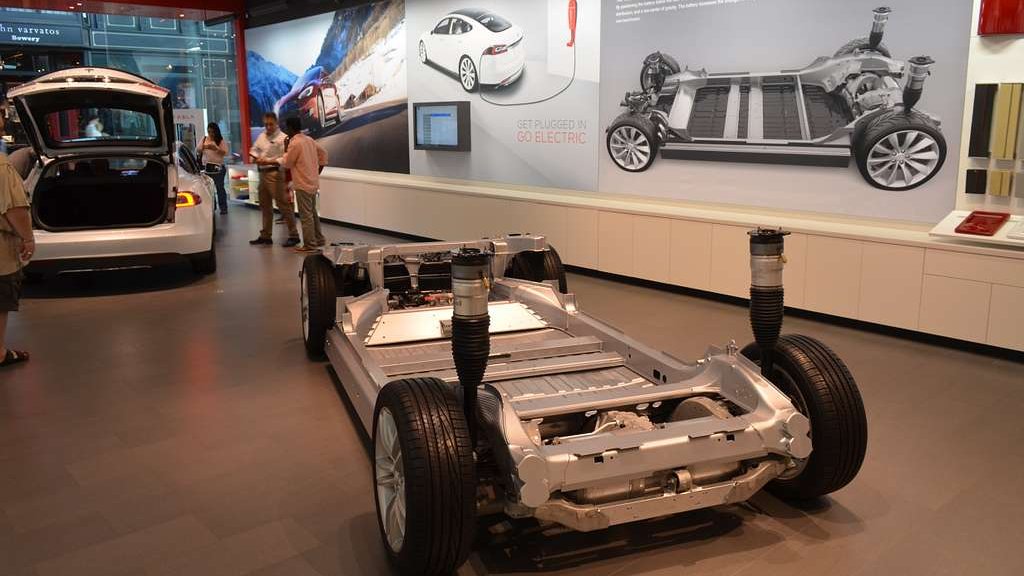
Elon Musk’s New Tesla Battery Prototype “CRYOCELL” Shocks the Industry: The electric vehicle revolution has already reshaped the global automotive landscape, but according to multiple industry leaks, analyst briefings, and speculative intelligence reports, the next leap may be even more dramatic. A rumored Tesla next-generation battery concept codenamed “CryoCell” is being discussed as a breakthrough that could redefine charging speed, thermal stability, and EV range limits.
While still unconfirmed, the concept centers on a radical idea: instead of merely improving energy density, the real bottleneck in modern EVs is thermal management, not battery capacity.
Introduction: The Hidden Problem Holding EVs Back
Most people assume that electric vehicles are limited by how much energy their batteries can store. In reality, the true limitation is far more complex.
The ultimate constraint in modern EV performance is heat.
During ultra-fast charging or sustained high-performance driving, lithium-ion batteries generate intense thermal energy. This leads to:
- Rapid cell degradation
- Reduced charging efficiency
- Forced power throttling
- In extreme cases, thermal runaway risks
This heat problem forces manufacturers to compromise between speed, safety, and longevity.
The rumored Tesla CryoCell project aims to eliminate this compromise entirely.
What is the CryoCell Battery Concept?
The CryoCell battery architecture is described as a next-generation energy system that moves beyond traditional cooling systems.
Instead of relying on external cooling loops or liquid jackets, CryoCell allegedly integrates microscopic thermal stabilization directly inside the battery cells themselves.
This represents a shift from macro-level cooling to cell-level thermal control.
Key Idea Behind CryoCell
The core principle can be summarized as:
Control heat at the exact point of generation, not after it spreads.
This means thermal stress is neutralized at the microscopic chemical junction level, where degradation normally begins.
Why Modern EV Batteries Hit a Thermal Wall
To understand why CryoCell is so disruptive, we need to examine current EV battery limitations.
H3: External Cooling Is No Longer Enough
Today’s EVs rely on:
- Liquid cooling plates
- Thermal jackets
- Airflow-based heat dissipation systems
These systems only manage heat after it spreads across the battery pack.
But during:
- Fast charging (250kW–350kW+)
- High-speed acceleration
- Track-level performance driving
heat forms faster than it can be removed.
H3: The Resulting Bottleneck
This leads to:
- Charging throttling after a few minutes
- Reduced charging curves
- Performance cutbacks
- Long-term battery wear
In short, the battery is always being “held back” by heat.
CryoCell’s Revolutionary Thermal Architecture
The rumored CryoCell system replaces external cooling dependence with a self-regulating internal thermal ecosystem.
H3: Microscopic Heat Stabilization
Instead of large-scale cooling channels, CryoCell integrates:
- Microscopic thermal buffers
- Embedded phase-change compounds
- Cell-level heat redistribution pathways
These components work inside each cell to manage energy spikes instantly.
H3: Phase Change Materials (PCM) Integration
A major part of the system reportedly involves Phase Change Materials (PCM).
These materials:
- Absorb heat during charging spikes
- Change physical state at molecular level
- Store energy without increasing temperature
This allows the battery to handle massive energy bursts without overheating.
In simple terms:
Energy goes in, but temperature stays stable.
H3: Regenerative Micro-Cooling Loops
Another key concept is regenerative thermal balancing.
Instead of dumping heat outward, CryoCell allegedly:
- Redistributes heat internally
- Balances thermal load across cells
- Converts thermal spikes into stabilized energy flow
This creates a self-correcting thermal system where heat is continuously managed rather than removed.
Performance Advantages of CryoCell Technology
If such a system were successfully developed and scaled, it could redefine EV performance benchmarks entirely.
H3: Ultra-Fast Charging Capability
Current EVs typically require:
- 30–45 minutes for 10%–80% charge
CryoCell concept projections suggest:
- Just a few minutes for similar charge levels
This is possible because thermal throttling would no longer limit charging input.
H3: Extreme Battery Lifespan
One of the most significant benefits is longevity.
Modern EV batteries last:
- 1,500 to 3,000 cycles
CryoCell could theoretically achieve:
- Hundreds of thousands of cycles
This is due to reduced thermal degradation at the cell level.
The implication is huge:
The battery could outlast the vehicle itself.
It could then be reused for:
- Grid storage systems
- Home energy backup
- Industrial power balancing
H3: Unrestricted Power Output
Today’s performance EVs often reduce output under stress due to heat buildup.
CryoCell would theoretically allow:
- Sustained maximum acceleration
- No thermal throttling at high speeds
- Consistent racetrack performance
This could eliminate one of the biggest compromises in electric performance engineering.
Supply Chain and Manufacturing Challenges
Despite its promise, CryoCell faces enormous industrial barriers.
H3: Advanced Material Dependency
The system would require:
- Specialized PCM compounds
- Redesigned battery casings
- New internal chemical structures
These are not widely available in today’s battery supply chains.
Manufacturers would need to build entirely new materials pipelines.
H3: Scaling Complexity
Even if the technology works in lab environments, scaling it is another challenge.
Key difficulties include:
- Precision manufacturing at microscopic scale
- Maintaining consistency across millions of cells
- Ensuring long-term stability under real-world conditions
This is one of the main reasons advanced battery technologies often take years or decades to reach mass production.
H3: Global Competition Intensifies
The battery race is already highly competitive.
Companies such as:
are heavily investing in:
- Solid-state batteries
- High-density thermal systems
- Alternative energy chemistries
CryoCell, if real, would accelerate this competition dramatically.
The New Global Battery Arms Race
The emergence of a system like CryoCell would not exist in isolation.
It would trigger a global shift in energy research priorities.
H3: Solid-State vs Thermal Stabilization
While many competitors focus on solid-state batteries, CryoCell represents a different direction:
- Solid-state: Focus on energy density
- CryoCell: Focus on thermal elimination
Both approaches aim to solve EV limitations but from different angles.
H3: Industry-Wide Pressure
If Tesla succeeds in scaling such a system, competitors would be forced to:
- Redesign thermal architectures
- Accelerate R&D timelines
- Reevaluate battery supply chains
This could compress decades of innovation into a few years.
Tesla’s Macro Strategy: Beyond Cars
The most important implication of CryoCell is not just automotive.
It suggests a shift toward a full energy ecosystem strategy.
H3: Platform-Level Energy Architecture
Instead of being just a car manufacturer, Tesla could evolve into:
- A battery platform provider
- A global energy infrastructure company
- A licensing-based technology ecosystem
This would extend into:
- Electric aviation
- Heavy transport systems
- Maritime electrification
H3: Licensing Potential
If CryoCell becomes viable, Tesla could potentially:
- License thermal architecture patents
- Provide battery modules to third-party manufacturers
- Standardize energy systems across industries
This would mirror how semiconductor companies operate today.
Integration Into Global Energy Grids
One of the most transformative possibilities is grid integration.
H3: High-Cycle Energy Storage Systems
CryoCell-like batteries could enable:
- Long-duration energy storage
- Rapid load balancing
- Reduced grid instability
Because of their projected long lifespan, they would be ideal for:
- Renewable energy storage
- Solar and wind stabilization
- Urban energy distribution systems
H3: Smart Energy Ecosystems
In a fully realized scenario, energy systems could:
- Store excess power during low demand
- Release power during peak usage
- Optimize energy flow across entire cities
This creates a self-balancing energy network.
Potential Risks and Uncertainties
Despite its promise, it is important to remain grounded.
CryoCell remains:
- Unverified publicly
- Technically complex
- Dependent on breakthrough materials
Major risks include:
- Manufacturing feasibility
- Cost of production
- Long-term reliability
- Safety validation under extreme conditions
Many advanced battery concepts fail not in theory, but in scaling.
Conclusion: A Possible Turning Point in EV Evolution
If the CryoCell concept is even partially accurate, it represents a shift in how we think about electric vehicles.
Instead of asking:
“How much energy can we store?”
The question becomes:
“How perfectly can we control energy behavior under stress?”
By potentially solving the thermal bottleneck, CryoCell could unlock:
- Near-instant charging
- Extreme range potential
- Multi-decade battery lifespans
- Continuous high-performance output
However, until confirmed by official sources or real-world deployment, CryoCell remains a speculative but highly influential concept in the future of battery innovation.
What is certain is this:
The future of EVs will not just be about bigger batteries—it will be about smarter thermal intelligence at the microscopic level.
FAQs
1. What is the Tesla CryoCell battery?
CryoCell is a rumored next-generation EV battery concept that focuses on solving one of the biggest EV limitations: thermal management at the cell level.
2. Is CryoCell officially confirmed by Tesla?
No. It is currently unconfirmed and based on speculative reports, analyst leaks, and industry discussions.
3. What problem does CryoCell aim to solve?
It targets the biggest EV bottleneck: heat generation during fast charging and high-performance driving, which causes degradation and throttling.
4. Why is thermal management so important in EVs?
Because excessive heat leads to:
- Battery degradation
- Reduced lifespan
- Slower charging speeds
- Safety risks like thermal runaway
5. How is CryoCell different from current EV batteries?
Traditional EVs use external liquid cooling systems, while CryoCell reportedly uses internal microscopic thermal stabilization.
6. What are Phase Change Materials (PCM)?
PCMs are special materials that absorb heat by changing their physical state, helping stabilize temperature without increasing heat levels.
7. How fast could CryoCell charge a vehicle?
Speculative estimates suggest 10% to 80% charging in just a few minutes, though this is not verified.
8. Would CryoCell increase EV range?
Yes, projections suggest potential for very high range capabilities, possibly even multi-thousand-kilometer theoretical limits.
9. Can CryoCell improve battery lifespan?
Yes. By reducing heat damage, it could theoretically enable hundreds of thousands of charge cycles, far beyond current EV batteries.
10. What is thermal runaway?
Thermal runaway is a dangerous condition where battery temperature rapidly increases uncontrollably, potentially causing fire or explosion.
11. How does CryoCell prevent overheating?
It allegedly uses microscopic heat redistribution and PCM-based absorption to stabilize temperature instantly at the cell level.
12. What are regenerative micro-cooling loops?
This refers to a system where heat is redistributed and balanced internally rather than expelled externally.
13. Will CryoCell improve EV performance?
If real, it could allow sustained maximum power output without thermal throttling, improving acceleration and endurance.
14. What are the biggest challenges for CryoCell?
Major challenges include:
- Material development
- Manufacturing complexity
- Cost scaling
- Long-term safety validation
15. Which companies are competing in similar technology?
Key players include:
- CATL
- BYD
- Various Japanese and South Korean battery research labs
16. Could CryoCell be used outside cars?
Yes, it could potentially be used in:
- Energy grid storage
- Electric aviation
- Heavy industrial transport systems
17. What is Tesla’s long-term goal with such technology?
The goal could be to evolve from an automaker into a global energy platform provider.
18. Would CryoCell replace solid-state batteries?
Not necessarily. It would be a competing approach, focusing on thermal control rather than only energy density.
19. When could CryoCell become available?
There is no official timeline, but such advanced technologies typically take many years of development and scaling.
20. Why is CryoCell considered important in the EV industry?
Because if successful, it could remove the biggest EV limitation—heat—unlocking faster charging, longer range, and higher performance simultaneously.
Read More:
- One of Tesla’s biggest threats just got banned in the U.S.
- Tesla looks keen to bring larger Model Y L to the U.S.
- New $20,748 Tesla Model 2 Senior Edition: 65+ Control, 8 Key Buttons & Easy Entry
- SpaceX just Made History after 1st Starfall Reentry Capsule Launch Demo! S40’s Fire test in Hours
- Tesla plans production boost at Giga Berlin following rebound in Europe