
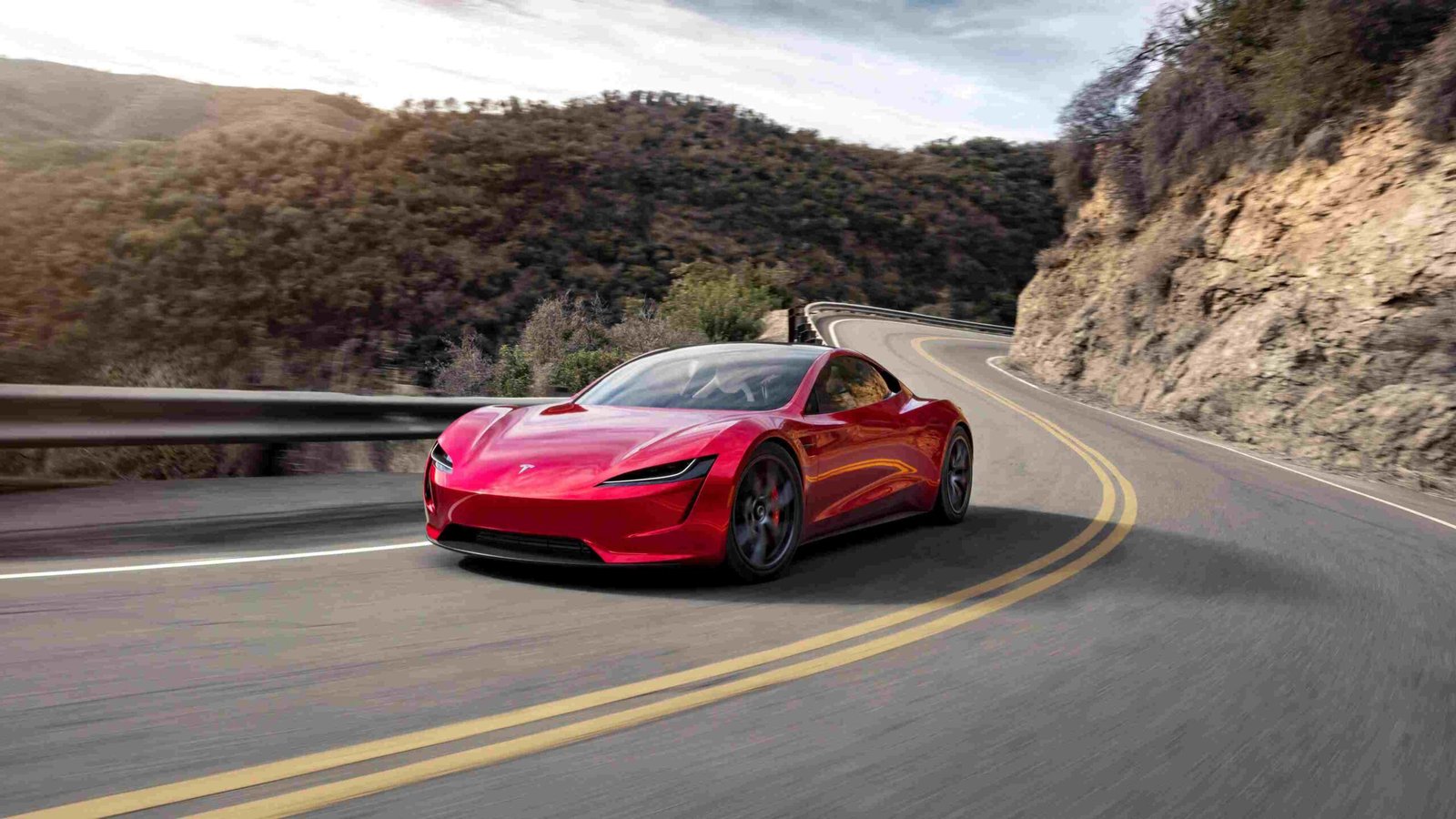
Gen 2 Tesla Roadster Flying BIG Launch Event, New Massive Specs: The Gen 2 Tesla Roadster is shaping up to be one of the most ambitious performance cars ever conceived. First revealed in 2017, the next-generation Roadster has evolved from a high-performance electric sports car into a potential showcase for advanced automotive and aerospace technology.
Tesla’s vision goes beyond simply adding more electric motors or increasing battery output. The proposed Roadster combines a dedicated carbon-fiber architecture, extreme electric performance, advanced aerodynamics, and an optional SpaceX-inspired cold-gas thruster system. If these targets are achieved, the car could redefine what a production performance vehicle is capable of.
Gen 2 Tesla Roadster: Massive Performance Targets
The second-generation Tesla Roadster is expected to target performance figures that remain extraordinary even by modern electric hypercar standards.
Key targets associated with the Roadster include:
- 0–60 mph in under 1.99 seconds for the standard version
- A projected sub-1-second 0–60 mph time with the SpaceX package
- 250+ mph target top speed
- Approximately 620+ miles of range
- A proposed battery capacity of around 200 kWh
- A dedicated carbon-fiber monocoque architecture
- A high-performance tri-motor electric powertrain
These figures show that Tesla is not positioning the Roadster simply as another fast EV. Instead, the vehicle is being developed as a technology demonstrator and halo car designed to explore the limits of electric vehicle performance.
Why Sub-1-Second Acceleration Is So Difficult
Electric motors can deliver enormous torque almost instantly, but acceleration is ultimately limited by tire grip.
When a vehicle produces more force than its tires can transfer to the road, the tires begin to slip. Increasing motor power alone therefore cannot indefinitely improve acceleration. This is particularly important when attempting to achieve a 0–60 mph time below one second.
Tesla’s proposed solution is to introduce an additional source of force through cold-gas propulsion. Rather than depending entirely on the tires, the SpaceX-inspired system could generate direct thrust to supplement the electric motors.
SpaceX Package and A71 Cold-Gas Thrusters
One of the most unusual elements associated with the Gen 2 Roadster is the proposed SpaceX Package, reportedly connected with an internal concept known as A71.
Cold-gas thrusters operate differently from conventional rocket engines. Instead of burning fuel, they use compressed gas stored under high pressure. When the gas is released through specially designed nozzles, its expansion produces thrust.
In a vehicle application, this technology could theoretically be used in several ways.
Forward Acceleration
Rear-facing nozzles could provide additional forward thrust during hard acceleration. This would supplement the electric motors and potentially help the Roadster overcome the limitations of tire traction.
Braking Assistance
Thrusters could also theoretically generate force in the opposite direction of travel, assisting the vehicle’s conventional braking system during extreme deceleration.
Cornering and Vehicle Control
Lateral thrust could provide another method of influencing vehicle dynamics. Instead of relying entirely on tires and suspension, the system could potentially generate additional forces during high-speed cornering.
Downforce and Vertical Force
Perhaps the most dramatic concept involves downward-facing thrusters. These could potentially increase the force pressing the vehicle toward the road, improving tire grip.
The more extreme concept is brief vertical lifting or hovering, although such a capability would involve major engineering, safety, regulatory, and practical challenges.
Carbon-Fiber Monocoque: A Dedicated Supercar Platform
Tesla’s Roadster development has reportedly involved a choice between adapting an existing vehicle platform and creating a completely new architecture.
An adapted Model S Plaid-based platform could have reduced development costs and simplified manufacturing. However, a sedan-derived chassis would bring compromises in weight, dimensions, packaging, and structural design.
The alternative is a dedicated carbon-fiber monocoque.
A carbon-fiber structure can provide excellent stiffness while helping reduce weight compared with conventional metal architectures. For an extreme-performance vehicle, this can improve acceleration, braking, handling, and overall vehicle response.
The dedicated platform also reinforces the Roadster’s role as a flagship Tesla performance vehicle, rather than simply a faster version of an existing sedan.
Design Influences and Aerodynamics
The Roadster’s styling has evolved considerably since its original unveiling. Design influences associated with the project include classic supercars and aerospace-inspired forms.
The Lamborghini Countach has been cited as an influence on the dramatic wedge-like proportions and aggressive stance, while the Lockheed SR-71 Blackbird represents another major source of inspiration for the low-drag, aerospace-style appearance.
More recent prototypes have showcased features such as butterfly-style doors, an active rear aerodynamic system, and a low-slung supercar profile.
Aerodynamics will be critical because a vehicle targeting speeds above 250 mph must carefully balance low drag with sufficient high-speed stability.
Street-Legal Roadster vs. SpaceX Variant
The biggest challenge may not be producing the required power. It could be making the extreme technology safe and practical for road use.
A standard Roadster would need to satisfy conventional automotive safety and regulatory requirements. A high-performance SpaceX-equipped version could face additional complications.
Major Engineering Challenges
Noise: High-pressure gas discharge can create extremely loud acoustic events, potentially making unrestricted operation unsuitable for public roads.
Debris: Powerful downward or rearward gas streams could disturb gravel, dust, or other road debris.
Pressure Storage: High-pressure composite tanks would require carefully engineered mounting and crash protection.
Packaging: Thruster hardware and pressure vessels would consume valuable interior space, potentially affecting passenger capacity.
Safety: Any system capable of generating substantial additional thrust would require sophisticated control software, fail-safes, and extensive testing.
For these reasons, an extreme SpaceX-inspired configuration could be better suited to controlled environments or specialized track applications rather than everyday road driving.
Gen 2 Tesla Roadster vs. Electric Hypercars
The competitive landscape has changed dramatically since Tesla introduced the Roadster concept in 2017.
Today, manufacturers such as Rimac, BYD, and Xiaomi have demonstrated that modern EVs can deliver extraordinary acceleration and sophisticated chassis technology.
The Rimac Nevera, for example, has established itself as one of the most capable electric hypercars, combining immense power with sophisticated all-wheel-drive torque vectoring. The BYD Yangwang U9 brings advanced active suspension technology, while the Xiaomi SU7 Ultra demonstrates how quickly new EV manufacturers can enter the high-performance market.
This makes the Roadster’s challenge much greater. Being fast is no longer enough.
Tesla needs to offer something genuinely different, and the proposed A71 cold-gas propulsion concept could provide exactly that distinction.
Testing and the Big Launch Question
Extreme technology requires extreme testing. If Tesla proceeds with demonstrations of the Roadster’s pneumatic propulsion system, conventional automotive proving grounds may not provide the required safety infrastructure.
SpaceX’s facilities in McGregor, Texas, offer an aerospace-style testing environment with large restricted areas, specialized equipment, telemetry systems, and experience handling high-pressure propulsion technology.
A controlled demonstration could potentially allow engineers to evaluate acceleration, braking, thrust vectoring, and other functions while maintaining greater separation between the vehicle and spectators.
The testing process would be particularly important because the Roadster combines technologies from two very different worlds: automotive engineering and aerospace propulsion.
What Makes the Gen 2 Tesla Roadster Different?
The second-generation Roadster represents a much broader idea than simply building the world’s fastest electric sports car.
Its proposed combination of a large battery, tri-motor electric powertrain, lightweight carbon-fiber structure, active aerodynamics, and cold-gas thrusters creates an engineering package unlike conventional EVs.
The most important question is not whether Tesla can build a very fast electric car. Other manufacturers have already demonstrated that capability.
The real question is whether Tesla can successfully integrate direct thrust into vehicle dynamics while maintaining the reliability, safety, usability, and regulatory compliance expected from a production vehicle.
Conclusion: The Future of High-Performance EVs
The Gen 2 Tesla Roadster remains one of the most intriguing performance-car projects in the automotive industry. Its proposed specifications—including 250+ mph performance, sub-2-second acceleration, long-range capability, and an optional SpaceX-inspired thruster system—place it firmly in hypercar territory.
More importantly, the Roadster represents Tesla’s attempt to move beyond conventional assumptions about how cars accelerate, brake, corner, and generate downforce.
If the company successfully brings its most ambitious concepts to production, the Roadster could become more than a fast EV. It could serve as a bridge between automotive and aerospace engineering, demonstrating a new approach to vehicle dynamics.
For enthusiasts, engineers, and technology fans, that makes the Gen 2 Tesla Roadster one of the most anticipated electric performance cars of the modern era.
FAQs
1. What is the Gen 2 Tesla Roadster?
The Gen 2 Tesla Roadster is Tesla’s next-generation electric sports car, designed to deliver extreme acceleration, high top speed, and long-range performance. It was originally unveiled in 2017 and has since evolved into a much more ambitious hypercar project.
2. How fast is the Tesla Roadster expected to be?
Tesla has targeted a 0–60 mph time of under 1.99 seconds for the standard Roadster. With the proposed SpaceX Package, the target could reportedly fall below 1 second, although such figures should be treated as targets rather than independently verified production specifications.
3. What is the expected top speed of the Gen 2 Roadster?
The Tesla Roadster has been associated with a target top speed of 250+ mph (400+ km/h), putting it in the territory of the world’s fastest electric hypercars.
4. How much range will the Tesla Roadster have?
Tesla has previously promoted a target range of around 620 miles (1,000 km). The actual production range could vary depending on final battery specifications, wheels, tires, aerodynamics, and driving conditions.
5. How large is the Tesla Roadster battery?
The Roadster has been associated with a battery capacity of approximately 200 kWh. Such a large battery would help support both high-performance acceleration and the vehicle’s ambitious long-range target.
6. What is the SpaceX Package?
The SpaceX Package is a proposed performance upgrade for the Roadster that incorporates cold-gas thruster technology inspired by aerospace systems. Its purpose is to generate additional thrust beyond what the electric motors and tires can provide.
7. What are A71 cold-gas thrusters?
A71 is a term associated with the proposed Roadster thruster concept. Cold-gas thrusters use compressed gas rather than combustion. When high-pressure gas is released through controlled nozzles, it produces thrust that can potentially assist acceleration, braking, cornering, or downforce.
8. Can the Tesla Roadster actually fly?
The concept has been associated with the possibility of using downward-facing thrusters to generate enough force for a brief lift or hovering maneuver. However, this should not be confused with conventional flight. Any such capability would involve significant engineering and safety challenges and should be regarded as a proposed experimental feature rather than a conventional flying function.
9. Why does the Roadster need thrusters?
The primary reason is traction. Electric motors can produce enormous torque, but tires have a physical limit to how much force they can transfer to asphalt. Additional direct thrust could theoretically help the Roadster accelerate beyond the limits of conventional tire traction.
10. Will the Tesla Roadster use a carbon-fiber chassis?
The development concept described for the next-generation Roadster includes a dedicated carbon-fiber monocoque. A lightweight, rigid structure could help improve acceleration, handling, braking, and overall vehicle dynamics compared with adapting a heavier sedan-based platform.
11. Is the Tesla Roadster a four-seater?
The original Roadster concept was presented as a 2+2 sports car. However, integrating high-pressure gas tanks and thruster hardware could significantly affect interior packaging. A specialized SpaceX configuration could therefore have fewer seats than the standard version.
12. Will the SpaceX Roadster be street legal?
The final regulatory status of any thruster-equipped Roadster would depend on its actual design and applicable regulations. Noise, pressure storage, debris, pedestrian safety, crash protection, and emissions-related rules could all create challenges. A highly specialized version may ultimately be better suited to controlled environments than normal public roads.
13. What cars compete with the Tesla Roadster?
The Roadster competes conceptually with electric hypercars such as the Rimac Nevera, BYD Yangwang U9, and Xiaomi SU7 Ultra. These vehicles demonstrate how quickly electric performance technology has advanced since Tesla announced the Roadster in 2017.
14. Where could Tesla test the Roadster’s thruster technology?
Aerospace facilities such as SpaceX’s McGregor, Texas, testing environment would offer advantages for evaluating high-pressure propulsion technology because of their large restricted areas and specialized infrastructure. Such testing could provide a safer environment for experimental demonstrations than ordinary automotive proving grounds.
15. Why is the Gen 2 Tesla Roadster so important?
The Roadster is significant because Tesla is attempting to combine electric vehicle technology with aerospace-inspired propulsion and advanced vehicle dynamics. If the proposed specifications and technologies reach production, the Roadster could become more than a fast EV—it could represent a new approach to high-performance automotive engineering.
Read More:
- Tesla is opening Cybercab rides to a select few
- SpaceX achieves incredible milestone with Starlink program
- New Footage revealed What Exactly Happened with Ship 40 before reaching Christmas Island Shocked Us
- Tesla Bot Gen 3 Is FINALLY NUTTY — Can Do 5,000 Tasks
- Tesla Cybercab launch preparations have begun
2 thoughts on “Gen 2 Tesla Roadster Flying BIG Launch Event, New Massive Specs”