
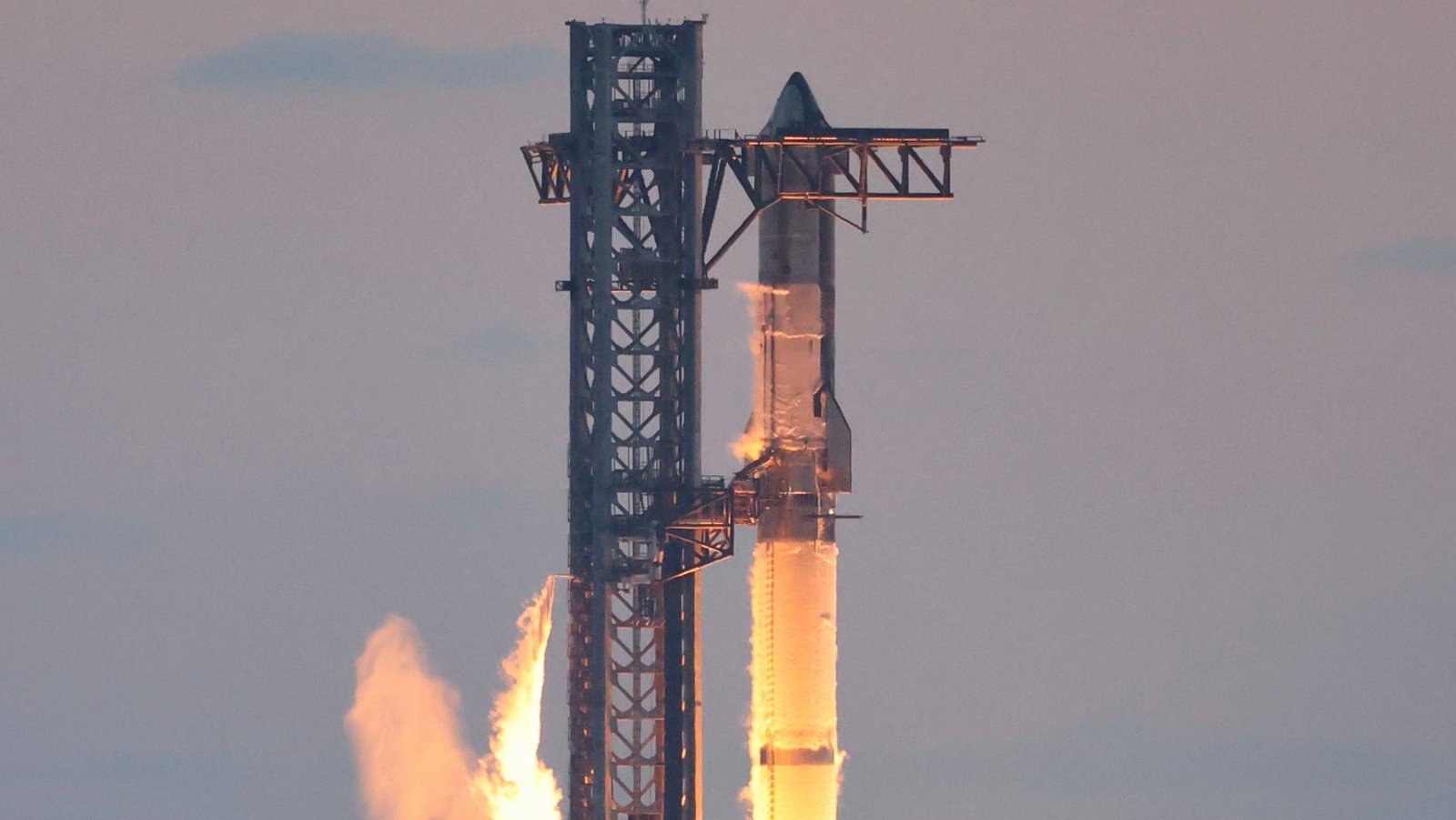
SpaceX Lit Single Engine Static Fire for Starship 41, Huh? China Landed 1st rocket Booster BUT: The commercial space industry is entering a new era in which rocket reusability, rapid launch cadence, and heavy-lift capability are becoming increasingly important.
Two developments highlight this transformation: SpaceX’s Starship Ship 41 (S41) is progressing toward its next major flight test at Starbase, while Chinese private aerospace company LandSpace has demonstrated a major milestone with the recovery attempt of its Zhuque-3 (ZQ-3) first-stage booster.
These developments show that the global race for reusable orbital rockets is becoming increasingly competitive. SpaceX is pushing toward a fully reusable heavy-lift system, while Chinese companies are developing their own methane-powered launch vehicles and recovery technologies.
SpaceX Starship 41 Moves Closer to Flight 14
At SpaceX’s Starbase facility in Boca Chica, Texas, Ship 41 has entered an important phase of ground testing. Following cryogenic testing in late June, the vehicle was moved to the test pad on August 19. SpaceX then quickly progressed to propellant loading and engine testing.
The most notable milestone was a single-engine static fire involving one center-mounted Raptor engine.
What Happened During the S41 Static Fire?
At approximately 11:06 PM CST, Ship 41 conducted a static-fire test lasting roughly 15 to 18 seconds. Instead of firing all six Raptor engines, SpaceX isolated one center engine.
This approach allows engineers to gather valuable data without immediately subjecting the complete propulsion system to the maximum stresses of a full-duration test.
The test can help validate several important systems, including engine ignition, thrust-vector control, propellant delivery, thermal performance, and engine control systems.
One particularly important objective is the ability of a Raptor engine to perform a reliable in-space relight. Such capability is essential for future Starship missions because engines may need to restart in space for trajectory changes, orbital maneuvers, or controlled deorbit operations.
Why a Single-Engine Test Matters
A single-engine static fire may look modest compared with a full six-engine test, but it provides engineers with a controlled way to examine critical hardware.
The test can help evaluate:
- Raptor engine ignition and shutdown
- Thrust-vector-control systems
- Engine gimbaling and actuators
- Propellant feed-line performance
- Thermal and mechanical stresses
- Future in-space relight capability
For Starship, these individual tests are important stepping stones toward increasingly complex flight demonstrations.
Starship Flight 14 Could Be a Major Milestone
Ship 41 is expected to play an important role in Starship Flight 14, which aims to push the vehicle further toward genuine orbital operations.
Unlike earlier developmental flights, the long-term objective is not simply to demonstrate atmospheric flight. SpaceX is working toward a system capable of orbital insertion, payload operations, controlled re-entry, and eventual rapid reuse.
A successful orbital mission would represent another major step toward SpaceX’s larger vision for Starship as a reusable heavy-lift launch system.
Before that happens, however, additional testing is expected. A full six-engine static fire would provide substantially more information about the complete propulsion configuration, while the Super Heavy booster must also complete its own preparations.
LandSpace Zhuque-3 Achieves a Historic Booster Landing
While SpaceX continues developing Starship, China’s private space sector is making progress of its own.
LandSpace recently achieved an important milestone with its methane-fueled Zhuque-3 rocket. During the mission, ZQ-3 successfully delivered the Honghu-03 satellite into orbit while attempting to recover its first-stage booster.
The booster ultimately achieved an upright landing, marking a significant achievement for China’s commercial launch industry.
Why Zhuque-3 Is Important
Zhuque-3 is designed around liquid methane and liquid oxygen, commonly known as Methalox. This is significant because methane is increasingly being adopted by next-generation launch companies seeking cleaner-burning and potentially reusable propulsion systems.
The rocket is approximately 66 meters tall and is designed with a reported LEO payload capability of around 18.3 metric tons.
Its architecture therefore places it among the emerging generation of large reusable launch vehicles.
How the Booster Landing Worked
The ZQ-3 first stage followed a controlled recovery sequence involving several key phases.
First, grid fins helped guide and stabilize the booster during atmospheric descent. The vehicle then used its engines to reduce velocity before transitioning into the final landing maneuver.
During the final phase, the booster relied on a central engine for controlled deceleration while its four landing legs were deployed.
The booster successfully reached the landing zone and touched down upright.
That was the good news.
The Big Problem: Fire After Touchdown
Shortly after landing, however, a significant engine-section fire developed.
The flames affected the aft portion of the booster and eventually caused the vehicle to tilt. Although the landing itself demonstrated that LandSpace had solved several difficult recovery challenges, the post-landing incident showed that landing successfully is only one part of rocket reusability.
The exact cause would require detailed investigation, but possible explanations include issues involving engine plumbing, residual propellant, or a leak during the landing burn.
This distinction is extremely important.
A reusable rocket must not only survive launch and return. It must also be capable of being inspected, refurbished efficiently, and flown again. Significant thermal or structural damage can dramatically reduce the economic value of a recovery.
Landing Legs vs. Tower Catch Systems
The developments at SpaceX and LandSpace also demonstrate that there is no single approach to booster recovery.
Traditional reusable boosters such as Falcon 9 use landing legs, while Starship is designed around a different concept involving tower-based catching infrastructure.
Landing legs offer an established and relatively straightforward recovery architecture. However, they add mass and require the vehicle to remain stable after touchdown.
Tower-catching systems attempt to remove some of that landing hardware from the vehicle. SpaceX’s Mechazilla system uses large mechanical arms to capture returning hardware near the launch tower.
China Is Exploring Alternative Recovery Methods
China is also investigating additional recovery technologies. The country’s aerospace sector has been developing cable-based recovery concepts, including systems intended to capture returning boosters.
A flexible cable network can potentially absorb some of the vehicle’s landing energy. However, cables must withstand extreme mechanical loads, repeated impacts, and exposure to rocket-engine exhaust.
This creates a different set of engineering challenges compared with rigid mechanical catching systems.
Reusability Is About More Than Landing
The biggest lesson from these developments is that successful touchdown does not automatically equal successful reusability.
A reusable rocket must solve several problems simultaneously:
- Survive launch and ascent
- Separate safely
- Control its trajectory during descent
- Perform a precise landing or capture
- Protect engines and critical structures
- Undergo rapid inspection
- Return to flight economically
This is where SpaceX’s experience becomes particularly important.
The company’s Falcon 9 program has already demonstrated the commercial value of frequent booster reuse. Starship is attempting to extend that philosophy to a much larger vehicle capable of transporting significantly greater payloads.
Launch Cadence Could Become the Real Competitive Advantage
The future of commercial launch competition may ultimately depend less on who lands a rocket first and more on how frequently and economically that rocket can fly.
A reusable booster that lands successfully but requires months of refurbishment may provide less economic value than one capable of rapid turnaround.
Manufacturing capacity also matters. Companies need large production facilities, reliable supply chains, standardized components, trained personnel, and efficient testing infrastructure.
Why Starship’s Scale Matters
Starship is being developed as a fully reusable heavy-lift launch system, with ambitions far beyond conventional medium-lift rockets.
Zhuque-3, meanwhile, represents an important step for China’s private launch sector and demonstrates that methane propulsion and booster recovery are becoming increasingly important areas of competition.
The two programs are therefore pursuing overlapping technologies while operating at different stages of maturity and industrial scale.
Conclusion: A New Era of Rocket Competition
The latest Starship and Zhuque-3 developments demonstrate how quickly the global launch industry is changing.
SpaceX Ship 41’s single-engine static fire represents another step toward increasingly ambitious Starship flight testing. The upcoming full-engine tests and future orbital attempt could provide valuable data about the vehicle’s propulsion, flight-control, and re-entry systems.
At the same time, LandSpace’s Zhuque-3 booster landing demonstrates that China’s commercial aerospace industry is making serious progress toward reusable orbital launch vehicles. The post-landing fire also reinforces a critical reality: reusability is much harder than simply achieving touchdown.
Ultimately, the most important metric may be launch cadence. The companies capable of combining reliable recovery, rapid refurbishment, high-volume manufacturing, and affordable operations will have the strongest position in the next generation of commercial spaceflight.
The rocket race is no longer simply about reaching orbit. It is increasingly about returning from orbit, flying again, and doing it repeatedly at industrial scale.
FAQs
1. What is SpaceX Starship Ship 41?
Starship Ship 41 (S41) is a SpaceX Starship upper-stage vehicle being prepared for advanced flight testing at Starbase in Boca Chica, Texas. It is intended to support the next phase of Starship development, including orbital operations and improved reusability.
2. What happened during the Starship 41 static fire?
Ship 41 conducted a single-engine static-fire test lasting approximately 15 to 18 seconds. SpaceX fired one center Raptor engine rather than all six engines simultaneously.
3. Why did SpaceX test only one Raptor engine?
A single-engine static fire allows engineers to evaluate engine performance, propellant systems, thrust-vector control, ignition, and other hardware under controlled conditions before progressing to more demanding tests.
4. What is a Raptor engine?
Raptor is SpaceX’s methane-fueled rocket engine family designed for Starship and Super Heavy. It uses liquid methane and liquid oxygen (Methalox) as propellants.
5. What is the purpose of Starship Flight 14?
Starship Flight 14 is intended to advance Starship’s orbital flight capabilities. Key objectives include testing orbital operations, payload-related activities, trajectory control, and controlled re-entry.
6. What is Zhuque-3?
Zhuque-3 (ZQ-3) is a large methane-fueled reusable rocket developed by Chinese private aerospace company LandSpace. It is designed to provide significant payload capacity to low Earth orbit while incorporating first-stage recovery technology.
7. Did Zhuque-3 successfully land its first-stage booster?
Yes. The Zhuque-3 first stage achieved an upright landing, representing a major milestone for LandSpace and China’s commercial space sector.
8. What happened to the Zhuque-3 booster after landing?
A significant fire developed in the engine section shortly after touchdown. The resulting thermal damage affected the aft portion of the booster and caused it to tilt.
9. Does a successful rocket landing mean the booster is reusable?
Not necessarily. True reusability requires a booster to survive landing with manageable damage and undergo inspection and refurbishment efficiently enough to support another flight.
10. What fuel does Zhuque-3 use?
Zhuque-3 uses liquid methane and liquid oxygen, commonly called Methalox. This propellant combination is also used by SpaceX’s Starship and Raptor propulsion system.
11. How does SpaceX recover reusable rockets?
SpaceX has traditionally used landing legs for Falcon 9 boosters. Starship is designed around a different approach, using a tower-based catching system with large mechanical arms near the launch tower.
12. What is the advantage of tower-based rocket catching?
A tower-catch system can potentially eliminate the need for heavy landing legs and associated hardware on the vehicle. This may help reduce vehicle mass and support faster turnaround, although it requires sophisticated ground infrastructure and highly precise guidance.
13. Is China developing other rocket recovery technologies?
Yes. China’s aerospace industry is exploring multiple recovery approaches, including cable-based catching systems for future reusable boosters. These systems offer an alternative to both conventional landing legs and rigid tower-catch mechanisms.
14. Why is rocket launch cadence important?
Launch cadence is a crucial measure of commercial space competitiveness. A rocket that can be recovered, inspected, refurbished, and launched again quickly can potentially reduce the cost per mission and increase overall launch capacity.
15. Is Zhuque-3 competing directly with Starship?
Both vehicles are part of the broader movement toward large, reusable, methane-powered rockets, but they are not identical systems. Starship is being developed as a much larger fully reusable heavy-lift system, while Zhuque-3 represents LandSpace’s approach to reusable orbital launch.
16. What is the biggest challenge for reusable rockets?
The biggest challenge is not simply landing a rocket. The real objective is achieving reliable, economical, and rapid reuse. Vehicles must survive launch, atmospheric return, landing, inspection, and refurbishment while maintaining a high flight cadence.
Read More:
- 500 TESLA SEMI 2.0 DELIVERED! NEW PRICE & 4 BIG Upgrades Revealed
- Elon Musk gives a timeline for SpaceX’s first Starship catch attempt
- Tesla admits to slow Model Y Robotaxi integration, but for a good reason
- SpaceX’s New Starship Heat Shield Upgrades after Elon Says Problems are Solved
- Gen 2 Tesla Roadster Flying BIG Launch Event, New Massive Specs