
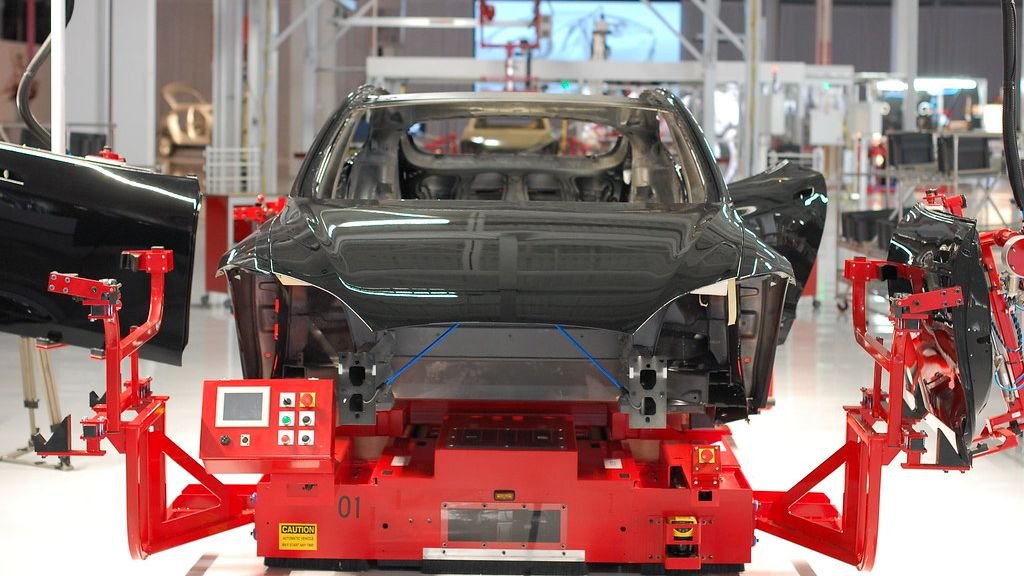
Giga Press 4.0 JUST ERASED 75% of Production Time! Welding Robots GONE: For more than a century, automobile manufacturing has relied on the same basic principle: move a vehicle through a long sequence of assembly stations while workers and robots progressively add components. This approach has become highly efficient, but it also creates a fundamental problem. As a vehicle becomes more complete, access to its interior and structural components becomes increasingly difficult.
Tesla’s Unboxed Manufacturing Strategy, combined with large-scale casting technology associated with the Giga Press, is designed to rethink that process from the ground up. Instead of simply making traditional robots move faster, the concept changes how the vehicle is assembled.
The goal is a manufacturing system built around parallel production cells, modular components, open access, and rapid final integration. In the supplied manufacturing concept, the long-term theoretical target can reach a 5-second cycle time, while factory footprints could potentially be reduced substantially.
The Problem With Traditional Car Manufacturing
Traditional automobile factories generally follow a sequential process.
A basic structural frame enters the production system and progresses through body welding, painting, wiring, interior installation and final assembly. Each stage depends heavily on the previous one.
Why Sequential Assembly Becomes Difficult
At the beginning of production, the vehicle structure is relatively open. Robots can access it from multiple directions.
But as manufacturing progresses, the vehicle becomes increasingly enclosed.
Doors, glass, seats, dashboards, wiring and body panels progressively restrict access. Robots working on later-stage operations may have to reach through small openings or use complicated tools.
This creates several problems:
- Longer robotic movements
- More complicated tooling
- Higher equipment costs
- Greater maintenance requirements
- Increased potential for manual intervention
- Reduced flexibility during production
A conventional assembly station might operate around a 34-second cycle time in an idealized example. Increasing robot speed alone can create additional mechanical stress and potentially increase maintenance and quality challenges.
The fundamental issue isn’t simply robot speed.
It is vehicle accessibility.
Tesla’s Unboxed Manufacturing Strategy
Tesla’s proposed solution is to break the vehicle into several independently manufactured modules.
Instead of continuously moving one partially completed vehicle down a single production line, multiple production cells can work simultaneously.
Parallel Manufacturing Changes the Workflow
A simplified Unboxed architecture could include:
- Front structural casting
- Rear structural casting
- Structural battery pack
- Floor and cabin assembly
- Interior modules
- Final integration
These components can be manufactured and tested separately before being brought together.
This is fundamentally different from traditional assembly.
Rather than asking a robot to install a component inside an increasingly enclosed vehicle, Tesla can install many components while the relevant module is still wide open and easily accessible.
Open Access Makes Automation Simpler
Imagine installing seats, wiring, electronics and interior components while the cabin floor is sitting openly inside a manufacturing cell.
Robots can approach the component from above, below or from the sides.
They don’t need to squeeze a complicated robotic arm through a windshield opening or narrow door frame.
That can potentially result in simpler tooling and shorter robotic movements.
Giga Press Technology and Structural Casting
One of the technologies closely associated with Tesla’s manufacturing strategy is the Giga Press, a large-scale casting system capable of producing substantial vehicle structures as single components.
Traditional automobile construction relies heavily on numerous stamped pieces that are subsequently joined together.
Large structural castings can reduce the number of individual components and joining operations.
Fewer Parts, Fewer Manufacturing Steps
A conventional vehicle body can contain a large number of stamped and welded components.
Large castings can consolidate portions of that structure into fewer pieces.
That potentially means:
Fewer parts → fewer joining operations → fewer production stations → simpler manufacturing flow
This is where the broader concept behind the headline “Giga Press 4.0” becomes important.
The major opportunity isn’t simply producing a larger casting. It is combining large-scale casting with a fundamentally different factory architecture.
From Welding Robots to Modular Integration
Traditional body shops depend extensively on automated welding.
Hundreds of robots may perform thousands of joining operations to transform individual stamped panels into a complete vehicle body.
Tesla’s structural casting approach can reduce the number of separate pieces that need to be welded together.
Why This Matters
If a structural section can be manufactured as a large casting, numerous individual welding operations can potentially disappear.
That doesn’t mean all welding robots disappear from automotive manufacturing. Rather, the architecture can reduce dependence on conventional body-panel welding by replacing many individual components with larger integrated structures.
This is an important distinction when discussing claims about “welding robots gone.”
The manufacturing philosophy is about reducing process complexity, not eliminating every form of joining technology.
Structural Battery Packs Add Another Dimension
Tesla’s manufacturing approach also connects with structural battery architecture.
In a traditional EV, the battery pack is essentially a large component installed beneath the vehicle.
A structural battery design can make the battery assembly part of the vehicle’s overall structural architecture.
This creates another opportunity for modular manufacturing.
Instead of treating the battery as an isolated component that arrives near the end of assembly, the battery and floor structure can become an integrated module.
Cybercab and Purpose-Built Manufacturing
A vehicle such as Tesla’s Cybercab provides an interesting example of how manufacturing and vehicle architecture can be designed together.
A purpose-built autonomous vehicle doesn’t necessarily need to preserve every component associated with traditional automobiles.
For example, a dedicated autonomous architecture can potentially eliminate or simplify traditional hardware such as:
- Conventional steering controls
- Pedal assemblies
- Traditional instrument clusters
- Certain mechanical interfaces
Fewer components can translate into fewer assembly operations.
The 5-Second Manufacturing Goal
One of the most ambitious elements of the Unboxed concept is its theoretical production speed.
The supplied manufacturing model describes a progression toward 10-second cycle times, with a longer-term theoretical target of approximately 5 seconds.
At a 5-second cycle, a single station could theoretically complete around 720 cycles per hour.
However, theoretical cycle time shouldn’t be confused with real-world factory output.
A factory must operate continuously while accounting for:
- Equipment downtime
- Material shortages
- Quality inspections
- Maintenance
- Rework
- Human intervention
- Buffer capacity
Therefore, overall factory efficiency matters more than the fastest demonstration cycle.
The Biggest Challenge: Tolerance Stack-Up
Parallel manufacturing introduces a major engineering challenge: tolerance accumulation.
Every manufactured component has permissible dimensional variation.
If the front casting is slightly outside its nominal dimension, the battery structure has another small variation, and the rear casting has another, those differences can accumulate when everything is finally joined.
Precision Becomes Critical
A final integration station may therefore require:
Machine vision + precision robotics + laser measurement + real-time alignment
The system must ensure that every module connects correctly.
Poor alignment could create:
- Panel gaps
- Water-sealing problems
- Structural inconsistencies
- Cosmetic defects
- Difficult rework
This makes quality control just as important as production speed.
Smaller Factories Could Become Possible
Another major advantage proposed for the Unboxed system is reduced factory footprint.
Traditional manufacturing requires extensive body shops, long assembly lines and large spaces dedicated to moving vehicles between stations.
A modular factory can distribute production across compact cells.
If successful, this could potentially reduce the required manufacturing footprint by up to 50% per unit of production capacity, according to the supplied concept.
That could affect construction costs, factory expansion and manufacturing flexibility.
What Will Determine Success?
The real test of Tesla’s manufacturing strategy won’t be a single impressive demonstration.
It will be sustained industrial performance.
First-Pass Yield
First-pass yield measures how many vehicles or modules pass inspection without requiring rework.
A five-second process is less valuable if every vehicle subsequently requires extensive adjustment.
Factory Uptime
Parallel production requires reliable equipment.
If one critical manufacturing cell repeatedly stops, its buffer can eventually run empty and interrupt final integration.
Maintenance
High-speed automation places enormous demands on robotic arms, sensors, tooling and alignment systems.
Maintaining accuracy over thousands of production hours will be essential.
Capital Efficiency
Tesla must also balance expensive automation equipment against savings from smaller factories and fewer manufacturing steps.
The economic advantage depends on the entire system, not just individual machines.
The Future of Automotive Manufacturing
Tesla’s Unboxed Manufacturing Strategy represents a significant conceptual departure from the traditional assembly line.
Instead of constantly trying to make a conventional production line faster, the strategy attempts to reorganize the manufacturing process itself.
Large structural castings, modular battery systems, open-access assembly cells and automated final integration can work together as a single manufacturing architecture.
The most important idea is therefore not simply that a Giga Press can produce a huge casting.
It is that vehicle manufacturing can potentially be redesigned around parallel production instead of sequential assembly.
If Tesla can overcome tolerance, quality, reliability and integration challenges while maintaining high production volumes, this approach could influence how future electric and autonomous vehicles are manufactured.
The ultimate breakthrough may not come from building faster robots.
It may come from building a factory where robots don’t have to fight the geometry of the vehicle in the first place.
FAQs
1. What is Tesla’s Unboxed Manufacturing Strategy?
Tesla’s Unboxed Manufacturing Strategy is a production approach that replaces much of the traditional sequential assembly line with parallel manufacturing cells. Different vehicle modules can be produced independently and then combined during final integration.
2. What is the Giga Press?
The Giga Press is a large-scale casting machine designed to produce major vehicle structural components as large integrated castings. This can reduce the number of smaller stamped parts and joining operations required during vehicle production.
3. Does the Giga Press eliminate welding robots?
It can reduce the number of welding operations required by replacing numerous smaller components with large structural castings. However, it does not mean that every welding robot disappears from automotive manufacturing.
4. What is the goal of Tesla’s Unboxed factory design?
The goal is to make vehicle production faster, simpler and more space-efficient by manufacturing multiple modules simultaneously rather than moving one increasingly complete vehicle through a long sequence of stations.
5. What is the proposed 5-second production cycle?
The 5-second cycle time is a theoretical long-term manufacturing target discussed in the supplied concept. At that rate, a station could theoretically complete approximately 720 cycles per hour, although real-world factory output would be affected by downtime, quality checks and other constraints.
6. How is Unboxed manufacturing different from a traditional assembly line?
Traditional manufacturing generally moves a vehicle through a sequential series of stations. Unboxed manufacturing divides the vehicle into separate modules that can be built in parallel before being brought together for final integration.
7. Why does open-access assembly matter?
Open-access assembly allows workers and robots to reach components from multiple directions. This can make it easier to install wiring, seats, electronics and interior components before the vehicle becomes enclosed.
8. How could Unboxed manufacturing reduce factory size?
Parallel production cells can require less space than a long continuous assembly line. The supplied concept suggests that factory footprints could potentially be reduced by up to 50% per unit of production capacity.
9. What role does the structural battery pack play?
A structural battery pack can become part of the vehicle’s structural architecture rather than functioning solely as a separate battery component. This can support Tesla’s modular approach to vehicle assembly.
10. What is tolerance stack-up?
Tolerance stack-up occurs when small dimensional variations from several independently manufactured components accumulate when those components are assembled together. Poor control can result in alignment, sealing or panel-gap problems.
11. How can Tesla control tolerance problems?
Tesla could use machine vision, precision robotics, optical measurement and real-time alignment systems to measure components and ensure accurate positioning during final integration.
12. Could the Cybercab benefit from Unboxed manufacturing?
The Cybercab is a purpose-built autonomous vehicle concept, making it potentially suitable for manufacturing methods designed specifically around simplified vehicle architecture and modular assembly.
13. Does faster cycle time automatically mean higher factory production?
No. A fast cycle time is only one manufacturing metric. Overall equipment effectiveness, first-pass yield, downtime, maintenance, material availability and rework all influence actual production output.
14. What are the biggest challenges of Tesla’s Unboxed strategy?
Major challenges include precision alignment, tolerance stack-up, automation reliability, equipment uptime, quality control and final-module integration. These challenges become increasingly important as production speeds increase.
15. Could Tesla’s manufacturing approach change the auto industry?
If the Unboxed strategy achieves reliable high-volume production, it could demonstrate an alternative to the traditional linear automotive assembly model. Its potential influence would depend on whether the manufacturing system can deliver consistent quality, uptime and economic efficiency at scale.
Read More:
- Tesla integrates Grok Bot into its vehicles for the ultimate personal assistant
- Tesla Semi lands the biggest electric truck deal in U.S. history
- Starship Flight 14 Ready for Full-stack and Final Test before Biggest Mission Yet
- Inside $119B Terafab World’s Largest Building SHOCKED
- Tesla Roadster is available for order once again following brief hold