
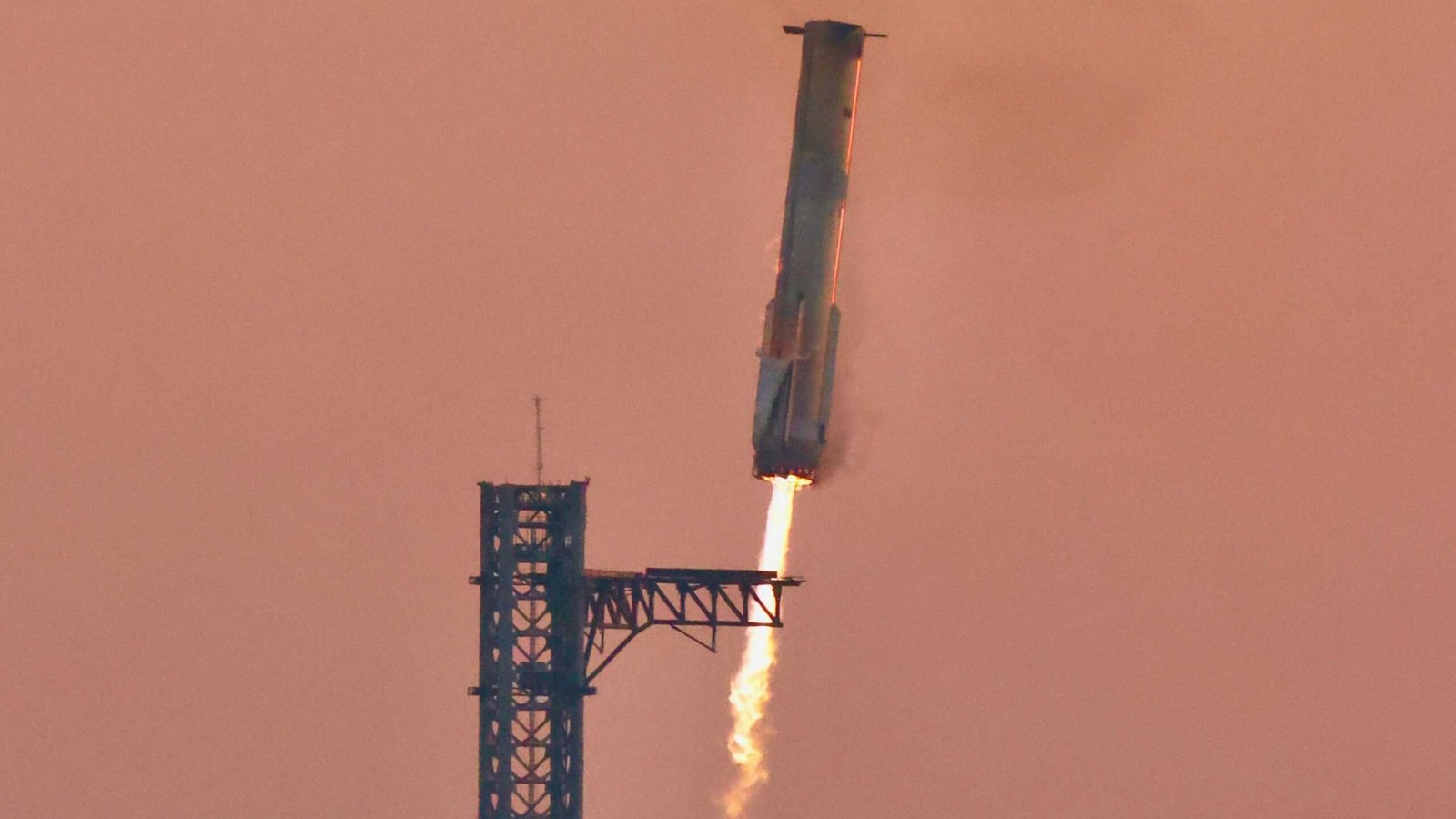
SpaceX Just Revealed Why Booster 20 Failed to Light 8 Raptor Engines After Starship Flight 13: SpaceX continues to push the limits of reusable rocket technology, and Starship Flight 13 delivered another milestone-filled mission. While the test achieved several important objectives, it also highlighted a major challenge during Booster 20’s landing burn, where multiple Raptor engines unexpectedly shut down after ignition. At the same time, Ship 40 successfully survived atmospheric re-entry, completed a soft ocean splashdown, and demonstrated impressive structural integrity.
The latest flight provides valuable engineering data that will shape future Starship missions, including Flight 14, Mechazilla tower catch attempts, and long-term missions to the Moon and Mars. Here’s a detailed technical breakdown of everything that happened during Starship Flight 13.
Booster 20’s Ascent Performed Almost Perfectly
The first phase of Flight 13 showed that Super Heavy Booster 20 (B20) performed extremely well during launch.
During ascent, all 33 Raptor engines ignited successfully and generated the enormous thrust needed to lift the fully stacked Starship system.
However, engineers observed one important issue.
At approximately T+2:06, onboard cameras revealed significant thermal heating inside the engine bay, particularly around the lower propellant plumbing.
This wasn’t the first time SpaceX engineers noticed excessive heating.
A similar thermal signature appeared during Flight 12, where engine bay temperatures were suspected to contribute to propulsion problems later in flight.
Although Booster 20 continued operating normally during ascent, these elevated temperatures may have played a critical role in the landing burn failure later in the mission.
Hot Staging Worked Exactly as Designed
At T+2:29, Ship 40 ignited all six Raptor engines while still attached to Booster 20.
This maneuver, known as Hot Staging, is one of the most demanding phases of any Starship launch.
Instead of separating first, the upper stage begins firing before disconnecting from the booster.
The hot-stage ring successfully redirected the intense exhaust gases without causing any structural damage.
This demonstrated once again that SpaceX’s hot staging system is becoming increasingly reliable.
Controlled Boostback Burn
After separation, Booster 20 began its boostback maneuver.
Rather than keeping all engines active, the flight computer gradually reduced engine count from:
- 33 Raptors
- 13 Raptors
- 5 Raptors
- 3 center Raptors
This carefully managed throttling sequence reduced structural stress while maintaining efficient trajectory control.
Everything appeared nominal until preparations began for the landing burn.
Why Booster 20 Failed During Landing Burn
The biggest event of Starship Flight 13 occurred during Booster 20’s landing sequence.
Instead of performing a controlled ocean landing, the booster impacted the Gulf of Mexico at very high speed.
Commanded Eight-Engine Landing Burn
Unlike previous flights that began braking using 13 Raptor engines, Booster 20 was commanded to ignite only 8 engines.
The planned configuration included:
- 2 center Raptors
- 6 middle-ring Raptors
Initially, the ignition sequence appeared successful.
However, only seconds later, the situation rapidly deteriorated.
Three Engines Shut Down Immediately
Soon after ignition, 3 of the 8 engines unexpectedly aborted.
This left only 5 operating Raptors available to slow the nearly 20-story-tall booster.
With dramatically reduced thrust, Booster 20 simply could not remove enough velocity before reaching the ocean surface.
The result was a high-speed splashdown, ending the recovery attempt.
Possible Causes Behind the Engine Shutdowns
Although SpaceX has not officially confirmed the exact cause, engineering analysis points toward several likely explanations.
1. Propellant Feed Starvation
If methane or liquid oxygen flow briefly dropped below operational limits, engine controllers would automatically shut down affected Raptors to prevent catastrophic damage.
2. Thermal Soak
The unusually high engine bay temperatures recorded during ascent may have overheated components within the fuel plumbing or manifold systems.
Heat-related expansion or sensor anomalies could interrupt stable propellant delivery.
3. Pressure Fluctuations
Rapid pressure changes inside the LOX and methane manifolds may have produced unstable flow conditions, forcing onboard computers to abort the affected engines.
Each of these possibilities is now likely undergoing extensive investigation inside SpaceX.
How Booster 20’s Failure Impacts Mechazilla Catch Attempts
One of SpaceX’s long-term goals is eliminating ocean splashdowns entirely.
Instead, returning boosters will eventually be caught directly by the giant Mechazilla launch tower.
However, Flight 13 clearly demonstrated why engine reliability remains absolutely critical.
Three Major Challenges Before Tower Catch
Reliable Engine Restarts
Every commanded landing engine must ignite successfully every single time.
Even one failed engine dramatically changes landing performance.
Protecting Launch Infrastructure
Attempting a tower catch with uncertain engine reliability could severely damage launch pads worth billions of dollars.
SpaceX simply cannot risk losing launch infrastructure.
Flight 14 Outlook
Because Booster 20 experienced post-ignition engine shutdowns, many analysts expect Flight 14 to conduct another controlled ocean landing before attempting a full tower catch.
Perfect engine restart reliability remains the highest priority.
Ship 40 Successfully Survived Re-entry
While Booster 20 experienced difficulties, Ship 40 (S40) delivered one of the most successful upper-stage flights to date.
After completing its orbital objectives, Ship 40 re-entered Earth’s atmosphere at approximately Mach 25.
The vehicle executed the now-famous belly-flop maneuver, using aerodynamic drag to slow itself before performing its dramatic vertical flip.
Smooth Ocean Landing
At approximately T+1 hour 05 minutes 18 seconds, Ship 40 ignited its landing engines using a sequential firing profile:
- 3 Raptors
- 2 Raptors
- 1 Raptor
The spacecraft completed a remarkably soft splashdown before gently tipping onto its side.
Most importantly, the stainless-steel structure remained fully intact.
Unlike earlier Starship prototypes that suffered structural failure upon impact, Ship 40 floated successfully on the ocean surface.
This represents another major achievement for Starship’s reusable spacecraft design.
Why Flames Appeared From Ship 40’s Nose Cone
One of the most widely discussed moments after splashdown was the appearance of flames near the spacecraft’s nose.
Fortunately, this was not an explosion.
Instead, it was the result of a carefully designed pressure relief system.
Header Tank Venting Explained
Ship 40 carries small header tanks containing reserve liquid methane and liquid oxygen used during landing.
Following splashdown:
- Residual heat warmed the remaining cryogenic propellants.
- Internal pressure gradually increased.
- Safety relief valves automatically opened.
- Escaping methane mixed with atmospheric oxygen.
- Contact with hot thermal protection surfaces ignited the vented gas.
The brief flame was actually evidence that the pressure relief system functioned correctly, preventing dangerous over-pressurization inside the spacecraft.
Flight 13 Also Achieved Important Orbital Milestones
Beyond launch and landing tests, Flight 13 successfully demonstrated several important in-space capabilities.
Successful Vacuum Raptor Relight
Approximately 39 minutes after launch, Ship 40 restarted a single Vacuum Raptor engine in orbit.
The engine burned continuously for 14 seconds.
This successful relight validates critical capabilities required for:
- Orbital maneuvering
- Precise deorbit burns
- Future Moon missions
- Mars landing trajectories
Reliable in-space engine restarts remain essential for the long-term Starship program.
Deployment of 20 Starlink V3 Satellites
Another major objective involved deploying 20 operational Starlink V3 satellites.
Following deployment:
- Every satellite powered on successfully.
- Telemetry links were established.
- Optical laser communication systems connected correctly.
- The satellite mesh network initialized as expected.
This demonstrates Starship’s growing role in expanding SpaceX’s next-generation Starlink constellation.
Flight 13 Shows Major Progress Despite Booster Setback
Although Booster 20 failed to complete its landing burn due to three unexpected Raptor engine shutdowns, the mission still represents another significant step toward fully reusable spaceflight.
The flight confirmed that hot staging, boostback operations, vacuum engine relights, Starlink V3 deployment, and Ship 40’s re-entry system all performed exceptionally well.
Perhaps the most encouraging achievement was Ship 40 surviving re-entry and remaining structurally intact after splashdown, proving that Starship’s thermal protection system and stainless-steel design continue to improve with every test.
As SpaceX analyzes Booster 20’s engine data, engineers will likely focus on thermal management, propellant manifold reliability, and engine restart performance before approving future Mechazilla tower catch attempts. If these issues are resolved, upcoming Starship flights could move even closer to achieving fully reusable launch operations, bringing SpaceX one step nearer to its ambitious goals of establishing a permanent human presence on the Moon and Mars.
FAQs
1. Why did Booster 20 fail during the landing burn?
Booster 20 failed because 3 of its 8 commanded Raptor engines shut down shortly after ignition, leaving only 5 active engines to slow the booster. The remaining thrust was insufficient for a controlled splashdown, resulting in a high-speed impact in the Gulf of Mexico.
2. Why did SpaceX command only 8 Raptor engines instead of 13?
For Flight 13, SpaceX used an 8-engine braking burn profile consisting of 2 center Raptors and 6 middle-ring Raptors. This was a modified landing strategy intended to evaluate engine performance and optimize landing operations.
3. What caused the Raptor engine shutdowns?
SpaceX has not officially confirmed the exact cause. However, engineers believe the shutdowns may have been caused by propellant feed starvation, thermal soak from engine bay heating, or pressure fluctuations in the methane and liquid oxygen manifolds.
4. Did Booster 20 complete its ascent successfully?
Yes. Booster 20 successfully completed its ascent, executed hot staging, and performed a clean boostback burn before encountering problems during the landing sequence.
5. What is hot staging in Starship?
Hot staging is a separation method where Ship 40 ignites its engines while still attached to Booster 20, allowing smoother stage separation and improving overall flight efficiency.
6. Why is engine bay heating important?
Excessive engine bay heating can affect fuel lines, sensors, and engine components. Similar thermal conditions were observed during Flight 12, making it a major focus for SpaceX engineers.
7. What happened to Booster 20 after the engine failures?
After losing three engines during the braking burn, Booster 20 maintained too much speed and impacted the Gulf of Mexico instead of completing a controlled splashdown.
8. What is Mechazilla?
Mechazilla is SpaceX’s giant launch tower equipped with mechanical arms designed to catch returning Super Heavy boosters instead of allowing them to land in the ocean.
9. Will Flight 14 attempt a Mechazilla catch?
Based on Flight 13’s engine restart issues, many experts expect Flight 14 to perform another ocean landing test before attempting a full Mechazilla tower catch.
10. Did Ship 40 survive re-entry?
Yes. Ship 40 successfully survived atmospheric re-entry, completed a controlled splashdown in the Indian Ocean, and remained structurally intact while floating on the water.
11. Why did Ship 40 float after landing?
The stainless-steel hull remained intact, preventing water from rapidly entering the vehicle. This allowed Ship 40 to stay buoyant after splashdown.
12. Why were flames seen coming from Ship 40’s nose cone?
The flames were caused by controlled venting of methane gas from the header tanks. As the gas escaped and contacted hot surfaces, it ignited briefly. This is considered a normal safety process.
13. What are header tanks?
Header tanks are smaller propellant tanks that store liquid methane and liquid oxygen specifically for Starship’s landing burn, ensuring a stable fuel supply during final descent.
14. Did Ship 40 restart its engines in space?
Yes. Ship 40 successfully completed a 14-second Vacuum Raptor engine relight in orbit, demonstrating an important capability for future orbital maneuvers and deorbit burns.
15. How many Starlink V3 satellites were deployed?
Ship 40 successfully deployed 20 operational Starlink V3 satellites, all of which initialized correctly and established optical laser communication links.
16. Why is the vacuum Raptor relight significant?
A successful vacuum engine relight proves Starship can perform orbital corrections, controlled deorbit burns, and future deep-space missions to destinations like the Moon and Mars.
17. What was the biggest success of Starship Flight 13?
The mission’s biggest success was Ship 40’s intact re-entry and soft splashdown, along with successful vacuum engine relight and Starlink V3 satellite deployment, demonstrating major progress toward a fully reusable spacecraft.
18. What lessons will SpaceX apply to future Starship flights?
SpaceX is expected to improve Raptor engine restart reliability, thermal management, propellant feed systems, and manifold pressure control before future flights. These improvements are essential for achieving successful Mechazilla booster catches and advancing the Starship program.
Read More:
- Massive Tesla Giga Press 4.0 Detroys All Welding Robots
- What SpaceX Starship Flight 13 just Did Shocked whole Industry. Musk Declared
- Tesla stock tumbles after earnings, one of its sharpest single-day declines
- SpaceX Starship Flight 13 faces wrath of the Texas skies
- Tesla door handle saga gets its latest chapter and a big change is coming