
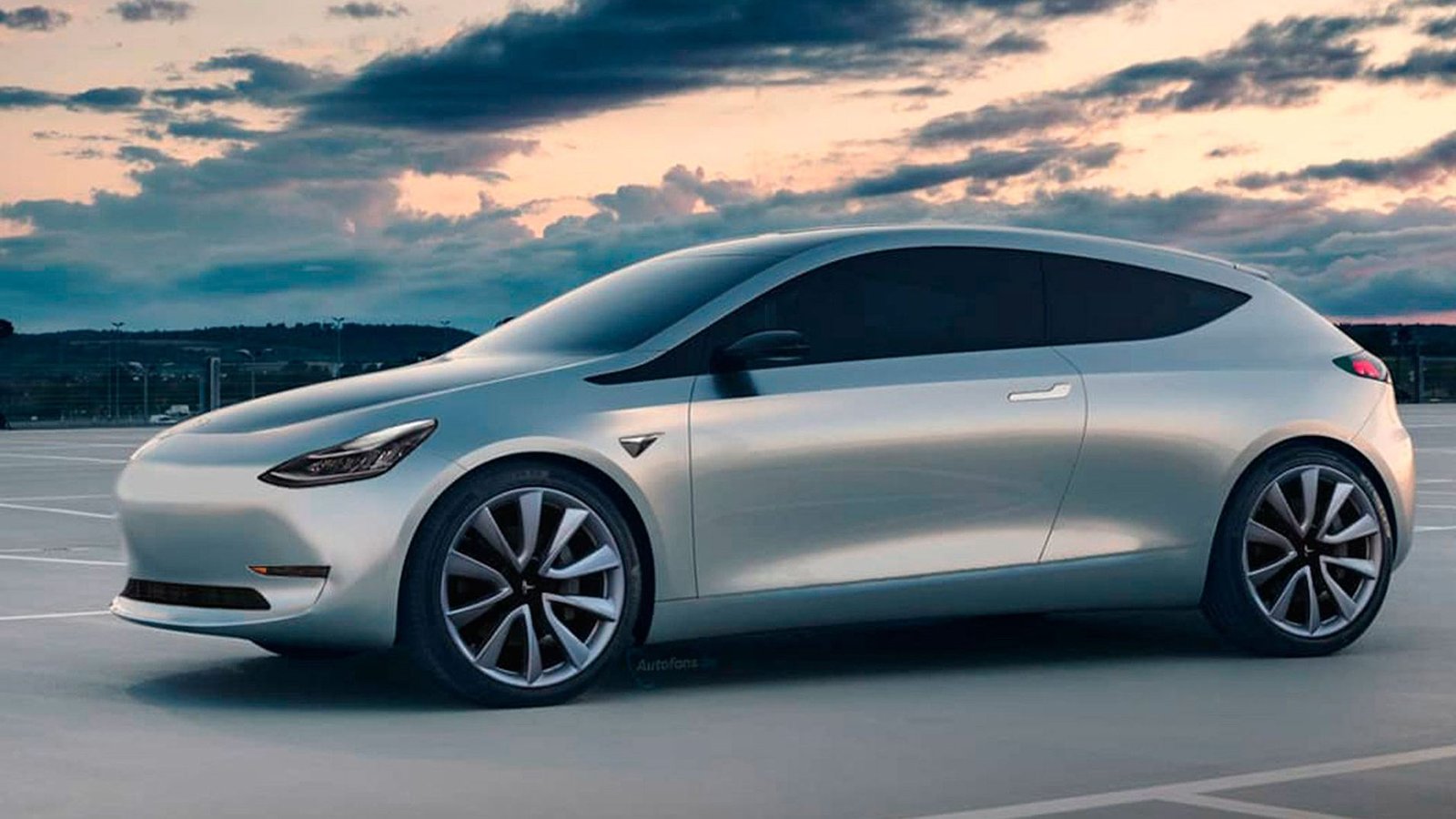
New Tesla Model 2 SUV: $25K, 4.28m, LFP Battery & AI4 Shock Chevy, Nissan, BYD: The electric vehicle industry is entering a major transition phase. After years of rapid growth, pure-play EV manufacturers are facing new pressure as demand growth slows, financing costs rise, and consumers become more price-sensitive. Tesla’s reported delivery performance of around 358,000 vehicles globally in Q1 2026, combined with two consecutive years of declining annual deliveries, highlights the need for a new strategy focused on affordable mass-market electric mobility.
The next battlefield is no longer only premium EVs. It is the $25,000 electric vehicle segment, where companies such as BYD, Chevrolet, and Nissan are targeting millions of first-time EV buyers. A compact Tesla SUV platform designed around lower cost, smaller dimensions, lighter weight, and advanced battery economics could become a major disruption in the global automotive market.
The rumored Tesla Model 2 SUV approach focuses on a completely different engineering philosophy rather than simply reducing features from larger Tesla models. Instead of shrinking a Model Y, Tesla’s strategy is expected to create a dedicated low-cost architecture optimized for efficiency and affordability.
Why Tesla Needs a $25,000 Compact SUV Platform
The EV Market Has Hit a Price Barrier
High interest rates, increasing insurance premiums, and expensive vehicle lineups have slowed EV adoption. Many electric vehicles remain positioned above the reach of average consumers, with most models competing in the $35,000+ price category.
Tesla’s current lineup, including the Model 3 and Model Y, delivers strong technology and performance but leaves room for a smaller, cheaper vehicle designed for mainstream buyers.
A sub-$25,000 Tesla compact crossover could target:
- Young EV buyers
- First-time electric vehicle owners
- Urban commuters
- Suburban families needing a second vehicle
The compact SUV format is especially important because buyers increasingly prefer crossover practicality over traditional hatchbacks.
Competition From BYD, Chevrolet, and Nissan
Tesla would enter an increasingly competitive affordable EV market. Rivals are already developing low-cost platforms focused on simple transportation rather than luxury features.
Key competitors include:
- BYD Seagull and Dolphin: Affordable international EV models targeting mass-market buyers.
- Next-generation Chevrolet Bolt EV: A low-cost American EV revival.
- Nissan Leaf successor: A practical entry-level electric vehicle.
The Tesla Model 2 SUV advantage would come from combining Tesla software, AI technology, manufacturing efficiency, and battery innovation into a lower-cost package.
Compact Dimensions Create Major Engineering Savings
4.28-Meter Length: Designed for Real-World Usability
One of the biggest changes expected from the new compact Tesla platform is size reduction. The reported target length is approximately 4.28 meters, making it around 51 centimeters shorter than the Tesla Model Y, which measures about 4.79 meters.
This smaller footprint provides several advantages:
- Lower material consumption
- Reduced manufacturing costs
- Better city maneuverability
- Improved garage compatibility
Many American homes have approximately 20-foot garages, but storage equipment, appliances, and household items often reduce usable parking space. A 4.28-meter vehicle leaves significantly more room for opening doors, accessing the rear hatch, and walking around the vehicle.
SUV Design Instead of Traditional Hatchback
Although smaller, the vehicle is expected to maintain a crossover SUV shape. This approach provides:
- Higher seating position
- Better visibility
- More practical cargo access
- Greater consumer appeal
The compact SUV category has become one of the fastest-growing automotive segments because it combines efficiency with everyday practicality.
500 kg Weight Reduction Could Transform EV Economics
The Mass Reduction Advantage
A major engineering target is reducing vehicle weight from approximately 2,000 kg in a Model Y-sized vehicle to around 1,500 kg.
This 500 kg reduction creates a chain reaction of savings across the entire vehicle.
Lower Weight Means Smaller Components
A lighter EV requires:
- Smaller battery capacity
- Lower-power motors
- Reduced suspension loads
- Smaller brakes
- Less structural material
The result is a vehicle that costs less to manufacture while maintaining competitive performance.
Efficiency Benefits of a Lightweight EV
Lower vehicle mass reduces energy consumption because less power is required for acceleration. It also decreases:
- Tire wear
- Brake stress
- Energy usage per mile
- Mechanical component loads
For affordable EV adoption, efficiency is just as important as battery size.
Single Rear Motor Architecture Reduces Cost and Complexity
Why Tesla Could Choose Rear-Wheel Drive Only
The expected compact Tesla SUV platform could use a single rear-wheel-drive motor, similar to the entry-level Model 3 RWD configuration.
Removing the second motor creates major savings:
- One inverter instead of two
- No front motor assembly
- Reduced wiring complexity
- Simplified cooling systems
- Lower manufacturing cost
A dual-motor all-wheel-drive system improves performance, but it also increases cost and weight. For a $25,000 vehicle, simplicity becomes a key advantage.
Better Efficiency and Reliability
A single-motor setup also reduces energy losses by eliminating unnecessary mechanical components.
Benefits include:
- Lower power consumption
- Fewer potential failure points
- Reduced maintenance requirements
- Lower production complexity
This approach matches the goal of creating a high-volume affordable EV platform.
LFP Battery Technology Is the Key to a $25K Tesla
Why Lithium Iron Phosphate Batteries Matter
Battery cost remains the biggest challenge for affordable electric vehicles. The expected solution is Lithium Iron Phosphate (LFP) battery technology.
Compared with nickel-based battery chemistries, LFP offers:
- Lower cost
- No cobalt dependency
- Improved supply stability
- Long cycle life
A smaller and lighter compact SUV does not require a massive battery pack. A target capacity of around 50–55 kWh could provide practical everyday range while keeping costs low.
Domestic LFP Production Could Change the Supply Chain
Local battery manufacturing is another important factor. Domestic LFP production helps reduce exposure to:
- Import tariffs
- Global supply disruptions
- Currency fluctuations
A reported $4.3 billion LG Energy Solution investment in domestic LFP production in Lansing, Michigan could support future affordable EV manufacturing by creating a regional battery supply chain.
Tesla Model 2 SUV vs Current Tesla Models: Expected Differences
| Feature | Model Y | Model 3 RWD | Tesla Model 2 SUV Target |
|---|---|---|---|
| Length | 4.79 m | 4.72 m | 4.28 m |
| Weight | ~2,000 kg | ~1,750 kg | ~1,500 kg |
| Drive System | Dual Motor AWD | Single Motor RWD | Single Motor RWD |
| Battery | 75–82 kWh | ~60 kWh | 50–55 kWh LFP |
| Price Target | $43,000+ | Around $36,190 | ~$25,000 |
How Tesla Model 2 SUV Could Shock Chevy, Nissan, and BYD
The future of EV competition will depend less on luxury features and more on manufacturing efficiency. A vehicle combining:
- 4.28-meter compact SUV packaging
- 500 kg weight reduction
- Single-motor simplicity
- Domestic LFP batteries
- Tesla AI and software technology
could create one of the most important affordable EV platforms in the market.
For Chevrolet, Nissan, and BYD, a $25,000 Tesla crossover would increase pressure on existing entry-level EV strategies. Tesla’s advantage would not only come from the vehicle itself but from its integrated approach to battery production, software, autonomous driving technology, and manufacturing scale.
Final Thoughts: The Future of Affordable Electric Mobility
The next major EV growth wave will come from vehicles that ordinary consumers can afford. A Tesla Model 2 SUV priced near $25,000 represents a shift from premium electric vehicles toward true mass-market transportation.
By combining compact engineering, lightweight design, single-motor efficiency, LFP battery economics, and advanced AI technology, Tesla could create a platform capable of accelerating global EV adoption.
The affordable EV race is beginning, and the winners will be companies that can deliver maximum value with minimum complexity.
FAQs
1. What is the Tesla Model 2 SUV?
The Tesla Model 2 SUV is an expected affordable electric vehicle platform designed to bring Tesla technology into the $25,000 EV segment. It is expected to focus on compact dimensions, lower manufacturing costs, and mass-market adoption.
2. How much will the Tesla Model 2 SUV cost?
The expected target price for the Tesla Model 2 SUV is around $25,000, making it significantly cheaper than current Tesla models like the Model 3 and Model Y.
3. When will the Tesla Model 2 SUV launch?
Tesla has not officially confirmed a production launch date for a Model 2 SUV. Industry expectations suggest that a low-cost Tesla platform could arrive in the future as Tesla expands affordable EV production.
4. Will the Tesla Model 2 SUV be cheaper than the Model 3?
Yes, the expected Tesla Model 2 SUV would be positioned below the Model 3 in price. The goal is to create a more affordable EV for first-time buyers and high-volume markets.
5. What will be the size of the Tesla Model 2 SUV?
The expected compact Tesla SUV could have an overall length of approximately 4.28 meters (14 feet), making it around 51 cm shorter than the Tesla Model Y.
6. Why is Tesla developing a smaller electric vehicle?
A smaller EV platform allows Tesla to reduce material costs, battery requirements, manufacturing complexity, and vehicle weight, helping achieve a lower selling price.
7. Will the Tesla Model 2 SUV use an LFP battery?
The expected Tesla Model 2 SUV could use a Lithium Iron Phosphate (LFP) battery pack because LFP batteries offer lower costs, longer cycle life, and reduced dependence on expensive minerals like nickel and cobalt.
8. How large will the Tesla Model 2 SUV battery be?
The expected battery capacity could be around 50–55 kWh, which is smaller than larger Tesla vehicles but suitable for a lighter and more efficient compact EV.
9. Why are LFP batteries important for affordable EVs?
LFP batteries reduce EV costs by using cheaper materials, avoiding cobalt, improving supply stability, and allowing manufacturers to produce lower-priced electric vehicles.
10. Will the Tesla Model 2 SUV have dual motors?
The expected configuration is a single rear-wheel-drive motor instead of a dual-motor all-wheel-drive system. This reduces cost, weight, and production complexity.
11. What are the benefits of a single-motor Tesla Model 2 SUV?
A single-motor setup can provide:
- Lower manufacturing costs
- Better efficiency
- Reduced maintenance complexity
- Lower vehicle weight
12. How much will the Tesla Model 2 SUV weigh?
The target curb weight could be around 1,500 kg, which is approximately 500 kg lighter than a Tesla Model Y-sized vehicle.
13. How does weight reduction improve EV performance?
Reducing weight improves:
- Driving efficiency
- Acceleration response
- Battery range
- Tire life
- Brake performance
A lighter EV requires less energy to move.
14. Will the Tesla Model 2 SUV compete with BYD vehicles?
Yes, the expected $25,000 Tesla would compete directly with affordable EVs from BYD, as well as models such as the Chevrolet Bolt EV and Nissan Leaf.
15. Why is Tesla targeting the compact SUV segment?
Compact SUVs are popular because they combine:
- Higher seating position
- Better cargo space
- Family-friendly practicality
- Urban-friendly dimensions
This makes them attractive to a wider range of buyers.
16. Could the Tesla Model 2 SUV use Tesla AI technology?
The vehicle is expected to benefit from Tesla’s software ecosystem, including advanced driver assistance features and future AI-based vehicle technologies.
17. Will the Tesla Model 2 SUV be made in the United States?
Tesla has not officially confirmed production details. However, domestic battery supply chains, including local LFP manufacturing, could support future affordable EV production in North America.
18. How will the Tesla Model 2 SUV affect Chevrolet, Nissan, and BYD?
A low-cost Tesla EV could increase competition by combining brand recognition, software advantages, battery technology, and manufacturing scale against existing affordable EV makers.
19. Can a $25,000 Tesla still have good range?
Yes. A lightweight body, efficient single motor, and LFP battery technology could allow a smaller battery pack to deliver practical daily driving range.
20. Why could the Tesla Model 2 SUV become important for the EV market?
The Tesla Model 2 SUV could accelerate EV adoption by making electric vehicles more accessible to mainstream buyers. A combination of affordable pricing, compact design, efficient engineering, and advanced technology could make it one of the most important future EV platforms.
Read More:
- Tesla stock tumbles after earnings, one of its sharpest single-day declines
- SpaceX Starship Flight 13 faces wrath of the Texas skies
- Tesla door handle saga gets its latest chapter and a big change is coming
- Tesla short sellers win big after shares fall after earnings
- Tesla’s Supercharger Diner probably just secured more locations