
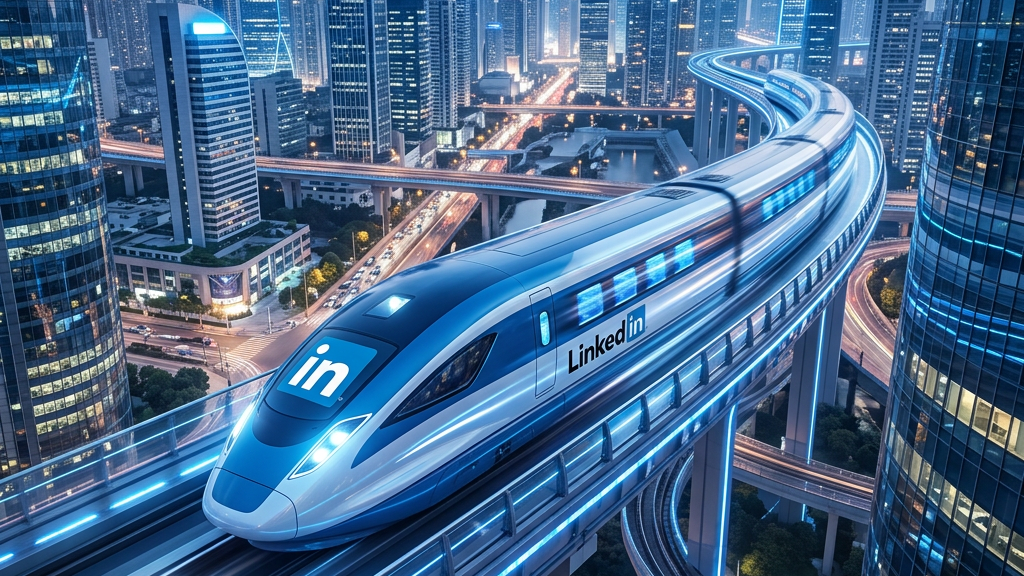
Tesla’s First Unmanned CyberTrain Will Destroy the Auto Industry: The idea of a Tesla CyberTrain has sparked massive discussions among technology enthusiasts and transportation experts. While Tesla has not announced such a product, the concept combines the company’s expertise in Artificial Intelligence (AI), Full Self-Driving (FSD), robotics, battery storage, and energy management into a futuristic high-speed rail ecosystem.
If Tesla ever entered the railway industry, it wouldn’t simply build another train. Instead, it could completely redefine how people travel by integrating autonomous transportation, predictive AI, renewable energy, and robotics into a single platform. Such a transformation could reshape the transportation industry and potentially reduce dependence on traditional automobiles for long-distance travel.
Why High-Speed Rail Is Becoming More Important
Throughout history, transportation infrastructure has determined the pace of economic growth.
The Industrial Revolution accelerated after railway networks connected factories with ports and cities. Goods that once took weeks to transport could suddenly move across countries within days.
Today, high-speed rail plays a similar role.
Countries like China, Japan, and many parts of Europe have invested heavily in high-speed passenger rail, allowing millions of passengers to travel hundreds of miles in just a few hours.
Meanwhile, the United States built one of the world’s most efficient freight rail systems but invested far more heavily in highways, commercial aviation, and personal vehicles than passenger rail.
This infrastructure gap creates an interesting opportunity for companies capable of combining software, AI, automation, and clean energy into future transportation systems.
Could Tesla Build an Autonomous CyberTrain?
Tesla has already demonstrated remarkable progress in:
- Artificial Intelligence
- Autonomous driving
- Battery technology
- Robotics
- Supercomputing
- Energy storage
Instead of designing only electric cars, Tesla has gradually evolved into a technology company that builds an entire ecosystem.
If those technologies were adapted to rail transportation, the concept of an autonomous CyberTrain becomes technically interesting.
Railways Are Simpler Than Self-Driving Cars
One reason this concept receives attention is because railway autonomy is fundamentally easier than road autonomy.
A self-driving car must constantly react to:
- Pedestrians
- Cyclists
- Traffic signals
- Construction zones
- Unexpected lane changes
- Aggressive drivers
- Weather conditions
A train, however, operates on fixed tracks.
Its route is predetermined, there are no lane changes, and the operating environment is much more controlled.
Although railway safety standards remain extremely demanding, the number of unpredictable situations is significantly lower than for autonomous road vehicles.
This makes AI-powered railway operation a more structured engineering challenge.
The Vision of Tesla’s CyberTrain
Rather than modernizing traditional locomotives, a hypothetical Tesla CyberTrain could borrow many design principles already seen in Tesla vehicles.
Minimalist Design
Tesla is known for reducing unnecessary mechanical complexity.
A CyberTrain could feature:
- Driverless operation
- Centralized AI control
- Minimal moving parts
- Aerodynamic design
- Lightweight structural frame
Removing a traditional driver cabin could also increase passenger capacity while improving aerodynamics.
Gigacast Manufacturing
Tesla revolutionized automobile production through Gigacasting, replacing hundreds of individual components with large aluminum castings.
Applying this technology to railway manufacturing could potentially offer:
- Lower production costs
- Reduced vehicle weight
- Greater structural rigidity
- Simplified maintenance
Fewer components also mean fewer possible failure points.
Advanced Sensors
A CyberTrain would likely rely on multiple sensor systems including:
- High-resolution cameras
- Radar
- Thermal imaging
- Track monitoring sensors
- Obstacle detection systems
Instead of depending on a human operator, onboard AI could continuously monitor track conditions and operating environments.
Artificial Intelligence Would Be the Real Engine
The most valuable part of a Tesla CyberTrain would not necessarily be its electric motors.
Its greatest strength would likely be its AI software.
Tesla already develops neural networks capable of analyzing enormous amounts of real-world driving data.
In a railway environment, similar AI systems could monitor:
- Track wear
- Wheel vibration
- Motor temperature
- Power consumption
- Infrastructure health
- Weather conditions
Instead of reacting after problems occur, AI could predict failures before they happen.
This approach is known as predictive maintenance.
Dojo Supercomputer Could Optimize Entire Rail Networks
Tesla’s Dojo supercomputer is designed to train AI models using massive datasets.
A future rail network could continuously upload:
- Track vibration
- Thermal readings
- Visual inspections
- Power usage
- Station traffic
- Train performance
Machine learning models could then optimize:
- Train schedules
- Energy consumption
- Maintenance timing
- Route planning
- Traffic flow
Rather than responding to delays, the system could proactively prevent them.
Optimus Robots Could Maintain Railway Infrastructure
Another fascinating possibility involves Tesla Optimus humanoid robots.
Railway maintenance requires thousands of workers performing dangerous tasks around the clock.
Autonomous robots could assist by:
Track Inspection
Robots equipped with cameras and sensors could inspect hundreds of miles of railway every day.
Infrastructure Repair
Optimus units could:
- Replace damaged rail components
- Tighten electrical connections
- Weld track defects
- Remove debris
- Inspect power lines
Manufacturing
Inside factories, robots could assemble train components with consistent precision while operating 24/7.
Megapack Batteries Could Stabilize the Electric Grid
High-speed trains consume enormous amounts of electricity during acceleration.
Likewise, regenerative braking returns significant energy back into the grid.
Tesla’s Megapack energy storage systems could act as massive battery buffers.
During periods of low electricity demand, Megapacks could store energy from the grid or renewable sources.
When trains accelerate, those batteries could instantly release stored power, reducing stress on local electrical infrastructure.
This creates a more stable and efficient railway energy system.
A Fully Connected Transportation Ecosystem
Perhaps the most exciting concept is not the train itself.
It’s the entire transportation ecosystem.
Imagine booking one trip through a single Tesla application.
Step 1
An autonomous vehicle picks you up from home.
Step 2
It delivers you directly to the correct railway platform.
Step 3
You board a high-speed autonomous CyberTrain.
Step 4
Upon arrival, another autonomous vehicle is already waiting.
The result is a seamless door-to-door travel experience without taxis, rental cars, or complicated transfers.
Would This Hurt the Auto Industry?
If autonomous high-speed rail became widely available, many people might choose trains over long highway drives.
Benefits could include:
- Lower travel costs
- Reduced traffic congestion
- Shorter commute times
- Lower carbon emissions
- Less dependence on private vehicles
However, saying such a system would “destroy the auto industry” is speculative. Cars would still be essential for many trips, especially in areas without extensive rail networks. A more likely outcome is that autonomous rail and automobiles would complement each other, with cars handling local travel and high-speed rail serving longer intercity journeys.
Challenges Tesla Would Need to Overcome
Even with Tesla’s expertise, building an autonomous rail network would involve major hurdles.
These include:
- Government approvals
- Railway safety certification
- Billions of dollars in infrastructure investment
- Land acquisition
- Construction timelines
- Coordination with existing rail systems
Technology alone would not be enough.
Final Thoughts
The Tesla CyberTrain remains a concept rather than an announced product, but it illustrates how Tesla’s technologies—Artificial Intelligence, Full Self-Driving software, Dojo supercomputing, Optimus robotics, and Megapack energy storage—could theoretically extend beyond automobiles into future transportation systems.
Whether Tesla ever builds a high-speed train remains unknown. If it does, its biggest contribution may not be the train itself but the integrated technology ecosystem that connects autonomous vehicles, intelligent rail operations, robotics, and clean energy into one seamless mobility platform. Such an approach could significantly influence the future of transportation, even if it doesn’t replace the automobile altogether.
FAQs
1. What is Tesla’s CyberTrain?
Tesla’s CyberTrain is a conceptual idea for a fully autonomous high-speed train that could combine Tesla’s AI, Full Self-Driving (FSD), robotics, and battery technologies. As of now, Tesla has not announced a CyberTrain product.
2. Has Tesla officially announced a CyberTrain?
No. Tesla has not officially announced the development or production of a CyberTrain. The concept is based on speculation about how Tesla’s existing technologies could be applied to rail transportation.
3. How would an unmanned CyberTrain work?
An autonomous CyberTrain could use AI-powered navigation, advanced sensors, onboard computers, and centralized monitoring systems to operate safely on dedicated railway tracks with minimal or no human intervention.
4. Why is autonomous rail easier than self-driving cars?
Railways operate on fixed tracks in controlled environments, eliminating lane changes and reducing unpredictable traffic scenarios. This makes the operating environment more predictable than public roads.
5. Could Tesla use Full Self-Driving (FSD) technology for trains?
Many of the technologies behind Tesla’s Full Self-Driving (FSD) system, such as computer vision and neural networks, could theoretically be adapted for railway applications, though Tesla has not announced any such plans.
6. What role could Dojo play in a CyberTrain network?
Tesla’s Dojo supercomputer could analyze massive amounts of operational data to improve route optimization, predictive maintenance, scheduling, and overall railway efficiency.
7. How could Optimus robots help railway operations?
Tesla’s Optimus humanoid robots could potentially assist with track inspections, infrastructure maintenance, manufacturing, station operations, and repetitive maintenance tasks.
8. What is predictive maintenance in railway systems?
Predictive maintenance uses AI and sensor data to identify equipment wear before failures occur, reducing downtime, improving safety, and lowering maintenance costs.
9. Could Tesla Megapacks power high-speed rail systems?
Tesla’s Megapack energy storage systems could help stabilize electricity demand by storing excess energy and supplying power during periods of high train acceleration.
10. Would a CyberTrain replace airplanes?
Not entirely. High-speed rail is generally more competitive on short to medium-distance routes, while airplanes remain more practical for long-distance and international travel.
11. Would autonomous trains replace personal cars?
Probably not. Personal vehicles would still be essential for local transportation, while autonomous high-speed rail could become a faster option for intercity travel.
12. What are the biggest challenges to building a CyberTrain?
Major challenges include government regulations, infrastructure costs, land acquisition, safety certification, railway construction, and integration with existing transportation networks.
13. How fast could a Tesla CyberTrain be?
Since Tesla has not announced a CyberTrain, there are no official speed specifications. Modern high-speed trains worldwide typically operate between 250 km/h and 350 km/h (155–217 mph).
14. Why is high-speed rail important for the future?
High-speed rail can reduce travel times, lower greenhouse gas emissions, decrease road congestion, improve regional connectivity, and support sustainable economic growth.
15. Could AI improve railway safety?
Yes. AI can assist with real-time monitoring, obstacle detection, predictive maintenance, automated scheduling, and operational decision-making, helping improve safety and efficiency when combined with robust engineering and oversight.
16. Will Tesla really build an unmanned CyberTrain?
There is no official confirmation that Tesla plans to build a CyberTrain. While the concept aligns with Tesla’s expertise in AI, energy, and automation, any future rail project would depend on company strategy, regulatory approvals, and infrastructure investments.
Read More:
- Elon Musk Confirms The BEST Tesla Bot Gen 3 To COOK, CLEAN & Serve BEER For $1/Hour
- Space finally faced the people living next to its next Terafab mega-project
- Tesla Cybertruck production snaps back after ugly supplier fight
- Elon Musk just Revealed Starship Flight 14 Launch Date & Goals Beyond What We Expected
- Elon Musk’s First Fully Autonomous Tesla CyberHouse Is Now For Sale