
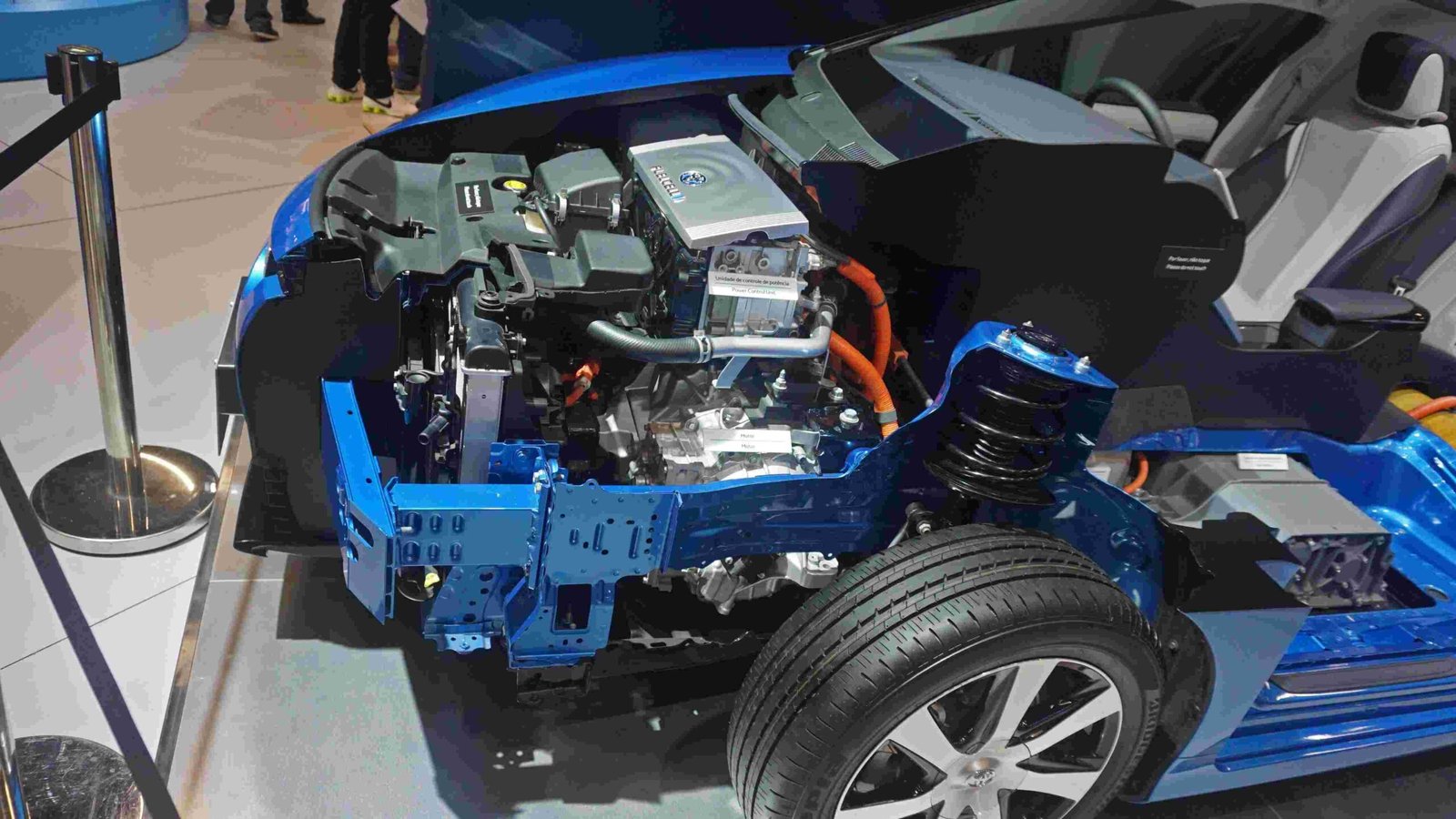
Tesla’s New American Next-Gen Electric Motor SHOCKED EV Industry: The global electric vehicle industry is entering a new era of powertrain innovation, and Tesla’s next-generation electric motor technology could become one of the most important developments in that transition. As automakers search for lower costs, greater efficiency, faster production, and stronger supply-chain independence, the electric motor has become a critical battleground.
Recent analysis surrounding Tesla’s next-generation motor strategy points toward a major shift: reducing or eliminating rare-earth materials, integrating power electronics, simplifying manufacturing, and dramatically accelerating production cycles. Instead of relying primarily on expensive materials and complex assembly processes, future EV motors could increasingly depend on smart magnetic engineering, automation, and manufacturing efficiency.
Why Tesla Is Moving Away From Rare-Earth Motors
For years, high-performance electric vehicles have relied heavily on Permanent Magnet Synchronous Motors (PMSMs). These motors are highly efficient because they use permanent magnets containing materials such as neodymium, dysprosium, and terbium.
These rare-earth elements provide strong magnetic properties that allow engineers to create compact motors with high torque density. However, their advantages come with significant economic and geopolitical risks.
Rare-Earth Supply Chains Create Major Risks
A major problem is that the global rare-earth industry is highly concentrated geographically. A large percentage of rare-earth refining and processing capacity is located in a limited number of regions, creating potential vulnerabilities for automakers.
Trade restrictions, geopolitical tensions, transportation disruptions, and price volatility can all affect the cost and availability of these materials.
For an automaker producing millions of vehicles, even a relatively small increase in motor material costs can have a significant effect on overall profitability.
Environmental Concerns Add More Pressure
Rare-earth extraction and refining can also create substantial environmental challenges. Chemical processing and mining operations can generate waste and require significant resources.
That creates an interesting contradiction for the EV industry. Electric vehicles are designed to reduce transportation emissions, yet some of their most important components depend on complicated mining and refining processes.
A rare-earth-free electric motor could therefore provide both economic and strategic advantages.
How a Rare-Earth-Free Tesla Motor Could Work
Eliminating rare-earth magnets does not necessarily mean sacrificing performance. Engineers can redesign the motor’s rotor and stator to produce torque through alternative magnetic principles.
One promising architecture is the Permanent Magnet-Assisted Synchronous Reluctance Motor, or PM-SynRM.
Instead of depending entirely on powerful rare-earth magnets, the rotor can be designed with carefully engineered magnetic flux barriers. These structures encourage magnetic flux to follow specific paths through the rotor.
The resulting reluctance torque contributes significantly to motor performance.
Engineers can potentially combine this effect with inexpensive materials such as ferrite magnets, reducing dependence on neodymium-based permanent magnets.
The Role of Advanced Rotor Design
The rotor is one of the most important components in an electric motor. Its geometry determines how effectively magnetic fields interact and ultimately how much torque the motor can generate.
Advanced manufacturing techniques allow engineers to create extremely precise rotor laminations and magnetic pathways.
This means future motors could achieve higher efficiency not simply through better materials, but through better engineering and geometry.
That philosophy fits directly into Tesla’s broader manufacturing strategy: use less material, simplify the design, and manufacture the remaining components faster.
Hairpin Windings Could Increase Motor Performance
Another important technology is the use of hairpin stator windings.
Traditional motors commonly use bundles of round copper wires. Hairpin designs instead use precisely formed rectangular copper conductors inserted into the stator slots.
This approach can increase the copper slot-fill factor, allowing more conductive material to occupy the available space.
Higher copper utilization can contribute to improved electrical performance and thermal management. Combined with sophisticated cooling systems, optimized winding geometry can help create a smaller and more powerful electric drive unit.
For high-volume EV production, manufacturing consistency is another major advantage.
Tesla’s Biggest Advantage Could Be Manufacturing Speed
Motor efficiency is only one part of the equation. Tesla’s larger opportunity could come from how quickly the motor can be manufactured.
A conventional EV drive unit can require numerous individual manufacturing and assembly stages. Each additional operation introduces equipment requirements, labor, quality-control steps, and potential failure points.
Tesla’s next-generation approach could instead focus on process consolidation and extreme automation.
The long-term objective is not merely to create a better motor—it is to create a motor that can be produced rapidly, consistently, and at massive scale.
The Sub-10-Second Manufacturing Vision
Future automated powertrain factories could target single-digit-second production cycles for certain highly integrated manufacturing stages.
If achieved, such speeds would represent a dramatic improvement compared with traditional manufacturing processes that can take many minutes across multiple assembly stages.
For vehicles such as robotaxis, affordable EVs, and high-volume Tesla models, manufacturing speed could become just as important as battery capacity.
The faster Tesla can manufacture drive units, the more efficiently it can scale vehicle production.
Silicon Carbide Optimization Could Reduce Costs
The inverter is another crucial component of an EV powertrain. It converts the battery’s DC electricity into three-phase AC electricity needed to operate the motor.
Modern high-performance EVs increasingly use silicon carbide (SiC) semiconductors because they can operate efficiently at high voltages and temperatures.
However, SiC components can be expensive.
A next-generation inverter could potentially use advanced electrical architectures and optimized switching strategies to reduce the amount of semiconductor material required.
The supplied analysis suggests that future designs could target significant reductions in SiC transistor surface area, potentially approaching 75% in certain architectures.
If such reductions are achieved without compromising performance, the result could be a smaller, cheaper, and more efficient inverter.
A Smaller Factory Could Change EV Economics
The manufacturing implications extend beyond the motor itself.
A highly integrated drive unit could reduce the number of separate components and assembly stations required. Automated casting, simplified structures, and integrated electronics could potentially shrink the factory footprint.
This creates a powerful manufacturing equation:
Fewer materials + fewer components + faster assembly + smaller factories = lower production costs.
For Tesla, this could be especially important because the company has historically emphasized vertical integration and manufacturing efficiency.
Instead of simply purchasing complete powertrains from external suppliers, greater internal control could allow Tesla to optimize the entire system around its vehicle architecture.
What This Means for the Global EV Industry
Tesla’s next-generation motor strategy could create significant competitive pressure across the automotive sector.
Traditional automakers that remain dependent on expensive rare-earth magnets and complex supplier networks may face higher costs.
Meanwhile, manufacturers that successfully develop rare-earth-free motors, integrated inverters, automated production, and compact drive units could gain a major cost advantage.
This could accelerate a broader industry shift away from material-intensive engineering toward manufacturing-focused innovation.
The Race Is No Longer Just About Battery Range
For years, EV competition focused heavily on battery capacity and driving range. Those factors remain important, but the next stage of competition is becoming more comprehensive.
Automakers are now competing on:
- Motor efficiency
- Manufacturing speed
- Material costs
- Power electronics
- Factory footprint
- Supply-chain independence
- Vehicle production scalability
A breakthrough in any one of these areas can influence the final price and profitability of an EV.
Conclusion: Tesla’s Motor Strategy Could Reshape EV Manufacturing
Tesla’s potential next-generation electric motor represents more than another improvement in EV performance. The larger opportunity lies in combining rare-earth-free materials, advanced rotor architecture, hairpin windings, optimized silicon carbide electronics, and highly automated manufacturing.
If these technologies can be commercialized at scale, Tesla could reduce its exposure to critical-material shortages while simultaneously lowering manufacturing costs.
The biggest disruption may therefore not come from a motor that simply produces more horsepower. It could come from a motor that is cheaper, simpler, faster to manufacture, easier to source, and optimized specifically for mass production.
As the EV industry enters its next phase, the winners may be determined not only by who builds the most powerful electric motor, but by who can manufacture millions of efficient motors at the lowest possible cost.
FAQs
1. What is Tesla’s next-generation electric motor?
Tesla’s next-generation electric motor is an advanced EV powertrain concept focused on higher efficiency, lower production costs, simplified manufacturing, and reduced dependence on rare-earth materials.
2. Why is Tesla moving toward rare-earth-free electric motors?
Reducing rare-earth materials can help Tesla lower supply-chain risks, material costs, and geopolitical dependence while making large-scale motor production more predictable.
3. What are rare-earth elements used in EV motors?
Common rare-earth materials include neodymium, dysprosium, and terbium. They are traditionally used in powerful permanent magnets found in many high-performance electric motors.
4. Can a rare-earth-free motor still deliver high performance?
Yes. Advanced designs such as Permanent Magnet-Assisted Synchronous Reluctance Motors (PM-SynRM) can generate torque using optimized rotor geometry and alternative magnetic materials.
5. What is a Permanent Magnet-Assisted Synchronous Reluctance Motor?
A PM-SynRM combines permanent-magnet torque with reluctance torque. Carefully designed magnetic barriers in the rotor help direct magnetic flux and improve motor performance.
6. What are hairpin windings in an electric motor?
Hairpin windings use precisely formed rectangular copper conductors instead of conventional bundles of round wire. They can improve copper utilization, electrical performance, and manufacturing consistency.
7. How could Tesla reduce electric motor manufacturing time?
Tesla could use greater automation, process consolidation, integrated components, and advanced casting techniques to reduce the number of manufacturing and assembly operations.
8. Could Tesla produce an electric motor in less than 10 seconds?
The single-digit-second cycle represents an ambitious manufacturing target for highly automated production stages. Actual production times depend on the specific process, factory design, and production technology used.
9. What role does silicon carbide play in Tesla’s next-generation powertrain?
Silicon carbide (SiC) is used in power inverters to efficiently control electricity between the battery and motor. Optimizing the inverter could reduce semiconductor requirements while maintaining high-voltage performance.
10. How does an EV inverter work?
An EV inverter converts direct current (DC) from the battery into three-phase alternating current (AC) that drives the electric motor. It also precisely controls motor speed and torque.
11. Could the new motor make Tesla vehicles cheaper?
Potentially. Lower material costs, reduced component counts, faster production, and smaller manufacturing footprints could help reduce the cost of producing future Tesla vehicles.
12. Why is manufacturing speed important for Tesla?
Faster manufacturing allows Tesla to produce more vehicles using fewer production resources. This could be especially important for high-volume EVs, robotaxis, and future mass-market models.
13. Could rare-earth-free motors improve Tesla’s supply-chain independence?
Yes. Reducing reliance on rare-earth magnets could give Tesla greater control over its powertrain supply chain and reduce exposure to material shortages, price fluctuations, and geopolitical disruptions.
14. How could Tesla’s next-generation motor affect other automakers?
If Tesla successfully combines low-cost materials, high efficiency, rapid manufacturing, and integrated power electronics, competitors may face pressure to redesign their own EV powertrains and manufacturing systems.
15. Could Tesla’s next-generation electric motor change the EV industry?
Potentially. A successful combination of rare-earth-free motor technology, advanced rotor designs, optimized inverters, and highly automated production could push the EV industry toward lower-cost and more scalable electric powertrains.
Read More:
- SpaceX just EXPOSED itself: Raptor BAD
- Elon Musk follows Trump’s lead, says a SpaceX name change is coming
- Tesla’s Giga Press 4.0 INSANE Speed, Cars Are Made So Fast
- Tesla Bot Gen 3 NEW DESIGN! Elon Musk Drops MASSIVE UPDATE 1,000/Week
- 2026 Tesla Model Q Finally Revealed – Official Information | Interior and Exterior Details