
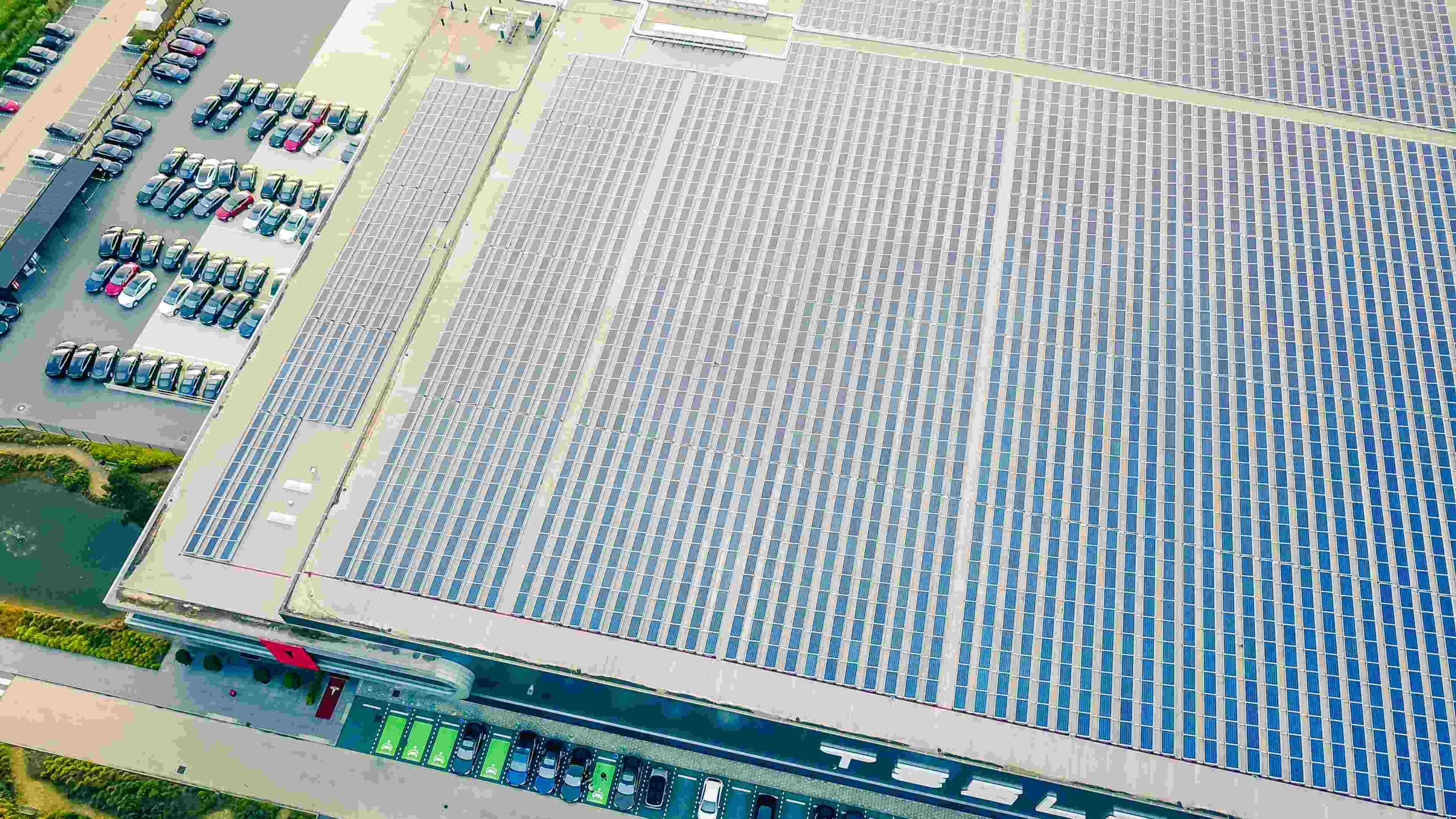
Tesla’s World’s First 1000GW Solar Factory Destroys Energy Industry: The global clean energy and electric vehicle (EV) market is entering a new era, and Tesla is once again leading the transformation. While most headlines continue to focus on Tesla’s quarterly vehicle deliveries, the company’s real long-term strategy is unfolding in solar energy, battery storage, autonomous trucking, and industrial logistics.
From a massive 1000GW solar manufacturing vision in Texas to expanding Gigafactory Berlin and advancing the Tesla Semi, the company is positioning itself as much more than an automaker. Tesla aims to become one of the world’s largest energy and infrastructure companies, capable of powering cities while revolutionizing commercial transportation.
Tesla’s Massive Brookshire Energy Campus Could Change the Solar Industry Forever
Tesla’s newest project near Brookshire, Texas, roughly 35 miles from Houston, represents one of the most ambitious manufacturing investments in clean energy history.
For years, Tesla’s solar business struggled following its $2.6 billion acquisition of SolarCity in 2016. The highly anticipated Buffalo Gigafactory failed to achieve its original vision after Panasonic exited the partnership, forcing Tesla to repurpose much of the facility for Supercharger components and AI data labeling.
However, everything changed with the quiet launch of Tesla’s TSP-420 solar panel in late 2025. Rather than simply introducing another solar product, Tesla was preparing for something significantly larger—a fully integrated solar manufacturing campus capable of reshaping the global energy market.
Tesla’s Goal: 1000GW of Annual Solar Production
The Brookshire facility is expected to begin with an impressive 100GW annual production capacity, but Elon Musk’s long-term vision extends to an astonishing 1 Terawatt (1000GW) of annual solar panel output.
To understand how significant this is:
- The entire United States installed approximately 32GW of new solar capacity during 2023.
- First Solar, America’s largest domestic solar manufacturer, expects around 17.7GW of annual manufacturing capacity by 2027.
- Tesla’s initial 100GW facility alone would exceed several times the annual solar deployment of the entire United States, while the ultimate 1000GW goal would completely redefine global solar manufacturing.
If Tesla reaches this objective, it would become one of the largest clean energy manufacturers ever built.
Why Tesla Chose Houston Instead of Austin
Tesla’s decision to build near Houston wasn’t accidental.
Houston offers one of America’s largest deep-water ports, making it ideal for importing heavy industrial equipment and exporting finished solar products worldwide.
Tesla has reportedly leased approximately 1.65 million square feet of industrial space in Brookshire with room for future expansion.
Even more importantly, the new solar factory sits next to Tesla’s existing Megapack battery factory, creating a fully integrated energy ecosystem.
Complete Vertical Integration
Unlike traditional manufacturers that rely on multiple suppliers, Tesla plans to control nearly every stage of production, including:
Raw Material Processing
The facility will process raw silicon ingots into wafers.
Solar Cell Manufacturing
Tesla will manufacture its own photovoltaic cells, reducing dependence on outside suppliers.
Finished Solar Panels
Final assembly of the company’s latest TSP-420 solar panels will occur under the same roof.
Battery Storage Integration
The nearby Megapack factory enables Tesla to deliver complete utility-scale energy solutions, combining solar generation with battery storage from a single supplier.
This level of vertical integration could significantly reduce manufacturing costs while increasing production efficiency.
A $4 Billion Investment in America’s Energy Future
Unlike Tesla’s earlier Buffalo project, which relied heavily on state incentives, the Brookshire campus is reportedly being funded almost entirely through Tesla’s own capital.
The company has also signed major equipment procurement agreements, including billions of dollars in advanced manufacturing machinery.
Overall investment in the Brookshire campus is expected to exceed $4 billion, making it one of Tesla’s largest infrastructure projects to date.
Gigafactory Berlin Is Preparing for Major Expansion
Tesla’s ambitions extend well beyond North America.
Regulatory filings indicate that Gigafactory Berlin-Brandenburg will nearly double its manufacturing footprint with a major northern expansion.
European Cybercab Production
The expanded facility is expected to manufacture Tesla’s upcoming Cybercab, allowing the company to build autonomous vehicles directly within Europe.
Localized production will reduce shipping costs while simplifying regional supply chains.
Increased 4680 Battery Cell Production
Tesla also plans to expand on-site production of its 4680 battery cells, supporting both electric vehicle manufacturing and stationary energy storage systems.
Workforce Growth
Beginning in October 2026, Tesla reportedly plans to increase production by approximately 20%, supported by the hiring of around 1,000 additional employees.
This expansion reflects Tesla’s confidence in growing European demand for both electric vehicles and clean energy technologies.
Tesla Semi Is Becoming a Commercial Success
While passenger vehicles receive most of the attention, Tesla’s Semi is quietly proving itself in real-world commercial operations.
The fleet has now accumulated more than 13.5 million miles of operational driving, with one truck exceeding 440,000 miles while maintaining approximately 95% fleet uptime.
These results demonstrate the durability required for heavy commercial transportation.
Advanced Vehicle Dynamics Control Improves Safety
Tesla recently completed extensive winter testing in Alaska using fully loaded trailers on icy roads.
Unlike conventional diesel trucks, which rely on slower mechanical systems to respond to wheel slip, Tesla’s Vehicle Dynamics Control (VDC) continuously analyzes:
- Wheel speed
- Steering angle
- Road traction
- Lateral G-forces
Using its independent electric motors, the Semi can instantly redistribute torque to maintain stability before dangerous trailer jackknifing develops.
This electronic response occurs within milliseconds, giving Tesla a significant advantage during severe weather conditions.
Tesla Is Building Autonomous Freight Transportation
Tesla is also accelerating development of autonomous commercial trucking.
Prototype Semi trucks have been spotted near Tesla’s Fremont factory carrying specialized roof-mounted validation systems used for ground-truth calibration.
Smarter AI Training
These systems compare Tesla’s camera-based neural network predictions against highly accurate laser and radar measurements.
Engineers use this data to identify errors and improve autonomous driving performance.
Heavy trucks create far greater computational challenges than passenger cars because they must account for:
- 82,000-pound gross vehicle weight
- Longer stopping distances
- Trailer articulation
- High-speed stability
- Complex regenerative braking behavior
To support these workloads, Tesla’s latest production Semi includes 10 exterior cameras and an interior monitoring camera.
Improved Driver Comfort and Productivity
Tesla has also refined the Semi’s interior based on fleet operator feedback.
Larger High-Resolution Displays
The truck now features dual 16-inch QHD displays that manage navigation, energy usage, vehicle monitoring, camera feeds, and future autonomous driving functions.
Better Cabin Ergonomics
Tesla redesigned several everyday features, including:
- Higher cup holders
- Larger storage compartments
- Extended side windows for easier access at toll booths and security checkpoints
Combined with its distinctive central driving position, these updates improve both visibility and long-distance driver comfort.
Why Tesla’s Energy Strategy Matters More Than Car Sales
Tesla’s long-term strategy is no longer centered solely on selling electric cars.
Instead, the company is building a complete ecosystem that includes:
- Utility-scale solar manufacturing
- Grid-scale battery storage
- Autonomous commercial transportation
- Artificial intelligence
- Advanced manufacturing
- Energy infrastructure
If the Brookshire campus achieves even a fraction of its planned 1000GW capacity, Tesla could fundamentally reshape the economics of renewable energy worldwide.
Final Thoughts
Tesla’s latest projects suggest the company is evolving into a global energy and industrial technology powerhouse rather than remaining just an electric vehicle manufacturer.
The combination of a potential 1000GW solar factory, vertically integrated battery production, expanding Gigafactories, and increasingly capable Tesla Semi trucks points toward a future where Tesla controls multiple layers of the clean energy ecosystem.
While investors often focus on quarterly vehicle deliveries, the company’s biggest opportunity may lie in powering electrical grids, supplying utility-scale renewable energy, and transforming global freight logistics. If these ambitious plans become reality, Tesla’s next decade could be defined less by cars and more by its role in building the world’s future energy infrastructure.
FAQs
1. What is Tesla’s 1000GW solar factory?
Tesla’s proposed 1000GW solar factory is a massive manufacturing project planned for Brookshire, Texas. The long-term vision is to produce up to 1 terawatt (1,000GW) of solar panels annually, making it one of the largest solar manufacturing facilities in the world.
2. Where is Tesla’s new solar factory being built?
The new Tesla solar manufacturing campus is being developed in Brookshire, Texas, approximately 35 miles west of Houston. The location offers easy access to shipping ports and existing Tesla energy infrastructure.
3. Why did Tesla choose Brookshire instead of Austin?
Brookshire provides excellent logistics through Houston’s deep-water port, making it easier to import manufacturing equipment and export finished solar products. The site is also close to Tesla’s Megapack battery production facility.
4. What is Tesla’s initial solar production target?
Tesla aims to begin production with approximately 100GW of annual solar manufacturing capacity, with a long-term goal of expanding to 1,000GW.
5. How does Tesla’s solar factory compare to the U.S. solar market?
Tesla’s planned 100GW initial capacity would be several times larger than the annual solar capacity installed across the entire United States in 2023, highlighting the project’s unprecedented scale.
6. What is Tesla’s TSP-420 solar panel?
The TSP-420 is Tesla’s latest solar panel introduced as part of its renewed solar energy strategy. It is expected to play a central role in the Brookshire manufacturing campus.
7. What is vertical integration in Tesla’s energy business?
Vertical integration means Tesla controls multiple stages of production, including silicon processing, wafer manufacturing, photovoltaic cell production, solar panel assembly, and battery storage, all within a unified manufacturing ecosystem.
8. How much is Tesla investing in the Brookshire energy campus?
Reports suggest Tesla’s total investment could exceed $4 billion, including factory construction, manufacturing equipment, and advanced automation systems.
9. What is happening at Gigafactory Berlin?
Tesla is expanding Gigafactory Berlin-Brandenburg with a major new production area expected to support Cybercab manufacturing, increased 4680 battery cell production, and higher vehicle output.
10. What is the Tesla Semi?
The Tesla Semi is Tesla’s fully electric Class 8 commercial truck designed for long-haul freight transportation, offering lower operating costs, improved efficiency, and advanced safety technologies.
11. How many miles has the Tesla Semi fleet completed?
Tesla’s Semi fleet has accumulated more than 13.5 million real-world driving miles, demonstrating the truck’s durability and commercial viability.
12. What is Tesla’s Vehicle Dynamics Control (VDC)?
Vehicle Dynamics Control (VDC) is Tesla’s advanced electronic stability system that continuously monitors wheel traction, steering input, and vehicle movement to prevent skidding and jackknifing, especially on slippery roads.
13. Is Tesla developing autonomous Semi trucks?
Yes. Tesla is actively testing autonomous driving technology for the Semi using specialized ground-truth validation systems to improve AI accuracy and prepare for future self-driving freight operations.
14. What improvements have been made to the production Tesla Semi?
The production Tesla Semi features dual 16-inch QHD displays, improved storage, higher cup holders, larger side windows, enhanced visibility, and updated driver-focused ergonomics.
15. Why is Tesla focusing on energy instead of just electric cars?
Tesla’s long-term strategy extends beyond electric vehicles to include solar energy, battery storage, AI, autonomous transportation, and utility-scale infrastructure, creating an integrated clean energy ecosystem.
16. Could Tesla’s energy strategy reshape the global renewable energy industry?
If Tesla successfully scales its solar manufacturing, battery storage, and autonomous logistics businesses, it could significantly reduce renewable energy costs, accelerate clean energy adoption, and transform global energy infrastructure.
Read More:
- Texas man charged in fatal Tesla crash where he blamed Autopilot
- Starship S40 finally Completed Full-Engine Fire Test, Faster Than Expected! Pad-2 in Strange Tests
- Elon Musk Unveils New Tesla Mega Projects That SHOCKED China
- Elon Musk outlines Tesla Optimus production expectations
- Tesla expands Robotaxi to Florida, marking its third state for autonomy
2 thoughts on “Tesla’s World’s First 1000GW Solar Factory Destroys Energy Industry”