
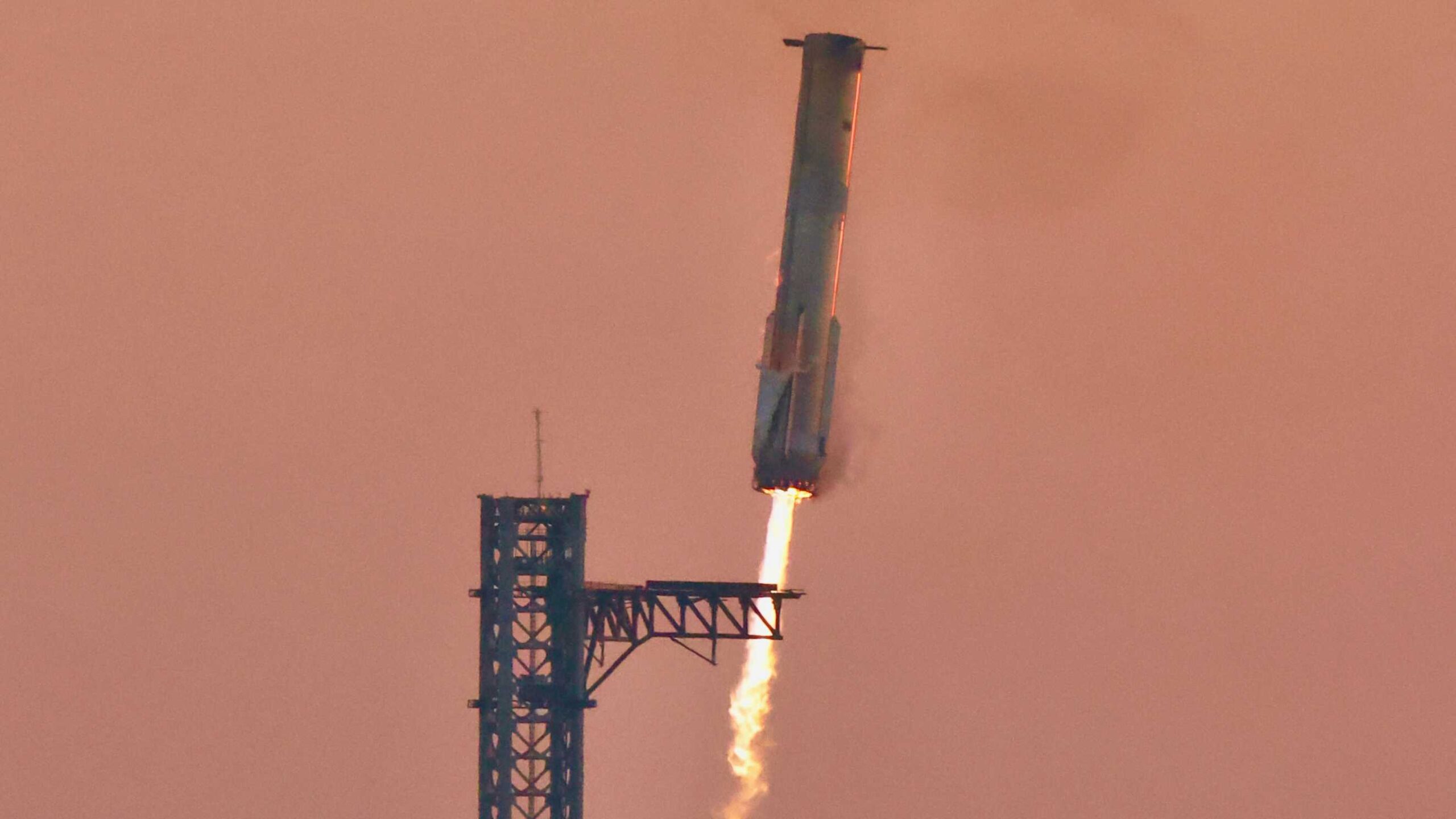
SpaceX has once again captured the attention of the global aerospace industry with the dramatic twelfth test flight of its gigantic Starship launch system. After a seven-month pause since October 2025, this mission marked far more than another experimental rocket launch. It represented the beginning of a completely redesigned era for Starship.
This latest mission introduced revolutionary upgrades across nearly every major system. From the orbital launch pad to the massive Super Heavy booster, from the advanced Raptor V3 engines to the redesigned upper-stage heat shield, Flight 12 was essentially a real-world demonstration of SpaceX’s most ambitious engineering overhaul yet.
The test flight delivered both spectacular successes and devastating failures. While the upper stage achieved orbital velocity, deployed payload simulators, and survived atmospheric reentry in near-perfect condition, the booster suffered a catastrophic engine failure during its return maneuver.
Still, the mission proved one thing clearly: SpaceX is rapidly evolving Starship into a fully reusable deep-space transportation system.
The Massive Importance of Starship Flight 12
The twelfth Starship mission was not a routine incremental test. It served as a critical validation platform for technologies that SpaceX hopes will eventually support:
- Moon missions
- Mars colonization
- Rapid satellite deployment
- Orbital refueling
- Full rocket reusability
- Multiple launches per day
Unlike previous flights, nearly every visible component of the rocket had undergone redesigns. Engineers used Flight 12 to stress-test entirely new systems under real operational conditions.
The mission demonstrated both the incredible pace of SpaceX innovation and the brutal reality of experimental aerospace engineering.
Upgraded Launch Pad Infrastructure
Why SpaceX Had To Redesign The Launch Pad
Earlier Starship launches exposed a major weakness in the orbital launch infrastructure. The sheer power generated by 33 Raptor engines caused extensive damage to the launch mount after nearly every mission.
Previous designs relied on a relatively exposed steel ring and upward-facing water suppression systems. Unfortunately, these systems struggled to handle the tremendous acoustic and thermal energy produced during liftoff.
To solve this problem, SpaceX completely rebuilt the launch environment.
The New Reinforced Launch System
The upgraded launch pad introduced several major engineering innovations.
Reinforced Throne Matrix
The new launch structure uses steel-reinforced concrete designed to survive millions of pounds of thrust pressure continuously.
This massive structural improvement dramatically increases durability while reducing post-launch repairs.
Dual-Channel Flame Deflector
Instead of allowing exhaust energy to blast outward in every direction, engineers created two deeply recessed flame channels.
These channels redirect the rocket exhaust safely away from sensitive ground equipment.
Old Design:
Rocket → Open blast → Severe surface damage
New Design:
Rocket → Water suppression → Split flame channels → Controlled energy dissipation
This redesign significantly improves operational efficiency.
Direct Inject Water Deluge System
Another critical addition was the high-pressure water injection system.
Rather than spraying water generally upward, the new system injects water directly into the engine exhaust plume at the base of the vehicle. This creates a thermal barrier that protects the pad from catastrophic damage.
The result was one of the cleanest Starship launches ever observed.
The Quick Disconnect Failure And Launch Scrub
The Dramatic Countdown Abort
Before the successful launch attempt, Flight 12 experienced a tense launch scrub.
The problem originated from the Quick Disconnect arm, a vital mechanism responsible for delivering cryogenic methane and oxygen into the upper stage.
Just before liftoff, the arm must retract safely away from the rocket. However, a mechanical pin became physically jammed during the countdown sequence.
This halted the launch instantly.
Although frustrating, the incident provided a valuable test of SpaceX’s new operational procedures.
SpaceX’s Rapid Overnight Recovery
Ground crews worked overnight to repair the issue and prepare the rocket for another attempt.
The following day, SpaceX demonstrated one of the mission’s most impressive achievements:
Ultra-fast cryogenic fueling.
The company successfully loaded the largest rocket ever built in only 30 minutes.
That accomplishment is extraordinary considering the rocket uses super-cooled propellants stored below -100°C.
For comparison, NASA’s smaller Space Launch System (SLS) often requires more than three hours for fueling operations.
NASA
The Revolutionary Raptor V3 Engines
A Radical Engine Redesign
Flight 12 marked the first operational debut of the new Raptor V3 engine architecture.
Previous Starship missions relied on older Raptor V1 and V2 engines. The V3 version introduces one of the most aggressive simplifications ever attempted in rocket engine design.
Engineers eliminated most visible:
- Fluid plumbing
- External wiring
- Sensor harnesses
- Auxiliary piping
Using advanced 3D metal printing, many components were integrated directly into the engine’s internal structure.
Why The Raptor V3 Is So Important
The redesign delivered two massive benefits.
1. Major Weight Reduction
Previous Raptors required heavy protective shielding around delicate external systems.
The new V3 design removed much of that shielding entirely.
This saved approximately 1 metric ton per engine.
Across all 33 booster engines, the weight reduction totaled roughly 33 tons.
That directly increases payload capability.
2. Improved Durability
Because fewer sensitive components are exposed externally, the engines can tolerate harsher conditions during launch and reentry.
This also simplifies maintenance for future reusable operations.
The Incredible Simultaneous 33-Engine Ignition
A Huge Milestone For SpaceX
Earlier Starship launches used staggered ignition sequences to avoid dangerous pressure spikes in the fuel system.
Flight 12 changed that completely.
Thanks to upgraded fuel distribution manifolds, the Super Heavy booster successfully ignited all 33 engines simultaneously.
The result was breathtaking.
The massive rocket leapt from the launch pad instantly and accelerated significantly faster than previous versions.
Within just 30 seconds, Starship climbed beyond 2 kilometers in altitude.
This represented a major leap in launch performance.
The Redesigned Hot-Staging System
Eliminating Disposable Hardware
Previous Starship missions used a detachable hot-stage adapter ring between the booster and upper stage.
Although functional, the ring was discarded into the ocean after separation, conflicting with SpaceX’s vision of complete reusability.
Flight 12 introduced a fully integrated hot-stage system.
Instead of a separate ring, engineers reinforced the top dome of the Super Heavy booster with armored steel plating and triangular vent structures.
This allowed the upper-stage engines to ignite directly above the booster without requiring disposable hardware.
Why Hot Staging Matters
Hot staging allows the upper-stage engines to ignite before complete separation.
This preserves momentum and improves overall launch efficiency.
The redesigned architecture is a critical step toward fully reusable orbital operations.
The Catastrophic Booster Failure
Everything Started Normally
At first, stage separation appeared successful.
The upper stage ignited properly and pushed away from the booster.
However, moments later, tracking cameras revealed something was wrong.
The booster began drifting sideways instead of performing its planned boost-back maneuver.
The Cascading Engine Meltdown
During the boost-back burn, the flight computer attempted to relight multiple Raptor V3 engines.
That is when disaster struck.
Initial Engine Failure
Several engines failed to ignite correctly and immediately shut down.
Cascading Shutdowns
Within seconds, additional engines began failing across the engine bay.
Severe Thrust Imbalance
Only four engines remained operational out of 33.
The imbalance created uncontrollable forces.
Structural Breakup
Bright flashes and flying debris soon erupted from the booster’s base.
The vehicle entered a violent uncontrolled spin before disintegrating high above the Gulf of Mexico.
What Caused The Failure?
SpaceX has not officially confirmed the root cause yet.
However, several possible explanations include:
- Fuel manifold pressure instability
- Ignition synchronization failure
- Thermal damage
- Engine bay structural resonance
- Propellant feed interruptions
This booster failure became the mission’s largest setback.
The Upper Stage Achieves Orbit
A Huge Success Despite Booster Loss
While the booster was lost, the Starship upper stage continued its mission successfully.
This represented one of the most important achievements of the entire flight.
The ship reached approximately 27,000 km/h, achieving its target orbital velocity.
That alone demonstrated major improvements in vehicle reliability.
Orbital Refueling Hardware Debut
Preparing For Deep Space Missions
One of Flight 12’s most historic upgrades was the debut of orbital refueling hardware.
Engineers added four docking ports around the payload bay area.
These systems are essential for future missions to:
- The Moon
- Mars
- Deep-space destinations
Because Starship cannot carry enough fuel for interplanetary missions during launch alone, tanker versions of Starship will eventually refill spacecraft while already in orbit.
Flight 12 marked the first real-world test of this docking architecture in space.
Upper Stage Engine Failure Containment
A Massive Engineering Victory
Shortly after stage separation, one of the upper-stage engines unexpectedly failed.
On older Starship designs, this would often trigger catastrophic chain reactions.
But Flight 12 demonstrated a major breakthrough.
The new reinforcement systems successfully contained the damage to only the failed engine itself.
The flight computer automatically rerouted fuel and adjusted thrust among the remaining engines.
The vehicle continued toward orbit without serious issues.
This was one of the mission’s most important reliability demonstrations.
Satellite Deployment Success
Starlink V3 Deployment Simulation
Once in orbit, Starship performed a sophisticated payload deployment demonstration.
The rocket released:
- 20 Starlink V3 satellite simulators
- 2 camera observation satellites
The Starlink simulators replicated the size and weight of next-generation operational satellites.
This allowed engineers to validate deployment mechanics under realistic orbital conditions.
External Camera Satellites
The two specialized camera satellites created stunning third-person views of Starship in orbit.
These spacecraft drifted away from the vehicle while recording high-definition footage of the ship against the darkness of space.
The footage provided some of the most visually spectacular images ever captured during a Starship mission.
Atmospheric Reentry And Heat Shield Validation
Entering One Of Aerospace’s Harshest Environments
After completing orbital objectives, Starship began reentry over the Indian Ocean.
Atmospheric reentry generates extreme heat due to plasma formation around the spacecraft.
Historically, Starship heat shields suffered:
- Missing tiles
- Burn damage
- Structural melting
- Severe erosion
Flight 12 changed that narrative dramatically.
The Cleanest Heat Shield Ever Observed
During descent, onboard cameras showed glowing purple plasma flowing around the vehicle’s heat shield.
Despite the brutal heating conditions, the upgraded thermal protection system performed almost flawlessly.
Post-reentry footage revealed:
- Zero major tile loss
- Minimal visible damage
- No large burn-through sections
- Excellent structural integrity
This represented the best Starship heat shield performance ever achieved.
The Controlled Ocean Landing Attempt
A Near-Perfect Descent
As Starship approached the ocean surface, it executed:
- Controlled aerodynamic maneuvering
- A vertical flip maneuver
- Engine relight
- Final deceleration burn
The spacecraft hovered briefly above the water before tipping over and exploding upon impact.
Importantly, this destruction was expected.
The mission profile had already achieved its primary objectives.
Why Flight 12 Matters For The Future Of SpaceX
Major Successes
Despite the dramatic booster loss, Flight 12 accomplished numerous critical milestones:
Successful Technologies Demonstrated
- Upgraded launch infrastructure
- Simultaneous 33-engine ignition
- Orbital velocity achievement
- Payload deployment systems
- Orbital docking hardware
- Engine failure containment
- Heat shield reliability
- Controlled atmospheric reentry
These achievements significantly advanced the Starship program.
Remaining Challenges
However, the booster failure revealed one major unresolved issue:
Reliable Raptor V3 relight capability.
Without dependable engine restarts during descent, SpaceX cannot safely recover Super Heavy boosters.
That also delays future milestones such as:
- Mechazilla booster catches
- Full rapid reusability
- Commercial payload operations
- Orbital refueling missions
- Human deep-space transportation
What Happens Next?
The Road To Flight 13
SpaceX engineers are now intensely analyzing telemetry from the failed booster.
The company’s development philosophy emphasizes rapid iteration and frequent testing.
Historically, SpaceX often solves major hardware problems within just a few flights.
Flight 13 will likely focus heavily on:
- Raptor V3 ignition reliability
- Booster engine bay stability
- Improved descent sequencing
- Aerodynamic control validation
If those issues are resolved, Starship could move dramatically closer to fully reusable orbital operations.
Final Thoughts
The twelfth Starship test flight perfectly captured the essence of modern experimental aerospace engineering.
It was chaotic, risky, spectacular, and incredibly informative.
The mission proved that the upgraded Starship platform possesses the structural strength, thermal protection, and orbital capabilities necessary for future deep-space exploration.
At the same time, the catastrophic booster failure reminded the world that building the largest reusable rocket system in history remains one of the hardest engineering challenges ever attempted.
Still, SpaceX continues moving forward at extraordinary speed.
Flight 12 may ultimately be remembered as the mission that transformed Starship from a powerful experimental rocket into a serious interplanetary transportation platform.
FAQs
1. What was the main objective of SpaceX’s twelfth Starship test flight?
The primary goal of the twelfth Starship test flight was to validate several major hardware upgrades, including the new Raptor V3 engines, redesigned launch infrastructure, upgraded heat shield system, and orbital refueling hardware.
2. Why was Starship Flight 12 considered so important?
Flight 12 was important because it introduced the most radical redesigns in Starship history. It served as a real-world test for technologies needed for future Moon missions, Mars exploration, and fully reusable rockets.
3. What caused the initial launch scrub?
The launch was initially delayed due to a malfunction in the Quick Disconnect (QD) arm. A mechanical pin became stuck, preventing the arm from retracting safely before liftoff.
4. How fast was Starship fueled before launch?
SpaceX successfully fueled the massive Starship vehicle in approximately 30 minutes, which is extremely fast for a rocket using super-cooled cryogenic propellants.
5. What are the new Raptor V3 engines?
The Raptor V3 is SpaceX’s latest rocket engine design featuring fewer external pipes, reduced wiring, advanced 3D-printed internal components, and major weight savings.
6. Why are the Raptor V3 engines significant?
These engines are important because they:
- Reduce rocket weight
- Improve efficiency
- Simplify maintenance
- Increase payload capability
- Support rapid rocket reusability
7. Did all 33 engines ignite successfully during liftoff?
Yes. For the first time, all 33 Raptor engines ignited simultaneously, allowing the rocket to leave the pad much faster than previous Starship flights.
8. What is hot-stage separation?
Hot-stage separation is a process where the upper-stage engines ignite before fully separating from the booster. This improves efficiency by maintaining forward momentum during staging.
9. What happened to the Super Heavy booster?
The booster suffered a catastrophic engine failure during its boost-back maneuver. Multiple engines failed to relight properly, causing cascading shutdowns and eventual structural breakup.
10. Did the upper stage successfully reach orbit?
Yes. Despite the booster failure, the upper stage successfully reached its target orbital velocity of around 27,000 km/h.
11. What payloads did Starship deploy during the mission?
Starship deployed:
- 20 Starlink V3 satellite simulators
- 2 specialized camera satellites for external orbital footage and telemetry collection.
12. What is orbital refueling hardware?
Orbital refueling hardware allows one Starship vehicle to transfer fuel to another while in space. This capability is essential for future deep-space missions to the Moon and Mars.
13. How did the upgraded heat shield perform?
The heat shield performed exceptionally well. The spacecraft returned with minimal tile damage, making it the cleanest Starship reentry ever observed.
14. Did Starship survive its ocean landing?
The spacecraft completed its planned descent and hover maneuver but tipped over and exploded after touching the ocean surface. This outcome was expected for the test profile.
15. What are the biggest challenges SpaceX still faces?
The biggest remaining challenge is achieving reliable Raptor V3 engine relights during booster descent. Without this, full rocket recovery and reuse remain difficult.
16. What could happen during Starship Flight 13?
Flight 13 will likely focus on:
- Fixing booster engine relight problems
- Improving descent reliability
- Testing advanced recovery systems
- Moving closer to full rocket reusability and operational missions
Read More:
- 2026 Elon Musk’s Terafab GigaFactory UPDATE Shocked Entire The World
- Elon Musk Shocked Everyone with New Optimus Update: Human Skin & Superintelligence
- Elon Musk called it Epic: The full story of SpaceX’s Starship Flight 12
- SpaceX Broke the Internet with Starship Flight 12 Launching…Never Seen Before
- “Raptor Shielding Failed!” SpaceX Revealed WHY Starship Booster 19 Brutally Exploded