
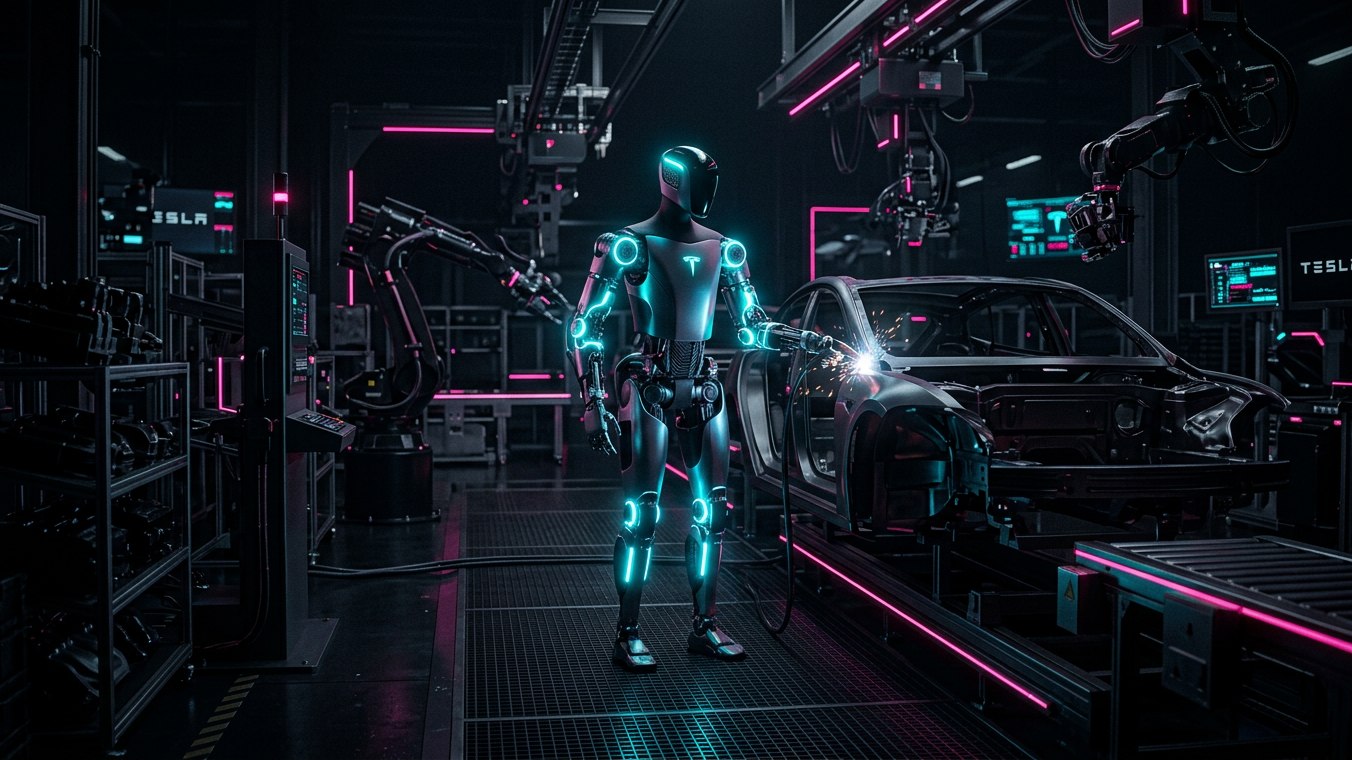
5,000 Tesla Bot Gen 3 READY To Replace Housekeepers For $1/Hour!: Tesla Optimus is entering a potentially transformative stage as the company moves its humanoid robot program from experimental prototypes toward commercial-scale manufacturing. While claims that the robot is ready to replace housekeepers for $1 per hour remain speculative, Tesla’s reported manufacturing plans point toward an ambitious future for humanoid robotics.
The transition is important because producing a few impressive prototypes is very different from manufacturing thousands or millions of reliable robots. Tesla is reportedly working on dedicated production infrastructure, internal testing programs, advanced neural-network training, and a specialized supply chain designed specifically for humanoid robots.
Tesla Optimus Moves Toward Mass Production
Tesla’s Optimus program has progressed beyond simple demonstrations. Supply-chain indications referenced in discussions around the Tesla Bot Gen 3 suggest an initial production order of approximately 5,000 units, with ambitions to expand deployment toward 15,000 robots within the year.
The larger objective is much more aggressive. Tesla’s proposed manufacturing strategy includes a pilot production operation at Fremont and a future high-volume facility in Texas.
Fremont Pilot Production Line
Tesla’s Fremont facility is expected to serve as an important testing and manufacturing validation environment. Rather than immediately attempting maximum production, a pilot line allows engineers to identify problems before scaling.
The Fremont operation is reportedly designed around several goals:
- Testing assembly processes
- Improving component tolerances
- Evaluating actuator and joint durability
- Identifying manufacturing bottlenecks
- Refining robot quality-control procedures
- Collecting real-world operational data
The long-term ambition discussed for the pilot operation reaches as high as 1 million robots per year.
That figure is enormous compared with today’s humanoid-robot industry, but it also demonstrates Tesla’s approach: establish the manufacturing architecture early, then improve it through successive production generations.
Giga Texas Could Become an Optimus Megafactory
Tesla’s long-term robotics strategy reportedly includes a massive 7-million-square-foot manufacturing facility at Giga Texas.
The proposed facility could eventually target production of up to 10 million humanoid robots annually.
That target should be viewed as a long-term ambition rather than an indication that Tesla is already producing robots at anything close to that volume. Manufacturing millions of sophisticated humanoid machines would require major advances in automation, component availability, reliability, and cost reduction.
What Is the Optimus Academy?
One of the most important parts of Tesla’s strategy is its planned internal deployment model.
Instead of immediately selling thousands of early Optimus robots to households, Tesla can deploy them inside its own manufacturing environment. This concept has been described as the Optimus Academy.
The basic idea is straightforward: put robots into real working environments, allow them to perform useful tasks, collect enormous amounts of data, and use that information to improve future versions.
Why Internal Testing Matters
A robot working inside a controlled factory has several advantages.
Tesla employees can monitor the machines, intervene when necessary, and collect detailed information about failures. Optimus could potentially perform tasks such as:
- Moving components
- Transporting materials
- Performing repetitive factory operations
- Handling parts
- Assisting production workers
- Navigating industrial environments
Every successful task creates useful data, while every failure provides another opportunity for improvement.
This creates a continuous learning cycle in which a fleet of robots can help Tesla discover edge cases that are difficult to reproduce in laboratory demonstrations.
Tesla’s FSD-Inspired AI Training Strategy
Tesla’s approach to Optimus is particularly interesting because the company is applying ideas associated with its Full Self-Driving neural-network development to robotics.
At a high level, the concept is a vision-to-control system.
Cameras capture the environment. Neural networks interpret what the robot sees, and the system converts that information into movements for the robot’s motors and joints.
The pipeline can be simplified as:
Cameras → Neural Network → Perception and Planning → Motor and Joint Commands
A car needs to understand lanes, vehicles, pedestrians and obstacles before deciding how to steer, accelerate or brake.
Optimus faces an even more complicated challenge.
The robot must understand three-dimensional objects, determine how to interact with them, estimate appropriate grip strength, move its arms and legs, maintain balance, and make rapid adjustments when circumstances change.
Dexterity Requires More Than Simple Automation
Picking up an object sounds easy until the object changes.
A robot might need to pick up a glass without breaking it, carry a heavy component without dropping it, or adjust its grip when an object begins slipping.
That means Optimus needs to coordinate:
- Vision
- Spatial awareness
- Motor control
- Balance
- Force estimation
- Hand dexterity
- Real-time corrections
This is one reason humanoid robotics is considerably more difficult than building a traditional industrial robotic arm.
Where Does Optimus Get Its Training Data?
Tesla’s strategy appears to involve multiple sources of data rather than relying exclusively on manually programmed instructions.
Human Demonstrations and Teleoperation
Human operators can demonstrate tasks to robots using specialized equipment and motion-capture technologies.
This provides detailed examples of how humans move their hands, arms and bodies while performing physical activities.
Instead of programming every movement individually, Tesla can potentially use these demonstrations to train neural networks that learn general patterns of physical interaction.
Learning From Internet Videos
Another intriguing training source is publicly available video.
Millions of online instructional videos show people performing activities such as cooking, repairing objects, using tools and manipulating everyday items.
A sufficiently capable AI system could potentially extract information about human actions, object relationships and task sequences from this enormous video corpus.
The goal is not simply to memorize videos but to learn generalized concepts that can later be applied to unfamiliar situations.
Digital Optimus Simulation
Simulation could become another major component of Tesla’s robotics strategy.
A digital version of Optimus can theoretically perform enormous numbers of tasks inside virtual environments without the physical limitations of a real robot.
Simulation offers several advantages:
- No physical wear and tear
- Faster experimentation
- Lower operating costs
- Large-scale scenario generation
- Safer testing of unusual situations
- Potentially massive training throughput
The resulting knowledge could then be transferred to physical robots.
The Biggest Challenges Are Hardware, Not Just AI
Artificial intelligence gets most of the attention, but hardware reliability may be one of Optimus’s greatest challenges.
A humanoid robot weighing roughly 70 kilograms needs to remain stable while moving around humans and handling objects.
Actuator Reliability
Optimus requires compact actuators capable of generating substantial force while operating efficiently.
These components must also survive millions of movement cycles without significant degradation.
A failure in a smartphone is inconvenient. A failed actuator in a large humanoid robot can stop the entire machine and potentially create a safety hazard.
Dexterity Versus Strength
Humanoid hands present another difficult engineering problem.
The same hand must potentially manipulate delicate objects while also providing enough strength for demanding industrial work.
Tesla therefore needs to balance precision, force, durability and energy efficiency within a compact mechanical system.
Thermal and Power Management
Advanced neural-network computing generates heat.
A humanoid robot cannot simply carry a large conventional cooling system because excessive weight would reduce mobility and battery efficiency.
Tesla must therefore develop efficient approaches to compute cooling and power consumption while preserving useful operating time.
Tesla Needs a New Robotics Supply Chain
Perhaps the most underestimated challenge is the supply chain.
The automotive industry already has mature suppliers for many components. Humanoid robotics is different.
There is no equivalent global Tier-1 ecosystem capable of immediately supplying millions of complete humanoid actuator systems, compact electronics and specialized robotic components.
Tesla may therefore need to develop substantial portions of the supply chain itself.
Important components include:
- Custom rotary and linear actuators
- High-density sensors
- Compact computing hardware
- Specialized circuit boards
- Batteries and power electronics
- Precision mechanical components
- Advanced semiconductor packages
Tesla’s semiconductor requirements also connect Optimus to the broader AI and autonomous-driving supply chain.
Companies such as Samsung and TSMC are important players in advanced semiconductor manufacturing, meaning chip availability and packaging capacity could become constraints if Optimus production expands dramatically.
Can Tesla Optimus Really Cost $1 Per Hour?
The headline claim that Tesla Bot Gen 3 could replace housekeepers for $1 per hour is attention-grabbing, but it should not be treated as an established consumer price.
The economics of humanoid robots depend on several variables, including purchase price, financing, maintenance, battery life, software costs, operating hours and reliability.
A robot that can operate for many hours with minimal supervision could eventually offer a compelling economic advantage over certain repetitive human tasks. However, reaching a genuine $1-per-hour effective operating cost would require extraordinary manufacturing scale and reliability.
That is why the manufacturing strategy is so important.
Tesla Optimus Production Roadmap
Tesla’s reported roadmap can be summarized as follows:
| Stage | Objective |
|---|---|
| Initial Run | Approximately 5,000 Optimus units |
| Early Deployment | Expansion toward 15,000 units |
| Testing | Internal Optimus Academy operations |
| Fremont Scale-Up | Potential capacity of up to 1 million units annually |
| Giga Texas | Long-term target of up to 10 million robots annually |
| AI Strategy | End-to-end vision-to-control neural networks |
| Supply Chain | Custom robotics components and advanced semiconductors |
The Bigger Picture for Humanoid Robotics
Tesla’s Optimus strategy represents more than another robotics project. If the company succeeds, it could create a new category of general-purpose machines capable of performing physical tasks in human environments.
The real breakthrough would not simply be demonstrating that one robot can fold clothes, carry parts or perform a factory task. The breakthrough would be creating a system that can reliably repeat thousands of different tasks at a commercially viable cost.
That requires three things working together: mass manufacturing, intelligent software and dependable hardware.
Tesla appears to be building its Optimus strategy around exactly that combination.
Conclusion
The transition from prototype to mass-produced humanoid robot could become one of Tesla’s most ambitious engineering projects. An initial fleet of around 5,000 Optimus units, followed by potentially larger deployments, would give Tesla an opportunity to gather real-world data and identify hardware and software problems before attempting truly massive production.
The Optimus Academy, FSD-inspired neural networks, simulation-based training and dedicated manufacturing infrastructure could all play important roles in that transition.
However, the biggest question remains whether Tesla can solve the difficult combination of cost, reliability, safety, dexterity, battery efficiency and supply-chain scale.
If it can, Optimus could eventually move beyond factory experiments and become a commercially useful general-purpose robot. For now, claims about $1-per-hour household labor should be considered future-looking projections rather than proven economics. The next major milestone is not a flashy demonstration—it is proving that thousands of robots can work reliably, safely and economically in the real world.
FAQs
1. What is Tesla Optimus?
Tesla Optimus is a humanoid robot being developed by Tesla to perform a wide range of physical tasks in factories and potentially, in the future, homes and other environments.
2. How many Optimus robots is Tesla planning to produce initially?
Reports and supply-chain indications referenced in the source suggest an initial production run of around 5,000 Optimus units, with potential expansion toward 15,000 units.
3. Is Tesla Optimus ready to replace housekeepers for $1 per hour?
Not yet. The $1-per-hour claim is a future-looking projection, not a confirmed consumer operating cost or rental price. Actual economics will depend on manufacturing costs, maintenance, energy consumption, reliability and utilization.
4. Where will Tesla manufacture Optimus robots?
Tesla’s reported strategy includes a pilot production line in Fremont, California, alongside plans for much larger-scale manufacturing at Giga Texas.
5. How many robots could the Fremont facility eventually produce?
The Fremont pilot operation has reportedly been discussed with a potential capacity of up to 1 million Optimus robots per year as manufacturing processes mature.
6. What is the Tesla Optimus Megafactory?
The proposed Optimus Megafactory at Giga Texas is intended to support extremely high-volume humanoid robot production. Long-term targets discussed for the facility reach as high as 10 million robots annually.
7. What is Optimus Academy?
Optimus Academy refers to Tesla’s internal deployment and testing approach, in which early Optimus robots can perform practical tasks inside Tesla facilities while generating valuable real-world training data.
8. Why would Tesla test Optimus internally first?
Internal testing allows Tesla to identify failures, improve software and collect operational data in controlled environments before potentially deploying large numbers of robots around general consumers.
9. How does Tesla train Optimus?
Tesla is developing an AI-based vision-to-control system that processes visual information and converts it into actions involving the robot’s the robot in simulated environments. Simulation can allow AI systems to practice tasks at large scale motors, joints and hands.
10. Is Optimus AI related to Tesla’s Full Self-Driving technology?
Tesla has described an approach to robotics that draws on concepts used in its Full Self-Driving neural-network development, particularly the idea of using neural networks to translate visual inputs into physical actions.
11. Can Optimus learn from human demonstrations?
Yes. Human demonstrations and teleoperation can provide training data showing how people manipulate objects, move their hands and complete physical tasks.
12. Can Tesla train Optimus using online videos?
Online video can potentially provide a large source of information about human activities, object interactions and task sequences. Such data could complement real-world robot demonstrations and simulation.
13. What is Digital Optimus?
Digital Optimus refers to the concept of training a virtual version of the robot in simulated environments. Simulation can allow AI systems to practice tasks at large scale without physically wearing out real robots.
14. What are the biggest hardware challenges for Optimus?
Major challenges include actuator durability, hand dexterity, power consumption, thermal management, balance and safety. A humanoid robot must be strong and precise while remaining lightweight and energy efficient.
15. Why is the Optimus supply chain difficult to build?
Unlike automobiles, mass-produced humanoid robots do not yet have a mature global supplier ecosystem. Tesla may need specialized actuators, sensors, electronics, computing systems and other components at extremely high volumes.
16. When could Tesla Optimus become a mainstream household robot?
There is no confirmed date for widespread household deployment. Tesla must first demonstrate that Optimus can be manufactured at scale, operate safely and reliably, and perform useful tasks at a commercially competitive cost.
Read More:
- Tesla’s most delayed Cybertruck feature is finally here
- Elon Musk’s Tesla Semi Finally Hits Mass Production 50.000 Trucks
- Elon Musk Reveals Starbase Louisiana Construction Has Begun
- Elon Musk rips ABC News over fatal NYC Tesla crash report
- Tesla ruined other cars for me: one year Model Y ownership review
1 thought on “5,000 Tesla Bot Gen 3 READY To Replace Housekeepers For $1/Hour!”