
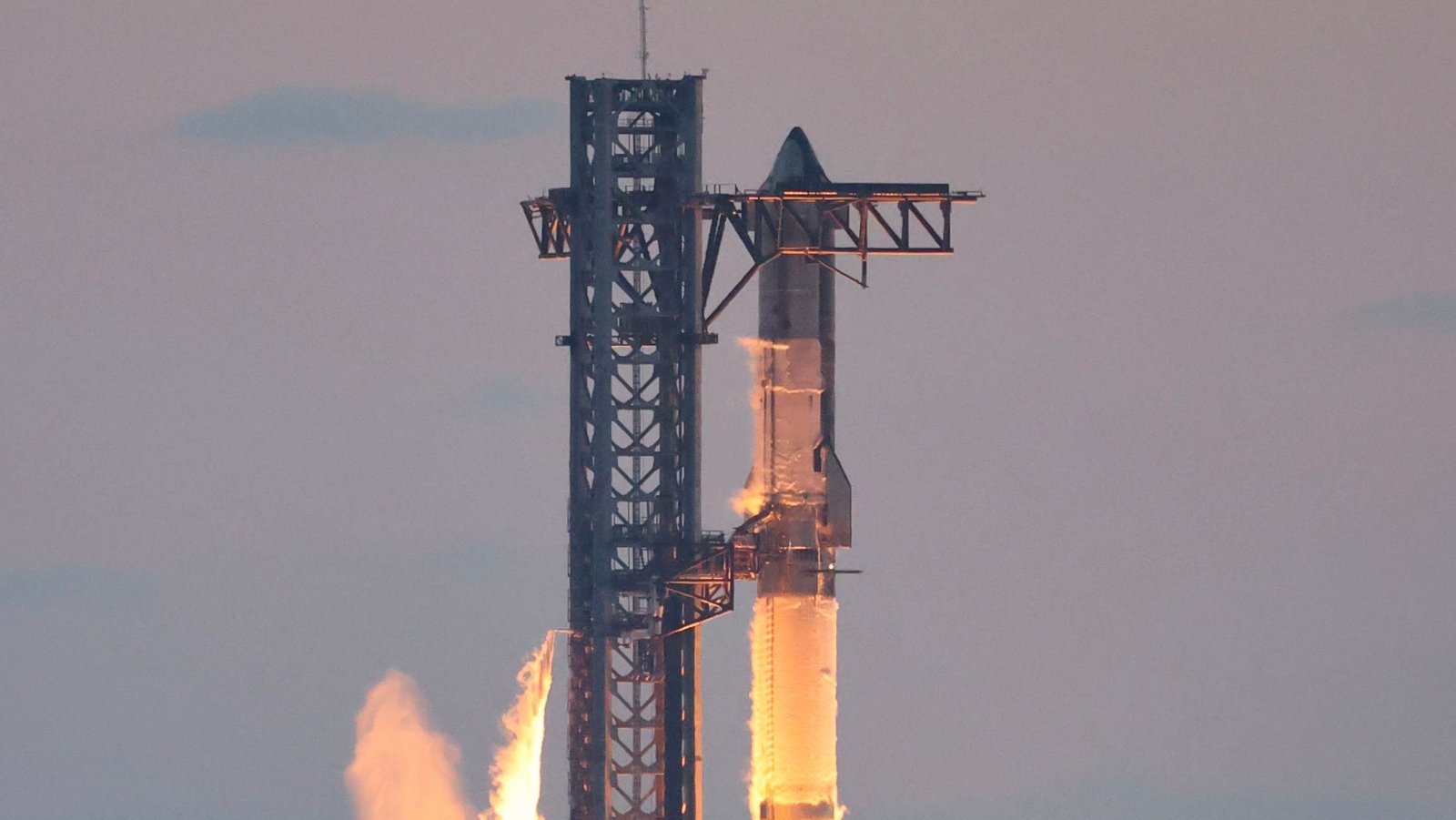
Wow! Starship Flight 15 Rocket Pair is getting “Cryo” together: The space launch industry is entering a highly active phase, with major developments taking place across reusable rockets, commercial satellite launches, and orbital sustainability. From SpaceX’s Starship testing at Starbase to Amazon’s expanding Ariane 6 launch agreement and the breakup of China’s Yaogan-50 satellite, the latest developments highlight both the rapid progress and growing challenges of modern spaceflight.
Based on updates featured in the GREAT SPACEX video “Wow! Starship Flight 15 Rocket Pair is getting ‘Cryo’ together!”, this article examines the latest Starship Flight 15 preparations, Amazon’s Project Kuiper launch plans, and the growing threat posed by space debris in Low Earth Orbit (LEO).
SpaceX Tests Starship Flight 15 Rocket Pair Side-by-Side
At SpaceX’s Starbase facility in Boca Chica, Texas, preparations for future Starship missions are accelerating. Two major components of the upcoming Starship Flight 15 mission—Booster 22 (B22) and Ship 42 (S42)—have been brought together at the Masseys test site for important testing activities.
Testing both parts of the same launch vehicle in close succession represents an important step toward increasing Starship’s launch cadence.
Starship Ship 42 Completes Cryogenic Testing
Ship 42 (S42) had previously completed an initial cryogenic proof test on September 3 before returning to the main production area.
On September 8, the ship’s test stand was moved to Mega Bay 2, where S42 was mounted before being transported back to the Masseys testing area on September 9.
The movement demonstrates the increasingly complex logistics required to prepare Starship hardware for flight. As SpaceX works toward faster turnaround times, the ability to move, test, inspect, and prepare flight hardware efficiently will become increasingly important.
Booster 22 Undergoes Cryogenic Proof Testing
Booster 22 (B22) was transported to Masseys on September 8 and subsequently underwent its primary cryogenic proof test.
Cryogenic testing is one of the most important ground-test procedures for a large liquid-fueled rocket. During the process, extremely cold propellants are loaded into the vehicle’s tanks, exposing the hardware to significant temperature changes and pressure loads.
One of the most visible effects is the formation of a thick layer of white frost across the rocket’s exterior.
However, the frost is more than just a spectacular visual effect. The test helps engineers evaluate the performance of the rocket’s propellant tanks, plumbing, seals, and structural systems under demanding conditions.
Successful cryogenic testing provides greater confidence in the hardware before additional preparations, including engine installation and other flight-readiness activities.
Why Side-by-Side Testing Matters for Starship
The simultaneous testing of B22 and S42 is particularly significant because it suggests SpaceX is developing the operational infrastructure needed for a much higher Starship launch frequency.
A faster launch cadence would allow SpaceX to gather flight data and telemetry more rapidly. Each mission can provide information that engineers use to improve subsequent vehicles, potentially accelerating the development cycle.
If the preceding mission schedule remains on track, Flight 15 could follow Flight 14 relatively quickly, potentially supporting the company’s broader goal of moving toward more frequent Starship launches.
Starship Flight 15 Could Support a Faster Launch Cadence
The long-term objective is not simply to launch another Starship. SpaceX is working toward a repeatable and increasingly efficient launch operation.
A higher launch cadence could provide several advantages:
- Faster hardware iteration
- More real-world flight telemetry
- Improved operational reliability
- Greater experience with booster recovery
- More opportunities to test Starship’s systems
- Preparation for increasingly complex missions
The ability to conduct frequent launches will be particularly important as SpaceX moves toward future missions involving more demanding orbital operations.
Flight 15 Preparation Timeline
The expected preparation sequence includes cryogenic testing, engine installation, additional testing, vehicle stacking, and final launch preparations.
The key objective is to transform individual tested components into a fully integrated flight vehicle as efficiently as possible.
Amazon Expands Ariane 6 Launch Order for Project Kuiper
While SpaceX focuses on Starship development, the commercial launch market is also seeing major activity in Europe.
Amazon has expanded its Ariane 6 launch agreement to support the deployment of its large Low Earth Orbit satellite constellation, Project Kuiper.
Amazon’s original launch strategy involved multiple launch providers. In 2022, the company contracted for 18 Ariane 6 launches, alongside missions using United Launch Alliance’s Vulcan Centaur and Blue Origin’s New Glenn.
The company has now added six additional Ariane 6 missions, bringing its total Ariane 6 order to 24 launches.
Why Ariane 6 Is Important to Amazon
Project Kuiper requires a large number of satellites to be placed into orbit. That makes launch availability and reliability critical components of the constellation’s deployment strategy.
Arianespace’s Ariane 6 has already conducted dedicated Amazon missions, helping place more than 100 satellites into orbit.
The expanded contract provides Amazon with additional launch capacity while giving Europe’s launch industry a substantial long-term customer.
For Arianespace, a large commercial backlog can help support production planning, launch operations, and manufacturing throughput.
Growing Competition in the Commercial Launch Market
The Ariane 6 agreement also illustrates how satellite operators are increasingly diversifying their launch options.
With massive LEO constellations requiring hundreds or thousands of satellites, companies cannot necessarily depend on a single launch provider. A diverse launch strategy can help reduce scheduling risks and provide greater flexibility.
Project Kuiper’s expanding launch campaign is therefore an important development for both Amazon and Europe’s commercial space sector.
China’s Yaogan-50 Satellite Breaks Up in Orbit
While rocket development and satellite deployment continue to accelerate, another problem is becoming increasingly difficult to ignore: orbital debris.
China’s Yaogan-50 reconnaissance satellite experienced an orbital breakup, creating dozens of trackable debris objects.
The satellite was launched on March 15 aboard a Long March 6A rocket and operated in a highly retrograde orbit at an altitude of approximately 952 kilometers (590 miles).
43 Trackable Debris Fragments Detected
On September 4, the U.S. Space Force cataloged 43 trackable fragments associated with the Yaogan-50 breakup.
According to orbital analysis cited in the report, the debris has become distributed across a broad altitude range of approximately 600 to 1,100 kilometers.
At these elevations, atmospheric drag is extremely weak compared with lower portions of LEO. Consequently, some fragments can remain in orbit for a very long time.
Why Orbital Debris Is a Serious Threat
Space debris is dangerous because satellites travel at extremely high orbital velocities. Even a relatively small fragment can cause severe damage if it strikes an operational spacecraft.
A breakup can also create additional debris, increasing the probability of future collisions.
This is closely associated with the concept of Kessler syndrome, in which collisions generate debris that increases the likelihood of further collisions.
The European Space Agency has documented hundreds of fragmentation events throughout the history of spaceflight, demonstrating that orbital debris is not a theoretical problem—it is an ongoing operational challenge.
The Future of Spaceflight: Faster Launches and Cleaner Orbits
The latest developments involving SpaceX Starship Flight 15, Amazon’s Ariane 6 launches, and Yaogan-50 reveal three different sides of today’s space industry.
SpaceX is working to achieve faster and more repeatable rocket operations. Amazon is securing additional launch capacity for a massive satellite constellation. At the same time, orbital breakups demonstrate the environmental and operational risks created by the growing number of objects in space.
These trends are interconnected. As more rockets launch and more satellites enter orbit, the industry will need better space traffic management, debris tracking, collision avoidance, and responsible satellite disposal.
Key Takeaways
| Development | Current Situation | Why It Matters |
|---|---|---|
| SpaceX Starship | B22 and S42 undergoing cryogenic testing | Supports faster Starship development and launch operations |
| Amazon Project Kuiper | Ariane 6 order increased from 18 to 24 missions | Provides additional launch capacity for the LEO constellation |
| Yaogan-50 | Orbital breakup produced 43 trackable fragments | Highlights the growing long-term orbital debris threat |
Conclusion
The space industry is moving rapidly toward an era of higher launch frequency, massive satellite constellations, and increasingly complex orbital operations.
At Starbase, the cryogenic testing of Starship Flight 15’s Booster 22 and Ship 42 demonstrates SpaceX’s push toward a more streamlined launch system. Meanwhile, Amazon’s decision to expand its Ariane 6 contract to 24 launches highlights the growing importance of reliable commercial launch capacity.
However, the Yaogan-50 breakup serves as an important reminder that the expansion of space activity comes with significant responsibilities. As launch rates and satellite populations increase, protecting the orbital environment will become just as important as developing faster and more capable rockets.
The next stage of the space race will therefore involve more than simply reaching orbit. Success will depend on achieving reliable launches, sustainable satellite operations, effective debris management, and long-term access to space.
FAQs
1. What is Starship Flight 15?
Starship Flight 15 is a planned SpaceX Starship mission involving Booster 22 (B22) and Ship 42 (S42). The vehicles are undergoing testing and preparation before their potential flight.
2. What is cryogenic testing on Starship?
Cryogenic testing involves filling a rocket’s propellant tanks with extremely cold liquids to test its tanks, plumbing, seals, and structural systems under realistic temperature and pressure conditions.
3. Why does Starship develop a layer of frost during testing?
The white frost forms when extremely cold propellants inside the vehicle cause the exterior surfaces to become very cold. Frost formation is a normal and highly visible part of cryogenic testing.
4. What are Booster 22 and Ship 42?
Booster 22 (B22) is the Super Heavy booster assigned to the Starship Flight 15 campaign, while Ship 42 (S42) is the upper-stage Starship vehicle intended to fly with it.
5. Where is SpaceX testing Starship Flight 15 hardware?
The Flight 15 hardware has been undergoing testing at the Masseys test site near SpaceX’s Starbase operations in Boca Chica, Texas.
6. Why is simultaneous testing of B22 and S42 important?
Testing the booster and ship in close succession demonstrates SpaceX’s ability to handle multiple pieces of flight hardware efficiently. This could help support a higher Starship launch cadence in the future.
7. Could SpaceX launch Starship missions more frequently?
SpaceX is working toward a higher launch cadence. More frequent launches could allow the company to collect additional flight data, improve hardware, and accelerate Starship’s development.
8. What is Project Kuiper?
Project Kuiper is Amazon’s Low Earth Orbit satellite constellation designed to provide broadband internet connectivity. The project requires a large number of satellite launches to build its network.
9. How many Ariane 6 launches has Amazon ordered?
Amazon originally ordered 18 Ariane 6 launches for Project Kuiper and later added six more missions, bringing the reported total to 24 Ariane 6 launches.
10. Why is Ariane 6 important for Project Kuiper?
Ariane 6 provides Amazon with additional launch capacity for deploying its LEO satellites. Using multiple launch providers can help Amazon manage its large-scale constellation deployment schedule.
11. How many Project Kuiper satellites has Ariane 6 launched?
According to the information discussed in the article, Ariane 6 has completed three dedicated Amazon missions, placing more than 100 satellites into orbit.
12. What happened to China’s Yaogan-50 satellite?
Yaogan-50 experienced an orbital breakup, resulting in dozens of trackable debris fragments. The event has raised additional concerns about the long-term space debris problem.
13. How many debris fragments came from Yaogan-50?
The U.S. Space Force cataloged 43 trackable debris fragments associated with the Yaogan-50 breakup.
14. Why is orbital debris dangerous?
Orbital debris can travel at extremely high speeds and potentially collide with operational satellites or spacecraft. A major collision can create even more debris and increase future collision risks.
15. What is Kessler syndrome?
Kessler syndrome describes a potential chain reaction in which collisions between objects in orbit create additional debris, increasing the likelihood of further collisions. It is one of the major long-term concerns associated with the growing population of objects in Low Earth Orbit (LEO).
Read More:
- 5,000 Tesla Bot Gen 3 READY To Replace Housekeepers For $1/Hour!
- Tesla’s most delayed Cybertruck feature is finally here
- Elon Musk’s Tesla Semi Finally Hits Mass Production 50.000 Trucks
- Elon Musk Reveals Starbase Louisiana Construction Has Begun
- Elon Musk rips ABC News over fatal NYC Tesla crash report