
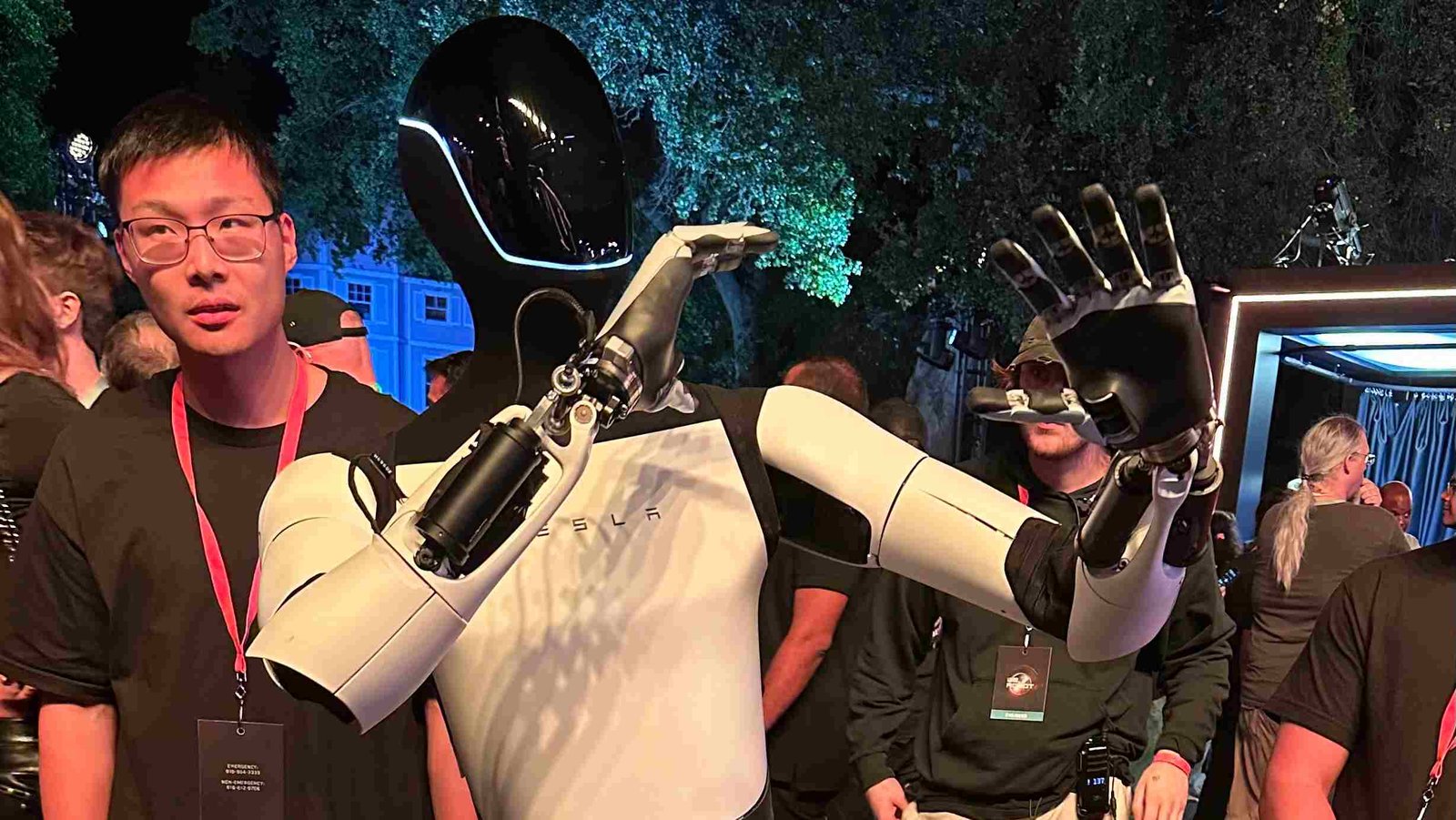
Tesla Bot Gen 3 SPECIAL Edition LEARNS 500 INSANELY COMPLEX Tasks – Best of 2027: Tesla is pushing humanoid robotics into a new phase with Optimus Gen 3, combining advanced artificial intelligence, end-to-end neural networks, sophisticated actuators, and large-scale physical training. The goal is no longer simply to build a robot that can walk or perform a handful of repetitive movements. Tesla is developing a general-purpose humanoid robot capable of learning and adapting to hundreds of complex tasks.
Presented at the CVPR (Computer Vision and Pattern Recognition) conference, Tesla’s Director of Autopilot Software, Ashok Elluswamy, discussed the architectural thinking behind Optimus. The approach closely resembles the philosophy behind Tesla’s Full Self-Driving system: instead of relying primarily on manually programmed rules, the robot can use neural networks to translate visual information and task objectives into physical actions.
With a training ecosystem called Optimus Academy, Tesla’s long-term vision is to create a continuously improving robot fleet in which real-world experience can contribute to better performance across future machines.
Tesla Optimus Gen 3: From Pixels to Physical Movement
Traditional industrial robots generally depend on carefully engineered software pipelines. A camera identifies an object, software calculates its position, a path planner determines movement, and an inverse kinematics system calculates the required joint angles.
This method works extremely well in controlled environments. However, humanoid robots need to operate in environments designed for humans, where objects can move, surfaces can change, and unexpected situations occur.
Tesla’s proposed approach is fundamentally different.
The Vision-Language-Action Model
The Vision-Language-Action (VLA) architecture attempts to connect perception, reasoning, and physical control into a unified system.
The basic concept can be summarized as:
Camera pixels → Neural processing → Motor control
Instead of creating a separate hand-coded response for every possible situation, the neural network can learn relationships between what the robot sees, what it needs to accomplish, and how its body should respond.
For example, imagine Optimus reaching for a component that has shifted slightly from its expected position. A rigidly programmed robot may require a new set of coordinates. A learned model can potentially recognize the difference and adjust its movement dynamically.
The system can also incorporate information about joint positions, velocities, torque, visual context, and task objectives, allowing the robot to make rapid adjustments while interacting with physical objects.
How Tesla Could Train Optimus to Learn Hundreds of Tasks
A powerful foundation model requires enormous quantities of useful training data. Tesla’s strategy involves combining multiple sources of information rather than depending on a single dataset.
1. Internet-Scale Video Data
Human beings learn many physical skills simply by observing others. Videos of manufacturing, assembly, cooking, tool usage, object handling, and other activities can provide neural networks with information about human behavior and task sequences.
Video does not provide all the information needed for robotics. A video may show a person picking up a component, but it does not directly reveal the precise force applied by their fingers.
Nevertheless, large-scale video can provide valuable contextual information about how objects are typically manipulated and how complex tasks are organized.
2. Human Teleoperation
The next layer involves human demonstrations and teleoperation.
Human operators can control robotic systems while performing complicated physical tasks. These demonstrations can potentially capture significantly richer information than ordinary video, including movement trajectories, joint configurations, timing, and interaction with objects.
This type of training is especially important for fine motor control and dexterity.
A robot learning how to insert a delicate connector, manipulate a flexible cable, or reposition an awkward component needs much more than basic visual recognition. It needs to understand how its movements affect the physical world.
3. Optimus Academy and Real-World Learning
Perhaps the most important component is the proposed Optimus Academy feedback loop.
Once robots are operating in real environments, every successful and unsuccessful interaction can become a potential source of training information.
A simplified learning cycle looks like this:
Deploy model → Robot performs task → Record outcome → Analyze failures → Retrain model → Update robots
If one robot encounters an unusual failure, that event could potentially become valuable training data. A future software update could then help other robots avoid the same mistake.
This creates the possibility of a fleet-learning effect, where robots collectively improve rather than operating as isolated machines.
The Engineering Challenge: Putting AI Inside a Humanoid Body
Building the intelligence is only half the problem. Optimus also has to physically execute the decisions generated by its neural networks.
Humanoid robots face severe constraints involving weight, battery capacity, heat, computing power, and actuator performance.
A vehicle has considerably more physical space for batteries, cooling systems, computers, and sensors. A humanoid robot must fit comparable capabilities into a body approximately shaped for human environments.
Every additional component adds weight. Every watt consumed reduces available energy for movement. Every heat-producing processor creates a thermal-management challenge.
Why Actuators Matter
Optimus requires powerful yet compact actuators capable of controlling its arms, legs, hands, and torso.
The ideal actuator needs to provide a combination of:
- High torque output
- Low weight
- Efficient power consumption
- Precise position control
- Fast response
- Long operating life
This is particularly important for tasks involving delicate objects. A robot cannot simply maximize grip strength. It needs to apply the appropriate amount of force for each object and situation.
Optimus Gen 3 and Tesla’s Manufacturing Strategy
Another major challenge is transforming a sophisticated prototype into a product that can be manufactured at extremely high volumes.
Tesla’s broader manufacturing philosophy emphasizes design for manufacturing (DFM), vertical integration, simplified assembly, and component standardization.
For Optimus, this could mean reducing unnecessary part counts, simplifying wiring, improving actuator manufacturing, and designing components specifically for automated production.
From Gen 3 Toward Gen 4
Optimus Gen 3 can be viewed as an important step toward a much larger manufacturing operation.
Future generations could increasingly emphasize:
- Simplified mechanical architecture
- Integrated electronics
- Standardized actuator families
- Reduced wiring complexity
- Higher production automation
- Lower manufacturing costs
- Greater vertical integration
Tesla has discussed ambitious production goals for humanoid robots, potentially reaching hundreds of thousands or eventually millions of units annually if manufacturing economics and technical performance allow.
At that scale, even tiny improvements become significant.
For example, saving just one minute per robot across a production run of one million robots represents more than 16,600 hours of manufacturing capacity.
That illustrates why manufacturing engineering can be just as important as artificial intelligence when developing a mass-market humanoid robot.
The 500-Task Challenge
One of the most interesting aspects of Optimus development is the emphasis on large numbers of physical tasks rather than simple demonstrations.
A genuinely useful factory humanoid needs to do far more than walk, wave, or pick up a single standardized object.
A broad task benchmark could include:
Industrial Material Handling
Optimus could be evaluated on tasks such as sorting components, moving containers, loading equipment, and organizing materials.
Precision Assembly
More demanding tasks could include connecting cables, inserting components, threading fasteners, and positioning small parts.
Unstructured Object Handling
Real factories contain objects that are misplaced, rotated, damaged, partially hidden, or difficult to grasp. A capable humanoid must learn to adapt instead of expecting every item to appear in a predetermined location.
The ability to perform hundreds of different tasks would represent a major shift from traditional industrial automation.
Force Feedback and Tactile Intelligence
Vision alone is not enough for sophisticated manipulation.
Humans use their fingertips to determine whether an object is slipping, whether a surface is soft or rigid, and how much force is required. Humanoid robots need comparable physical feedback.
Force-torque sensors and tactile sensing can help Optimus understand interactions that cameras cannot fully capture.
For example, if a component begins slipping from the robot’s hand, the system could detect changes in contact forces and increase grip pressure.
Similarly, a delicate component may require significantly less force than a heavy metal part.
This combination of vision, tactile feedback, motor control, and learned behavior is essential for useful robotic dexterity.
The Biggest Advantage: Fleet Intelligence
The long-term opportunity for Tesla may not simply be the physical robot itself. It could be the shared intelligence connecting thousands or millions of robots.
Consider the difference between two systems.
A fleet of 100 individually programmed robots may depend heavily on predefined routines and manual updates.
A large fleet using a shared neural foundation model could potentially collect enormous amounts of operational data. Successful trajectories can provide positive examples, while failures can reveal previously unknown edge cases.
As the fleet grows, the potential dataset grows with it.
This creates a powerful network effect:
More robots → More physical experience → More training data → Better models → More capable robots
Conclusion: Is Optimus Becoming the Next AI Platform?
Tesla Optimus Gen 3 represents an ambitious attempt to combine humanoid hardware, end-to-end AI, tactile sensing, large-scale training, and high-volume manufacturing into a single platform.
The biggest challenge is not teaching a robot one impressive trick. It is developing a system that can reliably perform hundreds of tasks, adapt to unfamiliar situations, operate safely around people, and remain economically viable at scale.
Tesla’s approach of connecting pixels directly to physical control, combined with human demonstrations and continuous fleet learning through Optimus Academy, could provide a pathway toward increasingly capable humanoid robots.
If Tesla can successfully solve the engineering, reliability, manufacturing, and AI challenges, Optimus could evolve from an experimental factory machine into a general-purpose physical AI platform.
The idea behind the next generation of humanoid robotics is simple but transformative: instead of programming every movement manually, build a robot that can see, learn, adapt, and improve.
And if that architecture works at massive scale, the real breakthrough may not be one Optimus robot completing 500 complex tasks—it could be millions of robots collectively learning how to perform them better.
Disclaimer: Specific Optimus generation specifications, production targets, task counts, and future capabilities can change as Tesla develops the platform. Claims about future production volumes and capabilities should be treated as targets or expectations rather than guaranteed outcomes.
FAQs
1. What is Tesla Optimus Gen 3?
Tesla Optimus Gen 3 is a next-generation humanoid robot designed to perform a wide range of physical tasks. Tesla’s broader goal is to develop a general-purpose humanoid robot that can operate in environments designed for humans, including manufacturing facilities.
2. What makes Optimus Gen 3 different from traditional robots?
Traditional robots often depend on pre-programmed routines, computer vision modules, path planners, and inverse kinematics. Optimus is being developed around a more AI-driven approach that can connect visual perception with physical actions, allowing the robot to adapt to changing conditions.
3. What does “pixels in, controls out” mean?
“Pixels in, controls out” describes an end-to-end neural approach in which camera information is processed by an AI model that generates control signals for the robot. Instead of relying entirely on manually designed intermediate stages, the system attempts to learn the relationship between what the robot sees and how it should move.
4. What is a Vision-Language-Action model?
A Vision-Language-Action (VLA) model combines visual information, task instructions, and physical actions. For a humanoid robot, this can help connect an instruction such as “pick up the component” with visual understanding and the appropriate movements required to complete the task.
5. How does Tesla train Optimus?
Tesla’s robotics strategy can involve multiple types of training data, including video observations, human demonstrations, teleoperation data, simulation, and real-world robot interactions. Combining these sources can give an AI model broader knowledge of both human behavior and physical manipulation.
6. What is Optimus Academy?
Optimus Academy refers to a physical training and learning framework associated with the development of Optimus. The concept is to use robot interactions and task outcomes to identify successful behaviors and difficult edge cases, creating additional data that can be used to improve future versions of the model.
7. Can one Optimus robot learn from another robot?
Potentially, yes. A major advantage of a shared AI architecture is fleet-wide learning. Data collected from one robot’s successful or unsuccessful task execution could potentially be incorporated into model improvements that are later distributed to other robots.
8. What kinds of tasks could Optimus perform?
A capable humanoid robot could potentially perform tasks involving material handling, sorting, component assembly, machine loading, transportation, inspection, and object manipulation. The ultimate goal is to make Optimus flexible enough to perform many different jobs rather than being limited to one repetitive task.
9. What is the 500-task benchmark for Optimus?
The 500-task concept represents a broad evaluation of a humanoid robot’s ability to perform many different physical activities. Such tasks can test vision, balance, dexterity, force control, object manipulation, and adaptation to unexpected situations.
10. Why is tactile sensing important for Optimus?
Cameras cannot provide all the information required for delicate physical manipulation. Force and tactile sensors can help a robot determine whether an object is slipping, how strongly it is pressing against a surface, and how much gripping force is appropriate.
11. Can Optimus adjust its grip automatically?
A sufficiently advanced control system can potentially use force and tactile feedback to adjust its grip during an interaction. For example, if an object begins slipping, the robot could respond by increasing its grip rather than continuing with a fixed movement pattern.
12. Why is manufacturing so important for Optimus?
Building a working prototype is very different from manufacturing hundreds of thousands or millions of robots. Tesla must reduce component costs, simplify assembly, improve reliability, optimize actuators, and develop efficient production systems if Optimus is to become a mass-produced product.
13. What is the difference between Optimus Gen 3 and future generations?
Future Optimus generations are expected to focus on improvements in manufacturability, cost, reliability, electronics, actuators, software, and physical performance. Specific specifications and production plans can change as Tesla continues developing the platform.
14. How could a large Optimus fleet improve AI performance?
A large fleet could generate enormous quantities of real-world robotics data. Robots operating in different environments would encounter different objects, layouts, failures, and edge cases. That information could potentially be used to improve shared AI models and distribute better capabilities across the fleet.
15. Could Optimus replace human workers?
Optimus is being developed with the potential to automate certain physical tasks, particularly repetitive or physically demanding work. However, full replacement of human workers is not guaranteed. Reliability, safety, economics, regulation, task complexity, and the robot’s ability to handle unexpected situations will determine where humanoid robots are practical.
16. Is Tesla Optimus Gen 3 the future of humanoid robotics?
Optimus Gen 3 represents Tesla’s ambitious attempt to combine AI foundation models, humanoid hardware, tactile sensing, large-scale data collection, and mass manufacturing. If Tesla can overcome the remaining technical and production challenges, Optimus could become an important example of how physical AI moves from controlled demonstrations toward real-world, general-purpose robotics.
Note: Tesla’s Optimus specifications, production targets, software capabilities, and future plans can change during development. Future capabilities should therefore be viewed as development goals rather than guaranteed results.
Read More:
- Tesla Giga Press 4.0 Mold Never Seen Before! Massive Casting Ever
- Elon Musk just set a condition that could end Falcon 9 as we know it
- FAA Huge Update on Starship Flight 14 Launch Date: Delay Again despite S41 Test Done, Why?
- New Elon Musk’s Terafab $119B Lagest Building On Earth SHOCKED Inside
- SpaceX and a new Trump order that could rewrite the next decade of launches