
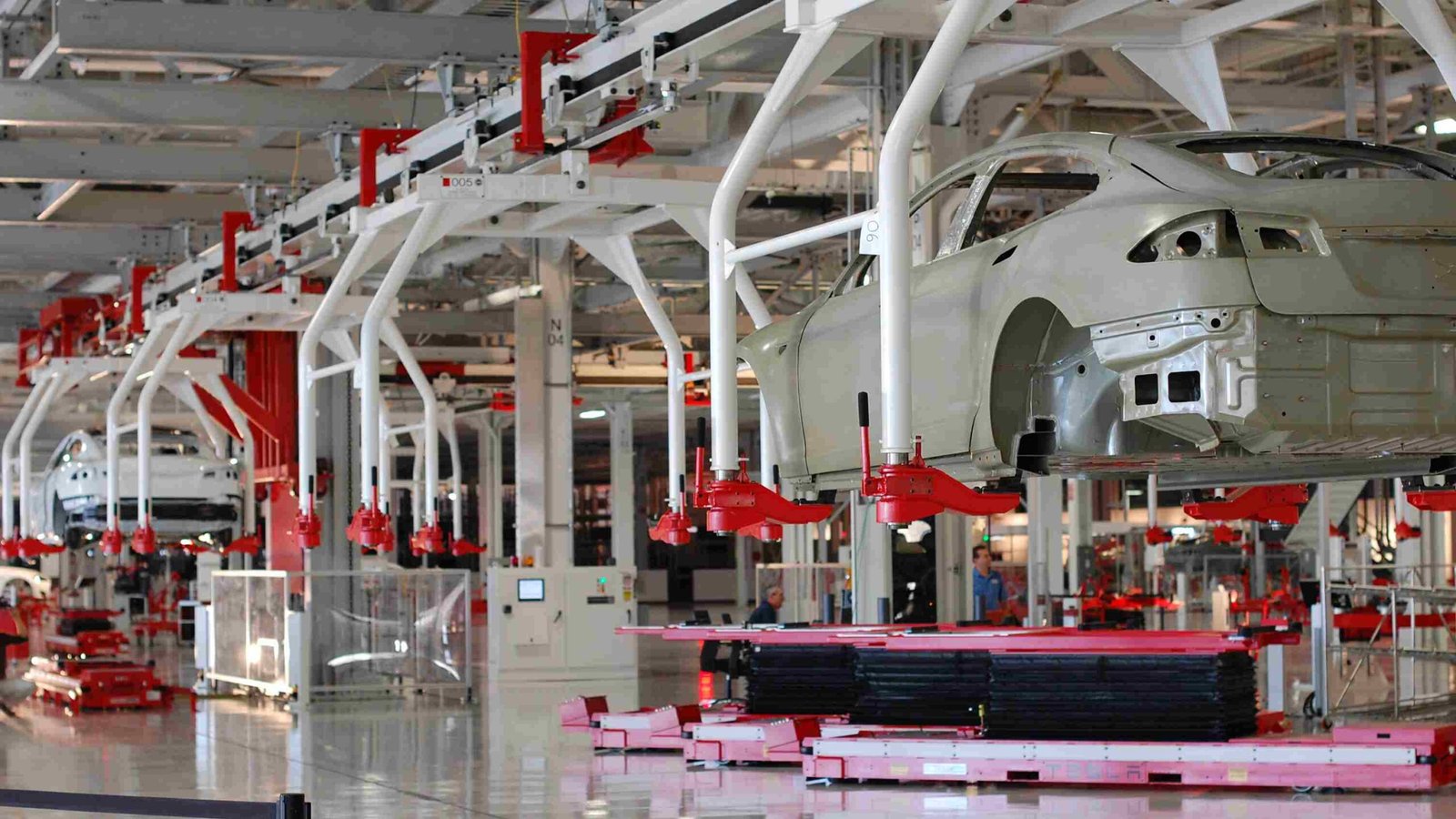
Tesla Giga Press 4.0 Mold Never Seen Before! Massive Casting Ever: While the world’s attention is often focused on artificial intelligence, autonomous robotaxis, Optimus humanoid robots, and Tesla’s software ambitions, another major transformation is happening far away from the spotlight: on the factory floor.
At Giga Texas, Tesla is pushing automotive manufacturing into a new era with increasingly massive high-pressure die-casting technology. At the center of this transformation is the concept of the Giga Press 4.0—a next-generation casting system designed to produce extremely large structural aluminum components with fewer manufacturing steps.
The idea is revolutionary. Instead of manufacturing hundreds of individual stamped, welded, and riveted pieces, a giant casting machine can potentially produce large sections of a vehicle structure as single-piece aluminum castings.
If Tesla succeeds in scaling this approach toward the proposed 50,000-ton class, automotive factories could begin to look dramatically different from traditional body shops.
1. The Evolution of Tesla Giga Casting
Tesla’s journey into mega-casting began with the 6,100-ton Giga Press, introduced for large structural components of the Model Y. The technology helped replace dozens of individual components and significantly simplified the body assembly process.
Tesla subsequently moved toward even larger casting systems, including approximately 9,200-ton and 16,000-ton machines, expanding the size and complexity of components that could be manufactured in a single casting operation.
The proposed Giga Press 4.0 represents an even more ambitious direction.
A machine capable of approximately 50,000 tons of clamping force would be enormous. Its purpose would not simply be to make a larger version of an existing component. Instead, the goal would be to explore the possibility of producing ultra-large vehicle structural castings with highly integrated geometries.
That could eliminate additional assembly operations and potentially reduce the number of parts required to build an automobile.
2. Why 50,000 Tons of Clamping Force Matters
One important point is that the tonnage rating of a die-casting machine does not mean that the machine injects molten aluminum with 50,000 tons of force.
Instead, the rating primarily describes the clamping force used to hold the two halves of the steel die together during injection.
During high-pressure die casting, molten aluminum is injected into a mold at extremely high speed. The metal creates pressure against the internal surfaces of the mold. The larger the projected surface area of the component, the greater the force attempting to separate the die halves.
The basic relationship can be expressed as:
Hydraulic Separation Force = Injection Pressure × Projected Surface Area
This creates one of the biggest engineering challenges in mega-casting.
If the clamping force is insufficient, the die can separate slightly during injection. This can produce flash, dimensional inaccuracies, surface defects, and potentially dangerous molten-metal leakage.
A much larger casting therefore requires a much more powerful and precisely controlled clamping system.
3. How a Giant Giga Press Could Manufacture a Vehicle Structure
The manufacturing process begins long before the casting machine closes its enormous dies.
Step 1: Preparing the Molten Aluminum
Aluminum ingots and recycled material are melted and brought to the required processing temperature. The molten alloy must then be carefully controlled to maintain consistent temperature and composition.
Gas management and filtration are also critical. Dissolved hydrogen and non-metallic inclusions can contribute to defects inside the finished casting.
For this reason, industrial casting systems can use processes such as argon degassing and ceramic filtration before the aluminum reaches the injection system.
Step 2: Preparing the Die
Before each casting cycle, robotic systems can apply a controlled amount of mold-release agent to the die surfaces.
The mold must also be properly conditioned thermally. Temperature variations across a massive die can affect filling, solidification, dimensional accuracy, and tool life.
For large structural castings, vacuum-assisted die casting can also be important. Removing air from the cavity helps reduce gas entrapment during the extremely rapid injection process.
Step 3: High-Speed Injection
Once the die is closed and clamped, a precision shot system forces molten aluminum into the cavity at very high velocity.
The injection process happens extremely quickly.
The objective is to completely fill the complex cavity before sections of the aluminum solidify prematurely.
This is particularly challenging with ultra-large castings, because the metal must travel through potentially long and complicated flow paths.
Step 4: Solidification and Extraction
After the cavity has been filled, the aluminum rapidly loses heat and solidifies against the cooled die surfaces.
Robotic extraction equipment can then remove the casting from the machine.
At this stage, thermal management becomes extremely important. Uneven cooling can create internal stresses, distortion, or dimensional problems.
Step 5: Trimming and Inspection
A freshly cast component contains excess material around gates, runners, and other process features.
Automated trimming systems remove this material before it is recycled back into the aluminum production process.
The finished casting can then undergo dimensional scanning, visual inspection, and non-destructive testing to identify defects that cannot be seen from the outside.
4. The Biggest Engineering Challenges
Making a giant aluminum casting is considerably more difficult than simply scaling up a smaller machine.
Porosity and Gas Defects
Air or gas trapped inside the casting can weaken structural components.
High-vacuum casting technology, optimized alloy chemistry, and controlled injection speeds can help minimize these problems.
Premature Solidification
If aluminum begins to solidify before the mold cavity is completely filled, defects such as cold shuts can occur.
Engineers therefore have to carefully optimize metal temperature, die temperature, injection velocity, and cavity geometry.
Die Wear and Thermal Fatigue
A casting die experiences repeated thermal cycling. Every production cycle exposes the tooling to extreme changes in temperature.
Over thousands of cycles, this can create thermal fatigue and tool wear.
Advanced tool steels, cooling channels, coatings, and careful thermal management are therefore essential.
Dimensional Distortion
A massive casting can experience uneven shrinkage as it cools.
The larger the component, the more difficult it becomes to maintain tight dimensional tolerances across its entire structure.
5. How Giga Casting Can Change Factory Economics
The biggest advantage of mega-casting may not be the casting itself. It is the simplification of everything surrounding it.
Traditional automotive body manufacturing involves stamping numerous individual panels and structural components. These pieces then move through welding, riveting, adhesive application, inspection, and assembly operations.
A mega-casting approach can consolidate many of those operations into a much smaller number of manufacturing steps.
That can potentially deliver:
- Fewer individual parts
- Fewer assembly operations
- Reduced factory footprint
- Lower material handling requirements
- Less welding and riveting
- Simplified logistics
- Reduced inventory complexity
For high-volume electric vehicle production, these advantages could have a major impact on manufacturing cost.
6. Repairability and Crash Safety
One of the biggest questions surrounding large structural castings is repairability.
If a large portion of a vehicle is produced as one casting, critics naturally ask what happens after a serious collision.
The answer depends heavily on the vehicle’s engineering and approved repair procedures.
Modern vehicle structures can incorporate crumple zones, replaceable crash structures, localized reinforcements, and engineered repair sections around larger structural components.
This means a single-piece casting does not automatically mean that every collision results in a total vehicle loss.
However, structural repair must be performed according to manufacturer-approved procedures because incorrect cutting, welding, straightening, or reinforcement could compromise crash performance.
7. Tesla’s Mega-Casting Strategy Could Influence the Entire Industry
Tesla is not alone in exploring large-scale structural casting.
Other major automakers and EV manufacturers are investigating mega-casting and giga-casting technologies as they search for ways to reduce manufacturing complexity.
The reason is straightforward: electric vehicles provide an opportunity to redesign manufacturing architectures from the ground up.
Instead of adapting decades-old production methods, manufacturers can rethink how vehicle structures are produced, assembled, inspected, and transported through the factory.
Tesla’s approach has therefore become an important reference point for the broader automotive industry.
8. The Future of the Giga Press 4.0
The most interesting question is not whether giant casting machines can be built. Modern industrial engineering has already demonstrated that extremely large presses are technically possible.
The real challenge is whether ultra-large structural castings can deliver the right combination of strength, reliability, cost, cycle time, quality, repairability, and production yield.
If Tesla can solve those problems, the implications could extend far beyond one vehicle.
A successful Giga Press 4.0 strategy could reduce part counts, simplify factories, shorten assembly lines, and fundamentally change the economics of mass-market vehicle manufacturing.
Conclusion
The Tesla Giga Press 4.0 represents a fascinating direction for the future of automotive manufacturing. While AI and autonomous driving attract most of the headlines, advances in industrial engineering and mega-casting could be just as transformative.
Moving from thousands of individual manufacturing operations toward highly integrated structural castings is a fundamental change in how cars are built.
The potential 50,000-ton class machine is therefore more than a bigger press. It represents Tesla’s broader ambition to turn vehicle manufacturing into a highly automated, highly integrated, high-speed production process.
If this technology reaches large-scale commercial production, the factory floor of the future may look dramatically different from the automotive factories of today.
FAQs
1. What is the Tesla Giga Press 4.0?
The Tesla Giga Press 4.0 refers to the next generation of Tesla’s large-scale high-pressure die-casting technology. The concept focuses on using extremely high clamping forces to manufacture large structural aluminum components in fewer pieces and with fewer assembly operations.
2. How powerful could the Giga Press 4.0 be?
The technology is associated with concepts reaching approximately 50,000 tons of clamping force. This would represent a major increase over the 6,100-ton, 9,200-ton, and 16,000-ton-class machines used or explored for large automotive castings.
3. What does the 50,000-ton rating actually mean?
The 50,000-ton figure primarily refers to clamping force, not the amount of force used to inject molten aluminum. The clamping system keeps the two halves of the die securely closed while high-pressure aluminum injection takes place.
4. Why does Tesla need such a massive casting machine?
A larger casting requires a larger die and can have a much greater projected surface area. During injection, molten aluminum creates forces that attempt to separate the die halves. Higher clamping force helps keep the mold sealed and prevents defects such as flash and dimensional inaccuracies.
5. What is Tesla’s Giga Casting technology?
Giga Casting is Tesla’s approach to manufacturing large vehicle structures using high-pressure aluminum die casting. Instead of producing numerous smaller stamped components and joining them together, Tesla can consolidate multiple parts into large single-piece castings.
6. How did Tesla’s Giga Press technology begin?
Tesla’s large-scale casting strategy became widely known through the 6,100-ton Giga Press, which was used to produce large structural components for the Model Y. Tesla subsequently explored larger machines capable of producing increasingly complex structural parts.
7. What are the main advantages of Giga Casting?
The biggest advantages include fewer parts, fewer welds, reduced assembly operations, lower material handling requirements, and potentially smaller factory footprints. These benefits can help manufacturers simplify production and reduce manufacturing costs.
8. How does a Giga Press reduce the number of robots?
Traditional vehicle body construction requires numerous robots for spot welding, riveting, adhesive application, component handling, and assembly. By replacing many individual components with a large casting, several of these operations can be eliminated or significantly reduced.
9. What material does the Giga Press use?
Tesla’s large structural casting strategy primarily involves aluminum alloys. Aluminum provides a useful combination of low density, strength, castability, and corrosion resistance, making it well suited to large automotive structural components.
10. What are the biggest challenges with ultra-large casting?
The major challenges include porosity, premature solidification, thermal fatigue, die wear, dimensional distortion, and maintaining consistent mechanical properties throughout a very large casting. Scaling up the process makes controlling these variables substantially more difficult.
11. Why is vacuum important during Giga Press casting?
During high-pressure die casting, trapped air can create internal pores and other defects. Vacuum-assisted casting removes much of the air from the mold cavity before aluminum is injected, helping improve casting quality and structural integrity.
12. Can Giga Castings be repaired after a crash?
Yes, depending on the location and severity of the damage, approved structural repair procedures may be possible. However, large structural castings require carefully controlled repair methods, and technicians must follow the vehicle manufacturer’s specifications to preserve structural and crash performance.
13. Does a single-piece casting make a Tesla impossible to repair?
Not necessarily. A large casting does not mean the entire vehicle must be replaced after every accident. Modern vehicle structures can incorporate replaceable crash components and engineered repair zones. The actual repairability depends on the specific damage and the manufacturer’s approved procedures.
14. Are other automakers using mega-casting technology?
Yes. Mega-casting and giga-casting are being investigated and adopted across the global automotive industry. Automakers are exploring large structural castings because they can potentially reduce part counts, simplify assembly, and improve manufacturing efficiency.
15. Could the Giga Press 4.0 change automotive manufacturing?
Potentially, yes. If Tesla can successfully scale ultra-large casting while maintaining quality, durability, production speed, repairability, and cost efficiency, the technology could significantly reshape automotive factories. The long-term goal is a more integrated manufacturing process in which fewer machines and fewer parts are required to build each vehicle.
Read More:
- Elon Musk just set a condition that could end Falcon 9 as we know it
- FAA Huge Update on Starship Flight 14 Launch Date: Delay Again despite S41 Test Done, Why?
- New Elon Musk’s Terafab $119B Lagest Building On Earth SHOCKED Inside
- SpaceX and a new Trump order that could rewrite the next decade of launches
- Tesla will launch Cybercab on September 3
1 thought on “Tesla Giga Press 4.0 Mold Never Seen Before! Massive Casting Ever”