
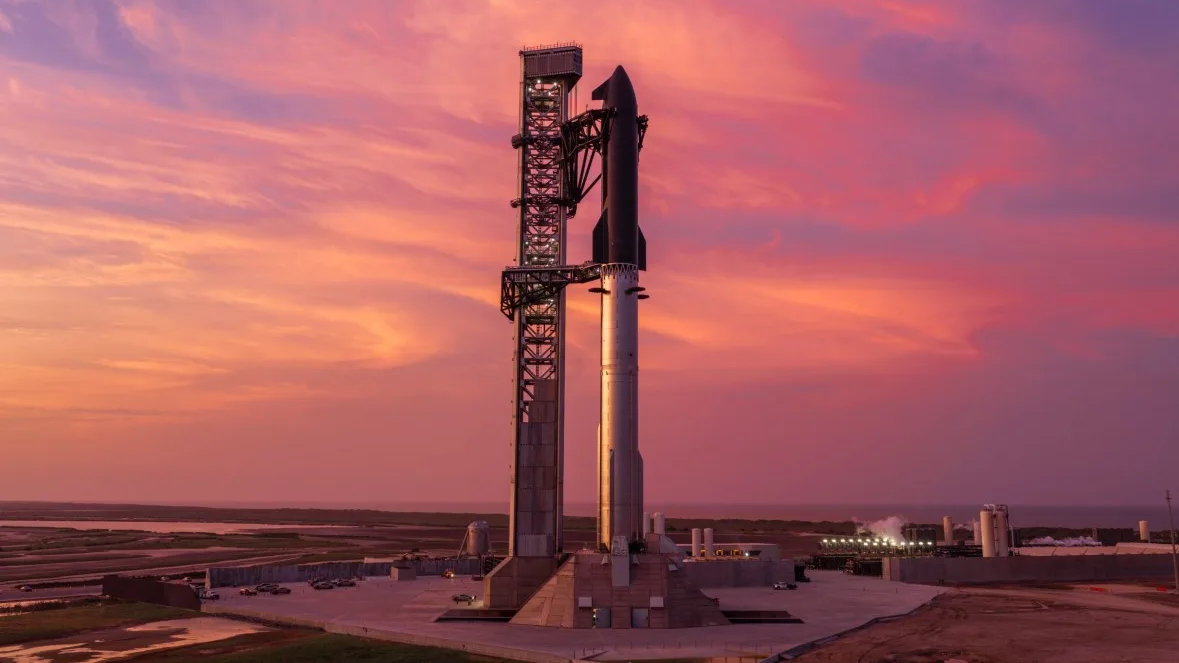
FAA Huge Update on Starship Flight 14 Launch Date: Delay Again despite S41 Test Done, Why?: SpaceX Starship Flight 14 is facing another schedule adjustment, raising an important question for space enthusiasts and industry observers: Why has the launch been delayed even after Ship 41 (S41) successfully completed its static-fire tests? According to the supplied video analysis and timeline, the answer lies in the complex combination of booster testing, FAA regulatory requirements, mission preparation, and orbital objectives.
The Starship program is moving toward a more ambitious phase. Flight 14 is not simply another test flight. It is expected to demonstrate critical capabilities involving orbital payload deployment, controlled re-entry, booster performance, and future reusability. That makes every stage of pre-launch qualification extremely important.
Why Is Starship Flight 14 Delayed Again?
The initial expectation was that Starship Flight 14 could launch in late August 2026. However, the schedule subsequently shifted toward September, with September 15, 2026, identified as the current target date in the supplied material.
The delay does not necessarily indicate a major problem with Ship 41. Instead, the primary issue appears to involve the readiness of the Super Heavy Booster 21 (B21) and the additional testing required before the complete launch stack can be cleared.
For a vehicle as powerful and complex as Starship, successful testing of one stage does not automatically mean the entire system is ready to fly. SpaceX must coordinate vehicle qualification, ground systems, regulatory approvals, flight safety requirements, and mission-specific preparations.
This explains why the completion of S41’s static-fire campaign does not immediately translate into a launch.
Ship 41 Static-Fire Tests: A Major Milestone
Ship 41 reportedly completed two static-fire tests on August 19 and August 20, 2026. These tests are an important part of validating the upper stage’s propulsion system before flight.
A static fire allows engineers to operate the vehicle’s engines while the spacecraft remains secured to the ground. Data from these tests can help validate engine performance, propulsion systems, structural behavior, thermal conditions, and related flight hardware.
The successful S41 campaign therefore represents a significant step toward Flight 14.
However, Starship consists of two major flight elements: the Starship upper stage and the Super Heavy booster. Both must be ready before launch.
Booster 21 Is a Critical Piece of the Puzzle
The supplied analysis identifies Booster 21 as a major remaining qualification milestone.
Although B21 had already completed cryogenic testing, additional preparation involving engine installation, alignment, inspections, and ground operations has affected the overall schedule.
Most importantly, B21 is expected to undergo a major 33-engine static-fire test.
The Super Heavy booster is designed around a large cluster of Raptor engines. Testing the complete engine configuration provides SpaceX with an opportunity to gather valuable data before exposing the booster to the demands of an actual launch.
The test is particularly significant because earlier Starship flights experienced engine-related anomalies, making propulsion reliability a critical consideration.
FAA TFR Windows and Launch Preparation
Another important factor behind the Flight 14 timeline is the role of the Federal Aviation Administration (FAA).
Rocket launches require extensive coordination because they can affect commercial aviation, surrounding communities, maritime activity, and public safety. Temporary Flight Restrictions (TFRs) can be established around launch and testing operations to protect aircraft from hazardous areas.
According to the supplied material, an FAA testing window from August 24 through September 5, 2026 provides an important period for B21-related operations.
This illustrates why a launch schedule cannot be determined solely by SpaceX’s internal engineering timetable. The company must align its hardware readiness with regulatory requirements and approved operational windows.
What Will Starship Flight 14 Attempt?
Flight 14 is particularly important because the mission is expected to move beyond earlier demonstration objectives and toward more operationally relevant capabilities.
Starlink V3 Deployment
One of the headline objectives is the deployment of Starlink V3 satellites.
The next-generation Starlink spacecraft are expected to be larger and more capable than previous satellite generations. Using Starship for their deployment could demonstrate the vehicle’s potential as a high-capacity commercial launch platform.
Successfully deploying operational payloads would therefore represent a major step for Starship’s commercial ambitions.
It would also provide practical information about the spacecraft’s payload deployment systems, orbital operations, guidance, and mission performance.
Controlled Re-Entry Instead of an Immediate Ship Catch
Another major point concerns the planned recovery strategy.
There has been significant interest in SpaceX eventually catching the Starship upper stage using the launch tower’s Mechazilla arms. However, the supplied material indicates that the first ship-catch attempt has been deferred.
Instead, Flight 14 is expected to target a controlled ocean splashdown in the Gulf of Mexico.
This approach can provide engineers with important flight data without immediately placing the expensive launch-tower infrastructure in the path of an experimental returning spacecraft.
The mission can therefore focus on trajectory control, thermal protection, re-entry guidance, and terminal descent performance before attempting a more demanding tower catch.
Why Reusability Matters for the Artemis Program
The significance of Starship Flight 14 extends beyond commercial satellite launches.
SpaceX’s Starship Human Landing System (HLS) is a central component of NASA’s Artemis lunar exploration strategy. One of the most challenging requirements is the ability to conduct orbital propellant transfer.
A lunar Starship cannot simply launch from Earth fully fueled and independently complete every phase of a lunar landing mission. Instead, the architecture requires multiple launches involving tanker spacecraft and orbital propellant infrastructure.
Orbital Refueling Is the Bigger Challenge
The basic concept involves launching tanker Starships, transferring liquid methane and liquid oxygen in low Earth orbit, and eventually supplying the lunar landing vehicle with enough propellant for its journey.
This creates a demanding logistics problem.
SpaceX must demonstrate not only that Starship can reach orbit, but also that it can be reused rapidly and reliably enough to support repeated tanker launches.
That is why successful Starship development has implications far beyond a single flight.
Starship and the Global Heavy-Lift Competition
The Starship program is also developing within an increasingly competitive launch industry.
Companies such as Blue Origin, United Launch Alliance, Arianespace, and Rocket Lab are developing new launch systems with different approaches to payload capacity, reusability, and operational cost.
China’s government-backed aerospace sector and commercial space companies are also working toward increasingly reusable launch technologies.
SpaceX’s strategic advantage will depend not simply on building the world’s largest rocket, but on achieving high launch frequency, rapid vehicle turnaround, reliable recovery, and low cost per kilogram to orbit.
If Starship eventually achieves full reusability at scale, its enormous payload capacity could significantly reshape the economics of space transportation.
What the Flight 14 Delay Really Means
The latest Flight 14 delay should not automatically be interpreted as a setback for the entire Starship program.
In fact, additional testing can be viewed as part of the development process for an exceptionally complex launch vehicle. S41’s successful static fires are encouraging, but the complete Starship system still requires integrated qualification.
The remaining B21 testing, regulatory coordination, mission preparation, and flight-safety analysis all contribute to the final launch timeline.
For SpaceX, the key challenge is finding the right balance between rapid development and flight reliability.
Conclusion: Why Starship Flight 14 Matters
Starship Flight 14 represents an important transition point for SpaceX. While the completion of Ship 41’s static-fire campaign has moved the upper stage closer to launch readiness, the overall mission depends on the qualification of Booster 21, regulatory coordination, and final integrated preparations.
The reported target of September 15, 2026, therefore reflects more than a simple calendar change. It demonstrates how testing, engineering analysis, FAA requirements, and mission objectives interact in modern commercial spaceflight.
Flight 14 could deliver several important milestones, including 33-engine Super Heavy testing, Starlink V3 deployment, controlled Starship re-entry, and additional data for future reusable operations.
Most importantly, every successful test brings SpaceX closer to its larger objective: transforming Starship into a fully reusable heavy-lift transportation system capable of supporting satellite deployment, commercial missions, and NASA’s Artemis lunar ambitions.
For that reason, the Flight 14 delay may be frustrating for launch watchers, but the additional preparation could ultimately be essential to making Starship safer, more reliable, and operationally sustainable.
FAQs
1. What is Starship Flight 14?
Starship Flight 14 is a planned test mission of SpaceX’s Starship launch system. The mission is expected to evaluate the performance of the Super Heavy booster and Starship upper stage, while also advancing orbital operations and payload deployment capabilities.
2. Why has Starship Flight 14 been delayed?
The delay is primarily associated with additional booster testing, vehicle preparation, regulatory coordination, and launch-window requirements. Even though Ship 41 completed its static-fire tests, the complete launch system must be ready before Flight 14 can proceed.
3. When is Starship Flight 14 expected to launch?
Based on the information provided, the current target is September 15, 2026. However, launch dates can change depending on testing results, regulatory approvals, weather, and vehicle readiness.
4. What is Ship 41 (S41)?
Ship 41 (S41) is the Starship upper-stage vehicle assigned to Flight 14. It is designed to perform the orbital portion of the mission, including payload deployment and controlled atmospheric re-entry.
5. Did Ship 41 complete its static-fire tests?
Yes. According to the supplied information, S41 completed dual static-fire tests on August 19 and August 20, 2026. These tests were an important step toward validating the vehicle’s propulsion systems before flight.
6. What is Booster 21 (B21)?
Booster 21 (B21) is the Super Heavy first-stage booster planned for Flight 14. It provides the enormous thrust required to lift the Starship vehicle from the launch site and is expected to perform its own recovery maneuver after separation.
7. Why is B21 testing important?
B21 requires extensive qualification because the Super Heavy booster contains a large cluster of Raptor engines. A full static-fire campaign can provide engineers with valuable data about engine performance, propulsion systems, structural loads, and ground infrastructure.
8. How many engines does the Super Heavy booster use?
The Super Heavy booster is designed with 33 Raptor engines. A full-engine static-fire test is therefore a major qualification milestone for the booster and its propulsion system.
9. What role does the FAA play in Flight 14?
The Federal Aviation Administration (FAA) is responsible for regulatory oversight associated with commercial space launches in the United States. Flight operations must satisfy applicable public-safety, airspace, and licensing requirements before launch.
10. What are TFRs and why do they matter?
Temporary Flight Restrictions (TFRs) are aviation restrictions established around certain operations, including rocket launches and testing. They help protect aircraft and the public by keeping unauthorized aviation traffic away from potentially hazardous areas.
11. What payload is Starship Flight 14 expected to carry?
The supplied material identifies Starlink V3 satellites as a major planned payload objective. Deploying these next-generation satellites would provide an important demonstration of Starship’s potential for high-capacity commercial payload delivery.
12. Will SpaceX attempt to catch the Starship with Mechazilla?
The supplied information indicates that the first Starship tower-catch attempt has been deferred. Instead, Flight 14 is expected to focus on a controlled re-entry and ocean splashdown, allowing SpaceX to gather additional flight data.
13. Where will the Starship upper stage splash down?
The planned trajectory described in the supplied material targets a controlled splashdown in the Gulf of Mexico, off the Texas coast. This can allow SpaceX to collect data on re-entry, guidance, thermal protection, and descent performance.
14. Why is Flight 14 important for Starship’s reusability?
Flight 14 can provide important information about orbital operations, controlled re-entry, thermal protection, and vehicle recovery. These capabilities are essential if SpaceX ultimately wants Starship to become a rapidly reusable transportation system.
15. How is Starship connected to NASA’s Artemis program?
SpaceX is developing a Starship Human Landing System (HLS) for NASA’s Artemis lunar exploration program. The architecture depends on capabilities such as orbital propellant transfer, making reliable Starship launches and tanker operations particularly important.
16. Does the Flight 14 delay mean Starship development is failing?
No. A schedule delay does not by itself indicate that the Starship program is failing. Large experimental launch systems routinely require additional testing and engineering work. If the delay allows SpaceX to collect more data and improve vehicle reliability and flight safety, it can ultimately support the program’s long-term objectives.
Read More:
- New Elon Musk’s Terafab $119B Lagest Building On Earth SHOCKED Inside
- SpaceX and a new Trump order that could rewrite the next decade of launches
- Tesla will launch Cybercab on September 3
- SpaceX Unexpected Cancel Catching Ship for Flight 14! S41 Full Engine Fire Test DONE
- Cybercab Robotaxi NEW Roll Out, Full Specs & Timeline UPDATE!
1 thought on “FAA Huge Update on Starship Flight 14 Launch Date: Delay Again despite S41 Test Done, Why?”