
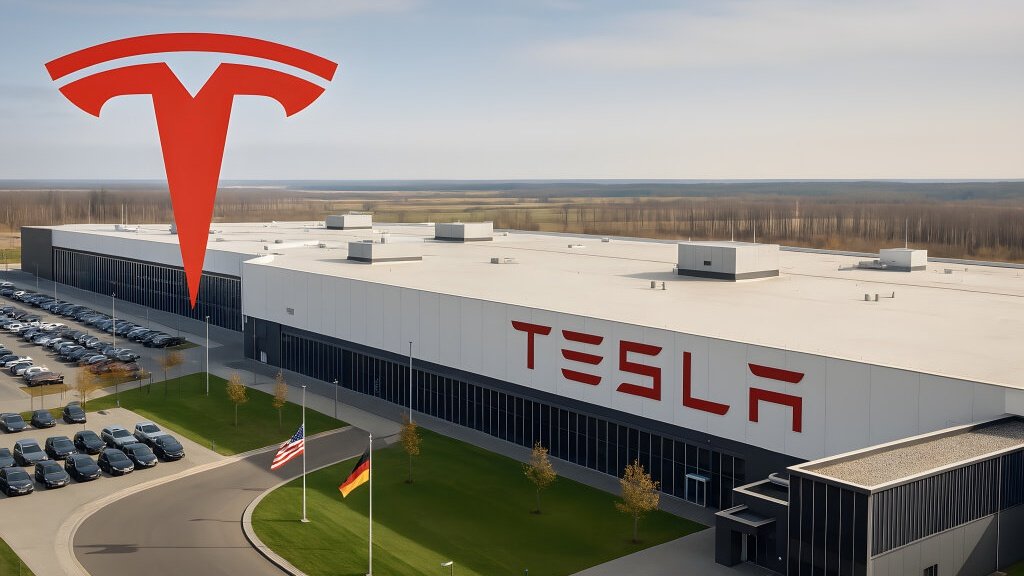
New Elon Musk’s Terafab $119B Lagest Building On Earth SHOCKED Inside: The global automotive and semiconductor industries may be approaching a major transformation. Elon Musk’s vision for Tesla extends far beyond electric vehicles, connecting artificial intelligence, robotics, semiconductor manufacturing, and advanced vehicle production into one integrated industrial ecosystem.
At the center of this strategy are two ambitious concepts: Terrafab, a proposed semiconductor mega-facility in Texas, and Tesla’s next-generation Unboxed manufacturing system. Together, they represent an attempt to solve two critical problems: the growing demand for AI computing hardware and the high cost and complexity of traditional vehicle assembly.
What Is Tesla’s $119 Billion Terrafab?
Terrafab is described as a proposed semiconductor manufacturing complex in Grimes County, Texas, with an estimated investment of around $119 billion to $122 billion.
If built at the scale outlined in the source material, the facility would be extraordinary in size. Its proposed footprint of approximately 100 million square feet would make it dramatically larger than Tesla’s Gigafactory Texas.
The central objective is straightforward: produce massive quantities of custom AI processors for Tesla, SpaceX, xAI, and related applications rather than depending entirely on external semiconductor suppliers.
Why Does Tesla Need So Many AI Chips?
Tesla’s future ambitions increasingly depend on computing power. Autonomous vehicles need processors capable of analyzing camera feeds, identifying objects, predicting movement, and making driving decisions in real time.
The same principle applies to Optimus, Tesla’s humanoid robot. A useful humanoid robot needs substantial onboard computing for vision, movement, balance, navigation, and interaction with its environment.
As autonomous fleets and robots scale, semiconductor demand could become one of the biggest constraints on deployment.
The Terrafab concept is therefore based on a simple idea: control the hardware supply chain to control the pace of innovation.
Terrafab’s Massive Manufacturing Ambition
The proposed facility is reported to target an eventual capacity of up to 1 million wafers per month, alongside ambitious computing-production targets.
Some projections associated with the concept suggest approximately 1 terawatt of compute capacity per year, potentially corresponding to billions of processors depending on processor design and power assumptions.
These numbers are enormous, but they should be understood as proposed targets rather than established production results.
The scale would also require sophisticated cleanrooms, advanced lithography, ultra-pure chemicals, power infrastructure, water systems, packaging facilities, and highly automated manufacturing equipment.
Why Advanced Semiconductor Manufacturing Is So Difficult
Producing advanced chips is considerably more complicated than simply constructing a large factory.
Modern semiconductor manufacturing requires:
- Extreme ultraviolet (EUV) lithography
- Ultra-clean manufacturing environments
- Advanced process control
- High-purity chemicals and materials
- Sophisticated wafer inspection
- Advanced packaging
- Extremely high manufacturing yields
Even tiny contaminants can damage semiconductor wafers. At advanced process nodes, maintaining consistent yields is one of the industry’s greatest technical challenges.
The Intel Connection
A semiconductor project of this scale would require enormous expertise. The source material describes an important connection with Intel, including involvement of experienced semiconductor manufacturing personnel and advanced process technology.
The strategic appeal is clear. Tesla brings enormous demand for specialized computing hardware, while an experienced foundry partner can provide knowledge in areas such as process development, cleanroom operations, lithography, and manufacturing.
Advanced process technologies such as 18A and future-generation nodes could potentially become important components of this strategy.
However, the exact structure, commercial terms, production schedule, and ultimate technology roadmap should be distinguished from projections and claims circulating online.
Two Different Chip Ecosystems
One of the most interesting aspects of the Terrafab concept is the possibility of producing chips for both terrestrial AI systems and space-based applications.
AI Chips for Tesla Robotics
Tesla’s proposed AI chip roadmap includes processors intended for autonomous vehicles and humanoid robots.
These processors would prioritize:
- High performance per watt
- Low latency
- Real-time computer vision
- Neural-network acceleration
- Reliable operation inside vehicles and robots
The long-term objective would be to make enough custom silicon to support large-scale deployment of Cybercab robotaxis and Optimus robots.
Space-Based Computing
SpaceX presents a different challenge.
Processors operating in satellites must tolerate radiation, vacuum, temperature changes, vibration, and limited opportunities for physical maintenance.
The concept described in the source material involves specialized computing hardware for Starlink and potentially future orbital computing infrastructure.
If successful, such technology could expand the role of satellites from communications platforms toward increasingly sophisticated distributed computing systems.
Tesla’s Unboxed Manufacturing Revolution
While Terrafab focuses on the brains of autonomous machines, Tesla’s Unboxed manufacturing strategy focuses on the machines themselves.
Traditional automotive manufacturing is largely sequential. A vehicle moves through stamping, body construction, painting, interior installation, and final assembly.
Tesla’s Unboxed concept attempts to change this model by building major vehicle sections simultaneously and bringing them together during final integration.
How the Unboxed Process Works
Instead of moving a partially completed vehicle through a long production line, separate manufacturing areas can work on different modules at the same time.
Potential modules include:
- Front structural sections
- Rear structural sections
- Battery-integrated floor structures
- Interior components
- Exterior body sections
- Doors and other assemblies
These components are then brought together at a final integration point.
Why Parallel Manufacturing Matters
The biggest potential advantage is parallelization.
In a conventional factory, a disruption at one stage can affect downstream operations. By separating manufacturing into modular streams, Tesla aims to make production more flexible and potentially reduce bottlenecks.
Workers and robots can also gain better access to components before the vehicle is fully assembled.
This could improve ergonomics, automation, quality control, and manufacturing speed.
The Gigapress and 50,000-Ton Concept
Tesla has already popularized the use of massive aluminum die-casting machines, commonly known as Gigapresses.
Instead of assembling dozens of smaller metal components through welding, a large casting machine can produce major structural sections as a single component.
The source material discusses a potential 50,000-ton casting system, which would represent another major step in this manufacturing philosophy.
How a Giant Casting Process Works
A simplified casting process involves:
- Aluminum is melted in a high-temperature furnace.
- Molten material is transferred to a holding system.
- A high-speed injection system pushes the metal into a mold.
- A massive clamping force keeps the mold closed.
- The component is cooled and removed.
- Automated inspection checks the finished casting.
The goal is to reduce component count, welding operations, factory space, and assembly complexity.
Reaction Injection Molding Could Change Vehicle Painting
Another potentially important technology is Reaction Injection Molding (RIM).
Traditional automotive paint shops require multiple stages, including coating, painting, drying, and curing. These facilities consume significant amounts of energy and space.
RIM can potentially produce polymer exterior components with color integrated into the material itself.
This means a vehicle panel could be manufactured with its color already incorporated rather than requiring the same conventional multi-layer paint process.
The potential benefits include simplified production, reduced paint-shop infrastructure, and faster manufacturing.
Why Tesla’s Strategy Matters
The most significant aspect of these projects is not any single machine or factory. It is the possibility of vertical integration.
Imagine a manufacturing ecosystem in which Tesla controls much more of the chain:
Semiconductor design → chip manufacturing → advanced packaging → AI computing → robotic systems → automated vehicle production
Such integration could reduce dependence on external suppliers for critical components.
It could also allow hardware and software teams to optimize products together rather than designing around components selected from the broader market.
Major Challenges Remain
Despite the enormous potential, these ambitions face significant obstacles.
Semiconductor Yield
Building a giant semiconductor facility does not automatically produce competitive chips. Achieving high yields at advanced process nodes requires years of engineering expertise and enormous investment.
Manufacturing Precision
The Unboxed process depends on extremely accurate alignment of independently produced modules. Millimeter-level precision becomes critical when separate structures must fit together during final assembly.
Capital Requirements
Projects involving hundreds of billions of dollars would require exceptional financial discipline. Construction, equipment, energy infrastructure, staffing, materials, and technology development would all represent substantial costs.
Supply Chain Complexity
Even a highly integrated semiconductor ecosystem cannot completely eliminate dependence on specialized suppliers. Advanced chip manufacturing relies on a global network of equipment, materials, chemicals, and engineering expertise.
The Future of Automotive and AI Manufacturing
Tesla’s Terrafab concept and Unboxed production strategy represent a broader industrial trend: manufacturing is becoming increasingly software-driven, automated, modular, and vertically integrated.
The automotive industry is no longer simply about producing mechanical machines. Modern vehicles increasingly resemble computers on wheels, while future robots could combine advanced AI with sophisticated mechanical systems.
That makes semiconductor availability just as important as batteries, motors, and steel.
If Tesla can successfully combine custom AI silicon, advanced semiconductor manufacturing, giant casting, modular assembly, and robotics, it could create a manufacturing system unlike the traditional automotive factory.
Conclusion
The story surrounding New Elon Musk’s Terafab $119B Lagest Building On Earth SHOCKED Inside illustrates an ambitious vision for the future of industrial production.
Terrafab is positioned as a potential answer to the enormous demand for AI computing hardware, while Tesla’s Unboxed manufacturing architecture aims to make vehicle production faster, simpler, and more modular.
The proposed 50,000-ton Gigapress, Reaction Injection Molding, custom AI processors, and advanced semiconductor manufacturing all point toward the same objective: reducing manufacturing complexity while increasing production scale.
However, many of the figures and timelines discussed around Terrafab remain ambitious projections rather than proven production outcomes. The real test will be whether these technologies can move from concepts and targets into reliable, high-volume manufacturing.
If they do, the impact could extend far beyond Tesla. It could influence the future of automotive manufacturing, artificial intelligence, robotics, semiconductor production, and space computing for decades to come.
FAQs
1. What is Tesla’s Terrafab?
Terrafab is a proposed massive semiconductor manufacturing facility in Texas intended to produce advanced AI chips and other computing hardware at very high volumes.
2. How much is Terrafab expected to cost?
The project has been described as requiring approximately $119 billion to $122 billion in investment. These figures should be treated as proposed estimates rather than confirmed final costs.
3. Where is Terrafab planned to be located?
The proposed Terrafab project is associated with Grimes County, Texas, where the development would require extensive land, power, water, cleanroom, and manufacturing infrastructure.
4. Why does Tesla want its own semiconductor manufacturing capacity?
Tesla’s future plans for autonomous vehicles, AI systems, and humanoid robots could require enormous quantities of specialized processors. In-house production could potentially reduce dependence on external chip suppliers.
5. How large could Terrafab become?
The concept described in the source material suggests a potential footprint of approximately 100 million square feet, making it vastly larger than many conventional manufacturing facilities.
6. How many chips could Terrafab potentially produce?
Some projections associated with the concept suggest the possibility of producing billions of AI processors annually. Actual output would depend on wafer sizes, chip designs, process technology, yields, packaging capacity, and other manufacturing factors.
7. What is the connection between Terrafab and Intel?
The proposed strategy includes cooperation with Intel and semiconductor manufacturing expertise associated with advanced process technologies. Such collaboration could help address the specialized knowledge required to operate a leading-edge foundry.
8. What are AI5, AI6, and AI7?
AI5, AI6, and AI7 refer to generations of Tesla-designed AI computing hardware discussed in connection with future autonomous-driving and robotics applications. Their purpose would be to provide efficient onboard computing for demanding AI workloads.
9. Could Terrafab manufacture chips for SpaceX?
The concept described includes specialized computing hardware for SpaceX and satellite applications. Space-qualified processors must handle radiation, extreme temperature changes, vibration, and other conditions that differ from terrestrial electronics.
10. What is Tesla’s Unboxed manufacturing system?
The Unboxed manufacturing system is Tesla’s proposed modular approach to vehicle production. Instead of assembling an entire vehicle sequentially along one long production line, major sections can be built simultaneously and integrated later.
11. What are the advantages of Unboxed manufacturing?
The approach could potentially provide better factory-space utilization, parallel production, improved worker access, greater automation, and reduced manufacturing complexity. It is designed to address some of the bottlenecks associated with traditional vehicle assembly.
12. What is a Gigapress?
A Gigapress is a very large die-casting machine capable of producing major aluminum vehicle structures as single pieces. This can reduce the number of individual parts, welds, and assembly operations required to build a vehicle.
13. What is the 50,000-ton Gigapress concept?
The 50,000-ton Gigapress is an ambitious casting-machine concept discussed in connection with future Tesla vehicle manufacturing. A machine of this scale could potentially produce very large structural components, although its practical production capabilities depend on engineering and manufacturing requirements.
14. How could Reaction Injection Molding help Tesla?
Reaction Injection Molding (RIM) can potentially create polymer exterior components with color incorporated into the material. This could reduce dependence on traditional multi-stage automotive paint processes and potentially lower factory space and energy requirements.
15. Could Terrafab and Unboxed manufacturing change the automotive industry?
If successfully implemented at scale, these technologies could have a significant impact on automotive manufacturing, semiconductor production, robotics, and AI infrastructure. However, Terrafab’s proposed capacity and several future manufacturing targets remain ambitious projections, so their ultimate impact will depend on successful construction, technology development, production yields, and commercial execution.
Read More:
- SpaceX and a new Trump order that could rewrite the next decade of launches
- Tesla will launch Cybercab on September 3
- SpaceX Unexpected Cancel Catching Ship for Flight 14! S41 Full Engine Fire Test DONE
- Cybercab Robotaxi NEW Roll Out, Full Specs & Timeline UPDATE!
- Tesla Robotaxi gets a massive upgrade in Nevada
2 thoughts on “New Elon Musk’s Terafab $119B Lagest Building On Earth SHOCKED Inside”