
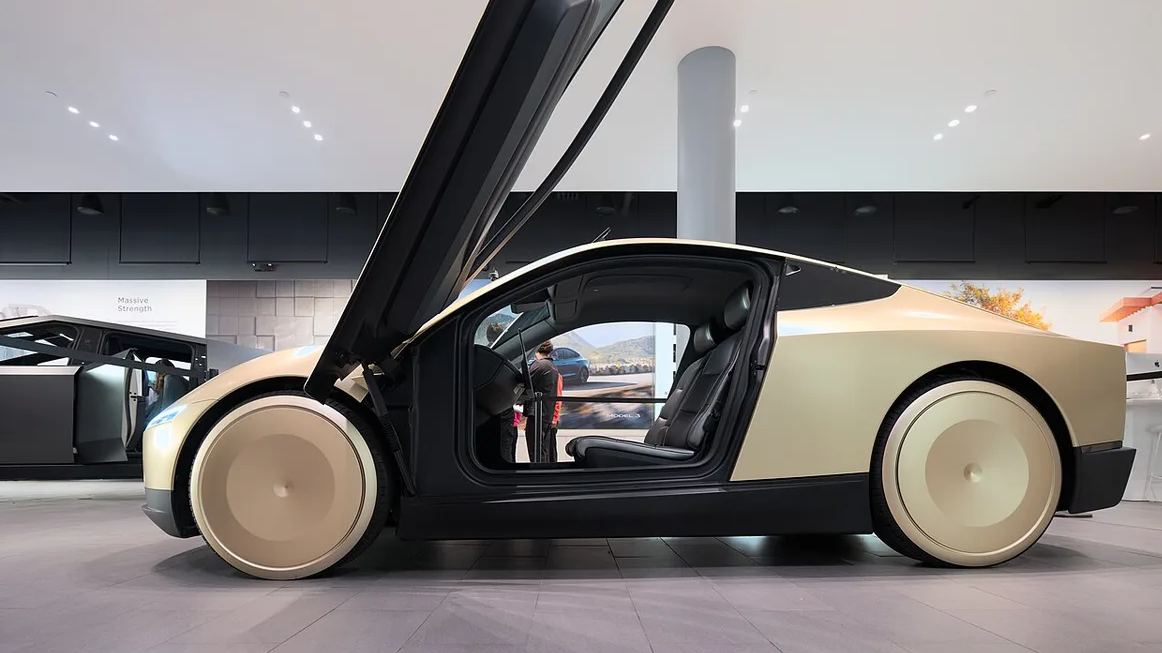
Elon Musk JUST UPDATED Cybercab! New Specs SPOTTED Before NEXT WEEK’s Event!: Tesla’s long-awaited Cybercab appears to be moving closer to a major milestone: commercial autonomous ride-hailing. With a dedicated Cybercab event expected in Austin, Texas, new production activity, leaked specifications, upgraded computing hardware, and purpose-built autonomous features are fueling speculation that Tesla is preparing to move beyond limited testing.
According to details outlined by TESLA CAR WORLD, the latest developments suggest that Tesla’s robotaxi strategy is becoming increasingly focused on real-world fleet deployment rather than simply demonstrating a futuristic concept.
From production lines in Texas to a growing robotaxi hub near Dallas, here are the key Cybercab updates you need to know.
Tesla Cybercab Production Is Scaling Up
One of the clearest signs that Tesla is preparing for a larger autonomous operation is the reported increase in Cybercab production and fleet activity.
Production of the Cybercab reportedly began at Gigafactory Texas in April 2026. By July, Tesla had already introduced an internal passenger service for employees, giving the company an opportunity to gather real-world operational data before broader public deployment.
The activity isn’t limited to Austin.
Nearly 100 Cybercabs Spotted Near Dallas
In mid-June, approximately 40 Cybercabs were reportedly spotted at an autonomous taxi staging facility in Irving, Texas, within the Dallas-Fort Worth metropolitan area.
By late August, that number had reportedly increased to nearly 100 vehicles.
The facility itself is reportedly designed to accommodate as many as 212 vehicles, suggesting that Tesla may be building infrastructure capable of supporting a substantially larger fleet.
This is important because the location reportedly isn’t simply a conventional vehicle storage lot. Its design includes capabilities associated with robotaxi fleet operations, including charging, dispatching, remote monitoring, and automated maintenance.
Moving production vehicles into a major metropolitan area could therefore represent a shift from manufacturing and testing toward operational fleet staging.
Leaked EPA Data Reveals Surprising Cybercab Specifications
Potentially even more interesting are specifications reportedly surfaced through U.S. Environmental Protection Agency (EPA) filings.
If these figures accurately represent the production Cybercab, Tesla may have designed the vehicle around extremely high efficiency rather than simply maximizing battery capacity.
53.3 kWh Battery With Up to 418 Miles of Range
The reported Cybercab battery pack has a capacity of approximately 53.3 kWh, while its EPA-rated range could reach up to 418 miles.
That combination would be particularly notable for a compact electric vehicle.
The reported target efficiency of at least 5.5 miles per kWh would put the Cybercab well above the efficiency of many commercial electric vehicles, which commonly operate closer to the 3–4 miles-per-kWh range.
Other reported specifications include:
- Drive layout: Front-wheel drive
- Motor: Single electric motor producing approximately 219 horsepower
- Curb weight: Around 3,113 pounds
- Battery: Approximately 53.3 kWh
- Reported range: Up to 418 miles
- Charging: Wireless inductive charging
The combination of a relatively small battery and low vehicle weight could be critical for a robotaxi. Instead of carrying a massive battery, Tesla appears to be focusing on efficiency, lightweight construction, and automated charging.
Why Front-Wheel Drive Could Matter
The reported front-wheel-drive configuration could also help Tesla maximize interior space.
For an autonomous taxi, cabin packaging is extremely important. There is no need to design the vehicle around a traditional driver’s experience, while passenger comfort and usable interior volume become much more significant.
A lightweight platform could also reduce energy consumption, allowing the Cybercab to spend more time transporting passengers before needing to recharge.
For a commercial fleet, every additional mile of usable range can potentially translate into higher vehicle utilization.
Cybercab May Feature Next-Generation AI Computing
Tesla’s autonomous strategy doesn’t depend solely on the vehicle’s mechanical design. The computer hardware inside the Cybercab could be just as important.
The production Cybercab reportedly features a significantly upgraded Full Self-Driving (FSD) computer architecture compared with the AI4 hardware found in Tesla’s current consumer vehicles used for pilot programs.
Tesla has not publicly confirmed whether the new system should officially be called AI5 or an optimized AI4 Plus configuration. However, reports indicate that the production hardware provides substantially more processing capacity and memory.
More Computing Power Could Extend the Cybercab’s Lifespan
This additional computing headroom could have an important advantage.
Tesla relies heavily on over-the-air software updates, meaning autonomous driving capabilities can evolve without requiring a vehicle to visit a service center.
By installing more capable hardware from the beginning, Tesla could potentially deploy increasingly sophisticated neural networks throughout the Cybercab’s commercial life.
That approach could reduce the risk of fleets becoming obsolete simply because their onboard computers cannot handle newer AI models.
FSD V15 Could Be Critical to Commercial Robotaxis
Hardware alone won’t make the Cybercab a successful robotaxi. Tesla’s Full Self-Driving software will ultimately determine whether the vehicle can operate safely and reliably without a human driver.
The upcoming FSD V15 is expected to represent a major software evolution.
Reports suggest that V15 could contain roughly 10 times the parameter count of previous versions, potentially allowing the system to process a much larger amount of information about the surrounding environment.
From Perception to Predictive Driving
A commercial robotaxi must simultaneously recognize road markings, pedestrians, cyclists, vehicles, traffic conditions, and unexpected hazards while planning its route.
The challenge becomes even greater when the vehicle operates continuously across different times of day and weather conditions.
A personal vehicle may be driven occasionally by a human who can compensate for unusual situations. A driverless robotaxi has a fundamentally different requirement: it must deliver consistent autonomous performance across repeated passenger trips.
That makes the development of FSD V15 one of the most important pieces of Tesla’s Cybercab strategy.
Purpose-Built Hardware Could Make Cybercab Different
Tesla appears to be designing the Cybercab specifically for 24/7 autonomous operation.
Several reported hardware features demonstrate this philosophy.
Individual Camera Cleaning Systems
Every external camera reportedly incorporates its own cleaning nozzle system.
This may sound like a minor feature, but it could become extremely important for autonomous driving.
Rain, mud, dust, road spray, and grime can interfere with camera visibility. A human driver can physically clean a windshield or camera area when necessary, but a driverless vehicle needs an automated solution.
Individual camera washers could help maintain consistent sensor visibility without human intervention.
Integrated Starlink Connectivity
The Cybercab is also reported to feature an integrated Starlink satellite communication system.
Continuous connectivity could be useful for fleet management, remote monitoring, software updates, diagnostics, and other operational functions.
For a large autonomous fleet, reliable communications can become a critical part of the overall system architecture.
Wireless Autonomous Charging
Perhaps one of the most significant features is wireless inductive charging.
Instead of requiring a human to connect a physical charging cable, Cybercabs could automatically position themselves over charging pads.
Once charging is complete, the vehicle could potentially leave the charging area and return to passenger service without human assistance.
That could help Tesla create a more automated robotaxi ecosystem, where vehicles, charging infrastructure, software, and remote monitoring work together.
Tesla’s Austin Event Could Mark a Major Turning Point
With a dedicated Cybercab event expected in Austin, the timing of these developments is particularly significant.
Production is reportedly underway. Fleet numbers near Dallas have grown substantially. A dedicated staging facility is being prepared for hundreds of vehicles. New EPA-related specifications have emerged, while upgraded computing hardware and specialized autonomous features point toward a vehicle designed for commercial operation.
None of these developments alone proves that Tesla is ready for unrestricted public robotaxi deployment.
However, taken together, they suggest that Tesla’s Cybercab program is progressing toward a much more serious commercial phase.
What Happens Next for Tesla Cybercab?
The biggest question is no longer simply whether Tesla can build an autonomous vehicle.
The bigger question is whether Tesla can operate a large-scale, reliable, economically viable driverless fleet.
The upcoming Austin event could provide important answers about production plans, autonomous capabilities, rollout locations, pricing, fleet management, and the timeline for public availability.
If the reported specifications and infrastructure developments are accurate, Tesla may be preparing for a major expansion of its robotaxi ambitions.
The Bottom Line
The Tesla Cybercab is becoming increasingly difficult to view as merely a futuristic prototype. Production activity, expanding fleet infrastructure, reported EPA specifications, upgraded AI computing, FSD V15 development, automated charging, camera-cleaning systems, and connectivity features all point toward a vehicle engineered around commercial autonomous transportation.
The Austin event could therefore become one of Tesla’s most important demonstrations yet.
If Tesla successfully combines efficient hardware with reliable autonomous software, the Cybercab could represent a significant step toward a future where driverless electric taxis operate at scale.
For now, all eyes are on Austin—and the next major update from Tesla.
FAQs
1. What is the Tesla Cybercab?
The Tesla Cybercab is a purpose-built electric vehicle designed for autonomous ride-hailing and robotaxi services. Unlike Tesla’s consumer vehicles, it is being developed specifically around driverless commercial transportation.
2. When did Tesla Cybercab production reportedly begin?
Reported production of the Cybercab began at Gigafactory Texas in April 2026. Tesla subsequently began an internal passenger service for employees as part of its testing and development process.
3. Where are Tesla Cybercabs being tested?
Cybercabs have reportedly been seen in Austin and the Dallas-Fort Worth area. A staging facility in Irving, Texas, has reportedly been used to support an expanding Cybercab fleet.
4. How many Cybercabs have reportedly been spotted near Dallas?
Reports indicate that around 40 Cybercabs were spotted at the Irving facility in June 2026, with the fleet reportedly growing to nearly 100 vehicles by late August.
5. What is the reported Cybercab battery capacity?
Leaked EPA-related information reportedly lists a battery capacity of approximately 53.3 kWh.
6. What is the reported range of the Tesla Cybercab?
The Cybercab has reportedly been associated with an EPA-rated range of up to 418 miles, although final official specifications should be confirmed by Tesla and the EPA.
7. How efficient could the Cybercab be?
Reported specifications indicate a potential efficiency of at least 5.5 miles per kWh. Its relatively low weight and compact battery could contribute to this high efficiency.
8. Does the Tesla Cybercab use front-wheel drive?
According to the reported specifications, the Cybercab uses front-wheel drive (FWD) and a single electric motor producing approximately 219 horsepower.
9. What type of computer does the Cybercab use?
Production Cybercabs reportedly feature an upgraded Full Self-Driving computer with more processing capacity and memory than standard AI4 hardware. Tesla has not clearly confirmed whether the system is officially AI5 or an enhanced AI4 variant.
10. Why does the Cybercab need more powerful AI hardware?
A more powerful computer can provide additional capacity for larger and more sophisticated neural networks. It could also allow Tesla to introduce future autonomous-driving improvements through over-the-air software updates.
11. What is FSD V15 and why is it important?
FSD V15 is an upcoming generation of Tesla’s Full Self-Driving software. It is expected to provide more advanced processing and decision-making capabilities, which could be important for reliable driverless commercial operation.
12. Will the Cybercab have automated charging?
Yes, the reported Cybercab design includes wireless inductive charging. This could allow vehicles to automatically position themselves over charging pads without requiring a person to plug in a cable.
13. Does the Cybercab have camera-cleaning technology?
Reported Cybercab hardware includes individual cleaning nozzles for external cameras. This feature could help remove rain, mud, dust, and road grime that might otherwise interfere with autonomous driving sensors.
14. Why could Starlink be included in the Cybercab?
An integrated Starlink connection could provide continuous connectivity for fleet monitoring, communications, diagnostics, and other robotaxi operations. Reliable connectivity could be particularly useful when managing a large autonomous fleet.
15. When could the Tesla Cybercab become publicly available?
Tesla has been moving toward commercial robotaxi operations, but the exact timing and availability depend on regulatory approvals, autonomous-driving performance, production capacity, and Tesla’s official rollout plans. The upcoming Austin Cybercab event could provide more information about Tesla’s commercial deployment timeline.
Read More:
- Tesla Semi factory is getting a celebration nobody expected
- Tesla just made Cybertruck more expensive
- SpaceX announces new Starbase for ‘thousands of Starship launches annually’
- Tesla Bot Gen 3 SPECIAL Edition LEARNS 500 INSANELY COMPLEX Tasks – Best of 2027
- Tesla Giga Press 4.0 Mold Never Seen Before! Massive Casting Ever