
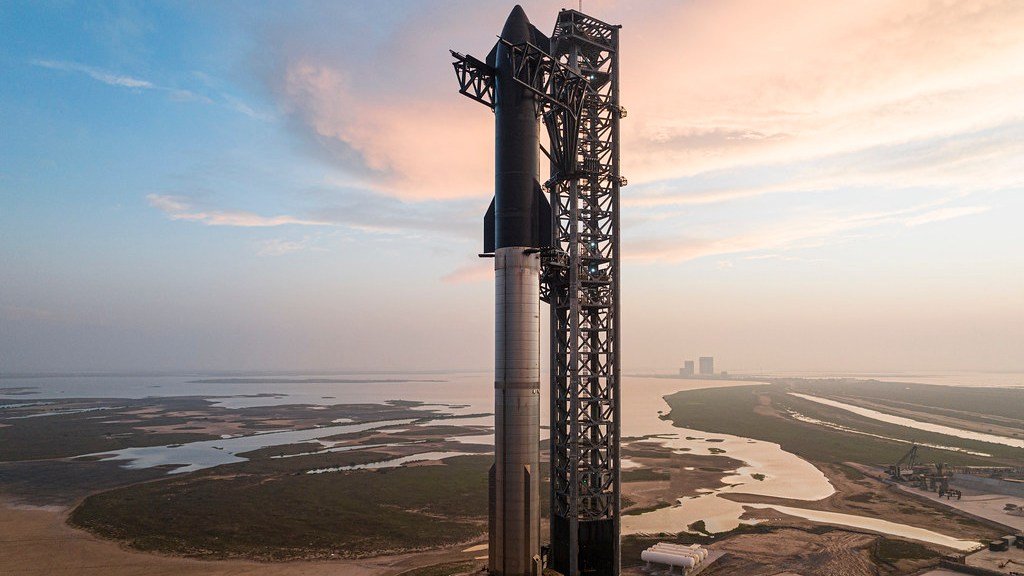
Starship Booster 21 Static Fire Completed, Flight 14 Countdown Begins…S40’s Route Confirmed: The countdown toward SpaceX’s Starship Flight 14 has entered a crucial phase after Super Heavy Booster 21 (B21) successfully completed its full-duration static fire test at Starbase. The milestone follows several days of technical inspections, scheduling uncertainty, and pad preparations, bringing the massive launch vehicle one step closer to its next test flight.
At the same time, Ship 40 (S40) is making its way back toward Texas aboard the heavy-lift recovery vessel Forte, while major developments in the United States and China signal a broader transformation of the global space industry.
From reusable rockets and maritime recovery to workforce development and large-scale manufacturing, the latest developments show that the space race is increasingly becoming a race to build complete spaceflight ecosystems.
Booster 21 Completes Critical Static Fire Test
The most significant development is the successful 33-engine static fire test of Booster 21 at SpaceX’s Starbase facility in Boca Chica, Texas.
The test was preceded by several technical delays. An earlier attempt encountered issues involving the Liquid Oxygen Quick Disconnect (LOX BQD) interface. Ground teams disconnected and inspected the connector on August 26 before carrying out additional verification work to confirm seal integrity and valve performance.
Extensive Ground Checks Before Ignition
On August 28, SpaceX began a comprehensive sequence of preparations for the test.
Engineers first performed functional checks of the pad’s Detonation Suppression System (DSS) and water-deluge equipment. Liquid nitrogen pressure tests were also conducted to verify the structural integrity of the launch infrastructure.
The surrounding highway was closed to establish a safe test perimeter, while the heavy Booster Transport Stand was moved away from the launch area.
SpaceX then began loading B21 with cryogenic propellants. The booster’s liquid oxygen (LOX) tank was filled to provide the necessary structural mass, while the liquid methane tanks received a partial load designed for the short-duration static-fire test.
33 Raptor Engines Ignite Simultaneously
The centerpiece of the operation came when all 33 Raptor 3 engines ignited simultaneously.
The engines generated an enormous amount of sea-level thrust, estimated at more than 9,000 metric tons, sending the exhaust plume through Starbase’s flame-trench system. The infrastructure is designed to divert the tremendous energy of the engines away from the orbital launch mount and surrounding equipment.
The static fire lasted approximately 15 seconds.
Post-test telemetry indicated that the engines completed their shutdown sequences normally, with no reported anomalous thermal or pressure behavior across the engine channels. For SpaceX, this makes the test an important validation point before B21 progresses toward flight configuration.
Booster 21 Moves Toward Flight 14
Following the successful static fire, SpaceX cancelled contingency pad closures that had been scheduled for August 29.
B21 is expected to return to Mega Bay 1 for additional inspections and flight processing. Engineers can use this period to examine the vehicle’s thermal protection systems (TPS), grid-fin actuators, and other hardware before the booster returns to the launch site.
The next major step will be stacking B21 beneath Ship 41 (S41).
If the remaining inspections and preparations proceed according to plan, SpaceX is targeting a mid-September launch window for Starship Flight 14.
The successful static fire does not by itself guarantee a launch date, since additional testing, regulatory requirements, weather, and vehicle readiness can affect the schedule. However, it removes one of the most important technical milestones from the immediate pre-flight checklist.
Ship 40 Recovery Route Takes the Long Way Home
While Booster 21 advances toward its next mission, Ship 40 is also making progress after completing its oceanic landing.
The spacecraft was secured by the specialized heavy-lift recovery vessel Forte near Christmas Island in the Pacific Ocean. Tracking data now shows that the vessel has selected a lengthy maritime route back toward Starbase.
Panama Canal vs. Cape of Good Hope
Two broad routes were considered for transporting the large spacecraft back to Texas.
The first option was the Panama Canal route, which would have taken the vessel eastward across the Pacific before entering the canal and continuing toward the Gulf of Mexico.
Although this route is geographically shorter, transporting large aerospace hardware through canal infrastructure presents logistical challenges. Vessel dimensions, lock clearances, scheduling, and maneuvering requirements can make the route less attractive for oversized cargo.
The second option is the Cape of Good Hope route.
Forte has selected this longer corridor, travelling west-by-southwest from the Pacific into the Indian Ocean, around southern Africa, and then northward through the Atlantic toward the Gulf of Mexico.
The vessel is reportedly maintaining an average speed of more than 14 knots, with an estimated transit time of roughly 40 days.
Why S40’s Return Matters
The projected arrival at Starbase in early October is significant because it allows SpaceX engineers to physically examine hardware recovered from an actual flight.
Engineers can inspect areas including the heat shield, engine bells, structural components, and other re-entry hardware. Such inspections provide valuable information that can influence subsequent Starship designs.
This is one of the central advantages of SpaceX’s reusable-vehicle strategy: hardware does not simply disappear after a test flight. Instead, engineers can recover components, study their real-world performance, and use those findings to improve future vehicles.
U.S. Space Academy Targets Future Workforce
The Starship program is only one part of a much larger transformation taking place across the space industry.
On August 28, an executive order established the United States Space Academy, creating a new institutional framework intended to develop highly trained personnel for America’s expanding space sector.
The proposed academy is designed to support workforce requirements across the U.S. Space Force, NASA, and commercial aerospace companies.
Building Skills for the Next Space Economy
Its potential curriculum includes subjects such as orbital mechanics, nuclear space propulsion, satellite infrastructure defense, autonomous systems, and life-support engineering.
NASA Administrator Jared Isaacman is leading the presidential commission responsible for developing the academy’s governance structure, location, academic charter, and service commitments.
The concept draws comparisons with established U.S. service academies such as West Point and Annapolis. However, its potential role extends beyond military applications.
As lunar exploration, orbital manufacturing, satellite networks, and commercial space stations expand, the industry will require a much larger workforce of engineers, technicians, operators, scientists, and aerospace specialists.
China Builds Shanghai “Rocket Star City”
China is pursuing a parallel strategy focused heavily on industrial-scale space manufacturing.
In Shanghai, the “Rocket Star City” initiative is being developed as an integrated aerospace production and logistics ecosystem.
One of its important components is the Lin Gang Road Wharf, which connects rocket manufacturing facilities with deep-water maritime infrastructure.
Water-Based Rocket Logistics
The concept addresses a major limitation faced by traditional rocket transportation: road infrastructure.
Large rocket stages can be difficult to move through highways, bridges, tunnels, and urban areas because of their size and diameter. By connecting factories directly with waterways, Shanghai’s model allows large components to be transferred onto barges and transported toward coastal launch infrastructure.
The planned industrial cluster covers approximately 9.3 square kilometers and is intended to become a major domestic space-industry hub.
Production targets reportedly include 80 commercial orbital rockets and 200 satellites per year by 2027, increasing to 150 rockets and 500 satellites annually by 2030.
This represents a shift from simply developing individual rockets toward creating an end-to-end manufacturing and transportation network capable of producing space hardware at high volume.
The Global Space Race Is Becoming an Industrial Race
The latest Starship developments demonstrate that the future of spaceflight will depend on much more than successful launches.
Booster 21’s static fire shows SpaceX continuing its rapid testing and iteration approach. Ship 40’s recovery voyage demonstrates the growing importance of retrieving and analyzing flight hardware.
Meanwhile, the U.S. Space Academy highlights the need to develop a skilled workforce capable of supporting increasingly complex missions. China’s Rocket Star City demonstrates another critical requirement: infrastructure capable of manufacturing and transporting spacecraft at scale.
Together, these developments point toward a future in which the competitive advantage of spacefaring nations and companies will depend on their ability to combine launch technology, reusable hardware, skilled workers, manufacturing capacity, logistics networks, and long-term infrastructure.
For SpaceX, the immediate focus remains Starship Flight 14. With Booster 21’s static fire now completed and preparations continuing, attention will turn toward final inspections, stacking with Ship 41, and the eventual launch campaign.
If the remaining milestones are completed successfully, the next Starship flight could provide another valuable step in SpaceX’s effort to develop a fully reusable heavy-lift spacecraft system—while the wider global space industry continues building the infrastructure needed for the next era of exploration.
FAQs
1. What is Starship Flight 14?
Starship Flight 14 is the next planned test mission in SpaceX’s Starship development program. It is expected to test the performance of the fully integrated Super Heavy booster and Starship upper stage.
2. What happened during Booster 21’s static fire test?
Super Heavy Booster 21 (B21) successfully fired all 33 Raptor 3 engines simultaneously during a full-duration static fire test lasting approximately 15 seconds.
3. How much thrust did Booster 21 generate during the static fire?
The 33 Raptor 3 engines produced more than 9,000 metric tons of sea-level thrust, generating an enormous exhaust plume that was directed through Starbase’s flame-trench system.
4. Why was the Booster 21 static fire delayed?
The test experienced technical delays related to the Liquid Oxygen Quick Disconnect (LOX BQD) interface. SpaceX ground crews disconnected and inspected the connector before carrying out additional checks of its seals and valve response.
5. What did SpaceX check before firing Booster 21?
Engineers performed several ground-system checks, including testing the Detonation Suppression System (DSS), water-deluge equipment, and liquid-nitrogen structural pressure systems. The launch area was also cleared before propellant loading began.
6. What propellants were loaded into Booster 21?
B21 was loaded with liquid oxygen (LOX) and liquid methane (CH₄). The LOX tank was fully loaded to provide structural mass, while the methane tanks received a partial load appropriate for the static-fire test.
7. What happens to Booster 21 after the static fire?
After the test, B21 is expected to return to Mega Bay 1 for additional inspections and flight processing. Engineers will examine its thermal protection systems, grid-fin actuators, and other hardware before it returns to the launch pad.
8. When could Starship Flight 14 launch?
SpaceX is targeting a mid-September launch window for Flight 14, although the exact launch date can change depending on vehicle readiness, testing, regulatory requirements, weather, and other operational factors.
9. What is happening to Ship 40?
Ship 40 (S40) is being transported back to Texas aboard the heavy-lift recovery vessel Forte after its oceanic landing and recovery near Christmas Island in the Pacific.
10. Which route is Forte taking to return Ship 40 to Texas?
Tracking indicates that Forte is using the Cape of Good Hope route, travelling through the Indian Ocean, around southern Africa, and then across the Atlantic toward the Gulf of Mexico.
11. Why didn’t Forte use the Panama Canal?
Although the Panama Canal route could be geographically shorter, the size of the recovery vessel and its oversized aerospace cargo can create challenges involving lock dimensions, clearance requirements, and scheduling. The Cape of Good Hope route provides an alternative maritime corridor.
12. When is Ship 40 expected to return to Starbase?
Based on the projected voyage, Ship 40 could arrive at Starbase in early October, giving SpaceX an opportunity to inspect the recovered spacecraft before subsequent Starship operations.
13. Why is recovering Ship 40 important for SpaceX?
Recovering S40 allows engineers to directly examine flight-tested hardware. Inspections of the heat shield, engine bells, structural components, and other systems can provide real-world data that helps SpaceX improve future Starship vehicles.
14. What is the U.S. Space Academy?
The United States Space Academy is a newly established educational and training initiative intended to develop skilled personnel for the U.S. Space Force, NASA, and the commercial space industry.
15. What is China’s Shanghai “Rocket Star City”?
Shanghai’s “Rocket Star City” is an industrial spaceflight hub designed to combine rocket manufacturing, satellite production, and maritime transportation. Its water-based logistics system can help move large rocket stages without the size restrictions associated with conventional highway transportation.
16. What do these developments mean for the global space industry?
The developments surrounding Starship Flight 14, Ship 40 recovery, the U.S. Space Academy, and China’s Rocket Star City show that the space industry is moving beyond individual launches. The emerging competition increasingly involves reusable spacecraft, skilled workforces, mass manufacturing, logistics infrastructure, and long-term spaceflight ecosystems.
Read More:
- Take A Look This Incredible Tesla Giga Press 50,000 Tons Destroying EV Industries
- OpenAI cites distrust of SpaceX in decision to drop Cursor partnership
- SpaceX Updated New Footage Revealed Unexpected S40 Status after 32 days of Floating
- New CATL 2000 Mile Range Battery & $63/kWh Change Everything
- Tesla Cybercab uses a unique strategy for picking up the right rider
1 thought on “Starship Booster 21 Static Fire Completed, Flight 14 Countdown Begins…S40’s Route Confirmed”