
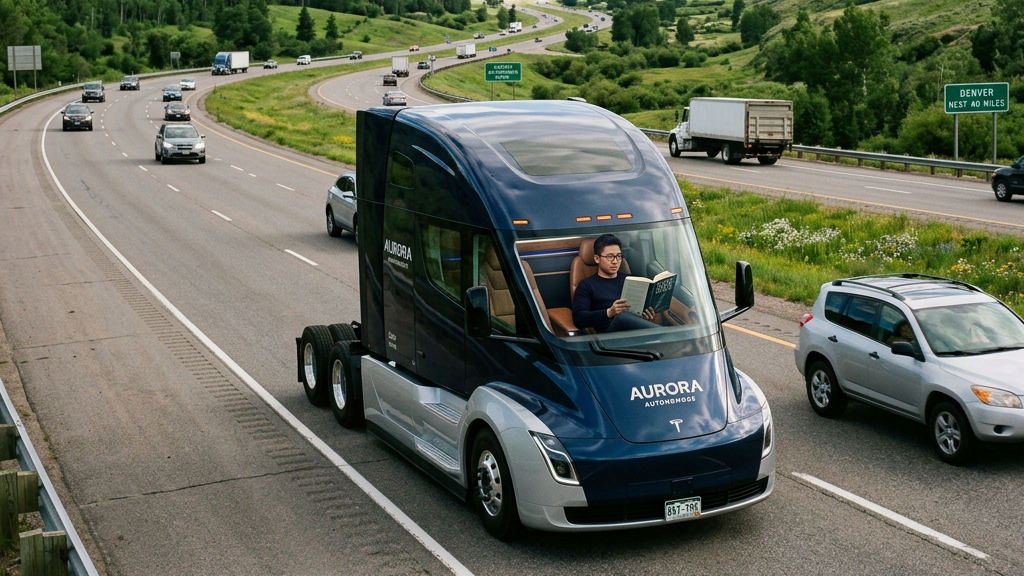
The Tesla Semi Takeover Has Finally Begun: The commercialization of advanced technology is entering a new phase. Across electric transportation, orbital spaceflight, and brain-computer interfaces, the biggest challenge is no longer simply proving that the technology works. The real challenge is building the manufacturing infrastructure, logistics networks, and operational systems required to produce and deploy it at scale.
That shift is becoming increasingly visible across several of Elon Musk’s major engineering ventures. Tesla’s Semi program, SpaceX’s Starship, and Neuralink’s brain-computer interface technology are all moving away from boutique prototypes and limited demonstrations toward industrial-scale infrastructure.
From a dedicated Tesla Semi factory in Nevada to SpaceX’s reusable orbital architecture and Neuralink’s expanding cleanroom campus in Texas, the common theme is clear: mass production requires massive infrastructure.
Tesla Semi Moves Toward High-Volume Manufacturing
The Tesla Semi represents one of the most ambitious attempts to electrify the Class 8 heavy-duty trucking market. Unlike passenger electric vehicles, heavy trucks require enormous battery capacity because of their weight, range requirements, and demanding operating cycles.
A 500-mile electric Semi can require a battery pack with energy capacity roughly comparable to 8–10 passenger EVs. That creates a major manufacturing bottleneck when battery cells are in limited supply.
Co-Locating 4680 Battery Production With Semi Assembly
Tesla’s approach is to address this bottleneck through vertical integration and co-located manufacturing.
The company’s dedicated Semi manufacturing infrastructure in Nevada is positioned alongside Gigafactory Nevada’s 4680 battery cell production, creating a more direct flow of battery components into truck assembly.
This approach can reduce transportation requirements, simplify supply-chain coordination, and potentially improve production efficiency.
The planned facility is designed around a potential annual capacity of approximately 50,000 Tesla Semi trucks once operating at full scale.
Tesla has also attracted major commercial interest, including fleet commitments associated with companies such as Einride and WattEV. Large fleet orders could become an important catalyst for transforming the Semi from a limited pilot vehicle into a mainstream commercial platform.
Megawatt Charging Could Change Electric Trucking
Manufacturing electric trucks at scale is only half the equation. Fleets also need charging infrastructure capable of keeping heavy vehicles moving.
Traditional DC fast chargers delivering around 150 kW to 350 kW may be adequate for passenger vehicles, but long-haul trucking requires dramatically higher power levels because downtime directly affects fleet economics.
The Rise of 1.2 MW Megacharging
Tesla’s Megacharger infrastructure is designed to deliver power at the megawatt level.
Some deployed charging systems are designed around outputs of up to 1.2 megawatts, or 1,200 kilowatts. At that power level, a commercial truck can potentially recover a substantial amount of driving range during a relatively short charging stop.
The scale of electricity required is equally significant.
Using the basic electrical relationship:
P = V × I
a 1.2 MW charging load could correspond approximately to 1,200 volts and 1,000 amps under a simplified example.
Such enormous power demands require sophisticated high-voltage grid connections, energy storage, and load management. Stationary battery systems can help manage peak demand and reduce stress on local electrical infrastructure.
Planned freight-charging networks along major corridors such as Interstate 5 and Interstate 10 could ultimately provide the infrastructure needed for electric trucks to operate beyond regional routes.
Tesla Semi Faces a Global Design Challenge
Scaling the Semi globally involves another issue: regulatory differences.
Aerodynamic design is particularly important for electric trucks because reducing drag can improve energy efficiency and extend usable range.
Camera Systems Could Improve Aerodynamics
Traditional American truck designs generally rely on physical side mirrors. These large mirror housings create aerodynamic drag and can contribute to higher energy consumption.
European regulations, however, have permitted Camera Monitor Systems (CMS) as alternatives to conventional mirrors under applicable UNECE rules.
Tesla’s European-spec Semi has demonstrated a design using digital camera systems instead of traditional large mirror assemblies.
The potential advantage is significant. Smaller camera pods can create a cleaner aerodynamic profile, reducing parasitic drag and potentially improving Wh-per-mile efficiency.
The regulatory divide between the United States and Europe therefore isn’t just a design issue. It could influence the efficiency, range, and eventual configuration of electric heavy trucks sold in different markets.
SpaceX Starship Is Entering a More Demanding Phase
While Tesla focuses on manufacturing and transportation infrastructure, SpaceX Starship is attempting something even more difficult: developing a fully reusable orbital transportation system.
Earlier Starship test flights primarily focused on proving individual aspects of the launch, flight, separation, re-entry, and landing architecture.
The next major objective is increasingly centered on full orbital operations and rapid reusability.
Orbital Re-Entry Creates a Massive Energy Problem
The physics of Starship’s upper-stage return are fundamentally different from the return of the Super Heavy booster.
The kinetic energy of a moving object is described by:
Eₖ = ½mv²
Because velocity is squared in this equation, the energy involved increases dramatically as velocity rises.
A Starship returning from orbit approaches orbital re-entry speeds, creating enormous thermal and aerodynamic loads. That makes recovering the upper stage substantially more challenging than catching the returning booster.
The Super Heavy booster returns after a comparatively short trajectory, while Starship must survive atmospheric re-entry and manage extreme heating before attempting a controlled landing.
Why the Starship Catch Requires More Testing
SpaceX has already demonstrated the mechanical tower catch concept with the Super Heavy booster.
Catching the Starship upper stage, however, introduces additional challenges involving thermal protection, guidance precision, structural loads, and residual kinetic energy.
Delaying an upper-stage catch while prioritizing orbital insertion and thermal-protection validation represents a risk-management strategy. Proving the vehicle can reliably survive orbital conditions is an essential prerequisite for eventual rapid reflight.
The long-term goal is not simply another successful launch. It is a reusable transportation system capable of flying repeatedly.
Neuralink Builds the Infrastructure for Bio-Digital Manufacturing
The same transition from prototype to scale is visible in Neuralink’s brain-computer interface technology.
Developing an implant in a laboratory environment is one challenge. Producing thousands or potentially millions of highly precise medical devices under strict manufacturing conditions is another.
112,000 Square Feet of Cleanroom Infrastructure
Neuralink’s expansion in Del Valle, Texas, represents a major investment in this manufacturing transition.
The planned facility is associated with approximately 112,000 square feet of infrastructure, including specialized manufacturing and cleanroom environments.
These facilities are designed to support the production of advanced neural implants such as Telepathy and the company’s Blindsight system.
The importance of cleanroom manufacturing cannot be overstated.
Why Cleanrooms Matter for Brain-Computer Interfaces
Neural implants contain extremely small components, including flexible threads and microscopic electrodes. Contamination during manufacturing can potentially compromise insulation, reliability, or signal performance.
A highly controlled cleanroom environment helps regulate airborne particles, humidity, electrostatic discharge, and other manufacturing variables.
Automation is equally important. High-volume production requires repeatable assembly processes capable of maintaining microscopic tolerances far beyond what traditional manual manufacturing can consistently achieve.
For medical technology, scale must also coexist with sterility, quality control, regulatory compliance, and long-term biocompatibility.
The Bigger Picture: Infrastructure Is the Real Moat
Tesla Semi, Starship, and Neuralink operate in completely different industries, but they share a remarkably similar industrial strategy.
Tesla needs battery supply, dedicated factories, and megawatt charging networks.
SpaceX needs orbital launch infrastructure, thermal protection systems, rapid refurbishment, and reusable recovery architecture.
Neuralink needs cleanrooms, precision automation, medical-device manufacturing, and robotic surgical infrastructure.
In each case, the technology itself is only the beginning.
From Prototype to Industrial Scale
The defining challenge of the next phase is converting breakthrough engineering into repeatable, high-volume production.
For Tesla, that means making electric heavy trucks economically viable for large fleets.
For SpaceX, it means turning Starship into a genuinely reusable orbital transportation platform.
For Neuralink, it means transforming experimental brain-computer interfaces into scalable medical devices.
The companies that solve these manufacturing problems could gain advantages that are difficult for competitors to replicate because the infrastructure itself becomes a strategic asset.
Conclusion
The Tesla Semi takeover is therefore about more than one electric truck. It represents a broader industrial shift toward the infrastructure required to make advanced technologies commercially practical.
From 50,000-unit annual Semi manufacturing ambitions and 1.2 MW charging systems to orbital re-entry technology and 112,000-square-foot neural-interface manufacturing facilities, the common objective is scale.
The next technological revolution may not be determined solely by who invents the most advanced machine.
It may be determined by who can manufacture it, power it, transport it, regulate it, and deploy it at enormous scale.
That is where the real competition is beginning.
FAQs
1. What is driving the Tesla Semi takeover?
The Tesla Semi’s move toward high-volume manufacturing is being driven by increasing fleet demand, dedicated production infrastructure, improved battery supply, and the development of megawatt-level charging networks.
2. How many Tesla Semi trucks could be produced annually?
Tesla’s dedicated Semi manufacturing facility in Nevada has been designed around a potential capacity of up to 50,000 trucks per year at full production.
3. Why is battery production important for the Tesla Semi?
A long-range Class 8 electric truck requires a very large battery pack, potentially using cells equivalent to several passenger EVs. Co-locating battery production with Semi assembly can help simplify logistics and improve supply efficiency.
4. What is the Tesla Semi’s expected driving range?
The Tesla Semi is offered in configurations targeting approximately 325 miles and 500 miles of range, depending on the version and operating conditions.
5. What is a Megacharger?
A Megacharger is a high-power charging system designed specifically for heavy-duty electric vehicles. Tesla’s infrastructure is designed to deliver charging power at the megawatt level, allowing electric trucks to recharge much faster than they could with conventional charging equipment.
6. How powerful is a 1.2 MW truck charger?
A 1.2 MW charger delivers up to 1,200 kilowatts of electrical power. Such charging levels require substantial grid connections, high-voltage equipment, and careful energy management.
7. Why does the Tesla Semi need a dedicated charging network?
Long-haul trucks operate on tight schedules, so extended charging downtime can reduce fleet productivity. A megawatt charging network along major freight corridors could make electric trucking more practical for high-mileage commercial operations.
8. Why are Tesla Semi designs different in the United States and Europe?
Commercial vehicle regulations differ between markets. European regulations allow certain Camera Monitor Systems (CMS) to replace traditional physical mirrors, while U.S. requirements have historically required conventional mirrors for many heavy vehicles.
9. Can cameras improve Tesla Semi efficiency?
Potentially, yes. Smaller camera pods create less aerodynamic drag than large physical mirrors, which can help reduce energy consumption and potentially improve the vehicle’s effective range.
10. What is SpaceX Starship designed to accomplish?
SpaceX Starship is being developed as a fully reusable spacecraft and launch system intended for orbital transportation. Its long-term objective is repeated, rapid reuse rather than one-time launches.
11. Why is catching the Starship upper stage so difficult?
The Starship upper stage returns from orbital velocity, creating extreme thermal and aerodynamic stresses. Its return involves substantially more energy and heat than the relatively lower-energy return of the Super Heavy booster.
12. Why is orbital velocity important to Starship’s re-entry?
Starship must reach roughly orbital velocity to remain in orbit. When it returns to Earth’s atmosphere at those speeds, enormous kinetic energy must be dissipated through atmospheric drag and the spacecraft’s thermal-protection system.
13. Why is Starship’s thermal protection system so important?
During atmospheric re-entry, the spacecraft experiences extreme heating. The thermal-protection system must survive repeated exposure while protecting the vehicle’s internal structures and systems.
14. What is Neuralink building in Texas?
Neuralink is expanding its Del Valle, Texas, campus with manufacturing infrastructure intended to support the production of advanced brain-computer interface hardware, including technologies associated with Telepathy and Blindsight.
15. Why does Neuralink need cleanrooms?
Brain-computer interfaces contain extremely small and sensitive components. Cleanroom manufacturing helps control airborne particles, humidity, electrostatic discharge, and other contaminants that could affect device reliability and manufacturing quality.
16. What do Tesla, SpaceX, and Neuralink have in common?
Although they operate in completely different industries, all three demonstrate the same fundamental principle: breakthrough technology must eventually transition from prototypes to scalable infrastructure. Tesla needs factories and charging networks, SpaceX needs reusable launch infrastructure, and Neuralink needs precision medical-device manufacturing. The ability to manufacture and deploy technology at scale may ultimately be as important as the original invention itself.
Read More:
- Starship Booster 21 Static Fire Completed, Flight 14 Countdown Begins…S40’s Route Confirmed
- Take A Look This Incredible Tesla Giga Press 50,000 Tons Destroying EV Industries
- OpenAI cites distrust of SpaceX in decision to drop Cursor partnership
- SpaceX Updated New Footage Revealed Unexpected S40 Status after 32 days of Floating
- New CATL 2000 Mile Range Battery & $63/kWh Change Everything
1 thought on “The Tesla Semi Takeover Has Finally Begun”