
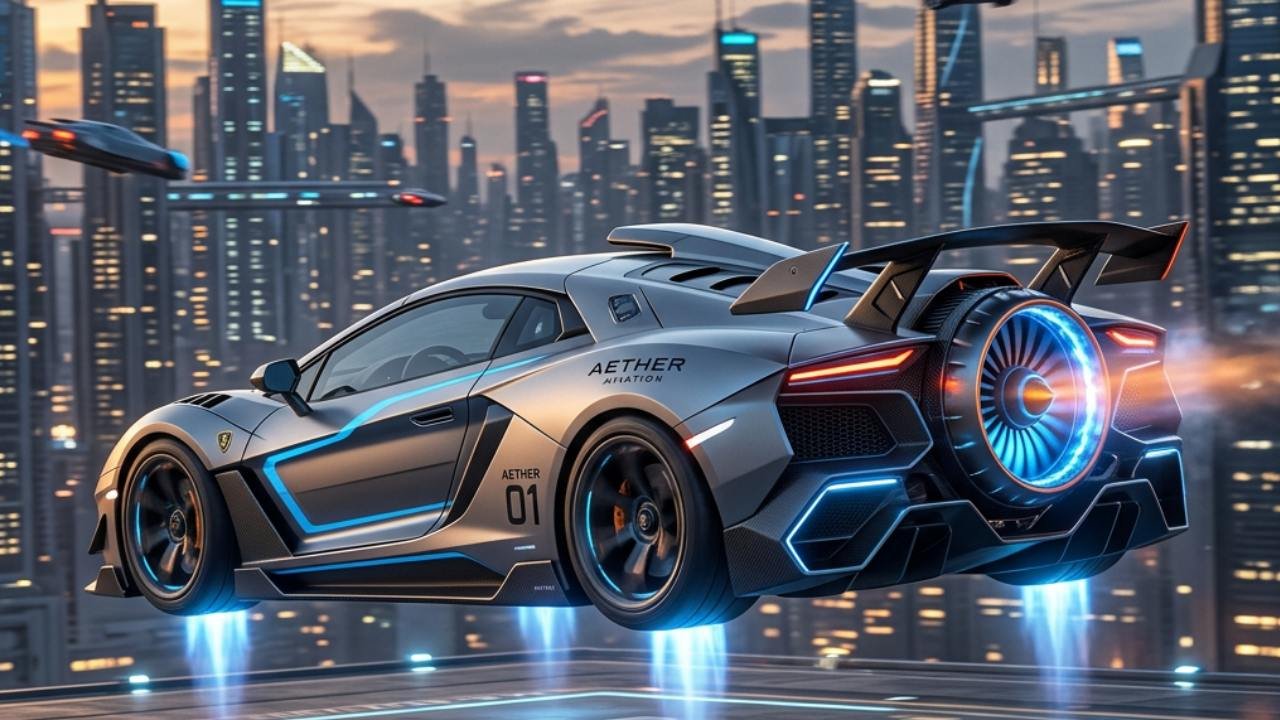
All the Most Advanced Flying Cars Coming to Market in 2027: For generations, flying cars have represented the ultimate vision of futuristic transportation. From science-fiction movies to ambitious engineering projects, the dream of traveling above congested highways is becoming increasingly realistic. Today, aerospace startups, electric vehicle manufacturers, and technology companies are developing innovative machines designed to combine road transportation with personal flight.
The emerging market includes electric vertical takeoff and landing (eVTOL) vehicles, jet-powered airbikes, and high-performance electric hypercars featuring advanced suspension technology. Although these vehicles have different capabilities, they share a common goal: transforming how people travel in the future.
As 2027 approaches, several groundbreaking projects are attracting attention. From the rocket-inspired Tesla Roadster to the road-and-air capabilities of ALEF Aeronautics Model A, these innovations highlight how rapidly transportation technology is evolving. However, their commercial availability, specifications, and production schedules vary, and not every futuristic vehicle will be widely available by 2027.
1. Tesla Roadster: Combining Hypercar Performance with Rocket Technology
The next-generation Tesla Roadster represents an ambitious attempt to push electric vehicle performance beyond conventional limits. Developed by Tesla, the upcoming electric sports car has been associated with advanced engineering concepts and potential collaboration with SpaceX.
One of the most talked-about proposed features is a package of compressed-gas thrusters designed to improve acceleration and vehicle control. Elon Musk has previously discussed the possibility of using rocket-inspired technology to enhance the Roadster’s performance.
Could the Tesla Roadster Actually Fly?
The idea of a Roadster capable of jumping or lifting off the ground has attracted considerable attention. However, it is important to distinguish between proposed capabilities and a verified production vehicle. A commercially available flying Roadster has not been established, and any airborne functions would require substantial engineering, safety testing, and regulatory approval.
The vehicle is also associated with ambitious performance targets, including acceleration from 0 to 100 km/h in under one second under certain proposed configurations. Such figures remain targets or claims that must be confirmed through production specifications and independent testing.
If Tesla successfully delivers its next-generation Roadster, it could become an important milestone in electric hypercar technology, even without genuine flight capabilities.
2. ALEF Aeronautics Model A: A Car Designed to Fly
ALEF Aeronautics Model A is one of the most recognizable projects in the developing flying-car industry. Unlike traditional electric cars, the Model A is designed to operate on ordinary roads and transition into vertical flight.
The California-based company is developing an all-electric vehicle that combines road mobility with an integrated aerial propulsion system. Its distinctive body incorporates multiple propellers intended to generate the lift required for takeoff and flight.
ALEF Model A Specifications and Expected Capabilities
| Feature | Reported Target |
|---|---|
| Vehicle type | Drive-and-fly electric vehicle |
| Proposed air range | Up to 177 km |
| Proposed ground range | Over 300 km |
| Estimated price | Approximately $300,000 |
| Pre-orders | More than 3,600 reported in the supplied source |
These figures represent reported targets and estimates rather than guaranteed production specifications.
How Does the ALEF Flying Car Work?
The Model A is designed to drive like a conventional vehicle before switching into flight mode. Its distributed electric propulsion system generates vertical lift, allowing the vehicle to rise without requiring a traditional runway.
This approach could prove useful in areas where road congestion creates significant transportation challenges. A vehicle capable of traveling on streets and taking off vertically could potentially offer greater flexibility than an aircraft requiring a dedicated runway.
Nevertheless, battery capacity, flight safety, weather conditions, aviation regulations, and infrastructure will determine whether the Model A becomes a practical transportation solution.
3. XPeng AeroHT: China’s Vision for a Flying Supercar
Chinese technology companies are investing heavily in next-generation mobility, and XPeng AeroHT has emerged as a prominent name in the flying-car sector.
Its modular flying-car concepts combine futuristic road vehicles with separate aerial propulsion systems. One of the most distinctive approaches involves a vehicle that can carry a compact aircraft module, allowing users to travel on roads before preparing for flight.
A Modular Approach to Personal Aviation
The aerial component of certain concepts uses folding arms and multiple electric propellers. Once deployed, the system can provide vertical takeoff and landing capabilities.
Instead of replacing the conventional car entirely, this approach attempts to combine the advantages of both transportation modes. Drivers could use roads for everyday journeys and switch to the aerial module when conditions, regulations, and infrastructure permit.
The company’s concepts illustrate how electric mobility and personal aviation could eventually work together. However, buyers should distinguish between demonstration vehicles, announced products, and models that have completed certification and entered regular commercial service.
4. BYD YangWang U9: Extreme Performance Without Taking to the Sky
Not every futuristic vehicle needs to fly to transform transportation technology. The BYD YangWang U9 demonstrates how advanced electronic controls and active suspension can dramatically change the behavior of a high-performance electric car.
Developed by Chinese automaker BYD, the electric hypercar features the company’s DiSus-X intelligent body-control system. This technology can rapidly adjust the vehicle’s suspension and body movement in response to driving conditions.
What Makes the YangWang U9 Different?
The U9 combines four electric motors with exceptionally high power output and sophisticated chassis controls. Demonstrations have showcased its ability to make dramatic vertical movements and jump over obstacles under controlled conditions.
These capabilities are not equivalent to sustained flight. Instead, they demonstrate how software-controlled suspension systems can expand the range of movements possible for a road vehicle.
The technology could have broader applications in vehicle stability, ride control, handling, and performance engineering. Although the YangWang U9 is not a flying car, it represents another direction in the evolution of advanced personal transportation.
5. Jetson ONE: A Personal Electric Flying Machine
The Jetson ONE takes a more direct approach to personal flight. Rather than attempting to function as a conventional road car, it is a compact, single-person electric vertical takeoff and landing aircraft.
Its lightweight construction uses materials such as aluminum and carbon fiber, while multiple electric motors power its distributed propulsion system.
Designed for Individual Flight
The Jetson ONE uses a joystick-based control system designed to make piloting more accessible. Its advertised top speed is approximately 102 km/h, although actual performance depends on operating conditions and applicable restrictions.
The aircraft is intended for recreational personal aviation rather than everyday road commuting. Its compact design makes it an interesting example of how electric propulsion can support small aircraft without conventional runways.
Specialized applications, including emergency response and search-and-rescue support, may also interest organizations exploring lightweight aerial platforms. However, any law-enforcement deployment or specialized variant depends on the relevant operator, equipment, and authorization.
6. Volonaut Airbike: A Jet-Powered Vision of the Future
The Volonaut Airbike offers a radically different vision of personal flight. Developed by inventor Tomas Patan, the machine resembles a futuristic speeder bike from science-fiction films.
Unlike battery-powered multicopters, the Airbike is associated with compact jet propulsion technology. Its lightweight design aims to provide an unusual combination of agility, speed, and minimal structure.
Reported performance figures have included speeds of up to 200 km/h and a weight of approximately 30 kilograms. These specifications should be treated as reported claims until independently verified under clearly defined operating conditions.
Can Jet-Powered Airbikes Become Practical Transportation?
Jet-powered personal aircraft face several challenges, including fuel consumption, heat, noise, flight stability, and passenger safety. They also require appropriate operating environments and compliance with aviation regulations.
Consequently, the Airbike is better understood as an experimental personal-flight concept than as a replacement for the family car.
Even so, it highlights the variety of propulsion technologies being explored as engineers search for new ways to move people through three-dimensional space.
7. The Biggest Challenges Facing Flying Cars in 2027
Despite impressive prototypes and demonstrations, flying cars still face substantial obstacles before they can become everyday transportation.
Safety and Certification
Vehicles that operate in the air must meet demanding aviation safety requirements. Manufacturers need to demonstrate reliable propulsion, flight controls, emergency procedures, and structural integrity.
Battery Range and Energy Efficiency
Electric flying vehicles generally require considerable power during takeoff and hovering. Improving battery energy density, charging speed, and overall efficiency will be essential for expanding their practical range.
Air Traffic Management
Large numbers of personal aircraft would require carefully coordinated flight routes, collision-avoidance systems, and communication with aviation authorities.
Affordability and Infrastructure
Many advanced personal aircraft remain expensive. Wider adoption will also depend on suitable landing areas, maintenance facilities, insurance, and pilot or operator requirements.
Conclusion: Will Flying Cars Become Reality in 2027?
The race to develop flying cars and personal aerial vehicles is moving beyond science fiction. Projects from Tesla, ALEF Aeronautics, XPeng AeroHT, Jetson, and Volonaut demonstrate several different approaches to next-generation transportation.
The Tesla Roadster explores the limits of electric hypercar performance, while ALEF aims to combine road driving with vertical flight. XPeng AeroHT is developing modular aerial mobility concepts, and Jetson ONE offers a compact alternative for individual flight. Meanwhile, BYD’s YangWang U9 demonstrates how advanced vehicle controls can transform performance on the ground.
However, 2027 should not be viewed as a guaranteed turning point when flying cars become common. Certification, production capacity, affordability, battery performance, and public acceptance will determine how quickly these technologies reach consumers.
The future may not involve every car flying above traffic. Instead, it could feature a combination of electric vehicles, specialized personal aircraft, autonomous transportation, and carefully managed aerial routes. If these technologies continue advancing, the boundaries between driving and flying may become less rigid over the coming decades.
FAQs
1. What are the most advanced flying cars expected in 2027?
Some of the most talked-about projects include the ALEF Aeronautics Model A, XPeng AeroHT flying-car concepts, Jetson ONE, and Volonaut Airbike. The Tesla Roadster is also attracting attention for its proposed rocket-inspired performance technology, although it is not a verified flying car.
2. Will flying cars be available to buy in 2027?
Some personal electric aircraft and flying-car projects may progress toward customer deliveries or expanded commercial operations around this period. However, availability depends on production schedules, aviation certification, safety testing, and local regulations.
3. What is the Tesla Roadster, and can it fly?
The next-generation Tesla Roadster is an upcoming electric sports car designed for extreme performance. Elon Musk has discussed potential SpaceX-inspired compressed-gas thrusters, but a production Roadster capable of sustained flight has not been confirmed.
4. How much will the ALEF Model A flying car cost?
The ALEF Aeronautics Model A has been associated with an estimated price of approximately $300,000. This is a reported estimate, and the final price, production configuration, and delivery arrangements may differ.
5. How far can the ALEF Model A travel?
Reported targets include an air range of up to 177 kilometers and a ground range exceeding 300 kilometers. These figures are proposed specifications and should not be treated as independently verified real-world performance.
6. How does the ALEF Model A flying car work?
The ALEF Model A is designed to drive on conventional roads and transition into vertical flight using an integrated electric propulsion system. Its multiple propellers generate the lift needed for takeoff without a traditional runway.
7. What is the XPeng AeroHT flying car?
XPeng AeroHT is developing futuristic personal aerial mobility concepts that combine road transportation with an aircraft module. Some designs use folding support arms and multiple electric propellers for vertical takeoff and landing (VTOL).
8. Can the XPeng AeroHT flying car avoid traffic jams?
In principle, an aerial vehicle could bypass road congestion by traveling through the air. However, practical use depends on flight authorization, weather conditions, available landing locations, safety systems, and air traffic management.
9. What makes the BYD YangWang U9 different from a flying car?
The BYD YangWang U9 is an electric hypercar featuring the DiSus-X active suspension system. It can perform dramatic suspension movements and controlled jumps, but these capabilities do not make it a vehicle capable of sustained flight.
10. What is the Jetson ONE personal flying aircraft?
The Jetson ONE is a compact, single-person electric VTOL aircraft powered by multiple electric motors. It uses a joystick-based control system and is designed primarily for personal recreational flight rather than conventional road driving.
11. What is the top speed of the Jetson ONE?
The Jetson ONE has an advertised top speed of approximately 102 km/h. Actual performance can depend on operating conditions, configuration, and applicable flight restrictions.
12. What is the Volonaut Airbike?
The Volonaut Airbike is an experimental personal aerial vehicle developed by inventor Tomas Patan. Its futuristic design and reported use of jet propulsion technology distinguish it from conventional electric multicopter aircraft.
13. How fast can the Volonaut Airbike travel?
Reported claims have placed its top speed at approximately 200 km/h. This figure should be treated as a reported performance claim rather than a universally verified operating speed.
14. Are flying cars safe for everyday transportation?
Flying cars and personal aircraft must meet demanding safety requirements before they can be widely used. Important considerations include propulsion reliability, emergency landing procedures, flight-control systems, weather limitations, and aviation certification.
15. What are the biggest challenges facing flying cars in 2027?
The main challenges include battery range, high manufacturing costs, aviation regulations, air traffic coordination, infrastructure, and passenger safety. Overcoming these obstacles will be essential for making personal aerial transportation practical.
16. Will flying cars replace traditional cars in the future?
Flying cars are unlikely to replace all conventional vehicles in the near future. Instead, electric cars, personal aircraft, eVTOL vehicles, and autonomous transportation systems may operate together, giving people more options for traveling on roads and through the air.
Read More:
- Tesla shows what Roadster drivers will see on screen before thruster activation
- Vast Space Announced Plan to Build Moon Base with SpaceX Shocked NASA
- Tesla Bot Gen 3 JUST Got A NEW Look! 2027 Version
- ELON MUSK Announces 100 $7,999 Tesla Tiny House Finally SHIPPING | Free Bill Tax, Inside COOL
- BIG UPDATE! 2026 Tesla Bot Gen 3 Finally Get NEW OLED Face & Double Tasks! Clean House IMPRESSIVE