
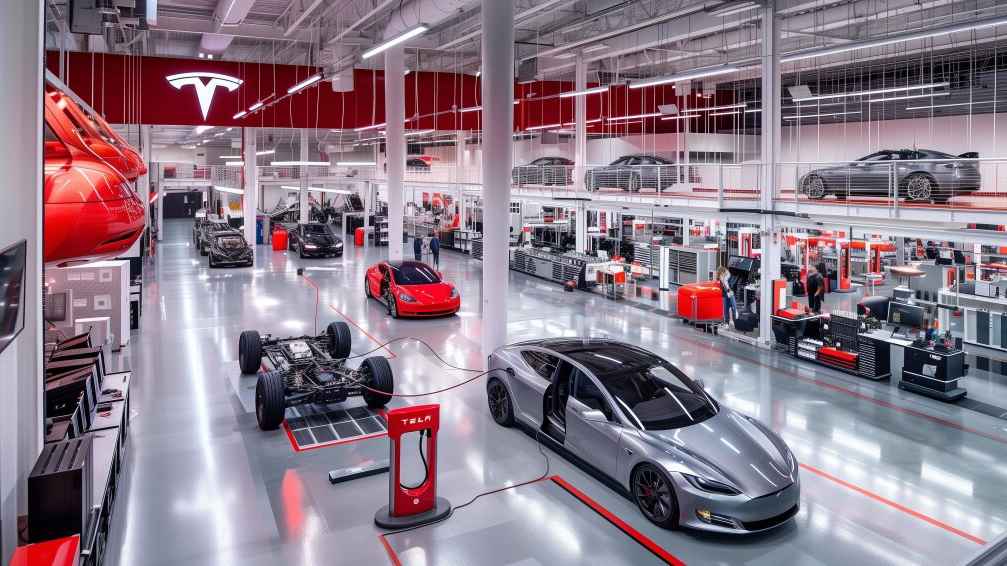
For decades, China dominated global manufacturing, positioning itself as the undisputed king of speed, scale, and cost efficiency. Massive factories, millions of workers, and non-stop production cycles made it nearly impossible to compete. But then something happened that changed the entire conversation.
Tesla, Inc. walked in — and redefined what “fast” manufacturing truly means.
According to Elon Musk, Tesla’s revolutionary Gigapress 2.0 can produce a finished vehicle in under 30 seconds. Not slightly faster. Not twice as fast. But at a speed that completely shatters every benchmark the automotive industry has ever known.
And here’s the shocking part: humans can barely stand near it while it operates.
Let’s break down exactly how this engineering monster works — and why it may completely reshape the global auto industry.
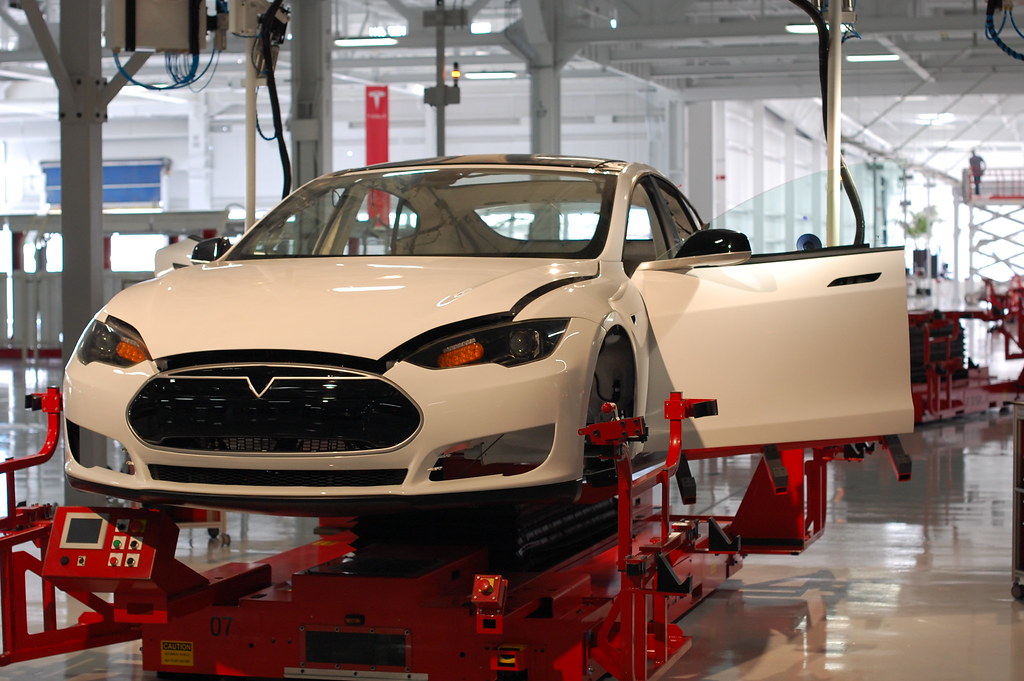
China’s Manufacturing Power vs Tesla’s Production Revolution
China’s automotive dominance isn’t built on hype — it’s built on massive scale. Hundreds of factories. Millions of workers. Continuous production lines. But the system still follows a traditional structure:
- Hundreds of separate parts
- Thousands of welds
- Dozens of robots
- Multiple quality checkpoints
- Assembly-heavy design
Even the most advanced Chinese EV factories take nearly two minutes per vehicle.
Tesla? Musk claims they’re pushing toward one vehicle every 30 seconds.
That’s not incremental improvement.
That’s a complete rewrite of manufacturing logic.
What Is the Tesla Gigapress?
The Tesla Gigapress is one of the largest die-casting machines ever built — roughly the size of a two-story house.
Instead of assembling dozens of metal components together, the Gigapress creates massive single-piece castings that form the vehicle’s structural foundation.
The first major breakthrough came when Tesla used a 6,000-ton Gigapress for the Tesla Model Y. That move:
- Replaced 70+ parts with just two giant castings
- Reduced production cost by 40%
- Integrated seamlessly with Tesla’s structural battery pack
- Simplified assembly dramatically
That alone was revolutionary.
But Gigapress 2.0? That’s a completely different beast.
Gigapress 2.0: The 50,000-Ton Manufacturing Monster
The new generation machine reportedly boasts a staggering:
50,000 tons of clamping force
To put that in perspective:
- The Model Y machine = 6,000–6,200 tons
- Gigapress 2.0 = 50,000 tons
- That’s roughly 8.5 times more powerful
This immense pressure allows Tesla to do something no other automaker has achieved at scale:
Cast an entire vehicle underbody in one seamless shot.
Even more shocking?
Musk has stated it can produce five underbody frames in a single cycle.
If accurate, that means Tesla’s production speed could leap beyond anything currently seen in global automotive manufacturing.
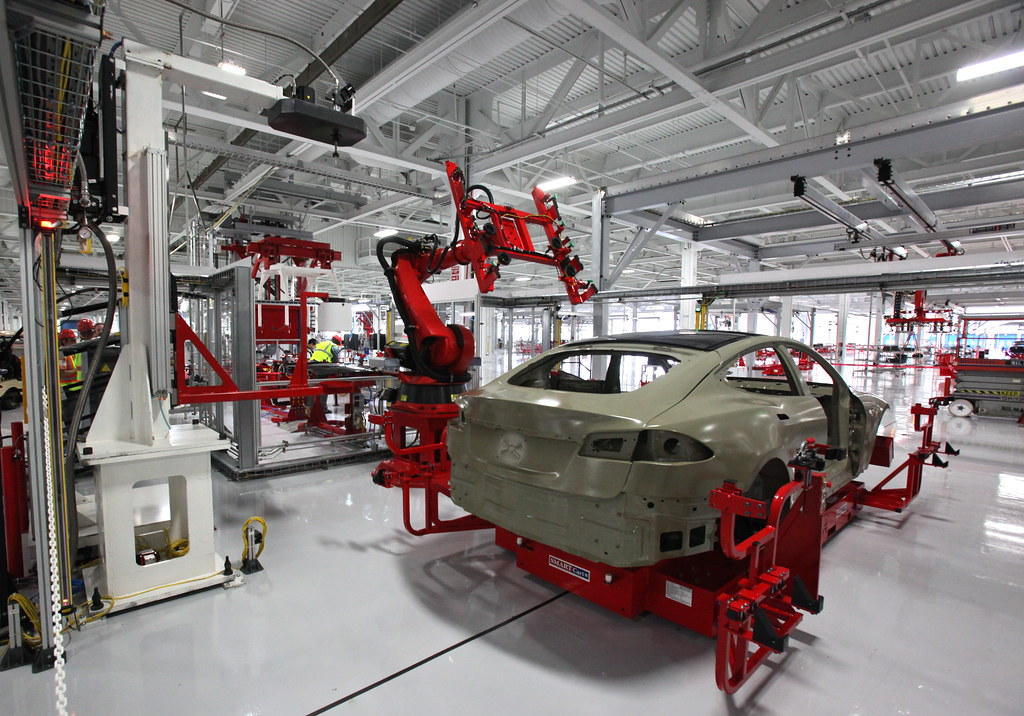
Why Tesla Built Gigapress 2.0
The answer lies in Tesla’s upcoming affordable EV — the Tesla Model 2.
Musk has hinted this vehicle could start at $29,990 and potentially become Tesla’s highest-volume model ever.
Production targets?
Some estimates suggest 30 to 40 million units over its lifecycle.
At first, critics dismissed that as another ambitious Musk projection.
But when Gigapress 2.0 entered the conversation, skepticism began turning into curiosity.
Because suddenly, the numbers started making sense.
How Gigapress 2.0 Actually Works
Let’s go inside the machine.
1. Material Preparation
Tesla uses high-quality aluminum alloy heated to approximately 850°C.
What makes this process unique?
- A blend of pure aluminum + recycled aluminum
- A dual-furnace system:
- One natural gas furnace for extreme heating
- One electric furnace for temperature stabilization
This parallel setup:
- Improves energy efficiency
- Reduces oxidation
- Maintains consistent alloy quality
- Supports Tesla’s sustainability goals
2. Mold Preparation & Lubrication
Before injection, robots apply a fine layer of soybean oil to the mold.
This small detail is critical.
It:
- Prevents aluminum from sticking
- Reduces mold wear
- Ensures smooth release
- Minimizes defects
Precision at this stage determines final part quality.
3. Vacuum Air Removal
Air trapped in molds can ruin a casting.
So Tesla deploys a vacuum system that removes every trace of trapped air before injection.
No bubbles. No weak points. No internal flaws.
4. High-Speed Aluminum Injection
Here’s where things get wild.
A high-speed piston injects molten aluminum into the mold in mere milliseconds.
The metal fills every intricate cavity instantly.
This process generates enormous pressure — and that’s where the 50,000-ton clamping force becomes essential.
Without that pressure, molds could crack or deform.
With it?
You get structural perfection.
5. Solidification & Quenching
Once injected, the aluminum solidifies inside the mold.
The part exits at nearly 500°C and is immediately submerged in a cold-water bath.
This process — known as quenching — dramatically:
- Increases tensile strength
- Enhances stiffness
- Improves surface hardness
- Reduces production time
The result? A stronger, lighter vehicle foundation.
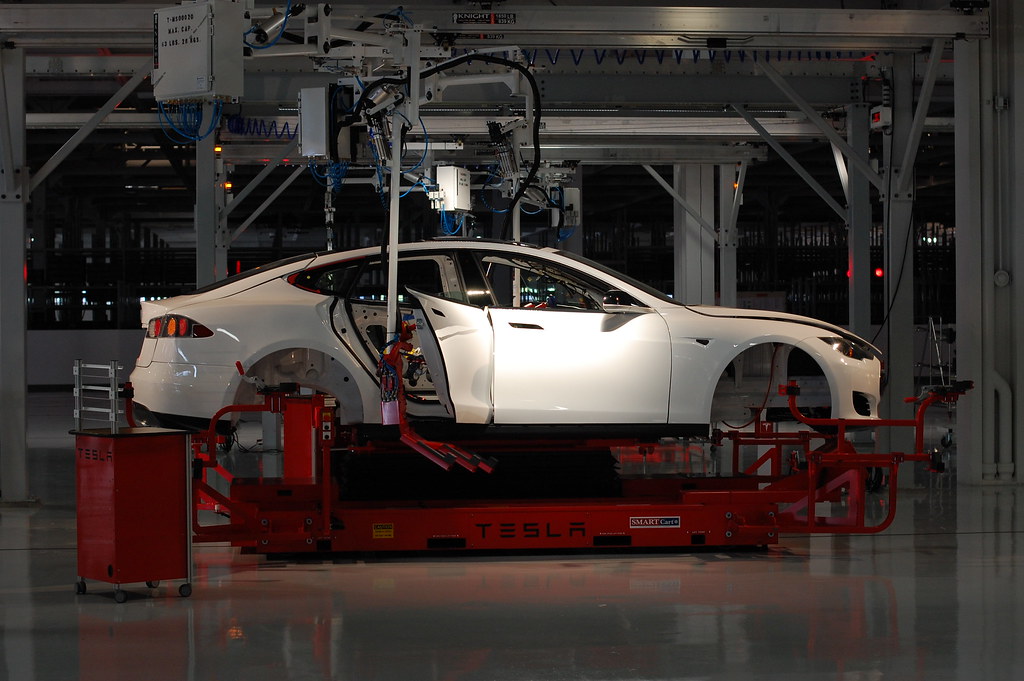
Why Humans Can’t Get Close
Gigapress 2.0 operates at extreme:
- Temperatures
- Speeds
- Pressure levels
The machine’s power and movement are so intense that production zones are heavily automated.
Humans are largely removed from the immediate area.
Tesla’s strategy isn’t just automation.
It’s hyper-automation.
From 200+ Parts to Just 90 Structural Components
The Tesla Model Y uses over 200 structural parts.
The upcoming Tesla Model 2 is expected to use around 90.
That’s nearly a 60% reduction in part count.
Fewer parts means:
- Fewer welds
- Fewer robots
- Fewer errors
- Faster assembly
- Lower cost
This is how Tesla can realistically approach a $30,000 EV price point.
Closed-Loop Recycling: Zero Waste Strategy
After every casting cycle:
- Excess aluminum is collected
- Recycled immediately
- Reintroduced into production
This creates a closed-loop system that:
- Reduces waste
- Cuts material costs
- Improves sustainability
- Strengthens Tesla’s environmental positioning
X-Ray Quality Inspection
Before moving forward, every casting undergoes X-ray scanning.
This ensures:
- No internal fractures
- No air pockets
- No hidden weaknesses
Tesla isn’t sacrificing quality for speed.
They’re enhancing both simultaneously.
The Model 2: Tesla’s Affordable EV Revolution
The Model 2 is expected to be Tesla’s first compact hatchback, targeting mass markets in Europe and Asia.
It will differ significantly from:
- Tesla Model 3
- Tesla Model Y
Rumored features include:
- Short overhangs
- Aggressive new headlight design
- Ultra-minimalist interior
- Compact urban-friendly dimensions
But the real breakthrough lies in battery technology.
LFP Battery Breakthrough
To keep costs down, Tesla is expected to use Lithium Iron Phosphate (LFP) batteries.
These batteries traditionally had lower energy density — but new cell designs are changing that perception.
Projected performance:
- Up to 300 miles (≈500 km) range
- 5% to 80% charge in 15 minutes
- Better cold-weather performance
- Lower cost per kWh
For a sub-$30,000 EV, that’s groundbreaking.
What This Means for the Global Auto Industry
Gigapress 2.0 isn’t just a machine.
It represents:
- A new manufacturing philosophy
- A cost compression strategy
- A scalability breakthrough
- A structural redesign of vehicle engineering
China built dominance through scale.
Tesla is building dominance through radical simplification and automation.
And if Musk’s claims hold true, automotive manufacturing may never look the same again.
Is Tesla Really That Far Ahead?
Here’s the uncomfortable truth for competitors:
- Tesla reduces part count
- Tesla eliminates welds
- Tesla removes labor bottlenecks
- Tesla increases speed
- Tesla lowers cost
- Tesla improves strength
All simultaneously.
That combination is extremely difficult to replicate.
Because it’s not just about building a bigger machine.
It’s about redesigning the entire car around the machine.
Final Thoughts: A Manufacturing Earthquake
For years, the affordable Tesla was rumored, delayed, canceled, revived.
But this time feels different.
With Gigapress 2.0 ready to deploy and the Model 2 nearing launch, Tesla appears poised to trigger a manufacturing earthquake.
If a $29,990 EV with 300 miles of range and ultra-fast charging hits global markets — produced every 30 seconds — it could redefine:
- EV affordability
- Production speed
- Structural engineering
- Global competition
One thing is certain:
The age of traditional automotive manufacturing is ending.
And Tesla just pressed the start button on something much bigger.
FAQs
1. What is Tesla’s Gigapress 2.0?
Tesla, Inc.’s Gigapress 2.0 is a next-generation die-casting machine capable of producing massive single-piece vehicle structures with up to 50,000 tons of clamping force, dramatically reducing production time and part count.
2. How fast can Gigapress 2.0 produce car parts?
According to Elon Musk, Tesla aims to produce major structural components in seconds, potentially enabling a finished vehicle to roll off the line in under 30 seconds, though this depends on full production integration.
3. What makes Gigapress 2.0 different from previous versions?
Earlier Gigapress machines used around 6,000 tons of force. Gigapress 2.0 reportedly uses 50,000 tons, allowing Tesla to cast an entire underbody in a single shot, and possibly produce multiple frames per cycle.
4. Which Tesla models use Gigapress technology?
The Tesla Model Y already uses large single-piece castings. The upcoming Tesla Model 2 is expected to rely heavily on Gigapress 2.0 for even greater manufacturing efficiency.
5. How does Gigapress reduce vehicle production costs?
By replacing dozens of welded parts with one large casting, Tesla eliminates:
- Hundreds of welds
- Multiple assembly steps
- Excess labor
- Extra robots
This dramatically lowers manufacturing costs and complexity.
6. Why is the 50,000-ton clamping force important?
The immense pressure ensures the mold stays sealed during high-speed aluminum injection, preventing defects and enabling larger, more complex single-piece castings.
7. What material does Tesla use in the Gigapress process?
Tesla uses a specially engineered aluminum alloy blend, combining pure aluminum with recycled material, melted at approximately 850°C for optimal casting performance.
8. How does Tesla ensure quality in Gigapress castings?
Each casting undergoes:
- Vacuum air removal before injection
- Precision mold lubrication
- Rapid quenching for strength
- X-ray scanning to detect internal defects
This ensures durability and structural integrity.
9. Why can humans not stand close to Gigapress 2.0?
The machine operates at extreme temperatures and pressure levels. The injection speed and clamping force create a highly automated, high-energy environment that is unsafe for close human proximity during operation.
10. How many parts will the Tesla Model 2 have?
Reports suggest the Tesla Model 2 could use around 90 structural parts, compared to over 200 in the Model Y — a reduction of nearly 60%.
11. What is the expected price of the Tesla Model 2?
Tesla has hinted the Model 2 could start around $29,990, positioning it as one of the most affordable long-range EVs on the market.
12. What battery technology will the Model 2 use?
The Model 2 is expected to use Lithium Iron Phosphate (LFP) batteries, offering:
- Lower cost
- Improved durability
- Fast charging capability
- Up to ~300 miles (≈500 km) of range
13. How fast can the Model 2 charge?
New-generation LFP cells may allow the Model 2 to charge from 5% to 80% in approximately 15 minutes, depending on charging infrastructure.
14. How does Gigapress 2.0 impact sustainability?
Tesla uses a closed-loop recycling system, where excess aluminum from each casting is re-melted and reused. This reduces waste, lowers raw material demand, and improves environmental efficiency.
15. Could Gigapress 2.0 change the entire auto industry?
Yes. If Tesla achieves mass production at unprecedented speeds while maintaining quality and reducing costs, Gigapress 2.0 could redefine global automotive manufacturing standards and force competitors to rethink traditional assembly methods.
Read More:
- Tesla wins FCC approval for wireless Cybercab charging system
- Tesla Giga Berlin plant manager faces defamation probe after IG Metall union complaint
- Elon Musk’s xAI Secures $3B Investment From Saudi AI Firm HUMAIN
- Musk company boycott proposal at City Council meeting gets weird and ironic
- Tesla dominates JD Power EV Satisfaction ranking, grabbing top two spots