
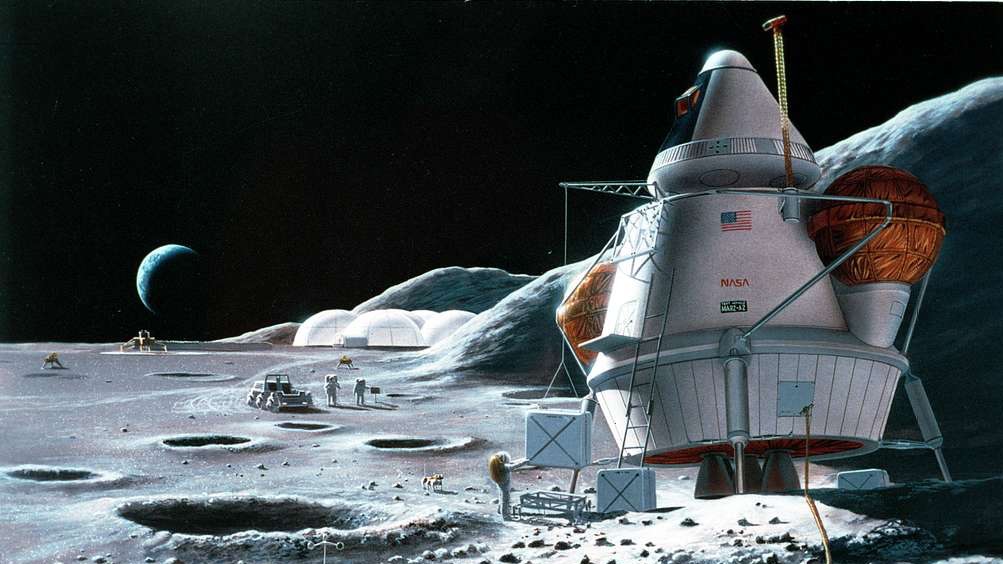
How NASA Will Build a Moon Base: The dream of establishing a permanent human presence on the Moon is rapidly transitioning from science fiction to reality. Through the ambitious Artemis Program, NASA is leading an unprecedented effort to build a sustainable lunar outpost at the Moon’s South Pole. Unlike the Apollo missions, which focused on short-term exploration and scientific discovery, Artemis is designed to create long-term infrastructure, unlock valuable resources, and lay the groundwork for a thriving lunar economy.
This historic initiative is unfolding amid a new era of geopolitical competition. The lunar South Pole has emerged as one of the most strategically important locations beyond Earth, attracting the attention of major space powers due to its abundant water ice reserves, continuous sunlight zones, and potential for future industrial development. As the United States and its international partners move forward with Artemis, China and its allies are pursuing their own lunar ambitions, creating what many experts describe as the next great space race.
In this article, we’ll explore exactly how NASA will build a Moon base, the technologies involved, the challenges ahead, and why this mission could redefine humanity’s future in space.
The Artemis Vision: Beyond Flags and Footprints
NASA’s Artemis Program represents a dramatic shift in lunar exploration strategy. Instead of sending astronauts for brief visits, the agency aims to establish a permanent lunar infrastructure network capable of supporting scientific research, resource extraction, and future missions to Mars.
The primary target is the Moon’s South Pole, a region believed to contain vast quantities of frozen water trapped within permanently shadowed craters. Water is arguably the most valuable resource in space because it can be converted into drinking water, breathable oxygen, and rocket fuel.
By building an operational presence around these resources, NASA hopes to create a self-sustaining lunar ecosystem that reduces dependence on supplies launched from Earth.
Why the Lunar South Pole Matters
Continuous Solar Energy
One of the most attractive features of the lunar South Pole is the presence of elevated ridges that receive near-continuous sunlight throughout the year. These areas, often called the Peaks of Eternal Light, provide ideal locations for solar power generation.
Reliable solar energy is critical for powering:
- Lunar habitats
- Communication systems
- Scientific laboratories
- Resource extraction facilities
- Autonomous robots and vehicles
Massive Water Ice Deposits
Adjacent to these sunlit ridges are deep craters that remain in permanent darkness. Temperatures inside these regions can reach extreme lows, preserving water ice that has accumulated over billions of years.
These deposits could support:
- Human survival
- Agricultural systems
- Oxygen production
- Hydrogen fuel manufacturing
- Deep-space transportation networks
This combination of sunlight and water makes the South Pole the most valuable real estate on the Moon.
The New Glenn Explosion: A Major Setback for Lunar Logistics
Before NASA can establish a Moon base, it must first develop reliable transportation systems capable of delivering cargo, equipment, and astronauts to the lunar surface.
A key component of this strategy involves commercial partnerships with private aerospace companies. One of the most important contributors is Blue Origin and its heavy-lift New Glenn rocket.
The Cape Canaveral Incident
On May 28, 2026, New Glenn suffered a catastrophic failure during an engine hot-fire test at Launch Complex 36 in Cape Canaveral.
The explosion caused extensive damage to launch infrastructure and immediately raised concerns about Artemis timelines.
Damage Assessment
Despite the severity of the blast, several critical systems survived:
- Liquid hydrogen storage facilities remained intact.
- Liquid oxygen tanks were undamaged.
- Methane storage infrastructure survived.
- Core launch tower components were considered repairable.
Blue Origin leadership expressed confidence that recovery efforts would allow New Glenn to return to service before the end of 2026.
Why This Matters for Artemis
The New Glenn rocket is expected to play a crucial role in transporting lunar cargo and supporting future Moon base construction efforts. Any delays could impact the delivery schedule for critical infrastructure components.
However, NASA’s diversified partnership strategy helps reduce dependence on any single launch provider.
Moonbase Phase 1: The Three Foundational Missions
NASA’s early lunar infrastructure strategy revolves around three specialized robotic missions designed to validate technologies and gather critical data.
Moonbase 1: Blue Origin’s Endurance Lander
The first mission involves Blue Origin’s Blue Moon Mark 1 spacecraft, known as Endurance.
This mission aims to land on the rugged terrain near Shackleton Ridge, one of the most strategically important areas at the South Pole.
Mission Objectives
Key goals include:
- Testing landing technologies
- Evaluating surface conditions
- Validating propulsion systems
- Collecting environmental data
Important Payloads
SCALPS Camera System
The Stereo Cameras for Lunar Plume-Surface Studies will analyze how rocket exhaust affects lunar soil during landing operations.
Understanding dust behavior is essential because lunar regolith can damage equipment and habitats.
Laser Retroreflector Array (LRA)
This passive navigation beacon will help future spacecraft land with greater precision by reflecting laser signals from orbiting satellites.
Moonbase 2: Astrobotic’s Griffin Mission
The second mission focuses on robotic exploration and mobility testing.
Using the Griffin lander, Astrobotic plans to deploy the FLIP Rover near Noble Crater.
What the FLIP Rover Will Do
The rover will test:
- Advanced battery technologies
- Autonomous navigation systems
- Rugged lunar tires
- AI-powered route planning
These technologies are essential for future lunar construction and mining operations.
Moonbase 3: Intuitive Machines and Reiner Gamma
The third mission takes a different scientific approach by investigating the mysterious Reiner Gamma Swirl.
Unlike the South Pole missions, this expedition focuses on understanding natural magnetic anomalies found on the lunar surface.
Why Reiner Gamma Is Important
Scientists believe localized magnetic fields in this region create a protective shield against solar radiation.
Understanding these natural defenses could help engineers develop radiation protection systems for future lunar habitats.
The Moonfall Drone Fleet: Mapping the Future Moon Base
One of the most innovative components of NASA’s lunar strategy is the Moonfall Drone Program.
Developed by engineers at NASA’s Jet Propulsion Laboratory (JPL), these autonomous flying robots are designed to operate in the Moon’s airless environment.
Unlike traditional rovers, Moonfall drones use propulsion systems to perform controlled hops across the surface.
Ultra-High-Resolution Mapping
Current lunar maps typically offer resolutions of approximately one meter per pixel.
Moonfall drones aim to improve this dramatically by producing maps with resolutions as detailed as one centimeter per pixel.
This unprecedented accuracy will allow NASA to:
- Identify safe landing zones
- Locate infrastructure sites
- Analyze geological features
- Plan transportation routes
Ice Detection and Resource Assessment
Each drone carries advanced ground-penetrating radar systems capable of scanning beneath the lunar surface.
These instruments will help determine:
- Ice concentration
- Deposit depth
- Resource quality
- Extraction feasibility
Establishing Operational Boundaries
After completing their surveys, Moonfall drones will position themselves around strategic locations near the future base.
This network of autonomous assets creates a continuous operational presence that supports communication, navigation, and monitoring activities.
Lunar Terrain Vehicles: Transportation for the Moon
A successful Moon base requires reliable transportation systems capable of moving astronauts and cargo across vast distances.
To address this challenge, NASA has selected two competing Lunar Terrain Vehicle (LTV) concepts.
FLEX Rover by Astrolab
The FLEX Rover is designed as a highly adaptable platform capable of transporting both equipment and astronauts.
Key advantages include:
- Modular cargo systems
- Scalable architecture
- Autonomous operations
- Long-distance travel capability
Pegasus Rover by Lunar Outpost
Developed in partnership with General Motors and Goodyear, the Pegasus Rover prioritizes durability and reliability.
The vehicle is engineered to withstand the Moon’s harsh environmental conditions while supporting long-duration missions.
Transformer-Inspired Design
One of the most remarkable aspects of both rover systems is their ability to fold into compact transportation configurations.
After landing on the Moon, the vehicles can autonomously unfold and prepare themselves for operation.
Performance Capabilities
The LTVs are expected to feature:
- Up to 200 kilometers of range
- Autonomous navigation
- Manual driving modes
- Operation during lunar night
- Extreme temperature resistance
These capabilities will significantly expand the reach of lunar explorers.
Designing a Lunar Megacity
When people imagine a Moon base, they often picture a densely packed colony. In reality, NASA’s vision resembles a distributed industrial network spread across hundreds of square miles.
The Dust Problem
Lunar dust presents one of the greatest engineering challenges.
When spacecraft land, engine exhaust creates powerful dust storms that can launch abrasive particles at extremely high speeds.
This phenomenon can damage:
- Solar panels
- Habitat windows
- Scientific instruments
- Communication equipment
Strategic Infrastructure Separation
To mitigate these risks, NASA plans to separate critical facilities across large distances.
Landing Zones
Landing pads will be located miles away from living quarters.
Habitat Areas
Astronaut habitats will occupy elevated terrain protected from debris.
Power Stations
Energy generation systems may be isolated to reduce interference and improve safety.
Mining Facilities
Resource extraction operations will be positioned close to ice-rich craters.
This distributed architecture improves safety while maximizing operational efficiency.
Creating a Self-Sustaining Lunar Economy
Perhaps the most revolutionary aspect of NASA’s Moon base strategy is its emphasis on economic sustainability.
The Apollo era depended entirely on government funding. Artemis seeks to create a commercial ecosystem that attracts private investment.
Water as the Foundation of Space Commerce
Water ice is expected to become the cornerstone of the lunar economy.
Through processing facilities, water can be separated into:
- Hydrogen
- Oxygen
Together, these elements form one of the most effective rocket propellants available.
Fuel Depots in Space
Instead of launching fuel from Earth, future spacecraft may refuel directly on the Moon.
This approach offers several advantages:
- Reduced launch costs
- Increased mission flexibility
- Expanded deep-space exploration
- Greater commercial opportunities
Private Sector Participation
Numerous private companies are already investing in lunar technologies.
These organizations view the Moon as:
- A transportation hub
- A mining destination
- A scientific marketplace
- A stepping stone to Mars
By creating economic incentives, NASA hopes to ensure the long-term viability of lunar settlement efforts.
The Geopolitical Race for Lunar Dominance
The Moon is becoming a focal point of international competition.
The United States and its Artemis partners are pursuing one vision for lunar development, while China is advancing its own independent program.
Strategic Importance
Control over key lunar resources could influence:
- Space transportation networks
- Scientific leadership
- Technological innovation
- Future interplanetary commerce
As a result, nations are increasingly viewing lunar infrastructure as a strategic asset.
The Artemis Accords
The Artemis Accords have attracted dozens of participating nations that support principles of peaceful exploration, transparency, and international cooperation.
This coalition forms the backbone of NASA’s broader lunar strategy.
The Road to a Permanent Human Presence
Building a Moon base is one of the most ambitious engineering projects ever attempted.
NASA’s approach combines:
- Government leadership
- Commercial innovation
- Autonomous robotics
- Resource utilization
- International partnerships
Each mission, rover, drone, and lander contributes to a larger vision of creating a permanent human foothold beyond Earth.
Conclusion
The answer to how NASA will build a Moon base lies in a carefully orchestrated combination of advanced technology, commercial partnerships, robotic exploration, and resource development. Through the Artemis Program, NASA is transforming the Moon from a destination for short scientific visits into a permanent frontier for human civilization.
Although challenges remain—including launch failures, harsh environmental conditions, and intense geopolitical competition—the overall momentum behind lunar development continues to accelerate. From autonomous Moonfall drones and next-generation Lunar Terrain Vehicles to water ice mining and commercial fuel production, every element of the plan is designed to support a sustainable off-world economy.
The Moon is no longer just a symbol of exploration. It is becoming the foundation of humanity’s future in space. If Artemis succeeds, the lunar South Pole may soon host the first permanent human settlement beyond Earth, serving as the gateway to Mars and the wider solar system.
FAQs
1. What is NASA’s Artemis Program?
NASA’s Artemis Program is a long-term lunar exploration initiative designed to return humans to the Moon, establish a sustainable lunar presence, and prepare for future missions to Mars.
2. Why is NASA building a Moon base?
NASA aims to build a Moon base to support scientific research, test deep-space technologies, utilize lunar resources, and create a permanent human presence beyond Earth.
3. Where will NASA’s Moon base be located?
The planned Moon base will be located near the lunar South Pole, a region believed to contain significant water ice deposits and areas that receive near-continuous sunlight.
4. Why is the lunar South Pole important?
The South Pole contains water ice reserves, permanently shadowed craters, and sunlit ridges that can provide sustainable energy for future lunar operations.
5. What role does water ice play in lunar exploration?
Water ice can be converted into drinking water, oxygen, and rocket fuel, making it one of the most valuable resources for long-term lunar habitation.
6. What is Blue Origin’s role in the Moon base project?
Blue Origin is developing the Blue Moon lander and the New Glenn rocket, both of which are expected to support cargo deliveries and future astronaut missions to the Moon.
7. What happened during the New Glenn rocket explosion?
During a hot-fire test in May 2026, Blue Origin’s New Glenn rocket experienced a catastrophic failure at Cape Canaveral, causing significant damage to launch infrastructure.
8. What is the Endurance lunar lander?
Endurance is Blue Origin’s Blue Moon Mark 1 spacecraft, designed to demonstrate lunar landing technologies and validate systems needed for future missions.
9. What is the purpose of the Moonbase 1 mission?
Moonbase 1 aims to test landing technologies, study lunar dust behavior, and gather data that will support future human landings.
10. What is the FLIP rover?
The FLIP (Flexible Logistics and Exploration) Rover is a robotic scout vehicle designed to test batteries, mobility systems, and autonomous navigation in the Moon’s harsh environment.
11. What are Moonfall drones?
Moonfall drones are autonomous flying robots being developed to map lunar terrain, identify water ice deposits, and help establish operational zones around future lunar infrastructure.
12. How will NASA map lunar resources?
NASA plans to use high-resolution cameras, ground-penetrating radar, and autonomous drones to locate and assess underground water ice and other valuable resources.
13. What are Lunar Terrain Vehicles (LTVs)?
LTVs are next-generation lunar rovers that will transport astronauts and cargo across the Moon’s surface while operating in extreme temperatures and rough terrain.
14. How far can Lunar Terrain Vehicles travel?
NASA’s planned Lunar Terrain Vehicles are expected to travel up to 200 kilometers on a single charge, significantly expanding astronaut mobility.
15. How will astronauts be protected from radiation on the Moon?
NASA is studying natural magnetic anomalies, such as those found at Reiner Gamma, to develop technologies that can shield astronauts from harmful cosmic radiation.
16. Will the Moon base become self-sustaining?
NASA’s long-term goal is to create a self-sustaining lunar economy by using local resources, especially water ice, to reduce dependence on supplies from Earth.
17. How could the Moon support a space economy?
The Moon could become a hub for fuel production, resource extraction, scientific research, and commercial space operations, creating new economic opportunities beyond Earth.
18. How will a Moon base help future Mars missions?
A permanent lunar outpost will allow NASA to test technologies, life-support systems, and resource utilization methods needed for long-duration missions to Mars and deeper into the solar system.
Read More:
- Tesla just did something in South Korea that no foreign carmaker has ever done
- Tesla tipped its hand at where Robotaxi is heading next
- Tesla revises FSD transfer policy on new Cybertruck trim, causing cancellations
- Elon Musk CONFIRMED! Tesla Cybercab Mass Deliveries Are Finally Here
- SpaceX just Did Something Impossible on Flight 13 Booster! Double Static Fire Tests Ready
1 thought on “How NASA Will Build a Moon Base”