
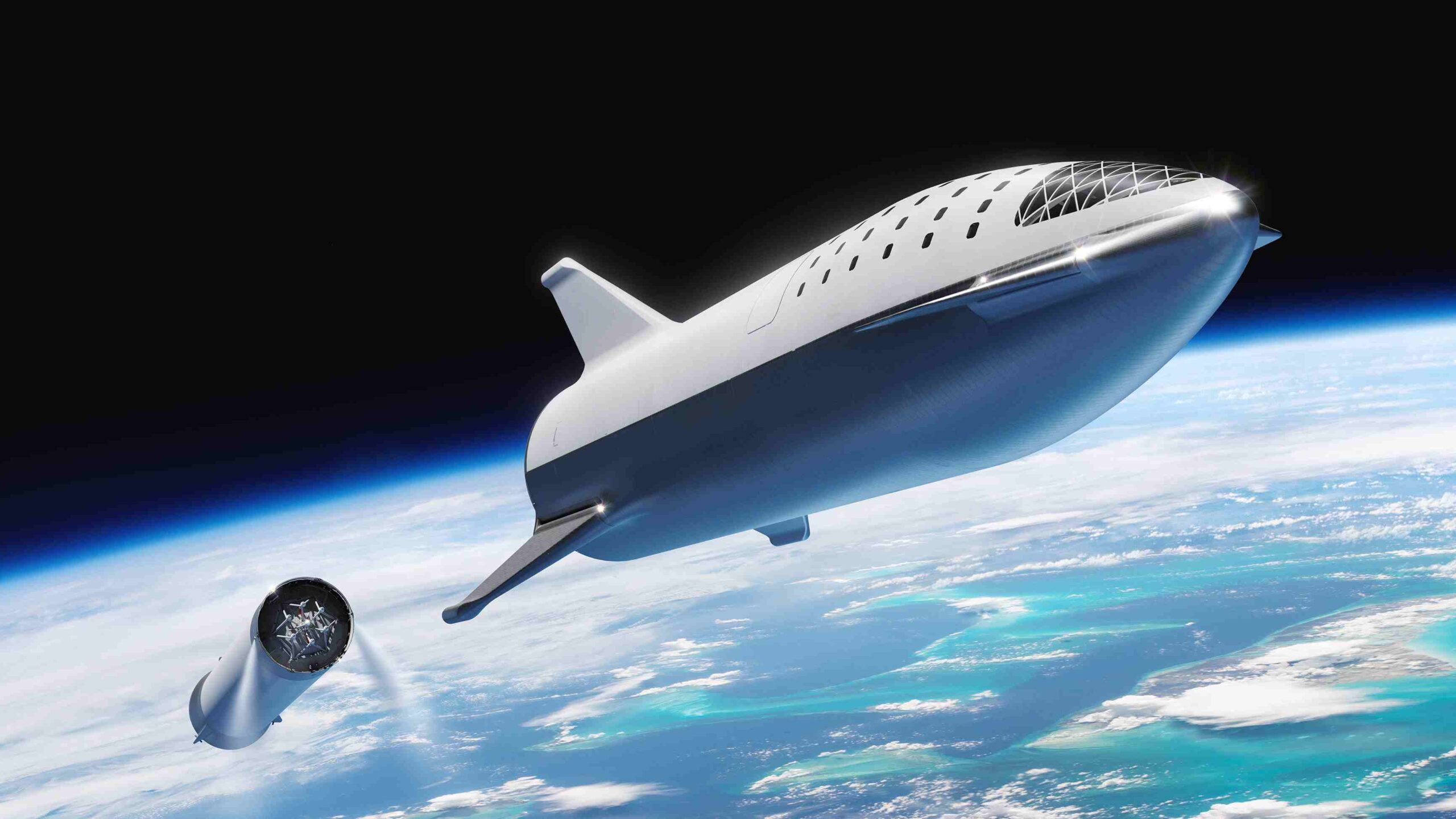
Elon Musk Reveals New Insane Project – SpaceX, Starship & AI: The world is entering a transformative age where space exploration, artificial intelligence, advanced manufacturing, and renewable energy infrastructure are no longer separate industries. Instead, they are converging into a unified ecosystem capable of reshaping human civilization forever.
At the center of this revolution stands Elon Musk, whose ambitious vision through SpaceX, Starship, Starlink, and emerging AI initiatives aims to fundamentally change humanity’s future. While many people view these projects as independent ventures, they are actually interconnected components of a much larger strategy: enabling humanity to become a multi-planetary species and advancing civilization up the Kardashev Scale.
Recent developments, including the rapid evolution of Starship, the integration of advanced AI capabilities, and plans for massive semiconductor manufacturing facilities known as Terra Fab, reveal a roadmap unlike anything previously attempted in human history.
This vision extends beyond launching rockets or building internet satellites. It focuses on creating the infrastructure necessary for humanity to harness unprecedented amounts of energy, deploy massive AI systems in space, and eventually expand throughout the solar system.
Understanding the Kardashev Scale: Measuring Civilization’s Progress
What Is the Kardashev Scale?
One of the most important concepts behind SpaceX’s long-term strategy is the Kardashev Scale, developed by Russian astrophysicist Nikolai Kardashev.
Rather than measuring progress through GDP, population size, or military strength, the Kardashev Scale evaluates civilizations based on their ability to capture and utilize energy.
This framework provides a universal way of assessing technological advancement.
Type I Civilization: Planetary Mastery
A Type I Civilization can utilize all energy available on its home planet, including:
- Solar energy
- Geothermal energy
- Ocean energy
- Atmospheric energy
Humanity has not yet reached this level. Experts estimate that we currently exist as a Type 0 Civilization, still heavily dependent on fossil fuels and limited energy infrastructure.
Type II Civilization: Harnessing a Star
A Type II Civilization captures the entire energy output of its parent star.
This concept is often associated with structures such as a Dyson Swarm or Dyson Sphere, massive networks of satellites designed to collect solar energy directly from a star.
Type III Civilization: Galactic Scale Power
A Type III Civilization can utilize energy across an entire galaxy, controlling power resources from billions of star systems.
While this remains far beyond our current capabilities, it represents the ultimate long-term destination for advanced intelligent species.
Why Energy Is the Ultimate Metric of Progress
Every major leap in human civilization has been driven by greater access to energy.
From:
- Fire
- Agriculture
- Steam engines
- Electricity
- Nuclear power
Each breakthrough increased humanity’s capacity to perform work and solve increasingly complex challenges.
According to SpaceX’s long-term philosophy, moving up the Kardashev Scale requires three critical capabilities:
1. Mass Transportation to Orbit
Civilizations cannot expand into space without moving enormous quantities of infrastructure beyond Earth’s gravity well.
2. Massive Solar Energy Collection
Future civilizations will require terawatt-scale energy generation, far exceeding what current terrestrial grids can provide.
3. Advanced Artificial Intelligence Infrastructure
Managing a multi-planetary civilization will require AI systems capable of processing unimaginable volumes of data in real time.
Starship: Breaking Earth’s Gravitational Bottleneck
The Problem with Traditional Rockets
For decades, spaceflight has suffered from a major limitation: rockets were disposable.
After completing their missions, launch vehicles were destroyed, resulting in enormous costs and extremely limited launch frequencies.
Imagine if airlines threw away every airplane after a single flight. Air travel would become unaffordable.
The same economic reality applies to space transportation.
Elon Musk’s Reusable Rocket Revolution
SpaceX changed the aerospace industry with the introduction of Falcon 9, proving that rocket boosters could land safely and fly again.
However, Starship takes reusability to an entirely new level.
The system consists of:
- The Starship upper stage
- The Super Heavy booster
Both are designed to be rapidly reusable.
The Innovative Tower Catch System
One of the most revolutionary features of Starship is the tower catch mechanism.
Instead of carrying heavy landing legs, returning vehicles are captured by giant mechanical arms attached to the launch tower.
This approach:
- Reduces vehicle weight
- Increases payload capacity
- Simplifies operations
- Improves launch economics
The ultimate objective is achieving airline-like turnaround times measured in hours rather than months.
Starship’s Massive Lift Capacity
The Largest Flying Machine Ever Built
Starship is not merely another rocket.
It is the:
- Largest rocket ever constructed
- Most powerful launch system in history
- Highest-capacity reusable spacecraft ever designed
Its thrust already exceeds that of the legendary Saturn V rocket used during the Apollo Moon missions.
Future Starship versions are expected to produce nearly three times the thrust of Saturn V.
Transforming Global Launch Capacity
Historically, all launch providers combined have delivered approximately 2,500 metric tons to orbit annually.
SpaceX’s vision aims to increase that number dramatically.
Projected Starship deployment could eventually support:
More than 1,000,000 metric tons per year
This represents one of the largest infrastructure expansions in human history.
The Rise of Orbital AI Data Centers
AI’s Growing Energy Problem
Artificial intelligence is advancing rapidly, but modern AI systems require enormous amounts of power.
Large-scale AI training facilities consume:
- Gigawatts of electricity
- Massive cooling resources
- Extensive physical infrastructure
As AI models continue growing, terrestrial limitations become increasingly problematic.
Why Space Is the Perfect Environment for AI
Space offers unique advantages for next-generation computing.
Benefits include:
Unlimited Solar Energy
Solar panels in orbit receive continuous sunlight without weather disruptions.
Vast Expansion Potential
Unlike Earth, orbital infrastructure is not limited by land availability.
Reduced Resource Competition
Space-based facilities avoid placing additional strain on terrestrial power grids.
The Challenge of Cooling in Space
While space provides abundant energy, cooling presents a different engineering challenge.
No Atmosphere Means No Air Cooling
On Earth, data centers rely on:
- Air conditioning
- Water cooling systems
- Heat exchange networks
In space, there is no atmosphere.
Therefore, orbital AI systems must rely entirely on radiative cooling.
Radiative Cooling Solutions
Large thermal radiators release excess heat directly into the vacuum of space.
These systems become essential components of future orbital computing platforms.
AI Satellites: The Next Evolution of Space Infrastructure
Simpler Than Communication Satellites
Interestingly, AI compute satellites may be simpler than existing Starlink satellites.
Starlink spacecraft require:
- Complex antennas
- Laser communication systems
- Dynamic network routing
AI satellites focus primarily on:
- Processing power
- Power management
- Thermal regulation
- Data synchronization
Advanced Semiconductor Architectures
Future orbital AI platforms are expected to utilize advanced hardware including:
- Nvidia Blackwell architectures
- Specialized Tensor Processing Units (TPUs)
- Space-optimized AI accelerators
Because Starship dramatically reduces launch costs, these systems can use larger and more powerful hardware than traditional satellites.
Terra Fab: The Semiconductor Factory of the Future
Why Semiconductor Production Must Scale
Building orbital AI infrastructure requires an unprecedented increase in chip manufacturing.
Current global AI infrastructure is measured in gigawatts.
Future space-based AI networks will require production on a completely different scale.
The Terra Fab Vision
To support this growth, Elon Musk’s teams have proposed Terra Fab, a gigantic semiconductor manufacturing complex.
The facility is expected to cover approximately:
100 Million Square Feet
Making it one of the largest manufacturing operations ever conceived.
The Terra Fab Scaling Roadmap
Phase 1: One Gigawatt Per Year
The initial goal focuses on producing:
1 GW of AI compute hardware annually
Phase 2: Ten Gigawatts Per Year
Within approximately 2.5 years, production targets could increase tenfold.
Phase 3: One Hundred Gigawatts Per Year
The next stage aims to match current global AI infrastructure production.
Phase 4: One Terawatt Per Year
The ultimate goal is reaching:
1 Terawatt of AI Hardware Production Annually
This amount of computing power exceeds the energy consumption of many nations.
Why Space-Based AI Becomes Essential
Operating a terawatt-scale AI infrastructure on Earth would create enormous challenges:
- Grid overload
- Land requirements
- Environmental concerns
- Cooling limitations
Space eliminates many of these constraints.
By combining:
- Continuous solar energy
- Massive radiative cooling systems
- Virtually unlimited expansion potential
Orbital AI networks become a practical long-term solution.
The Moon: Humanity’s Future Industrial Hub
Why Lunar Manufacturing Makes Sense
As civilization expands, launching every component from Earth becomes inefficient.
The Moon offers two major advantages:
Low Gravity
The Moon’s gravity is only one-sixth that of Earth’s.
No Atmosphere
Without atmospheric drag, launching materials becomes dramatically easier.
Building Infrastructure from Lunar Resources
Future lunar industries could manufacture:
- Solar panels
- Structural supports
- Thermal radiators
- Satellite frames
Using locally sourced lunar materials.
Only highly advanced semiconductor components may initially need to be imported from Earth.
This dramatically reduces transportation costs.
The Lunar Mass Driver Concept
A Revolutionary Launch System
Instead of relying on chemical rockets, future lunar infrastructure could utilize mass drivers.
A mass driver functions similarly to:
- Magnetic railguns
- Maglev train systems
- Electromagnetic launch tracks
How It Works
Using electricity generated by lunar solar farms, payloads are accelerated along massive electromagnetic tracks.
Because there is no atmosphere:
- No aerodynamic drag exists
- No fuel is required during launch
- Deployment costs become dramatically lower
This system could enable continuous transportation of infrastructure throughout the solar system.
The SpaceX Civilization Loop
When viewed together, these technologies form a self-reinforcing cycle.
Starship
Provides low-cost transportation to orbit.
Terra Fab
Produces advanced AI hardware.
Orbital AI Infrastructure
Processes vast amounts of information.
Lunar Manufacturing
Supplies materials for expansion.
Mass Drivers
Deploy infrastructure throughout the solar system.
Each component strengthens the others.
The result is a scalable framework for building a true multi-planetary civilization.
The Future of Humanity Beyond Earth
Human civilization is approaching a historic inflection point.
For thousands of years, humanity remained confined to a single planet.
Today, breakthroughs in:
- Reusable rockets
- Artificial intelligence
- Semiconductor manufacturing
- Renewable energy systems
- Space infrastructure
are creating entirely new possibilities.
The combination of SpaceX, Starship, AI-powered orbital data centers, Terra Fab manufacturing, and lunar industrialization represents one of the most ambitious technological roadmaps ever proposed.
Whether every milestone unfolds exactly as envisioned remains uncertain. However, the direction is clear: humanity is building the foundations required to become a spacefaring civilization.
If successful, these interconnected technologies could help humanity climb the Kardashev Scale, unlock unprecedented energy abundance, and establish permanent settlements across the solar system.
The age of planetary civilization may soon give way to the age of interplanetary civilization, and Elon Musk’s vision could become one of the defining chapters in humanity’s journey toward the stars.
FAQs
1. What is Elon Musk’s new SpaceX and AI project?
Elon Musk’s latest vision combines SpaceX, Starship, artificial intelligence, and large-scale semiconductor manufacturing into a unified strategy aimed at creating a multi-planetary civilization. The project focuses on expanding humanity’s energy, computing, and space infrastructure capabilities.
2. What is the Kardashev Scale?
The Kardashev Scale is a method of measuring a civilization’s technological advancement based on its ability to harness and utilize energy. It classifies civilizations into Type I, Type II, and Type III levels.
3. Where does humanity currently rank on the Kardashev Scale?
Humanity is currently considered a Type 0 Civilization, meaning we have not yet fully harnessed all the energy available on Earth and still rely heavily on finite energy resources.
4. Why is Starship important for the future of civilization?
Starship is designed to dramatically reduce the cost of access to space through rapid reusability. Its massive payload capacity could enable the deployment of large-scale infrastructure in orbit, including satellites, solar power systems, and AI data centers.
5. How does Starship differ from traditional rockets?
Unlike traditional expendable rockets, Starship is fully reusable. Both the spacecraft and booster are designed to return, be refueled, and fly again, similar to commercial airplanes.
6. What is the tower catch system used by Starship?
The tower catch system uses giant mechanical arms on the launch tower to catch returning Starship vehicles. This eliminates the need for heavy landing legs, increasing payload capacity and improving efficiency.
7. What are orbital AI data centers?
Orbital AI data centers are proposed computing platforms located in space that use solar energy to power advanced artificial intelligence systems. These facilities could process enormous amounts of data without relying on Earth-based power grids.
8. Why would AI data centers be built in space?
Space provides access to continuous solar energy, unlimited expansion opportunities, and reduced strain on terrestrial infrastructure. These advantages make it attractive for future large-scale AI operations.
9. How are space-based AI systems cooled?
Since there is no atmosphere in space, orbital AI systems use radiative cooling panels that release heat into the vacuum of space instead of relying on air conditioning or water cooling.
10. What is Terra Fab?
Terra Fab is a proposed mega-scale semiconductor manufacturing facility designed to produce enormous quantities of AI hardware for both Earth-based and space-based computing infrastructure.
11. What is the goal of Terra Fab?
The long-term objective of Terra Fab is to scale AI hardware production from 1 gigawatt per year to 1 terawatt per year, supporting future orbital computing networks and advanced AI systems.
12. Why is the Moon important for future space infrastructure?
The Moon has low gravity and no atmosphere, making it an ideal location for manufacturing and launching large structures into space at significantly lower costs than Earth.
13. What is a lunar mass driver?
A lunar mass driver is an electromagnetic launch system that accelerates payloads using electrical energy instead of chemical rocket fuel. It could be used to launch satellites and infrastructure from the Moon into deep space.
14. How could AI help manage a multi-planetary civilization?
Advanced AI could coordinate transportation, manufacturing, communication, resource management, and scientific operations across Earth, the Moon, Mars, and future settlements throughout the solar system.
15. Could these technologies help humanity become a Type I or Type II civilization?
If successfully developed, technologies such as Starship, orbital AI infrastructure, space-based solar power, and lunar manufacturing could significantly accelerate humanity’s progress toward becoming a Type I Civilization and eventually lay the groundwork for a Type II Civilization.
Read More:
2 thoughts on “Elon Musk Reveals New Insane Project – SpaceX, Starship & AI”