
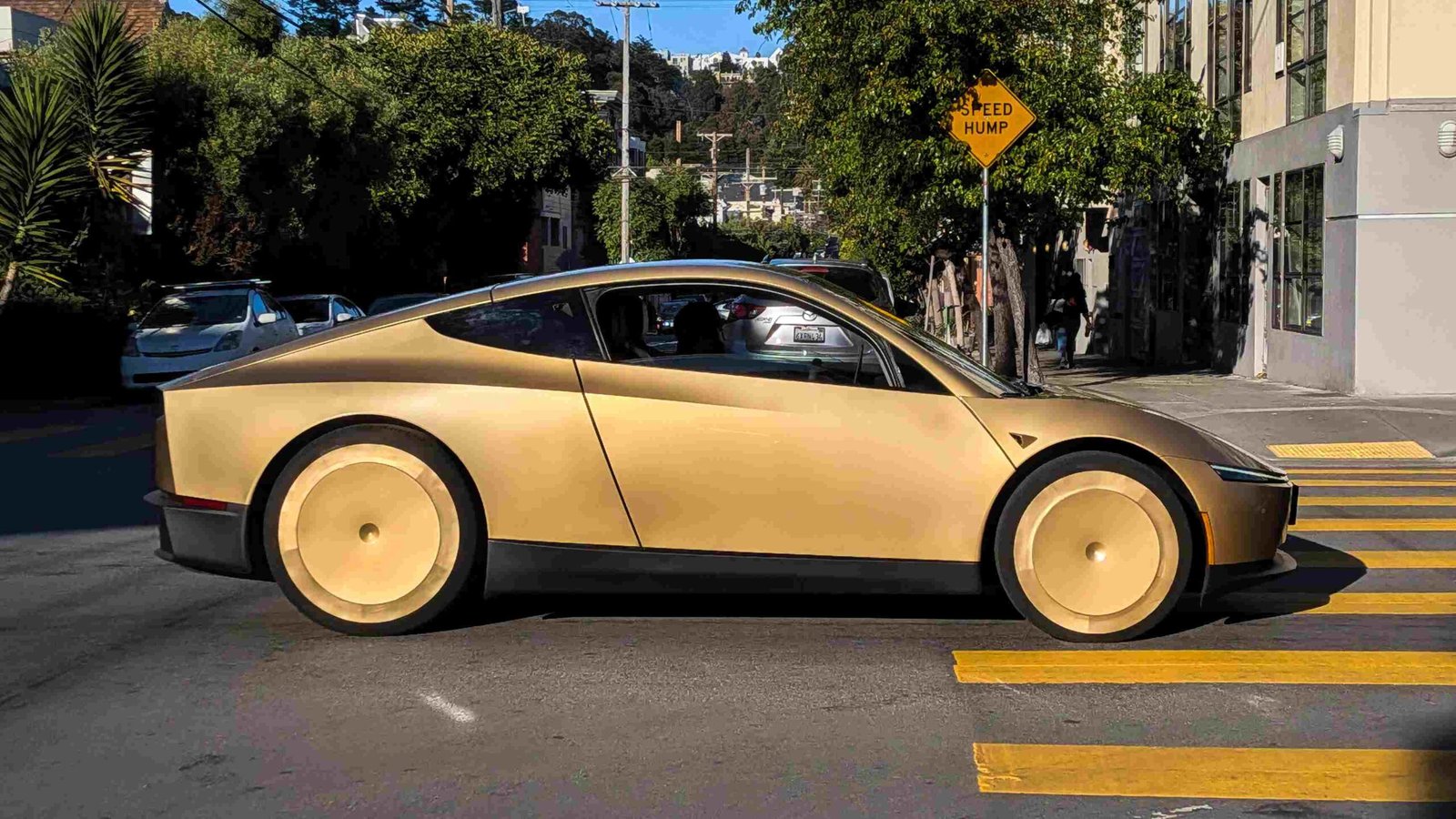
It Happened! Tesla Cybercab Gets 2 MASSIVE Upgrades Before Official Launch: The Tesla Cybercab is moving closer to becoming a major part of the future of urban transportation, and two important upgrades could make a bigger difference than they initially appear.
As Tesla continues testing Cybercab vehicles at Gigafactory Texas ahead of a planned public deployment in Austin, the focus is expanding beyond self-driving software. The latest developments point toward a more complete autonomous transportation system—one designed not only to drive without a human driver but also to communicate with passengers, pedestrians, and other road users.
The two standout upgrades are native tactile Braille labeling inside the vehicle and programmable RGB exterior lighting. Together, they address two major challenges facing robotaxis: accessibility and human-machine communication.
Tesla Cybercab’s Two Major Upgrades
For years, autonomous vehicle development has concentrated on perception systems, neural networks, sensor technology, and vehicle control. But building a commercially successful robotaxi requires much more.
A truly autonomous mobility network needs four interconnected layers:
- Perception and neural networks
- Vehicle motion control
- Human-machine interface (HMI)
- Commercial fleet scaling
The Cybercab’s latest design changes demonstrate how Tesla is addressing the third and fourth layers of this equation.
1. Built-In Braille for Better Accessibility
One of the most significant upgrades is the integration of Braille interfaces inside the Cybercab cabin.
Autonomous vehicles have the potential to dramatically increase mobility for people with visual impairments and other disabilities. However, relying almost entirely on smartphone applications or touchscreen interfaces can create accessibility problems.
Native tactile controls provide passengers with another way to interact with the vehicle.
These controls could help passengers:
- Request an emergency stop or pull-over
- Adjust climate or audio settings
- Confirm vehicle status
- Understand or operate doorway controls
- Maintain control without depending entirely on a smartphone
This approach follows the principles of Universal Design, where products and services are designed to be usable by as many people as possible regardless of physical or sensory ability.
Why Smartphone-Only Interfaces Aren’t Enough
Smartphone apps are convenient for requesting an autonomous ride, but they aren’t always reliable during unexpected situations.
A phone could have a dead battery, a damaged screen, connectivity problems, or an interface that is difficult for a particular passenger to navigate.
That is why physical accessibility features inside an autonomous vehicle matter. Braille and tactile controls provide a backup layer that can give passengers greater independence and confidence.
For a driverless vehicle, that sense of control could become an important part of the overall passenger experience.
2. Programmable RGB Lighting Changes Robotaxi Communication
The second major upgrade involves programmable RGB light strips mounted on the exterior of the Cybercab.
Removing the human driver also removes many subtle communication signals that people naturally rely on.
A conventional ride-hailing driver can wave to a passenger, make eye contact, gesture toward a pedestrian, or use headlights to communicate. A completely driverless vehicle cannot rely on these human behaviors.
This creates a new human-machine interface challenge.
Identifying the Correct Cybercab
Imagine leaving a concert or airport terminal and seeing several identical Cybercabs arriving at the same time.
Which vehicle is yours?
A programmable lighting system could provide the answer.
The Cybercab could potentially synchronize its external light color with information displayed through the passenger’s app. For example, a passenger might be assigned a specific color, while the matching vehicle displays that same color through its front light strip.
This creates a simple visual connection:
Passenger Match → App Color → Cybercab Light Color
Such a system could reduce confusion in busy pickup areas and potentially shorten curbside dwell times.
RGB Lighting Could Also Communicate With Pedestrians
The benefits of exterior lighting extend beyond passenger identification.
Autonomous vehicles operate in environments filled with pedestrians, cyclists, and other drivers. These road users need to understand what a driverless vehicle is doing.
Programmable lighting could eventually become a form of visual communication language.
For example, different lighting patterns could potentially indicate:
- Vehicle availability
- Passenger pickup status
- Vehicle arrival
- Loading or unloading
- Pedestrian detection
- Yielding or slowing behavior
A possible interaction could look like:
Vision System → Pedestrian Detected → RGB Signal → Vehicle Yields
The objective isn’t simply to make the Cybercab look futuristic. The lighting system could help create a standardized communication layer between autonomous vehicles and humans.
Cybercab Testing: From Giga Texas to Austin Streets
Before autonomous vehicles operate at commercial scale, they must undergo extensive testing.
Testing at Gigafactory Texas allows Tesla to repeatedly evaluate vehicle behavior under controlled conditions.
Cybercab testing can include demanding scenarios such as:
- High-speed lane transitions
- Emergency braking
- Sudden obstacle avoidance
- Stop-and-go driving
- Rough or cobblestone surfaces
- Suspension and chassis durability testing
- Sensor calibration validation
However, controlled testing can never fully replicate the complexity of a real city.
Real-World Autonomous Driving Is Much Harder
Urban environments introduce unpredictable variables.
A self-driving vehicle may encounter a pedestrian suddenly crossing the road, a cyclist changing direction without warning, construction zones, double-parked vehicles, unusual traffic patterns, or obscured road signs.
Pickup zones create another challenge. A robotaxi must find a safe place to stop without blocking traffic or creating additional hazards.
This is why the transition from test-track validation to real-world autonomous deployment represents one of the biggest challenges for the Cybercab program.
Fleet Scaling Could Become the Real Bottleneck
Getting regulatory permission to operate thousands of autonomous vehicles is only one part of the challenge.
The bigger question may be whether the physical infrastructure can actually support them.
A large-scale Cybercab fleet requires:
- Automated high-voltage charging
- Cleaning and sanitization facilities
- Vehicle maintenance and repair centers
- Sensor inspection and calibration
- Remote assistance and tele-operations
- Sophisticated ride-hailing dispatch systems
Tesla has reportedly been targeting an initial deployment of approximately 2,500 Cybercabs, despite a regulatory allowance that could permit a larger number.
That difference highlights an important reality: regulatory approval does not automatically equal operational capacity.
The Economics Behind Tesla’s Robotaxi Strategy
The financial appeal of autonomous ride-hailing comes largely from eliminating one of the biggest costs in traditional ride-hailing: the human driver.
In conventional transportation network companies, driver compensation can represent a substantial portion of fare revenue. Autonomous vehicles could fundamentally change that cost structure.
Instead of paying drivers, an autonomous fleet would primarily incur expenses such as:
- Electricity and charging
- Maintenance
- Insurance
- Software
- Depot operations
- Remote support
- Vehicle depreciation
The other major advantage is asset utilization.
A privately owned car can spend most of the day parked. An autonomous robotaxi, however, could potentially operate for much longer periods, only returning to a depot for charging, cleaning, or maintenance.
Some financial projections have estimated approximately $40,000 in annual net operating profit per optimized Cybercab.
At that level:
2,500 Cybercabs × $40,000 = $100 million in annual net operating profit
Of course, actual profitability will depend on utilization, pricing, energy costs, maintenance, insurance, regulatory requirements, and real-world operating performance.
Passenger Trust May Decide the Cybercab’s Future
Technology alone won’t guarantee mass adoption.
The biggest challenge could ultimately be passenger trust.
Entering a vehicle without a steering wheel or pedals requires a psychological adjustment. Passengers need to understand what the vehicle is doing and feel confident that they can interact with it when necessary.
Designing for Confidence
Several elements can help create that confidence:
- Smooth acceleration and braking
- Clear route and navigation displays
- Real-time visualization of the vehicle’s surroundings
- Accessible physical controls
- Clear external communication
- Predictable pickup behavior
The combination of Braille controls and RGB exterior lighting is therefore more significant than it may appear.
One feature gives passengers a greater sense of control inside the vehicle. The other helps the vehicle communicate with people outside it.
The Cybercab Is Becoming More Than a Car
The Tesla Cybercab represents a broader shift from thinking about autonomous vehicles as individual cars to viewing them as urban transportation infrastructure.
Self-driving technology remains the foundation, but commercial success depends on everything surrounding it: accessibility, human-machine interfaces, fleet logistics, regulatory compliance, passenger psychology, and economics.
The two latest upgrades demonstrate this transition clearly.
Braille interfaces can make the cabin more inclusive and reduce dependence on smartphone screens. Meanwhile, programmable RGB lighting can help solve the communication problems created when a human driver disappears.
If Tesla can successfully combine these features with reliable autonomous driving, efficient fleet operations, and a compelling economic model, the Cybercab could become more than another EV.
It could represent a new model for scalable, autonomous urban mobility.
The real test begins when these vehicles move from controlled testing environments into the unpredictable streets of the real world. That is where Tesla’s technology, business model, and human-centered design will ultimately have to prove themselves.
FAQs
1. What is the Tesla Cybercab?
The Tesla Cybercab is a fully autonomous electric robotaxi designed to provide driverless transportation. It is intended to operate without conventional steering controls or a human driver.
2. What are the two major Cybercab upgrades?
The two highlighted upgrades are built-in Braille/tactile labeling inside the cabin and programmable RGB exterior lighting. These features are designed to improve accessibility and communication between the vehicle, passengers, and pedestrians.
3. Why is Braille important in the Cybercab?
Braille controls can give visually impaired passengers a tactile way to interact with the vehicle. This can reduce dependence on smartphone apps and touchscreen interfaces for important functions.
4. How could Cybercab’s RGB lighting help passengers?
The programmable RGB light strip could help passengers identify their assigned Cybercab in crowded pickup locations. Matching colors or lighting patterns between the passenger app and vehicle could make pickups easier.
5. Can the Cybercab’s lights communicate with pedestrians?
Potentially, yes. Exterior lighting could become a visual communication system that indicates vehicle states or acknowledges situations such as pedestrian detection and yielding.
6. Why does an autonomous vehicle need a human-machine interface?
A human driver naturally communicates through eye contact, gestures, head movements, and other visual cues. A driverless vehicle needs alternative ways to communicate its intentions to passengers and other road users.
7. Where is Tesla testing the Cybercab?
Tesla has been testing Cybercab vehicles at Gigafactory Texas, where vehicles can undergo repeated validation in controlled environments before broader public deployment.
8. What challenges does Cybercab face in real-world driving?
Real-world cities introduce unpredictable conditions, including jaywalking pedestrians, cyclists, construction zones, double-parked vehicles, weather-related visibility issues, and complicated pickup areas.
9. How many Cybercabs could Tesla initially deploy?
The material discussed an initial target of approximately 2,500 Cybercabs, while also referencing a regulatory allowance of up to 5,000 autonomous vehicles.
10. What is the biggest challenge in scaling a Cybercab fleet?
Scaling involves much more than manufacturing vehicles. Tesla would need charging infrastructure, cleaning facilities, maintenance centers, sensor calibration, remote support, and sophisticated fleet-management systems.
11. How could Cybercabs make money?
The robotaxi business could reduce traditional ride-hailing’s dependence on human driver labor. Vehicles could potentially operate for longer periods, increasing utilization while generating revenue from passenger trips.
12. How much profit could one Cybercab potentially generate?
Some financial projections referenced in the analysis estimate approximately $40,000 in annual net operating profit per optimized Cybercab. Actual results could vary significantly depending on utilization, pricing, maintenance, insurance, energy costs, and other expenses.
13. Could 2,500 Cybercabs generate $100 million annually?
Using the stated projection of $40,000 per vehicle, the calculation would be 2,500 × $40,000 = $100 million in annual net operating profit. This is a projection rather than a guaranteed financial result.
14. Why is passenger trust important for robotaxis?
Passengers must feel comfortable entering and traveling in a vehicle without a human driver. Smooth driving, clear visual information, accessible controls, predictable behavior, and effective communication could all help increase passenger confidence.
15. Could the Tesla Cybercab change urban transportation?
Potentially. If Tesla can achieve reliable autonomous driving while solving accessibility, passenger trust, fleet management, regulatory, and economic challenges, the Cybercab could evolve from an autonomous vehicle into part of a larger urban mobility infrastructure.
Read More:
1 thought on “It Happened! Tesla Cybercab Gets 2 MASSIVE Upgrades Before Official Launch”