
The global space race has entered a defining chapter, and the stakes have never been higher. What was once framed as a balanced competition between NASA’s commercial partners has now evolved into a decisive shift in direction. The Artemis program—humanity’s bold initiative to return to the Moon—has undergone a quiet but profound transformation.
For years, the narrative revolved around two major players: SpaceX and Blue Origin. Both were expected to deliver competing lunar landers for the historic Artemis 3 mission. But as of April 2026, it is becoming increasingly clear that the competition is effectively over.
SpaceX’s Starship Human Landing System (HLS) has emerged as the only realistic path forward for Artemis 3—and possibly beyond.
The Artemis 3 Pivot: A Mission Redefined
From Lunar Landing to Orbital Testing
Originally envisioned as a triumphant return to the Moon, Artemis 3 was supposed to replicate the magic of Apollo 11 Moon Landing—but with modern technology. The mission architecture included launching astronauts aboard Orion via the Space Launch System (SLS), docking with a lunar lander in orbit, and descending to the lunar surface.
That vision has changed.
NASA has quietly restructured Artemis 3 into a Low Earth Orbit (LEO) test mission, now scheduled for mid-2027. Instead of landing on the Moon, astronauts will:
- Launch aboard Orion
- Rendezvous with a commercial lunar lander in Earth orbit
- Conduct docking, integration, and system validation tests
This pivot reflects a deeper reality: NASA is no longer willing to risk a full lunar landing without proven hardware.
Why Only One Lander Will Fly
While NASA publicly maintains that “one or both” landers could be tested, the economics and risks say otherwise. Launching two separate landers for a single mission would:
- Multiply costs into the billions
- Increase mission complexity
- Introduce unacceptable risk to crew safety
In practical terms, Artemis 3 has become a selection filter.
Whichever lander flies this mission will almost certainly be the one used for Artemis 4’s actual Moon landing.
The Rise of Starship HLS
A Spacecraft Unlike Any Before
The dominance of SpaceX comes down to one word: scale.
The Starship HLS is not just a lunar lander—it’s a full-fledged spacecraft. Standing over 50 meters tall, it dwarfs every previous human-rated lander in history.
To put that into perspective:
- Apollo Lunar Module: ~4.5 cubic meters of habitable space
- Starship HLS: ~614 cubic meters
That’s a 135x increase in living and working volume.
Habitability: The “Stay Factor”
NASA’s long-term goal is no longer just planting flags—it’s building a sustained presence on the Moon. This is where Starship HLS completely outclasses its competition.
Key advantages include:
- Massive interior space for extended missions
- Ability to support larger crews comfortably
- Room for scientific labs and equipment
This aligns with NASA’s evolving vision of establishing a permanent lunar foothold, often referred to as “Moon Base Alpha.”
Cargo Capability That Changes Everything
Starship HLS can deliver up to 100 tons of payload to the lunar surface. This enables:
- Deployment of pressurized rovers
- Installation of large solar arrays
- Transport of habitat modules
In contrast to short-term missions, this capability enables true lunar infrastructure development.
Blue Origin’s Blue Moon: Falling Behind
A Capable but Delayed Competitor
Blue Origin’s Blue Moon Mark 2 is a technically solid lander. At 16 meters tall and powered by BE-7 hydrogen engines, it represents a significant step forward compared to Apollo-era systems.
However, its challenges are substantial.
Development Bottlenecks
Blue Moon’s progress is tied to its uncrewed predecessor:
- The Mark 1 cargo variant is still under testing
- It lacks crew-ready systems like life support and docking interfaces
This dependency has slowed development significantly.
Timeline Disadvantages
Despite recent milestones, Blue Origin faces:
- At least two more years before a crew-capable version is ready
- Limited real-world testing compared to SpaceX
In the fast-moving Artemis timeline, this delay is critical.
The “Taxi” Limitation
Blue Moon is designed for:
- 2–4 astronauts
- Missions lasting up to 30 days
While impressive, it functions more like a lunar taxi rather than a long-term habitat.
NASA’s priorities have shifted toward sustainability and expansion, making Blue Moon less aligned with current goals.
The SpaceX Advantage: Proven Technology
Flight Heritage Matters
One of SpaceX’s biggest strengths is its reliance on existing, battle-tested systems.
The Starship HLS leverages technology from:
- The Dragon spacecraft program
- Repeated missions to the International Space Station
This includes the highly reliable Dragon Eye rendezvous sensors, which have successfully completed dozens of docking operations.
Rapid Iteration and Testing
Unlike traditional aerospace development, SpaceX thrives on rapid iteration:
- Continuous Starship test flights at Starbase
- Frequent upgrades and design improvements
- Aggressive timelines toward orbital refueling
Upcoming milestones include:
- Starship Version 3 (V3) flights
- Orbital refueling demonstrations—critical for lunar missions
This fast-paced development cycle has allowed SpaceX to outpace competitors by years.
The Artemis 4 Mission: Where It All Leads
If Starship HLS successfully completes Artemis 3 testing, Artemis 4 will become the true lunar landing mission.
Mission Breakdown
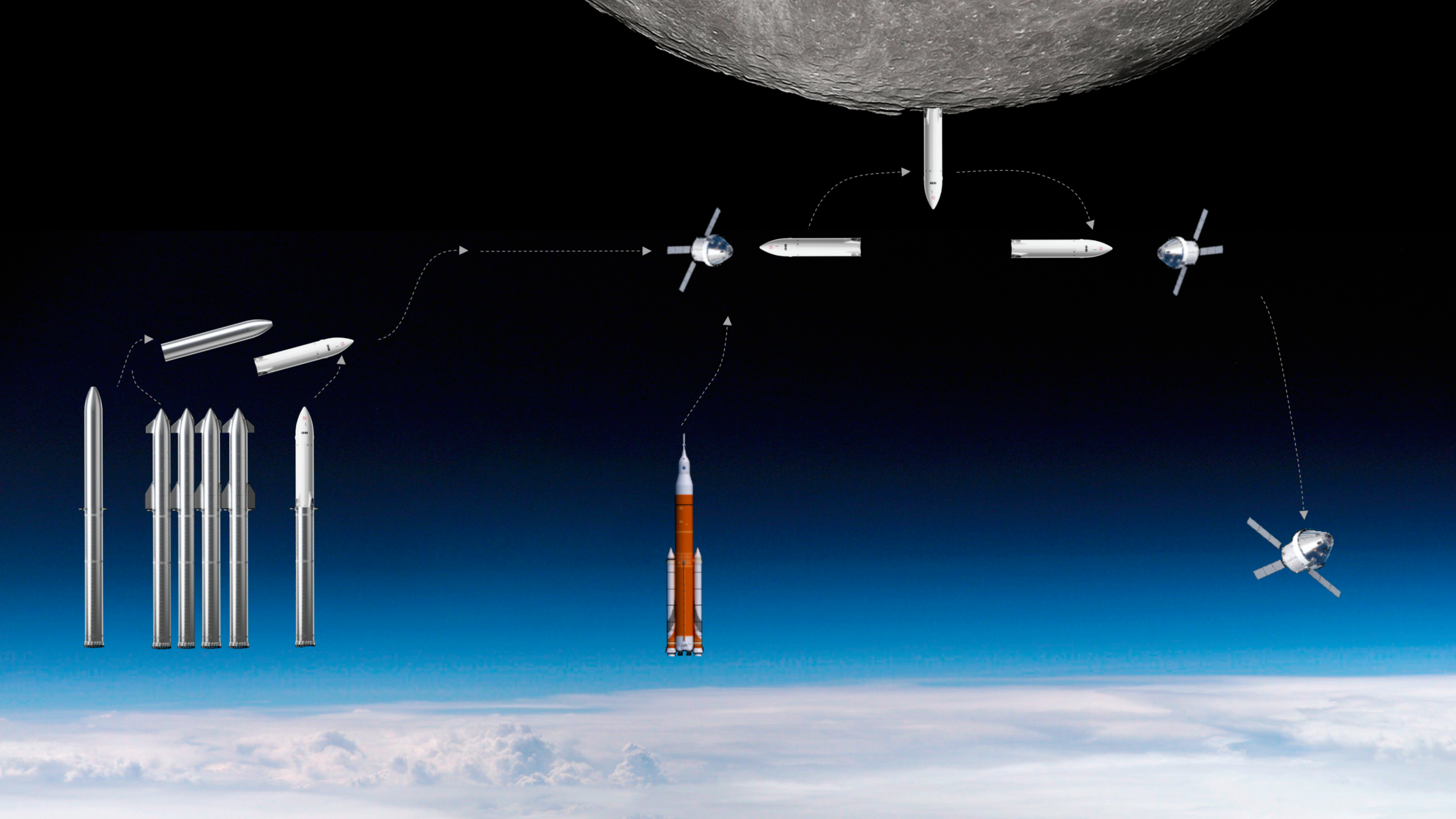
The Artemis 4 architecture will involve a complex sequence:
1. Launch Phase
- Four astronauts launch aboard Orion via SLS
2. Refueling in Orbit
- Starship HLS launches separately
- Multiple tanker Starships refuel it in Low Earth Orbit
3. Lunar Transit
- Starship travels to Near-Rectilinear Halo Orbit (NRHO) around the Moon
4. Surface Operations
- Two astronauts descend to the lunar surface
- Two remain in orbit aboard Orion
5. Exploration
- A week-long mission at the lunar south pole
- Scientific research and infrastructure setup
This mission represents a quantum leap beyond Apollo, both in complexity and capability.
Why NASA Chose Starship
The decision is not officially framed as a “winner-takes-all” scenario—but the evidence is clear.
Key Factors Behind the Shift
1. Scale and Capability
Starship’s size enables long-duration missions and infrastructure deployment.
2. Proven Systems
SpaceX’s existing technology reduces risk significantly.
3. Development Speed
Rapid testing cycles have accelerated readiness.
4. Strategic Vision Alignment
Starship supports NASA’s goal of a permanent lunar presence, not just short visits.
What This Means for Blue Origin
Despite falling behind, Blue Origin is far from irrelevant.
Future Roles May Include:
- Cargo delivery missions
- Backup landing systems
- Support for later Artemis phases
NASA still values redundancy—but for Artemis 3 and 4, the timeline simply doesn’t allow for delays.
Conclusion: Starship Stands Alone
The Artemis program is no longer about symbolic achievements—it’s about building the future of human space exploration.
And in that future, one spacecraft has emerged as indispensable:
SpaceX’s Starship HLS.
With unmatched cargo capacity, revolutionary habitability, and proven technology, it is uniquely positioned to meet NASA’s immediate and long-term goals.
While Blue Origin remains an important partner, the reality is clear:
For Artemis 3 and Artemis 4, Starship is not just an option—it is the only viable path forward.
As NASA shifts its focus from “landing” to “staying,” the race has effectively been decided.
And for now, SpaceX stands alone at the forefront of humanity’s return to the Moon.
FAQs
1. What is the Artemis 3 mission?
Artemis 3 is a mission by NASA aimed at returning humans to space as part of the Artemis program. It has now been redefined as a Low Earth Orbit test mission rather than a direct lunar landing.
2. Why is Artemis 3 no longer landing on the Moon?
NASA shifted Artemis 3 to a testing mission to ensure safety, docking systems, and integration are fully validated before attempting a high-risk lunar landing.
3. What is Starship HLS?
Starship HLS is a Human Landing System developed by SpaceX designed to transport astronauts from lunar orbit to the Moon’s surface and back.
4. Why is SpaceX leading the Artemis program?
SpaceX is ahead due to rapid development, proven technology, massive payload capacity, and successful past missions, giving it a clear advantage over competitors.
5. What happened to Blue Origin’s Blue Moon lander?
Blue Origin’s Blue Moon is still under development and faces timeline delays, making it less ready for Artemis 3 compared to Starship.
6. Will Blue Origin still be part of Artemis missions?
Yes, Blue Origin may still contribute through cargo missions, future landers, or support roles, even if it is not selected for Artemis 3 or 4.
7. How big is Starship compared to Apollo’s Lunar Module?
Starship HLS is massive, offering about 614 cubic meters of space, compared to just 4.5 cubic meters in the Apollo Lunar Module—a 135x increase.
8. What makes Starship suitable for long-term lunar missions?
Its large interior, high cargo capacity, and ability to support extended stays make it ideal for building a sustainable human presence on the Moon.
9. What is the role of the International Space Station in this context?
Technology used in Starship is derived from missions to the International Space Station, especially docking and rendezvous systems.
10. When is Artemis 3 expected to launch?
Artemis 3 is currently targeted for mid-2027, focusing on orbital testing instead of a Moon landing.
11. What will Artemis 4 do?
Artemis 4 is expected to perform the actual Moon landing, using the lander that proves successful during Artemis 3 testing.
12. How will astronauts reach the Moon in Artemis missions?
Astronauts will travel aboard Orion, launched by SLS, then transfer to a lander like Starship HLS to descend to the lunar surface.
13. What is orbital refueling and why is it important?
Orbital refueling allows Starship to refill fuel in space, enabling it to carry heavy payloads and travel to the Moon efficiently.
14. How many astronauts will land on the Moon?
Typically, two astronauts will descend to the Moon, while others remain in orbit for support and coordination.
15. What is NASA’s long-term goal with Artemis?
NASA aims to establish a permanent human presence on the Moon, enabling scientific research, resource utilization, and future missions to Mars.
Read More:
- Tesla is sending its humanoid Optimus robot to the Boston Marathon
- Elon Musk reveals shocking Tesla Optimus patent detail
- Tesla Q1 Earnings: What Elon Musk and Co. will answer during the call
- SpaceX wins its first MARS contract but it comes with a catch
- Blue Origin Failed to Deploy Payload after Booster Landing, WHY! Lunar Lander Mission Delayed!?