
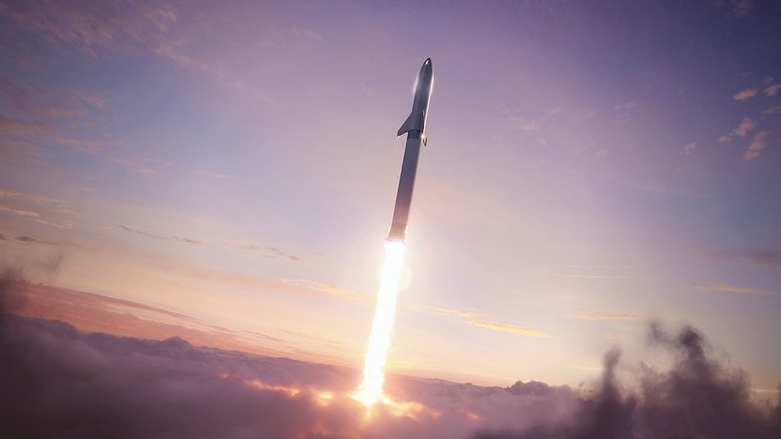
NASA Ordered Starship HLS to do Something Never Seen Before in Artemis 4! Is SLS Dead?: The future of human space exploration is undergoing a dramatic transformation. For more than five decades, NASA’s approach to sending astronauts beyond Earth relied on a relatively straightforward concept: a powerful rocket launches a spacecraft, astronauts travel to their destination, complete the mission, and return home.
That was the philosophy behind the legendary Apollo Program, which successfully landed humans on the Moon using the mighty Saturn V rocket. However, the modern Artemis Program is rewriting the rulebook entirely.
NASA has quietly introduced a revolutionary change to the architecture of Artemis 4, one that shifts significant responsibilities away from the traditional Space Launch System (SLS) and places them squarely on SpaceX’s Starship Human Landing System (HLS).
This isn’t just a minor adjustment. It represents one of the most significant operational changes in modern spaceflight history.
The biggest question now being asked across the aerospace industry is simple:
Is NASA gradually reducing the role of SLS while turning Starship into the backbone of deep-space exploration?
Let’s examine what NASA is planning and why this new mission architecture could redefine the future of lunar and interplanetary travel.
The Evolution from Apollo to Artemis
The Apollo missions followed a highly linear mission profile.
The Saturn V launched astronauts and lunar hardware together in a single launch. Everything needed for the mission was packed into one integrated system.
How Apollo Worked
- Saturn V launched from Earth.
- Apollo spacecraft traveled toward the Moon.
- Astronauts entered lunar orbit.
- Lunar Module separated and landed.
- Crew returned to Earth.
While highly effective, this architecture depended heavily on one giant rocket performing nearly every critical task.
The Artemis Program takes a completely different approach.
Instead of relying on a single launch vehicle, NASA is building an interconnected ecosystem involving:
- Space Launch System (SLS)
- Orion spacecraft
- Starship Human Landing System (HLS)
- Commercial launch providers
- Orbital refueling infrastructure
- Future lunar logistics networks
This distributed architecture is designed to be more scalable, flexible, and sustainable than Apollo.
Artemis 4 Introduces a Radical New Mission Design
One of the most significant changes in Artemis 4 is the relocation of the primary rendezvous point.
The Original Artemis Plan
Under the original concept:
- SLS launches Orion and astronauts.
- Starship HLS travels separately to the Moon.
- Both spacecraft meet in Near-Rectilinear Halo Orbit (NRHO).
- Astronauts transfer into Starship.
- Starship lands on the lunar surface.
This model placed the critical docking operation nearly 400,000 kilometers away from Earth.
NASA’s New Earth-Orbit Rendezvous Strategy
NASA’s updated plan completely changes this process.
Instead of meeting near the Moon:
- Orion launches aboard SLS.
- Orion remains in Low Earth Orbit (LEO).
- Starship HLS launches separately.
- Starship refuels in Earth orbit.
- Starship docks with Orion in LEO.
- Both spacecraft travel together toward the Moon.
This may sound like a simple adjustment, but it fundamentally changes mission operations.
Starship HLS Becomes the Main Deep-Space Propulsion System
The most surprising aspect of Artemis 4 is what happens after Orion and Starship dock.
Traditionally, Orion would perform much of the journey toward the Moon using its own propulsion system.
Under the revised architecture, Starship HLS takes control.
A Never-Before-Seen Role for Starship
After docking:
- Orion remains attached to Starship.
- Starship fires its powerful vacuum-optimized Raptor engines.
- The combined spacecraft perform the Trans-Lunar Injection (TLI) burn.
- Starship effectively pushes Orion toward lunar orbit.
This means Starship is no longer functioning as merely a lunar lander.
Instead, it becomes:
- A transportation system
- A propulsion platform
- A deep-space transfer vehicle
- A lunar lander
NASA is assigning Starship responsibilities that no previous commercial spacecraft has ever carried.
Why NASA Is Moving the Rendezvous to Earth Orbit
NASA’s decision wasn’t made randomly.
The new architecture offers several significant advantages.
Improved Crew Safety
Safety remains NASA’s highest priority.
Conducting docking operations close to Earth creates a much safer environment for astronauts.
Immediate Abort Capability
If something goes wrong during docking:
- Orion can separate from Starship.
- Orion can perform reentry procedures.
- The crew can return to Earth within hours.
This capability simply doesn’t exist when docking occurs near the Moon.
When astronauts are hundreds of thousands of kilometers from Earth, even minor technical failures can become life-threatening emergencies.
Faster Mission Recovery Options
Operating in Low Earth Orbit allows:
- Continuous communications
- Faster troubleshooting
- Real-time monitoring
- Rapid decision-making
Mission controllers gain far more flexibility than they would in deep space.
Reduced Dependence on Complex Lunar Orbit Operations
The previous architecture relied heavily on NRHO.
While NRHO offers strategic advantages, it also creates operational constraints.
Challenges of NRHO
Near-Rectilinear Halo Orbit requires:
- Precise navigation
- Tight timing windows
- Additional propulsion maneuvers
- Extended mission planning
Moving critical operations into Earth orbit simplifies many of these challenges.
Better Lunar Emergency Response
Under the new model, astronauts on the Moon could potentially reconnect with Starship more quickly during emergencies.
This creates additional flexibility and could improve crew survival options if unexpected situations occur during lunar surface operations.
The Orbital Refueling Revolution
The entire Artemis 4 strategy depends on one groundbreaking capability:
Orbital refueling.
Without it, Starship cannot perform its assigned role.
Why Starship Needs Refueling
Starship is incredibly large.
Launching from Earth consumes a massive amount of propellant.
To travel to the Moon, Starship must refill its tanks after reaching orbit.
How the Refueling Process Works
The concept involves:
- Tanker Starships launching repeatedly.
- Tankers transferring liquid oxygen and methane.
- Fuel accumulating inside a depot vehicle.
- Starship HLS receiving the propellant needed for lunar operations.
This process effectively creates a space-based gas station.
If successful, it will represent one of the most important technological breakthroughs in the history of human spaceflight.
How the New Architecture Benefits NASA
The revised mission profile delivers several major advantages.
Lower Propellant Requirements
By staging operations in Earth orbit, Starship can use a more direct trajectory.
Benefits include:
- Less fuel consumption
- Fewer orbital maneuvers
- Reduced mission complexity
Fewer Tanker Launches
Every tanker launch adds:
- Cost
- Risk
- Scheduling complexity
Reducing fuel requirements means NASA and SpaceX may need fewer tanker missions.
That improves mission efficiency considerably.
Better Schedule Reliability
One of the biggest threats to Artemis timelines is launch coordination.
The new architecture reduces logistical pressure and provides greater flexibility when assembling the mission.
What Does This Mean for the Space Launch System (SLS)?
This is where the debate becomes interesting.
Many observers are asking whether SLS is slowly becoming less important.
The Original Vision for SLS
SLS was designed as a super-heavy-lift rocket capable of sending astronauts and cargo beyond Earth orbit.
Its mission was ambitious:
- Launch crew
- Launch payloads
- Perform deep-space missions
- Serve as America’s primary exploration vehicle
However, reality has introduced challenges.
The Major Challenges Facing SLS
Extremely High Costs
Each SLS launch is estimated to cost billions of dollars.
Maintaining frequent lunar missions becomes difficult under constrained budgets.
Development Delays
The program experienced years of delays before Artemis 1 finally launched.
Meanwhile, commercial providers advanced rapidly.
Technical Issues
During Artemis 1 preparations, NASA encountered recurring hydrogen leak problems that repeatedly delayed launch attempts.
These issues highlighted the complexity of operating such a massive expendable launch system.
Is NASA Redefining the Role of SLS?
Rather than eliminating SLS, NASA appears to be narrowing its responsibilities.
A New Division of Labor
Under the emerging strategy:
SLS Focuses On
- Launching astronauts
- Delivering Orion safely to orbit
- Crew transportation
Starship Focuses On
- Deep-space propulsion
- Orbital refueling
- Lunar transportation
- Surface landing operations
This approach allows each vehicle to specialize in what it does best.
Instead of competing, SLS and Starship become complementary systems.
The Biggest Technological Challenges Still Ahead
Despite its advantages, the new Artemis architecture remains highly experimental.
Several critical technologies must work perfectly.
Orbital Cryogenic Refueling
This is arguably the most important challenge.
No organization has ever transferred hundreds of tons of cryogenic fuel between giant spacecraft in orbit.
Key Technical Obstacles
Fluid Management in Microgravity
Without gravity:
- Liquids float freely.
- Propellant sloshes unpredictably.
- Fuel positioning becomes extremely difficult.
Thermal Control
Liquid methane and liquid oxygen must remain extraordinarily cold.
Solar heating can cause:
- Boil-off
- Pressure changes
- Fuel losses
Preventing these issues requires advanced insulation systems.
Automated Docking and Transfer Systems
The refueling process must be:
- Reliable
- Precise
- Repeatable
- Autonomous
Any failure could jeopardize the entire mission.
Can Starship Actually Land on the Moon?
Another major challenge is the lunar landing itself.
The Scale Problem
Starship is enormous.
The vehicle stands more than 50 meters tall and is dramatically larger than the Apollo Lunar Module.
This creates unique engineering concerns.
Lunar Surface Risks
SpaceX must demonstrate that Starship can:
- Land safely on uneven terrain
- Avoid tipping over
- Prevent dangerous dust clouds
- Control engine plume effects
The lunar south pole environment adds additional complexity due to rough terrain and challenging lighting conditions.
Artemis 3 Will Be the Ultimate Test
Before Artemis 4 can fully realize its potential, Artemis 3 must succeed.
Why Artemis 3 Matters
The mission will validate several mission-critical technologies:
- Orbital refueling
- Long-duration Starship operations
- Human lunar landings
- Deep-space life-support systems
Success would provide proof that NASA’s new architecture can work.
Failure would force major revisions to future lunar plans.
The Future of Human Deep-Space Exploration
The Artemis Program is increasingly becoming a partnership between government and commercial spaceflight.
NASA appears to be transitioning from a model where it owns and operates every major component to one where commercial providers supply critical infrastructure.
The Growing Importance of Starship
The latest Artemis 4 changes show that Starship is no longer a simple lunar ferry.
It is evolving into:
- A transportation hub
- A deep-space tug
- A lunar lander
- A refueling platform
- A future Mars transport system
Its role continues expanding with every new mission revision.
Conclusion: Is SLS Dead?
The answer is no—but its role is changing dramatically.
NASA is not abandoning SLS. Instead, the agency appears to be transforming it into a highly specialized crew transportation system while assigning increasingly complex deep-space responsibilities to Starship HLS.
The Artemis 4 redesign reveals a broader strategic shift.
Rather than depending on a single government-owned launch vehicle, NASA is embracing a distributed space exploration architecture built around commercial innovation and orbital infrastructure.
If SpaceX successfully demonstrates orbital refueling, deep-space propulsion, and lunar landing operations, Starship could become the most important spacecraft ever developed since Apollo.
And if Artemis 4 unfolds as planned, history may remember this mission as the moment when humanity’s return to the Moon stopped looking like Apollo 2.0 and started looking like the foundation of a true interplanetary transportation network.
FAQs
1. What is the main change NASA introduced for Artemis 4?
NASA is shifting the primary rendezvous and docking operation from lunar orbit to Low Earth Orbit (LEO). Instead of meeting near the Moon, Orion and Starship HLS will dock around Earth before traveling together to lunar orbit.
2. Why is NASA using Starship HLS for Artemis 4?
NASA selected SpaceX’s Starship Human Landing System (HLS) because of its massive payload capacity, reusable architecture, and ability to support future lunar and deep-space missions.
3. What is Starship HLS?
Starship Human Landing System (HLS) is a modified version of SpaceX’s Starship spacecraft designed to transport astronauts between lunar orbit and the Moon’s surface during Artemis missions.
4. Does Starship HLS replace the Space Launch System (SLS)?
No. SLS still plays a critical role by launching astronauts aboard the Orion spacecraft. However, Starship is taking on more responsibilities related to deep-space propulsion and lunar landing operations.
5. What is the Space Launch System (SLS)?
The Space Launch System (SLS) is NASA’s super heavy-lift rocket developed for Artemis missions. It is currently the most powerful rocket used by NASA for human deep-space exploration.
6. Why is docking in Earth orbit considered safer?
Docking in Low Earth Orbit allows astronauts to return home quickly if technical problems occur. Emergency abort options are significantly easier compared to operations conducted near the Moon.
7. What is a Trans-Lunar Injection (TLI) burn?
A Trans-Lunar Injection (TLI) burn is a powerful engine firing that accelerates a spacecraft out of Earth’s orbit and places it on a trajectory toward the Moon.
8. Will Starship HLS perform the TLI burn for Artemis 4?
Yes. Under NASA’s updated mission architecture, Starship HLS is expected to use its Raptor engines to propel both itself and the docked Orion spacecraft toward lunar orbit.
9. What is orbital refueling?
Orbital refueling is the process of transferring propellant between spacecraft in space. SpaceX plans to use tanker Starships to refill Starship HLS before it departs for the Moon.
10. Has orbital refueling ever been done at this scale before?
No. Large-scale transfer of hundreds of tons of cryogenic methane and liquid oxygen between spacecraft has never been demonstrated in orbit, making it one of the biggest challenges facing Starship.
11. Why does Starship need orbital refueling?
Starship consumes most of its fuel during launch. Refueling in orbit enables it to carry enough propellant for lunar missions and future interplanetary travel.
12. What is Near-Rectilinear Halo Orbit (NRHO)?
Near-Rectilinear Halo Orbit (NRHO) is a highly elliptical orbit around the Moon that NASA originally planned to use as a staging area for Artemis missions and the future Lunar Gateway.
13. Is NASA abandoning NRHO for Artemis 4?
NASA is adjusting mission operations to reduce dependence on NRHO for critical rendezvous activities. However, NRHO and the Gateway program may still play important roles in future lunar exploration.
14. What are the biggest technical risks for Starship HLS?
Major challenges include orbital refueling, cryogenic fuel storage, automated docking, long-duration spaceflight operations, and safe lunar landings on uneven terrain.
15. How is Starship different from the Apollo Lunar Module?
Starship is dramatically larger, more powerful, and fully reusable. It can carry substantially more cargo and astronauts than the small lunar modules used during the Apollo era.
16. What role will Artemis 3 play in validating this architecture?
Artemis 3 will serve as the first real-world test of Starship HLS, including lunar landing operations and several technologies required for future Artemis missions.
17. Could Starship eventually be used for missions beyond the Moon?
Yes. SpaceX intends Starship to support missions to Mars, deep-space exploration, cargo transportation, and potentially long-term human settlement beyond Earth.
18. Is SLS becoming obsolete because of Starship?
Not currently. NASA still relies on SLS for launching astronauts aboard Orion. However, the growing capabilities of Starship are gradually shifting more mission-critical responsibilities toward commercial systems, changing the balance of future space exploration.
Read More:
- SpaceX makes $20 billion move to optimize its balance sheet
- Tesla finally clarifies fatal Texas crash, confirms driver manually overrode acceleration
- Tesla tops American-Made Index for sixth-consecutive year
- Tesla gets another layer of gamification with Free Supercharging on the line
- SpaceX’s New Starship HLS Cabin Interior to Land Humans on the Moon for the First Time
1 thought on “NASA Ordered Starship HLS to do Something Never Seen Before in Artemis 4! Is SLS Dead?”