
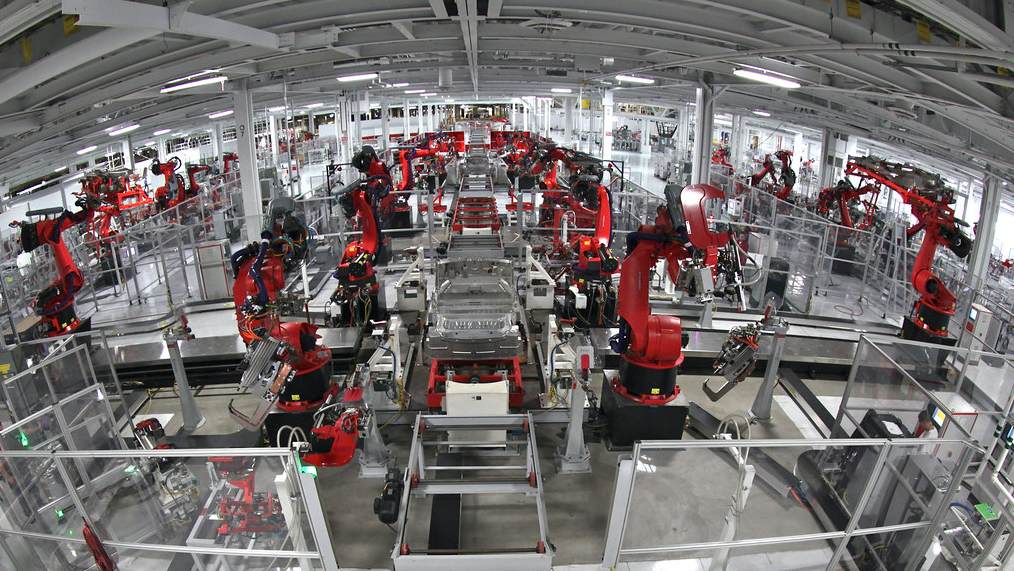
Elon Musk Reveals 5s Giga Press INSANE Speed: The automotive industry has followed a familiar formula for more than a century. Car manufacturers competed by building better vehicles with improved performance, luxury, styling, safety features, and fuel efficiency. While these factors still matter, Elon Musk believes the real battle for automotive dominance is no longer happening inside the vehicle itself—it is happening inside the factory.
Tesla’s latest manufacturing vision aims to achieve an astonishing 5 to 6-second vehicle production cycle, a breakthrough that could redefine how automobiles are designed, built, and delivered worldwide. Rather than simply creating electric cars, Tesla is reinventing the entire manufacturing process through innovations such as the Giga Press, Unboxed Assembly Process, Structural Battery Packs, and 48-Volt Electrical Architecture.
This revolutionary approach positions Tesla not merely as an EV manufacturer but as one of the most advanced manufacturing companies on the planet.
Why Elon Musk Thinks the Factory Is the Real Product
One of Elon Musk’s most important philosophies is simple yet powerful:
The factory itself is the product.
While most automakers focus on improving cars, Tesla focuses on improving the machine that builds the car. This philosophy mirrors some of the biggest industrial revolutions in history.
The Ford Revolution
Henry Ford did not invent the automobile. Instead, he transformed manufacturing through the invention of the moving assembly line, enabling mass production and dramatically reducing vehicle costs.
This innovation allowed Ford to dominate the automotive market for decades.
The Toyota Revolution
Similarly, Toyota did not create Japan’s first car. Its success came from developing the Toyota Production System (TPS) and introducing lean manufacturing principles that minimized waste, optimized inventory, and improved efficiency.
Toyota became a global powerhouse because it perfected the manufacturing process rather than simply building better cars.
Tesla’s Manufacturing Revolution
Tesla is now executing what many consider the third major automotive manufacturing revolution.
Instead of optimizing existing assembly methods, Tesla is eliminating unnecessary manufacturing steps altogether. The company’s objective is not to make workers move faster or robots operate quicker.
The goal is to remove complexity entirely.
In manufacturing, true speed comes from eliminating tasks, not accelerating them.
Every part removed from a vehicle reduces:
- Welding operations
- Robotic movements
- Quality inspections
- Assembly stages
- Potential failure points
- Production costs
This philosophy forms the foundation of Tesla’s next-generation manufacturing strategy.
The Rise of the Giga Press
At the center of Tesla’s manufacturing revolution is the Giga Press.
Traditional vehicle production involves creating a car’s frame using dozens or even hundreds of individual stamped metal parts. These parts are then welded, riveted, glued, and assembled through lengthy production lines.
This process introduces complexity, labor costs, and opportunities for manufacturing defects.
Tesla decided to challenge this decades-old approach.
What Is a Giga Press?
The Giga Press is an enormous high-pressure die-casting machine developed in partnership with IDRA Group, a subsidiary of LK Machinery.
Instead of assembling dozens of components, the machine injects molten aluminum into massive molds to create large structural sections of a vehicle as a single piece.
This dramatically reduces the number of parts required for vehicle construction.
Tesla’s Giga Press Evolution
6,000-Ton Giga Press
The first major breakthrough came with Tesla’s 6,000-ton Giga Press used in the Model Y.
This machine enabled Tesla to cast the entire rear underbody section as one giant component.
Previously, this section required more than 70 individual welded parts.
Now it is manufactured as a single piece.
9,000-Ton Giga Press
Tesla later expanded the technology with a 9,000-ton Giga Press developed specifically for the Cybertruck.
The Cybertruck’s stainless-steel architecture requires stronger and more complex structural components, making larger casting capabilities essential.
The Vision of a 50,000-Ton Giga Press
Perhaps the most ambitious concept involves Tesla’s vision for a future 50,000-ton Giga Press.
Such a machine would represent a monumental leap in manufacturing capability.
Rather than casting a single component at a time, Tesla could potentially manufacture multiple major vehicle structures simultaneously.
The concept resembles modern toy manufacturing, where a single mold produces multiple completed pieces in one cycle.
If implemented successfully, this could eliminate entire sections of conventional assembly lines.
The Engineering Challenges Behind Massive Castings
Building gigantic castings is not as simple as pouring molten metal into a mold.
The physics involved become increasingly difficult as component sizes increase.
Air Pocket Formation
If molten aluminum flows too quickly into a mold, turbulence can trap air inside the casting.
These air pockets weaken structural integrity and can compromise crash safety.
Premature Solidification
If the metal flows too slowly, it may begin cooling before the mold is fully filled.
This results in incomplete castings and structural defects.
Tesla’s Advanced Solutions
To overcome these challenges, Tesla developed several advanced technologies:
- High-speed conformal cooling systems
- Automated mold separation mechanisms
- AI-powered quality inspection systems
- Computer vision-based defect detection
- Real-time density analysis
These innovations help ensure each casting meets strict quality standards while maintaining ultra-fast production speeds.
How Giga Casting Eliminates Manufacturing Complexity
One of Tesla’s greatest advantages is the ability to remove enormous amounts of manufacturing complexity.
Traditional automotive manufacturing often relies on:
- Hundreds of stamped parts
- Thousands of welds
- Multiple robotic stations
- Complex supply chains
With Giga Casting, many of these processes disappear entirely.
The benefits include:
Lower Production Costs
Fewer parts mean lower material and labor expenses.
Improved Structural Strength
Single-piece castings eliminate weak points created by welds and joints.
Faster Manufacturing
Reduced assembly stages shorten overall production time.
Better Quality Control
Fewer components mean fewer opportunities for defects.
Reduced Factory Footprint
Manufacturing equipment and floor space requirements decrease significantly.
This reduction in complexity is a key reason Tesla can pursue its ambitious 5-second production target.
Breaking the Traditional Assembly Line
Even with large castings, traditional assembly lines create bottlenecks.
For over 100 years, automakers have relied on a sequential manufacturing process.
The vehicle moves from station to station while workers and robots perform specific tasks.
This method has inherent limitations.
The entire production line can only move as fast as its slowest stage.
Tesla’s solution is called the Unboxed Assembly Process.
What Is Tesla’s Unboxed Assembly Process?
The Unboxed Assembly Process completely reimagines vehicle production.
Instead of building a car step by step on a moving assembly line, Tesla divides the vehicle into independent modules.
Each module is assembled simultaneously in separate areas of the factory.
Front Module Assembly
The front section receives:
- Suspension components
- Cooling systems
- Steering hardware
Rear Module Assembly
The rear section is equipped with:
- Drive units
- Power electronics
- Rear suspension systems
Side and Floor Module Assembly
Additional teams prepare:
- Floor structures
- Side panels
- Doors
- Interior trim components
Because these sections remain fully accessible, robots can work more efficiently without navigating cramped vehicle interiors.
Once complete, all modules are joined together in a final assembly stage.
This dramatically increases manufacturing speed and efficiency.
Why Parallel Manufacturing Is a Game-Changer
The biggest advantage of Tesla’s Unboxed Process is parallelization.
Instead of waiting for one task to finish before another begins, multiple operations occur simultaneously.
Benefits include:
Faster Production
Several major vehicle systems are assembled at the same time.
Better Factory Utilization
Manufacturing space is used more efficiently.
Reduced Labor Costs
Automation becomes easier and more effective.
Improved Scalability
New factories can expand production more rapidly.
Lower Vehicle Costs
Reduced assembly complexity lowers overall manufacturing expenses.
This approach resembles modern electronics manufacturing more than traditional automotive production.
In some Cybercab production zones, machinery operates at such high speeds that human workers are restricted from entering for safety reasons.
The Role of Structural Battery Packs
Tesla’s manufacturing revolution extends beyond casting and assembly.
The company also redesigned one of the most important parts of an electric vehicle: the battery pack.
What Is a Structural Battery Pack?
Traditional EV batteries are heavy units mounted inside a vehicle’s frame.
Tesla’s 4680 Structural Battery Pack changes this approach.
Instead of acting solely as an energy storage system, the battery pack becomes part of the vehicle’s structure.
The battery serves as:
- The vehicle floor
- A structural support element
- A connection point between front and rear castings
This integration reduces weight while increasing structural rigidity.
It also eliminates additional components that would otherwise be required.
Why Tesla Switched to a 48-Volt Architecture
Another critical innovation involves Tesla’s move from a traditional 12-volt electrical system to a modern 48-volt architecture.
Benefits of 48-Volt Systems
A higher voltage allows Tesla to reduce electrical current requirements significantly.
This creates several advantages:
Thinner Wiring
Smaller wires reduce vehicle weight.
Lower Material Costs
Less copper is required throughout the vehicle.
Simplified Assembly
Robots can route wiring more easily.
Increased Efficiency
Power distribution becomes more effective.
Better Scalability
Future electronic systems can operate more efficiently.
Combined with Tesla’s centralized Ethernet networking architecture, these changes dramatically simplify vehicle electronics.
Cybercab: The Ultimate Manufacturing Platform
Perhaps the most important application of Tesla’s manufacturing innovations is the upcoming Cybercab.
Unlike traditional vehicles adapted for new manufacturing methods, Cybercab was designed from the beginning around manufacturing efficiency.
Every aspect of the vehicle architecture supports ultra-fast production.
Structural Component Comparison
The difference is remarkable.
Model Y
Approximately 200 structural components
Cybercab
Approximately 80 structural components
This reduction represents a massive simplification of vehicle design.
Fewer parts mean:
- Faster production
- Lower costs
- Higher reliability
- Greater manufacturing scalability
By eliminating more than half the structural complexity, Tesla dramatically reduces assembly requirements.
Can Tesla Really Build a Car Every 5 Seconds?
The idea sounds almost impossible.
However, when examining the technologies involved, the goal becomes more realistic.
Tesla combines:
- Giga Casting
- Structural Battery Packs
- Unboxed Assembly
- AI Quality Control
- 48-Volt Architecture
- Advanced Robotics
Each innovation removes bottlenecks that traditionally slow vehicle production.
Tesla’s Gigafactory Shanghai already ranks among the most efficient automotive manufacturing facilities in the world.
The Cybercab platform pushes this efficiency even further.
If all systems work together as intended, achieving a 5 to 6-second production cycle could become a reality.
Tesla’s Competitive Advantage Is Nearly Impossible to Copy
Most automotive innovations can eventually be replicated.
A competitor can reverse-engineer a vehicle.
Battery chemistry can be duplicated.
Software features can be imitated.
Manufacturing ecosystems are much harder to copy.
Tesla’s competitive moat consists of:
- Proprietary manufacturing processes
- Custom-built robotics
- Advanced casting technology
- AI-driven quality systems
- Structural battery integration
- Optimized factory design
Recreating this ecosystem would require years of research, billions of dollars, and extensive engineering expertise.
This makes Tesla’s manufacturing advantage one of its most powerful long-term assets.
Conclusion
Tesla’s greatest innovation may not be the electric car, the Cybertruck, or even autonomous driving.
The true breakthrough lies in its effort to reinvent manufacturing itself.
By treating the factory as the product, Elon Musk is challenging assumptions that have defined automotive production for more than a century.
Through the Giga Press, Unboxed Assembly Process, Structural Battery Packs, 48-Volt Architecture, and the upcoming Cybercab, Tesla is building a manufacturing system designed for unprecedented speed and efficiency.
The vision of producing a vehicle every five seconds may sound like science fiction today. However, if Tesla succeeds, the company will not simply lead the electric vehicle market—it could redefine industrial manufacturing for generations to come.
As history has shown with Ford and Toyota, the companies that master production systems often become the companies that shape the future. Tesla appears determined to be the next chapter in that story.
FAQs
1. What is Tesla’s Giga Press?
Tesla’s Giga Press is a giant high-pressure die-casting machine that creates large vehicle structural components from a single piece of molten aluminum. It replaces dozens of smaller parts, reducing manufacturing complexity and production costs.
2. Why is Tesla’s Giga Press considered revolutionary?
The Giga Press eliminates the need for numerous welded parts and assembly steps. By producing large sections of a vehicle as one piece, Tesla can significantly improve manufacturing speed, quality, and efficiency.
3. What is the 5-second vehicle production goal?
Tesla aims to reduce vehicle production cycle times to approximately 5 to 6 seconds per car through advanced automation, giga casting, and its innovative Unboxed Assembly Process.
4. How does giga casting improve vehicle manufacturing?
Giga casting replaces multiple stamped and welded components with a single cast structure. This reduces part counts, assembly time, factory space requirements, and potential manufacturing defects.
5. What is Tesla’s Unboxed Assembly Process?
The Unboxed Assembly Process is Tesla’s new manufacturing method where vehicle modules are assembled separately and simultaneously before being joined together in the final production stage.
6. How is Tesla’s assembly process different from traditional car manufacturing?
Traditional assembly lines build cars sequentially from one station to another. Tesla’s approach allows multiple sections of the vehicle to be assembled in parallel, greatly increasing production efficiency.
7. What is a structural battery pack?
A structural battery pack serves both as an energy storage system and as part of the vehicle’s structural framework, reducing weight and improving rigidity.
8. What are Tesla 4680 battery cells?
4680 battery cells are Tesla’s next-generation cylindrical battery cells designed to provide higher energy density, lower production costs, and better integration with structural battery packs.
9. Why is Tesla moving from 12V to 48V electrical systems?
A 48-volt architecture reduces current requirements, allowing Tesla to use thinner wiring, lower material costs, improve efficiency, and simplify vehicle assembly.
10. What is the purpose of the Cybercab?
The Cybercab is designed to maximize manufacturing efficiency and autonomous transportation capabilities. It serves as a showcase for Tesla’s next-generation production technologies.
11. How many structural parts does the Cybercab have?
Tesla’s Cybercab is expected to use approximately 80 major structural components, compared to around 200 structural components in the Model Y.
12. What challenges does Tesla face with large-scale casting?
Large-scale casting presents challenges such as air pocket formation, uneven metal flow, premature cooling, and maintaining structural integrity across massive cast components.
13. How does Tesla use AI in manufacturing?
Tesla uses AI-powered computer vision systems to inspect castings in real time, identify defects, monitor production quality, and optimize manufacturing efficiency.
14. Could other automakers copy Tesla’s manufacturing system?
While competitors can adopt similar technologies, replicating Tesla’s fully integrated manufacturing ecosystem—including giga casting, structural batteries, robotics, software, and factory design—would require substantial time and investment.
15. How does Tesla’s manufacturing strategy create a competitive advantage?
Tesla’s manufacturing innovations reduce production costs, increase output, improve quality, and enable faster scaling, creating a significant long-term competitive advantage.
16. Will Tesla’s 5-second production target become reality?
Although extremely ambitious, Tesla’s combination of Giga Press technology, Unboxed Assembly, structural battery packs, and advanced automation makes the 5-second vehicle production goal increasingly achievable in future manufacturing facilities.
Read More:
- NASA Ordered Starship HLS to do Something Never Seen Before in Artemis 4! Is SLS Dead?
- SpaceX makes $20 billion move to optimize its balance sheet
- Tesla finally clarifies fatal Texas crash, confirms driver manually overrode acceleration
- Tesla tops American-Made Index for sixth-consecutive year
- Tesla gets another layer of gamification with Free Supercharging on the line