
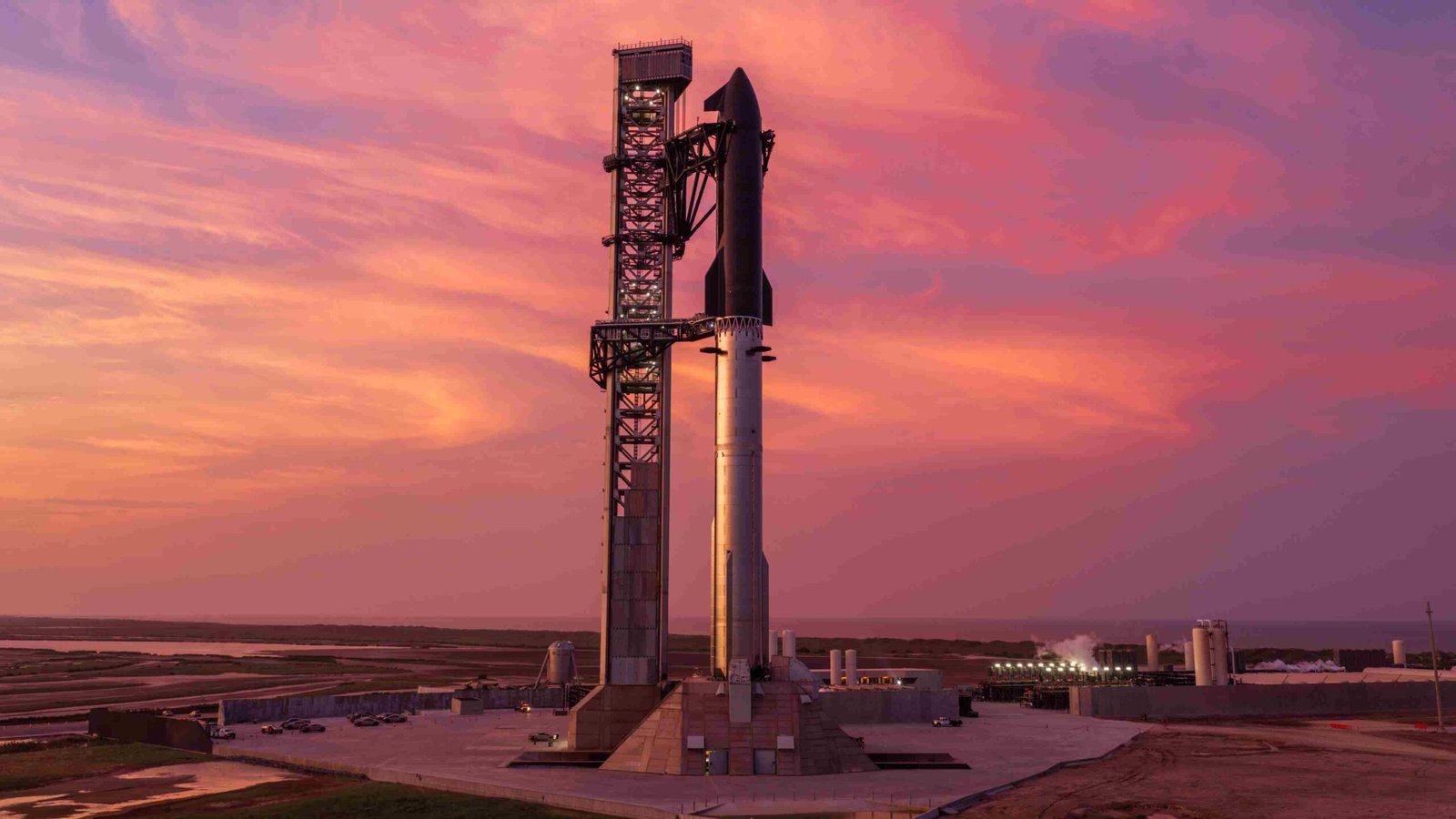
SpaceX is launching TWO Starship flights in Parallel to catch the Ship Sooner: SpaceX’s Starship development program is entering a critical stage as the company works toward full vehicle reusability. The massive spacecraft is designed to eventually launch, return, and fly again with minimal refurbishment, but achieving that goal requires solving one of the most difficult challenges in modern rocketry: safely recovering the Starship upper stage, known as Ship, at the launch site.
After successful ocean soft-landings during recent test flights, attention has increasingly shifted toward the possibility of using Mechazilla, the launch tower’s giant mechanical arms, to catch the returning Ship. However, the next flight is expected to prioritize orbital objectives and payload deployment rather than immediately attempting the highly complex tower catch.
Instead, SpaceX is preparing for a more deliberate strategy involving parallel flight operations, additional infrastructure, and continued engineering refinement. This approach could allow the company to move toward the Ship catch while maintaining a high launch cadence.
Starship Ship Catch Timeline: Why SpaceX Is Taking a Step-by-Step Approach
The Ship catch represents a major transition from experimental recovery to a potentially operational fully reusable transportation architecture. Unlike an ocean splashdown, a tower catch requires the spacecraft to return with extraordinary precision and position itself between the tower’s mechanical arms.
Flight 13 Demonstrated Important Recovery Capabilities
The successful ocean landing sequence provided valuable information about Starship’s ability to survive atmospheric entry and perform its terminal landing maneuver.
The data gathered from these flights can help SpaceX improve:
- Guidance and navigation
- Engine relight performance
- Descent control
- Thermal protection
- Vehicle structural performance
- Landing trajectory accuracy
These capabilities are essential before attempting to bring a Ship back toward a launch tower containing expensive infrastructure.
Why Defer the Ship Catch?
A failed tower catch could have consequences far beyond the loss of one spacecraft. The launch tower and surrounding infrastructure represent a critical part of Starbase’s operational capability.
Protecting that infrastructure could therefore be an important consideration while SpaceX continues testing.
A controlled ocean landing provides an additional opportunity to collect flight data without placing the primary launch tower directly at risk. At the same time, SpaceX can prepare additional hardware and infrastructure for future catch attempts.
Two Starship Flights Could Accelerate the Catch Strategy
One of the most important developments in the program is the move toward parallel launch operations.
Rather than treating every Starship flight as an isolated test, SpaceX is building an operational environment where multiple vehicles and launch facilities can support different parts of the development program.
This creates an important distinction between launch testing and recovery testing.
One mission can focus on orbital objectives and payload deployment, while another can eventually be configured around more aggressive recovery objectives.
A New Starbase Operating Model
The long-term vision involves multiple launch towers and supporting infrastructure operating simultaneously.
This could allow SpaceX to:
- Prepare multiple Starship vehicles at the same time.
- Conduct launches with shorter gaps between missions.
- Test different recovery techniques.
- Reduce dependence on a single launch facility.
- Increase the amount of real-world flight data collected.
The result could be a significantly faster development cycle.
Pad A and Pad B: Building Redundancy Into Starship Operations
SpaceX’s expansion of Starbase infrastructure is closely connected to its ambitions for rapid Starship turnaround.
A dual-pad architecture can potentially divide responsibilities between different launch facilities. One tower could support regular orbital launches while another provides additional capacity for testing, recovery, and future high-frequency operations.
Why Multiple Towers Matter
The biggest advantage is not simply having another launch pad. It is the creation of operational redundancy.
If a complicated recovery experiment temporarily affects one facility, another facility could potentially continue supporting launches.
This becomes increasingly important as Starship transitions from a development program toward a system intended to support frequent missions.
The architecture also has implications for orbital propellant transfer. Future Starship missions could require tanker launches followed by rendezvous and propellant transfer in orbit. Such an operation demands a much higher launch cadence than traditional expendable rockets.
Engineering Lessons From Ocean Recovery
Before a Ship can be caught by Mechazilla, SpaceX needs to demonstrate that the spacecraft can repeatedly survive the demanding conditions of orbital re-entry.
Guidance and Trajectory Control
A successful ocean landing demonstrates that Starship can target a relatively precise recovery zone. A tower catch, however, requires considerably tighter control.
The Ship must descend toward a narrow target area and maintain the correct position and velocity as it approaches the tower.
Even a small trajectory error could prevent the mechanical arms from safely engaging the spacecraft.
Terminal Landing Performance
Starship’s landing sequence involves a dramatic transition from a horizontal belly-flop configuration to a vertical orientation before the final landing burn.
That maneuver places substantial demands on the engines, flight-control software, and vehicle structure.
For a successful tower catch, the vehicle would need to execute the maneuver with extremely consistent timing.
Thermal Protection
The Ship’s heat shield is another major engineering challenge.
Orbital re-entry exposes the spacecraft to extreme temperatures, making the thermal protection system essential to vehicle survival.
A tower catch introduces another requirement: the areas used for mechanical engagement must withstand the loads associated with capture while remaining compatible with the surrounding heat-shield structure.
Why Ship Catching Is Harder Than Booster Catching
SpaceX has already demonstrated the concept of catching Super Heavy boosters with Mechazilla. However, catching the Ship presents a different set of engineering challenges.
Super Heavy Recovery
The booster returns after the first stage of flight and performs a controlled atmospheric descent. Its recovery architecture was specifically developed around tower capture.
The booster’s structure and aerodynamic configuration are therefore optimized for the recovery sequence.
Starship Ship Recovery
The upper-stage Ship travels through orbital flight conditions before beginning its return to Earth.
It must endure:
- Hypersonic atmospheric re-entry
- Extreme aerodynamic heating
- High structural loads
- A controlled belly-flop maneuver
- Engine relight and landing
- Precise final positioning
The vehicle then needs to arrive at the tower with enough control authority to align with the catching arms.
That makes Ship recovery a significantly more complex extension of the reusable architecture.
Flight 14 and the Importance of Payload Deployment
The next major missions are not solely about recovery.
Starship’s development also depends on demonstrating its ability to perform useful orbital missions and payload operations.
The planned deployment of next-generation Starlink V3 satellites represents an important part of this progression.
Successfully placing operational payloads into orbit would demonstrate that Starship is moving beyond purely developmental objectives toward a system capable of supporting practical missions.
This creates a balancing act for SpaceX: the company needs to test increasingly ambitious recovery technologies while protecting the ability to conduct productive orbital flights.
From Experimental Flights to Rapid Reusability
The broader objective extends far beyond a single Ship catch.
SpaceX ultimately wants Starship to operate more like a reusable transportation system than a conventional expendable rocket.
What Full Reusability Could Enable
If both the Super Heavy booster and Ship can eventually be recovered and rapidly returned to service, Starship could support a much higher flight frequency.
That architecture could potentially be used for:
- Large satellite deployments
- Human spaceflight
- Lunar missions
- Cargo transportation
- Orbital refueling
- Deep-space exploration
The key word is turnaround. Reusability only reaches its full potential when vehicles can be recovered, inspected, prepared, and launched again quickly.
The Road Ahead for Mechazilla
Deferring a Ship catch attempt does not remove it from SpaceX’s broader development strategy. Instead, additional flights can provide opportunities to improve the technology before attempting one of the program’s most demanding recovery maneuvers.
The combination of ocean landing tests, parallel vehicle preparation, additional launch infrastructure, and increasingly sophisticated orbital missions creates a pathway toward that goal.
The eventual Ship catch will require the spacecraft to survive orbital re-entry, execute its landing maneuver precisely, and arrive at the launch tower in exactly the right position for Mechazilla’s arms to capture it.
If SpaceX can demonstrate that capability reliably, it would represent a major step toward the company’s long-term vision of a fully reusable, rapidly reusable Starship system.
For now, the strategy is increasingly centered on gathering more flight data while expanding infrastructure. Rather than relying on a single high-risk demonstration, parallel operations could allow SpaceX to pursue faster testing and safer recovery development at the same time.
FAQs
1. What is the main goal of SpaceX’s Starship program?
The main goal is to develop a fully reusable space transportation system capable of carrying people, cargo, and satellites to Earth orbit and eventually supporting Moon and Mars missions.
2. What is the Ship in SpaceX’s Starship system?
Ship is the upper-stage spacecraft of the Starship system. It is designed to travel to orbit, deploy payloads, survive atmospheric re-entry, and eventually return to the launch site for recovery and reuse.
3. What is Mechazilla?
Mechazilla is SpaceX’s launch-tower recovery system. Its large mechanical arms, commonly called “chopsticks,” are designed to catch returning Starship vehicles and Super Heavy boosters.
4. Why is SpaceX delaying the Ship catch?
The Ship catch is an extremely demanding recovery maneuver. SpaceX can use additional flights to gather more data, refine guidance and landing systems, and reduce risks to important launch infrastructure before attempting a tower catch.
5. What happened during the earlier Starship ocean landings?
Recent Starship test flights demonstrated the spacecraft’s ability to perform controlled ocean soft-landings. These missions generated valuable information about re-entry, guidance, propulsion, and terminal landing performance.
6. Why is catching Ship more difficult than catching Super Heavy?
Ship experiences orbital re-entry, extreme heating, and a complex belly-flop-to-vertical landing maneuver. It must then align precisely with the tower’s catching arms, making the recovery sequence particularly challenging.
7. What does launching two Starship flights in parallel mean?
Parallel operations refer to preparing multiple vehicles and using multiple launch facilities to support Starship testing and launches at the same time. This approach could increase the overall flight-testing cadence.
8. How could two launch pads accelerate Starship development?
Multiple pads can provide additional launch capacity and operational flexibility. While one facility is being prepared or used for a particular mission, another could potentially support separate testing or launch activities.
9. What is the purpose of Pad B at Starbase?
Pad B is part of SpaceX’s effort to expand Starbase infrastructure. Additional launch infrastructure can support higher launch frequency, recovery experiments, and future Starship operations.
10. Why is protecting the launch tower important?
A failed Ship catch could potentially damage critical launch infrastructure. Protecting the tower helps SpaceX maintain its ability to conduct subsequent orbital missions while recovery technology continues to mature.
11. What engineering improvements are needed for a Ship catch?
SpaceX needs highly precise guidance and trajectory control, reliable engine performance, stable terminal descent, robust thermal protection, and structural systems capable of handling the mechanical loads associated with a tower catch.
12. Why is thermal protection important for Starship?
During orbital re-entry, Ship encounters extremely high temperatures. Its thermal protection system must protect the vehicle’s structure and internal systems while allowing the spacecraft to perform a controlled landing.
13. What is the belly-flop maneuver?
The belly-flop is Starship’s aerodynamic descent configuration. Ship uses its large body surface and control surfaces to manage its descent before rotating into a vertical orientation for the final landing burn.
14. How could parallel launches support future orbital refueling?
Future Starship missions may require multiple tanker launches to transfer propellant in orbit. A higher launch cadence supported by multiple facilities could make these complex orbital refueling operations more practical.
15. What role do Starlink satellites play in Starship testing?
Starlink payload deployments can provide opportunities to demonstrate Starship’s ability to perform commercial orbital missions, including carrying and releasing operational satellites.
16. When could SpaceX attempt a Ship catch?
The exact timing depends on the results of ongoing Starship testing, vehicle readiness, regulatory requirements, and launch-site infrastructure. SpaceX has indicated that future flights will continue building toward more advanced recovery attempts.
17. What would a successful Ship catch demonstrate?
A successful catch would demonstrate a major part of SpaceX’s intended rapid-reuse architecture. It would show that the upper stage can return to a designated launch site and be captured by the tower rather than requiring conventional recovery methods.
18. Why is full Starship reusability important?
Full reusability could allow both the Super Heavy booster and Ship to be recovered and flown again. Combined with rapid turnaround, this architecture is intended to increase launch frequency and potentially reduce the cost of transporting large payloads to orbit.
Read More:
- SpaceX revealed Starship Flight 14 Orbital Plans & B20 Failure Cause Shocked the Entire Industry
- Elon Musk’s First Tesla Cyberbike Prototype Shocked the Industry
- SpaceX’s next Starship launch is about to attempt its biggest leap yet
- Starship Flight 14 Launch Date just Changed Again, No Launch This Week
- Elon Musk’s New Update On $119B Terafab, Biggest Building On Earth