
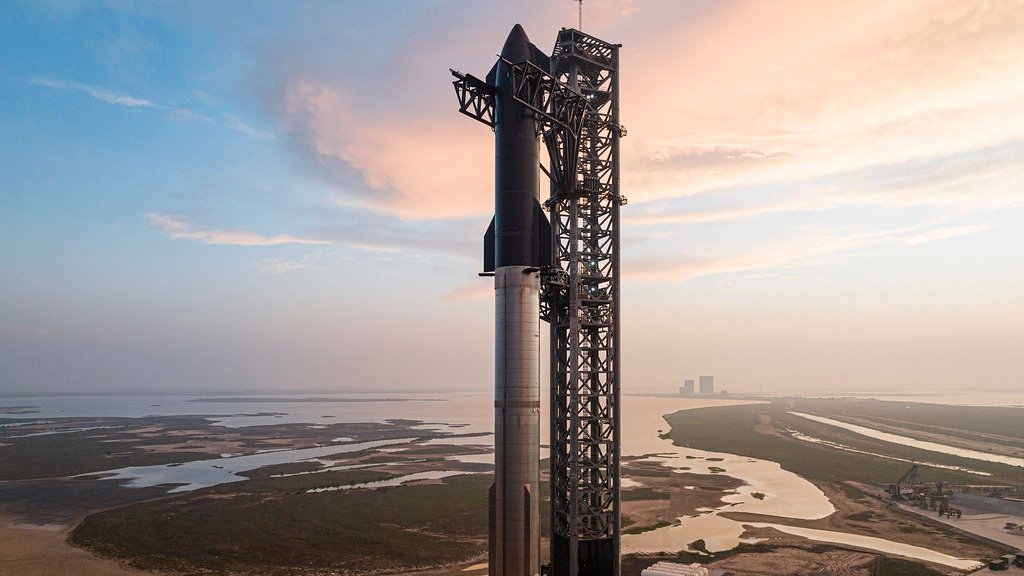
SpaceX’s Secret Starship Plan Is Massive! What Is It Really For?: SpaceX’s Starship program could be about much more than transporting people to the Moon or Mars. According to the vision outlined in a recent Starship update attributed to Elon Musk, the long-term objective is to transform spaceflight into a high-frequency commercial transportation system capable of delivering enormous quantities of hardware into orbit.
The proposed scale is extraordinary. Instead of launching a few thousand tons into orbit each year, the vision involves eventually reaching hundreds of thousands or even millions of tons annually. That increase could support new forms of orbital infrastructure, including AI computing platforms, solar-powered data centers, communications satellites, and other commercial services.
From Rocket Launches to Orbital Infrastructure
Traditional spaceflight has largely focused on individual missions. Governments and companies launch satellites, scientific spacecraft, crewed vehicles, and exploration hardware when specific missions are ready.
The proposed Starship strategy takes a different approach: make orbital transportation routine and commercially useful.
According to the figures in the supplied Starship update, global launch activity could be measured at roughly 2,500 tons per year, with SpaceX accounting for a substantial portion of that capacity. The long-term objective described is dramatically larger.
The 2,000-Launch Starship Concept
One of the most ambitious figures associated with the plan is a potential 2,000 Starship launches in 2028.
The calculation presented is straightforward:
- 200,000 tons targeted for delivery to orbit
- Approximately 100 tons of reusable payload per Starship flight
- 200,000 ÷ 100 = 2,000 launches per year
That would translate into approximately 5.5 launches every day, or roughly one launch every 4.3 hours.
This is not simply a rocket-development challenge. It would require an entirely new industrial model for launch operations.
Turning Starship Into a Space Transportation System
For thousands of annual launches to become possible, SpaceX would need to operate Starship more like a commercial transportation network than a conventional launch vehicle.
The supplied comparison highlights the scale of the challenge. Falcon 9 reached 165 launches in 2025, after years of development and operational refinement. A Starship system operating at thousands of flights per year would therefore represent a dramatic increase in launch frequency.
Multiple Launch Pads Could Be Essential
A single launch pad would not realistically support the proposed cadence by itself.
The concept described in the update involves potentially multiple launch pads, allowing vehicles to be launched, recovered, inspected, refueled, and prepared while other pads remain active.
The ultimate goal would resemble an airport-style operation for spacecraft, with rapid turnaround becoming just as important as vehicle performance.
That requires more than rockets. It requires automated ground systems, propellant infrastructure, maintenance facilities, airspace coordination, supply chains, and recovery operations.
Why Orbital AI Compute Could Be the Bigger Opportunity
Perhaps the most interesting part of the proposed Starship strategy is its connection to artificial intelligence.
Earth-based AI data centers require enormous quantities of electricity, land, cooling infrastructure, and grid capacity. Orbital computing offers a radically different concept: place computing hardware where it can receive continuous access to sunlight.
The AI1 Satellite Concept
The supplied update describes a proposed first-generation AI1 satellite designed around solar power, thermal management, and onboard computing rather than conventional satellite architecture.
The concept includes a massive 70-meter wingspan and approximately 150 kW of peak solar power per satellite.
The satellites could also use high-speed optical communication links to connect computing nodes across orbit.
The broader idea is simple: launch computing infrastructure into space, use solar energy to power it, process data in orbit, and transmit information through high-bandwidth communications networks.
From Megawatts to Gigawatts
The projections described in the update envision orbital computing expanding from an initial 1 gigawatt-scale target toward much larger levels.
The proposed progression includes:
- 2027: Around 1 GW of orbital computing
- 2028–2029: Potential expansion toward 10 GW to 100 GW
- Thousands of specialized computing satellites supporting the network
These numbers should be understood as ambitious targets or projections, not established operational capacity.
If such infrastructure became technically and economically viable, however, Starship’s enormous payload capacity would have a potential commercial purpose beyond exploration.
Starlink V3 Adds Another Major Demand Driver
AI computing would not be the only reason for increased launch activity.
The next generation of Starlink satellites, referred to in the supplied material as Starlink V3, could require substantial launch capacity as SpaceX expands its broadband constellation.
The update estimates that approximately 500 dedicated Starship launches could eventually be needed for Starlink V3 deployment under the stated scenario.
That illustrates an important feature of SpaceX’s proposed strategy: multiple businesses could simultaneously create demand for a high-volume orbital transportation system.
Instead of Starship existing solely to serve one exploration program, it could potentially support communications, computing, energy infrastructure, scientific missions, and future deep-space logistics.
The Biggest Challenge Is Not Just the Rocket
Building a huge reusable rocket is only one part of the equation. Achieving thousands of launches would require a transformation across the entire spaceflight industrial ecosystem.
Regulatory Challenges
Launch frequency is constrained by regulatory approvals, safety requirements, airspace management, environmental considerations, and accident investigations.
The supplied material states that Starbase launch operations face limits that are far below the proposed thousands-per-year target.
That means achieving the envisioned cadence would likely require expanded launch infrastructure, additional operational sites, and regulatory frameworks capable of handling much higher launch frequency.
Propellant Production Must Scale
Starship’s enormous size also creates a major fuel logistics challenge.
Thousands of launches would require vast quantities of liquid oxygen and liquid methane.
A high-frequency Starship network therefore could not depend on small-scale propellant production. It would need industrial-scale manufacturing, storage, transportation, and rapid fueling systems capable of supporting repeated launches.
Pad Turnaround Is Critical
Another challenge is the physical stress placed on launch infrastructure.
A vehicle as powerful as Starship generates immense acoustic energy, heat, vibration, and mechanical stress during launch.
Rapidly restoring a launch pad after each mission would become a critical part of the operation. The faster SpaceX wants to launch, the more important pad durability and rapid refurbishment become.
What Could Starship Ultimately Become?
The most important idea behind this vision is not necessarily the exact 2,000-launch figure.
The larger concept is the creation of a massively scalable orbital transportation system.
If Starship eventually reaches high levels of reusability and rapid turnaround, its enormous payload capacity could reduce the cost and difficulty of putting large infrastructure into orbit.
That could open opportunities for orbital data centers, advanced communications networks, solar-energy systems, scientific platforms, manufacturing facilities, and eventually deep-space infrastructure.
Even a fraction of the proposed 2028 cadence could represent a substantial increase in orbital delivery capability.
Conclusion: SpaceX Is Thinking Beyond Mars
The popular image of Starship often centers on Mars, the Moon, and human exploration. But the commercial opportunity described in this vision is much broader.
The proposed strategy revolves around making spaceflight frequent, reusable, scalable, and economically productive.
A future in which hundreds or thousands of Starship missions operate annually would fundamentally change how humanity thinks about orbital infrastructure. Instead of treating every launch as an exceptional event, space transportation could become a routine industrial service.
The 2,000-launch target, gigawatt-scale orbital computing concepts, and massive Starlink deployment plans remain highly ambitious. Whether those timelines and numbers can be achieved depends on engineering progress, launch infrastructure, regulation, manufacturing, and economics.
But the direction is clear: the ultimate Starship opportunity may not simply be getting humans to another planet. It could be building the transportation backbone for a much larger commercial economy in space.
FAQs
1. What is SpaceX’s secret Starship plan really about?
The proposed strategy goes beyond Moon and Mars missions. It envisions Starship becoming a high-frequency orbital transportation system capable of delivering massive amounts of infrastructure into space.
2. What is the Starship 2,000-launch target?
The supplied projection describes a potential target of 2,000 Starship launches in 2028. This figure comes from a proposed goal of delivering about 200,000 tons to orbit with roughly 100 tons of reusable payload per flight.
3. How many Starship launches per day would 2,000 launches require?
Two thousand launches annually would average approximately 5.5 launches per day, equivalent to roughly one launch every 4.3 hours.
4. How much payload could Starship deliver under this projection?
The scenario assumes approximately 100 tons of reusable payload per Starship flight. At 2,000 flights, that would theoretically provide around 200,000 tons of orbital delivery capacity per year.
5. Why does SpaceX want to launch so much mass into orbit?
The proposed demand comes from potential commercial orbital infrastructure, including Starlink satellites, AI computing platforms, communications systems, and other large-scale space infrastructure.
6. What is orbital AI computing?
Orbital AI computing refers to placing computing hardware and supporting infrastructure in space. The concept could use abundant sunlight for power while using satellites and optical communications to connect computing resources.
7. What is the AI1 satellite concept?
The supplied Starship update describes AI1 as a proposed first-generation orbital computing satellite featuring large solar arrays, onboard computing equipment, and thermal-management systems.
8. How much power could an AI1 satellite generate?
The projection described in the material gives AI1 a 70-meter wingspan and approximately 150 kW of peak solar power.
9. Could orbital data centers use solar power continuously?
One potential advantage of space-based solar power is access to sunlight without many of the nighttime, weather, and cloud limitations experienced by ground-based solar installations. Actual system performance would depend on orbital design and other engineering factors.
10. How much orbital computing capacity is being proposed?
The supplied projections describe a possible progression from approximately 1 GW of orbital computing toward 10 GW to 100 GW in later stages. These are ambitious projections rather than established operational capacity.
11. What role could Starlink V3 play in Starship’s launch plans?
Starlink V3 could create another major source of launch demand. The supplied material estimates that hundreds of Starship flights could be required to deploy a large next-generation satellite constellation.
12. Why would SpaceX need multiple Starship launch pads?
Thousands of annual launches would require extremely rapid launch-pad turnaround. Multiple pads could allow launches, inspections, maintenance, fueling, and preparations to happen in parallel.
13. Could Starship launches eventually operate like an airport?
That is the general operational concept behind an extremely high launch cadence. Starship would need standardized procedures for vehicle processing, fueling, recovery, maintenance, and rapid turnaround, similar in principle to other high-throughput transportation systems.
14. What are the biggest challenges to launching Starship thousands of times?
Major challenges include regulatory approvals, launch-site capacity, propellant production, vehicle reliability, pad durability, airspace coordination, manufacturing, and recovery operations.
15. Why is methane and liquid oxygen production important for Starship?
Starship requires large quantities of liquid methane and liquid oxygen. Thousands of launches would therefore require a much larger industrial supply chain for producing, storing, transporting, and rapidly loading these propellants.
16. Is the 2,000-launch Starship target guaranteed for 2028?
No. The 2,000-launch figure is an extremely ambitious target or projection described in the supplied material. Achieving it would depend on major advances in Starship reusability, launch infrastructure, regulation, manufacturing, and operational reliability.
17. What could Starship ultimately be used for?
Beyond exploration, Starship could potentially support Starlink deployment, orbital computing, communications infrastructure, scientific missions, large-scale space manufacturing, solar-energy systems, and deep-space logistics if the required technical and commercial systems become viable.
Read More:
- SpaceX revealed Starship Flight 14 Orbital Plans & B20 Failure Cause Shocked the Entire Industry
- Elon Musk’s First Tesla Cyberbike Prototype Shocked the Industry
- SpaceX’s next Starship launch is about to attempt its biggest leap yet
- Starship Flight 14 Launch Date just Changed Again, No Launch This Week
- Elon Musk’s New Update On $119B Terafab, Biggest Building On Earth