
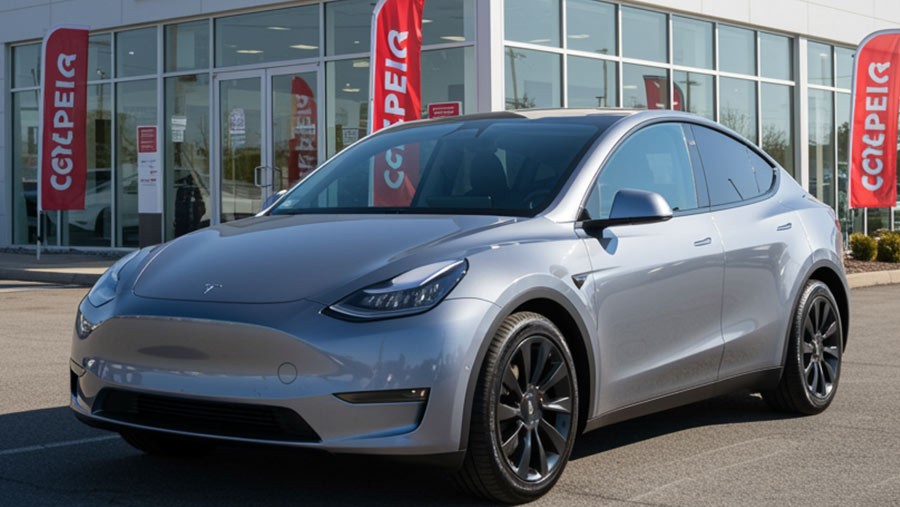
Tesla Finally UNLOCKED New 4.0 Production Line Destroy EV Industry: The global automotive industry is witnessing one of the most significant manufacturing revolutions since Henry Ford introduced the moving assembly line more than a century ago. For decades, carmakers have relied on a relatively unchanged production model involving stamping, welding, painting, and assembling thousands of individual parts in a sequential process.
Now, Tesla is attempting to completely rewrite the rules of vehicle manufacturing with its groundbreaking Production 4.0 ecosystem at Gigafactory Texas. Driven by Elon Musk’s vision for the upcoming Cybercab robotaxi, this revolutionary manufacturing system aims to produce vehicle body structures in less than 10 seconds, dramatically reducing costs, factory space requirements, and production complexity.
By combining next-generation mega-casting technology, the innovative Unboxed Process, advanced AI-powered quality control systems, and even eliminating traditional paint shops, Tesla is positioning itself to transform automotive manufacturing forever.
In this article, we explore how Tesla’s Production 4.0 system works, why it could disrupt the entire EV industry, and what it means for the future of vehicle production.
The End of Traditional Automotive Manufacturing
For over 100 years, vehicle production has followed the same fundamental pattern.
Manufacturers stamp metal sheets into components, weld them together into a unibody structure, send them through energy-intensive paint shops, and then move them down lengthy assembly lines where workers and robots install thousands of parts.
While highly refined, this process has several limitations:
- Massive factory footprints
- High labor costs
- Thousands of components
- Complex logistics networks
- Production bottlenecks
- Accumulated manufacturing tolerances
Even modern automotive plants require hours to complete a single vehicle.
Tesla believes there is a better way.
With Production 4.0, the company is redesigning both the vehicle architecture and manufacturing process from the ground up.
Tesla Production 4.0: A Manufacturing Revolution
Tesla’s Production 4.0 system is designed around one primary goal:
Produce vehicles faster, cheaper, and more efficiently than ever before.
The strategy focuses on two major innovations:
- Advanced Mega-Casting Technology
- The Unboxed Manufacturing Process
Together, these technologies allow Tesla to:
- Reduce factory floor space by 40%
- Eliminate hundreds of robots
- Minimize supply chain complexity
- Lower production costs
- Increase manufacturing speed dramatically
This approach moves automotive manufacturing closer to the efficiency of consumer electronics production.
The Evolution of Tesla’s Giga Casting Technology
The Birth of the 6,100-Ton Giga Press
Tesla first shocked the automotive industry with the introduction of the 6,100-ton Giga Press for the Model Y.
Traditionally, a vehicle’s rear underbody consists of more than 70 individual parts that must be stamped, welded, and assembled.
Tesla replaced all those components with a single aluminum casting.
The benefits were immediate:
- Fewer parts
- Faster production
- Lower costs
- Improved structural rigidity
At Gigafactory Shanghai, this innovation helped reduce key manufacturing stages to roughly 35 seconds per vehicle.
This was already considered revolutionary by industry standards.
The Cybertruck and the 9,000-Ton Giga Press
Tesla pushed even further with the launch of the Cybertruck.
To support the vehicle’s unique stainless-steel exoskeleton architecture, Tesla deployed a massive 9,000-ton Giga Press.
The Cybertruck demonstrated that ultra-large castings could provide:
- Exceptional strength
- Improved durability
- Better crash performance
- Greater manufacturing efficiency
More importantly, it proved that Tesla’s casting strategy could scale.
The Alleged 50,000-Ton Multi-Cast System
Now Tesla appears ready to take another giant leap.
Reports suggest that the Cybercab production line may utilize a stunning 50,000-ton multi-cast system.
This machine isn’t simply larger—it operates differently.
Instead of producing a single front or rear structure per cycle, the new system could potentially cast up to five major vehicle structures simultaneously.
Benefits of the 50,000-Ton Giga Press
- Multiple castings per production cycle
- Drastically reduced production times
- Higher manufacturing throughput
- Lower labor requirements
- Greater economies of scale
As a result, Tesla expects vehicle body production times to fall from roughly 35 seconds to under 10 seconds.
That level of speed is virtually unheard of in automotive manufacturing.
Understanding Tesla’s Unboxed Process
Perhaps the most revolutionary aspect of Production 4.0 is Tesla’s Unboxed Process.
This system completely eliminates the traditional linear assembly line.
Problems with Traditional Assembly Lines
In a conventional factory, manufacturers first create a complete vehicle shell.
Afterward, workers and robots must reach inside through doors, windows, and openings to install:
- Seats
- Wiring
- Electronics
- Dashboards
- Interior trim
This creates several inefficiencies:
- Restricted access
- Sequential workflows
- Production bottlenecks
- Increased labor complexity
If one station experiences delays, the entire assembly line slows down.
How the Unboxed Process Works
Instead of building the shell first, Tesla divides the vehicle into separate sub-assemblies.
These include:
- Front section
- Rear section
- Side structures
- Structural battery pack
- Floor assembly
Each component is manufactured independently.
Parallel Manufacturing
Every section is assembled simultaneously in dedicated work cells.
This parallel approach dramatically improves efficiency.
Benefits include:
- Faster assembly
- Better automation
- Reduced factory congestion
- Greater production flexibility
Open Access Manufacturing
Because the vehicle shell doesn’t exist yet, robots enjoy unrestricted 360-degree access.
This allows:
- Direct seat installation
- Simplified wiring placement
- Faster electronics integration
- Improved robotic efficiency
Tasks that previously required awkward positioning become simple automated operations.
Final Snap-Merge Assembly
Once every sub-assembly is fully equipped, they converge at a central location.
Tesla then combines them into a completed vehicle through a highly automated joining process.
The result is a dramatic reduction in assembly time and factory complexity.
Why Tesla Can Build Cars Faster Than Competitors
Creating massive castings at ultra-high speed presents enormous engineering challenges.
Tesla’s solution combines advanced metallurgy, software, and thermal management technologies.
Computational Fluid Dynamics and Precision Casting
When molten aluminum enters a mold, it must flow perfectly.
Even minor deviations can create defects such as:
- Air pockets
- Structural voids
- Cold shuts
- Surface imperfections
Tesla uses sophisticated Computational Fluid Dynamics (CFD) simulations to predict metal flow behavior.
These digital models help engineers optimize:
- Mold design
- Injection speed
- Pressure distribution
- Cooling efficiency
The result is consistent, high-quality castings.
Conformal Cooling Technology
Traditional casting molds use straight cooling channels.
Tesla utilizes advanced conformal cooling systems that follow the exact geometry of the part.
Benefits include:
- Faster cooling
- Reduced warping
- Improved consistency
- Shorter cycle times
This technology enables aluminum to solidify rapidly without sacrificing structural integrity.
Tesla’s Proprietary Aluminum Alloy
One of Tesla’s most underrated advantages is its material science expertise.
Most cast automotive components require lengthy heat-treatment processes after casting.
These procedures add:
- Time
- Cost
- Energy consumption
Tesla developed a proprietary aluminum alloy that reaches optimal strength immediately after cooling.
Advantages
- No post-casting heat treatment
- Faster production
- Lower manufacturing costs
- Improved scalability
This innovation gives Tesla a significant competitive edge.
AI-Powered X-Ray Inspection
Quality control becomes challenging when parts are produced every few seconds.
Traditional inspection methods simply cannot keep up.
Tesla solves this problem using AI-powered X-ray scanning systems.
Every casting is automatically inspected immediately after production.
AI Inspection Benefits
- Real-time defect detection
- Reduced scrap rates
- Higher manufacturing consistency
- No production interruptions
Computer vision systems compare each part against a digital twin and instantly identify defects.
Defective components are automatically recycled.
Tesla Wants to Eliminate the Paint Shop
One of the most expensive parts of vehicle manufacturing is painting.
Traditional paint shops require:
- Massive facilities
- Large energy consumption
- Water-intensive processes
- Environmental controls
Tesla’s Production 4.0 strategy may eliminate this bottleneck entirely.
What Is Color Infusion Technology?
Tesla is reportedly developing color-infused molded body panels.
Instead of applying paint afterward, pigments are embedded directly into the panel material during manufacturing.
This means:
The Color Is the Material
The finish isn’t painted on top.
The panel itself contains the color.
Benefits of Color-Infused Panels
Improved Scratch Resistance
Since the color extends throughout the material, scratches remain nearly invisible.
Unlike traditional paint:
- No exposed primer
- No color mismatch
- Better long-term appearance
Faster Repairs
Damaged panels can be replaced instantly without repainting.
This is especially valuable for robotaxi fleets.
Lower Manufacturing Costs
Removing paint shops reduces:
- Capital expenditures
- Energy use
- Water consumption
- Environmental impact
Massive Supply Chain Simplification
Tesla’s manufacturing strategy doesn’t just improve factory efficiency.
It also transforms the entire supply chain.
Fewer Parts, Greater Efficiency
The Model Y contains approximately 200 major structural components.
The Cybercab reportedly reduces that number to around 80 parts.
Benefits include:
- Fewer suppliers
- Simplified logistics
- Reduced inventory
- Lower transportation costs
Every eliminated component reduces complexity across the entire manufacturing ecosystem.
Closed-Loop Recycling System
Tesla’s highly standardized aluminum architecture enables a powerful recycling process.
Rejected castings and production scrap are immediately returned to nearby furnaces.
The material is:
- Melted
- Reprocessed
- Recast
This creates a closed-loop manufacturing system.
Advantages include:
- Lower waste
- Reduced carbon footprint
- Improved material efficiency
- Lower production costs
Engineering Designed for Autonomous Driving
The Cybercab isn’t just another EV.
It is designed from the ground up for full autonomy.
That requires an entirely different engineering philosophy.
Eliminating Structural Play
Traditional vehicles contain hundreds of joints, welds, and fastening points.
Over time, these can develop:
- Flexibility
- Fatigue
- Structural variance
Tesla’s mega-cast architecture creates a nearly monolithic structure.
The result is:
- Greater rigidity
- Improved durability
- More predictable handling
Why This Matters for AI Driving Systems
Autonomous vehicles rely on precision.
Tesla’s Full Self-Driving system constantly calculates:
- Steering inputs
- Braking forces
- Vehicle dynamics
A rigid, consistent chassis provides predictable behavior.
This allows AI systems to operate more accurately and safely.
For a vehicle without a steering wheel or pedals, consistency is critical.
Can Tesla Truly Disrupt the Entire EV Industry?
If Production 4.0 succeeds, Tesla could gain one of the largest manufacturing advantages in automotive history.
Potential benefits include:
Lower Vehicle Costs
Faster production and fewer parts significantly reduce manufacturing expenses.
Higher Profit Margins
Improved efficiency increases profitability.
Faster Scaling
Smaller factories can produce more vehicles.
Competitive Pressure
Legacy automakers may struggle to match Tesla’s manufacturing innovations.
Many competitors can purchase similar machinery, but replicating Tesla’s:
- Software systems
- Alloy formulations
- AI infrastructure
- Manufacturing expertise
will be far more difficult.
The Future Beyond Cybercab
Tesla’s ambitions extend beyond robotaxis.
The technologies developed through Production 4.0 could become the foundation for future manufacturing systems across multiple industries.
Many analysts believe these innovations will eventually support:
- Future Tesla vehicles
- Energy products
- Autonomous systems
- Optimus humanoid robots
By building a highly automated production ecosystem, Tesla is creating a platform capable of manufacturing increasingly complex machines at unprecedented scale.
Final Thoughts
Tesla’s Production 4.0 initiative represents far more than an upgrade to traditional manufacturing.
It is a complete reimagining of how vehicles are designed, assembled, and delivered.
Through a combination of 50,000-ton mega-casting technology, the revolutionary Unboxed Process, AI-powered quality control, color-infused body panels, and closed-loop recycling systems, Tesla is attempting to achieve something the automotive industry has never seen before.
If successful, the company could reduce production times to mere seconds, lower costs dramatically, simplify supply chains, and establish a manufacturing advantage that competitors may take years to match.
Whether Production 4.0 ultimately fulfills its promise remains to be seen, but one thing is clear: Tesla is no longer just building electric vehicles—it is attempting to redefine industrial manufacturing itself.
The age of the traditional assembly line may finally be coming to an end.
FAQs
1. What is Tesla’s Production 4.0 manufacturing system?
Tesla Production 4.0 is the company’s next-generation manufacturing approach that combines mega-casting technology, the Unboxed Process, AI-driven automation, and advanced materials to produce vehicles faster, cheaper, and more efficiently than traditional automotive factories.
2. What is the Unboxed Process?
The Unboxed Process is Tesla’s new assembly method where different sections of a vehicle are built separately and simultaneously before being joined together in a final assembly stage. This eliminates the need for a traditional linear assembly line and significantly reduces manufacturing time.
3. How is Tesla’s Production 4.0 different from traditional car manufacturing?
Traditional car manufacturing follows a sequential process of stamping, welding, painting, and assembly. Tesla’s Production 4.0 uses parallel manufacturing, large-scale castings, and advanced automation to reduce factory space, labor requirements, and production bottlenecks.
4. What is a Giga Press?
A Giga Press is a massive industrial die-casting machine used by Tesla to create large vehicle body structures from a single piece of aluminum. It replaces dozens of smaller components that would traditionally need to be welded together.
5. How large is Tesla’s rumored 50,000-ton Giga Press?
Reports suggest Tesla’s next-generation casting system for the Cybercab could use an astonishing 50,000 tons of clamping force, making it significantly larger and more powerful than the 6,100-ton and 9,000-ton Giga Presses currently used.
6. How fast can Tesla’s Production 4.0 build vehicle structures?
Tesla aims to reduce vehicle body production time from approximately 35 seconds per structure in the Model Y to less than 10 seconds using its advanced multi-casting technology.
7. What is the Tesla Cybercab?
The Tesla Cybercab is Tesla’s upcoming fully autonomous robotaxi designed without a traditional steering wheel or pedals. It is expected to be the first vehicle produced using the full Production 4.0 manufacturing ecosystem.
8. How does Tesla reduce the number of vehicle parts?
Tesla uses large aluminum castings to replace numerous stamped and welded components. This reduces major structural parts from around 200 in the Model Y to approximately 80 in the Cybercab.
9. What are the benefits of mega-casting technology?
Mega-casting offers several advantages, including:
- Fewer vehicle parts
- Faster production
- Lower manufacturing costs
- Improved structural rigidity
- Simplified supply chains
- Reduced factory complexity
10. How does Tesla use AI for quality control?
Tesla employs AI-powered X-ray inspection systems that scan every casting in real time. Computer vision software analyzes each component for defects such as cracks, porosity, and dimensional variations before allowing it to continue through production.
11. What is Tesla’s color infusion technology?
Color infusion technology involves embedding pigments directly into molded body panels during manufacturing. Unlike traditional paint, the color becomes part of the material itself, reducing the need for expensive paint shops.
12. Why does Tesla want to eliminate paint shops?
Paint shops are among the most expensive and energy-intensive parts of vehicle manufacturing. Eliminating them helps Tesla reduce:
- Water usage
- Energy consumption
- Production costs
- Environmental impact
13. How does Tesla’s manufacturing system support autonomous driving?
Tesla’s large cast structures create a highly rigid chassis with fewer joints and welds. This provides more predictable vehicle dynamics, helping the Full Self-Driving (FSD) system make precise steering, braking, and handling decisions.
14. What is Tesla’s closed-loop recycling system?
Tesla recycles aluminum scrap and rejected castings directly within the factory. The material is melted, reprocessed, and reused in new castings, reducing waste and lowering the carbon footprint of vehicle production.
15. Could Tesla’s Production 4.0 change the entire EV industry?
If successful, Production 4.0 could transform the EV industry by lowering vehicle costs, increasing manufacturing speed, simplifying supply chains, and creating a production model that competitors may find difficult to replicate.
Read More:
- Tesla upgrades Model Y’s affordable trims with new interior features
- Ferrari CEO’s self-driving stance echoes Elon Musk’s — sort of
- Tesla Model 3 has a tasty Supercharging incentive, but it’s ending soon
- SpaceX Ready to Push Starship Program Stronger than Ever after Flight 12: What Comes Next?
- New $12,749 Tesla Model 2 Will DESTROY Gas Cars Forever For Seniors 55+
2 thoughts on “Tesla Finally UNLOCKED New 4.0 Production Line Destroy EV Industry”