
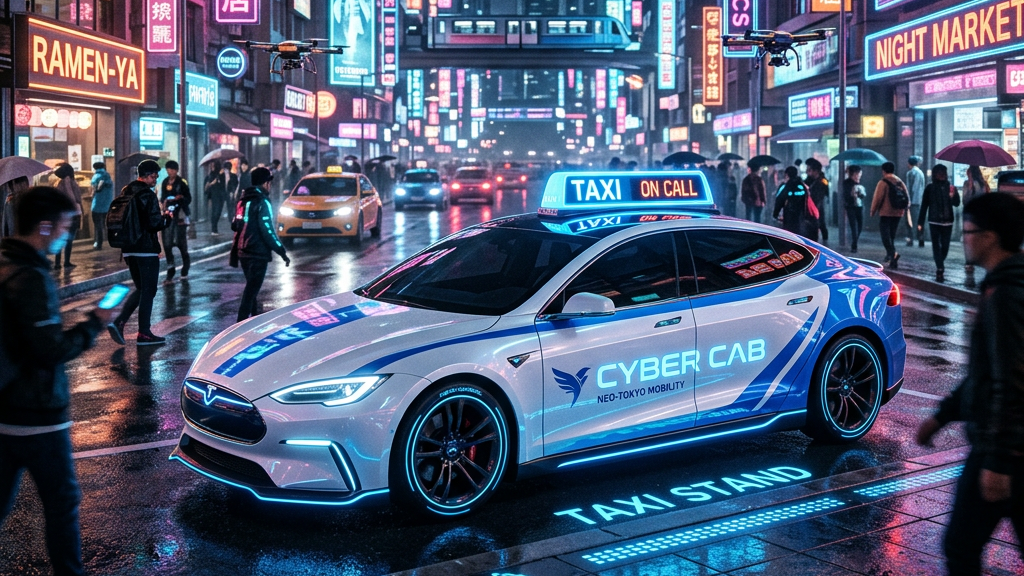
Tesla’s INSANE New Upgrade Makes Cybercab 100% SAFE: The automotive industry is entering a new era where autonomous vehicles (AVs) are no longer science fiction but an emerging reality. While many people believe that Artificial Intelligence (AI) alone will eliminate accidents, Tesla’s latest Cybercab proves that true autonomous safety depends on much more than software.
Tesla has completely redesigned the Cybercab from the ground up instead of modifying an existing electric vehicle. Every aspect of the vehicle—from its structural battery pack and 10-airbag safety system to wireless charging and first responder emergency protocols—has been engineered specifically for driverless transportation.
Rather than assuming autonomous software is perfect, Tesla acknowledges that rare edge-case accidents can still happen. That is why the Cybercab combines advanced Level 4 autonomous driving, physical safety innovations, intelligent emergency systems, and fleet management into one closed-loop transportation platform.
In this article, we’ll explore every major upgrade that makes Tesla’s Cybercab one of the most advanced autonomous vehicles ever designed.
Why Tesla Built an Entirely New Cybercab Instead of Modifying Existing Cars
For years, most autonomous vehicle companies simply added cameras, lidar sensors, radar systems, and powerful computers onto existing passenger cars.
Tesla chose a completely different strategy.
Instead of retrofitting a Model Y or another EV, Tesla developed an entirely purpose-built autonomous platform.
This approach follows Tesla’s famous manufacturing philosophy:
“The best part is no part.”
By removing unnecessary components such as:
- Steering wheel
- Pedals
- Steering column
- Instrument cluster
- Traditional mirrors
- Mechanical driving controls
Tesla dramatically reduced complexity, weight, manufacturing costs, and maintenance requirements.
The result is a vehicle designed exclusively for robotaxi operations, not traditional personal transportation.
Physical Specifications: Lightweight Design with Maximum Efficiency
One of the biggest engineering achievements of the Cybercab is its remarkable efficiency.
Ultra-Lightweight Construction
The Cybercab weighs only 3,113 pounds, making it roughly 700 pounds lighter than the Tesla Model 3.
Lower weight offers numerous advantages:
- Longer driving range
- Reduced energy consumption
- Improved handling
- Lower tire wear
- Better fleet operating economics
Every unnecessary kilogram removed allows the vehicle to travel farther while consuming less electricity.
Compact Structural Battery
Instead of using a massive battery pack, Tesla equips the Cybercab with a compact:
47.6 kWh Structural Battery
Despite its smaller capacity, the Cybercab delivers an astonishing:
418 miles of driving range
This translates into an incredible efficiency rating of approximately:
6 miles per kWh
Few production electric vehicles come close to this level of efficiency.
Brand-New Front-Wheel Drive Motor
Tesla also introduced a newly developed:
219-horsepower Front-Wheel Drive Motor
Rather than maximizing acceleration, this motor focuses on:
- Urban efficiency
- Smooth operation
- Low energy consumption
- Continuous commercial driving
Since robotaxis spend most of their time navigating city streets rather than racing, this motor perfectly matches its intended mission.
Advanced Passive Safety That Protects Everyone
One of the most overlooked aspects of autonomous vehicles is what happens after a collision.
Tesla understands that even the best AI cannot completely eliminate every accident.
Therefore, Cybercab introduces several new passive safety technologies.
Active Hood System
Pedestrians remain among the most vulnerable road users.
Tesla’s new Active Hood System automatically raises the rear edge of the hood whenever sensors detect a pedestrian collision between:
15–32 mph (25–52 km/h)
This creates additional deformation space that prevents a pedestrian’s head from striking the hard engine structure beneath the hood.
The system significantly reduces impact forces and improves pedestrian survival rates.
Revolutionary 10-Airbag Protection
Unlike traditional vehicles, Cybercab passengers may recline, work, relax, or change seating positions during autonomous trips.
Tesla redesigned the interior protection system accordingly.
The Cybercab features 10 airbags, including:
Front Airbags
Protect occupants during frontal collisions.
Knee Airbags
Prevent lower-leg injuries.
Curtain Airbags
Shield passengers from side impacts and broken glass.
Inner Side Airbags
Prevent passengers from colliding with one another.
Outer Side Airbags
Reduce injuries during side-door impacts.
This multi-directional protection system provides safety regardless of passenger posture.
Emergency Rescue Features Designed for First Responders
Autonomous vehicles introduce unique rescue challenges.
Without a steering wheel or traditional controls, firefighters and emergency teams require new procedures.
Tesla has addressed these concerns with several mechanical fail-safe systems.
Dual Emergency Cutoff Loops
The Cybercab operates on a 326-volt high-voltage electrical system.
To protect emergency workers, Tesla installed:
- One emergency cutoff beneath the front hood
- Another behind the passenger-side B-pillar
If one area becomes inaccessible after a crash, responders can still disconnect the battery using the second cutoff location.
This dramatically improves rescue safety.
Orange Battery Coolant
Tesla also changed the coolant color.
The battery coolant is now bright orange, allowing rescue personnel to immediately identify high-voltage cooling fluid during accident recovery.
This helps distinguish it from ordinary vehicle fluids.
Manual Door Release
Although daily operation relies on electronic controls, every passenger door also includes a hidden mechanical release lever.
Even if the vehicle completely loses electrical power, occupants can still exit safely.
Centralized Window Controls
Instead of placing window switches inside each door, Tesla relocated every window control beneath the central display.
This makes them much easier to locate during emergency evacuations.
Neutral Override for Towing
Because Cybercab lacks a traditional gear selector, Tesla created a dedicated mechanical override.
Emergency personnel can manually place the vehicle into Neutral, allowing it to be pushed or safely towed away.
SAE Level 4 Autonomous Driving
The Cybercab is designed for SAE Level 4 autonomy.
This means the vehicle performs every driving task independently within its approved operating conditions.
No driver supervision is required.
However, Tesla also designed intelligent fallback procedures whenever something unexpected occurs.
Passenger Safety Monitoring
Internal cameras and sensors continuously monitor passengers.
If someone:
- Unbuckles a seatbelt
- Attempts to open a door while moving
the Cybercab immediately:
- Cancels the trip
- Activates hazard lights
- Pulls over safely
This prevents dangerous situations before they escalate.
Hardware Failure Protection
If the vehicle experiences:
- Camera malfunction
- Computer failure
- Sensor degradation
the software initiates a safe emergency routine.
The Cybercab will:
- Activate hazards
- Locate a safe parking area
- Pull over autonomously
- Notify Tesla support in real time
This redundancy greatly improves operational safety.
Self-Cleaning Camera System
Tesla’s autonomous driving system relies entirely on cameras.
Dirty lenses could compromise vehicle vision.
To solve this problem, Cybercab includes:
- High-pressure air cleaning
- Automatic washer fluid spray
- Intelligent obstruction detection
Whenever the AI detects dirt, mud, bugs, or road salt covering the cameras, the cleaning system automatically restores clear visibility.
This minimizes downtime while improving safety.
Revolutionary Communication with Police and Emergency Workers
One of Cybercab’s most innovative features is its ability to communicate directly with first responders.
External B-Pillar Speaker and Microphone
Tesla integrated a live communication system into the vehicle’s B-pillar.
Police officers or firefighters can speak directly to Tesla’s remote operations team through the vehicle itself.
This allows:
- Emergency route changes
- Incident coordination
- Vehicle overrides
- Real-time assistance
The feature addresses one of the public’s biggest concerns regarding autonomous vehicles: the inability to interact with them during emergencies.
First Responder Authentication
Tesla also developed an intelligent authentication system.
Emergency personnel simply:
- Wear their official uniform
- Present their badge to the camera
The Cybercab verifies their identity before granting authorized control functions.
This prevents unauthorized tampering.
Hand Gesture Recognition
The vehicle recognizes standard traffic control gestures from:
- Police officers
- Crossing guards
- Construction workers
Whether instructed to stop, proceed, or change direction, the Cybercab dynamically responds to human traffic controllers.
Smarter Navigation Through Construction Zones
Construction zones frequently confuse conventional navigation systems.
Tesla’s camera-based neural network continuously analyzes:
- Traffic cones
- Temporary lane markings
- Road barriers
- Police instructions
Instead of relying solely on digital maps, the Cybercab adapts to the real-world driving environment in real time.
This significantly improves autonomous performance in complex urban settings.
Wireless Charging Eliminates Human Refueling
A robotaxi cannot depend on someone plugging it into a charger every night.
Tesla solved this problem with fully autonomous inductive wireless charging.
Instead of using charging cables, the Cybercab automatically parks above a charging pad.
Tesla reports charging efficiency exceeding:
90%
This approaches the efficiency of conventional plug-in charging while eliminating robotic charging arms and moving parts.
Intelligent Energy Management
The Cybercab constantly predicts upcoming energy requirements.
If battery capacity cannot complete the next passenger trip, it simply:
- Rejects new ride requests
- Drives itself to the nearest charging station
- Recharges automatically
- Returns to service
No human intervention is required.
Manual Charging Release
If a charging system becomes jammed, technicians can manually disconnect the charging mechanism using an emergency release hidden behind the rear wheel arch.
This minimizes maintenance delays.
Built for Continuous Fleet Operations
Unlike personal vehicles that remain parked most of the day, the Cybercab is engineered for nearly continuous commercial operation.
Traditional cars average approximately:
5% daily utilization
Cybercab aims for:
80–90% utilization
This dramatically improves fleet economics.
Massive Operational Design Domain
Tesla designed Cybercab to operate across:
- Urban streets
- Highways
- Rural roads
- Parking garages
- Airport pickup zones
- Private roads
The system functions during:
- Daytime
- Night driving
- Light rain
- Fog
- Light snow
If severe weather develops, the software automatically suspends new trips or safely parks until conditions improve.
Structural Battery Architecture
One of the most important engineering breakthroughs is Tesla’s structural battery pack.
Traditional EVs place the battery inside a protective frame.
Cybercab eliminates that extra structure.
Instead:
- The battery itself forms the chassis.
- Passenger seats mount directly to the battery structure.
- Component count decreases dramatically.
- Vehicle rigidity increases.
- Manufacturing becomes faster.
- Weight is reduced.
This approach improves crash performance while simplifying production.
Why Cybercab Could Change Urban Transportation Forever
Tesla’s Cybercab is much more than another electric vehicle.
It represents an entirely new transportation philosophy.
Rather than focusing exclusively on autonomous driving software, Tesla redesigned every aspect of the vehicle around commercial driverless operation.
Its innovations include:
- Purpose-built autonomous platform
- 418-mile driving range
- 6 miles per kWh efficiency
- 47.6 kWh structural battery
- 219 HP front-wheel drive motor
- 10-airbag protection system
- Active Hood pedestrian safety
- 326V emergency electrical isolation
- Dual emergency cutoff loops
- Manual rescue overrides
- Automatic camera cleaning
- Wireless inductive charging
- Real-time police communication
- Level 4 autonomous driving
- Continuous fleet optimization
Every system works together to maximize passenger safety, operational reliability, and commercial efficiency.
Final Thoughts
Tesla’s latest Cybercab demonstrates that true autonomous driving requires far more than advanced AI. While sophisticated software is essential, Tesla has shown that physical safety systems, emergency rescue protocols, structural engineering, redundant hardware, intelligent fleet management, and autonomous charging are equally important.
By combining a lightweight structural battery chassis, industry-leading energy efficiency, 10-airbag cabin architecture, Active Hood pedestrian protection, first responder communication systems, and SAE Level 4 autonomous capabilities, Tesla has created one of the most comprehensive autonomous transportation platforms ever developed.
Although no vehicle can realistically be considered 100% safe under every possible real-world condition, the Cybercab’s extensive safety innovations significantly reduce risks while setting a new benchmark for autonomous mobility. As Tesla continues refining its robotaxi ecosystem, the Cybercab could become the blueprint for the future of urban transportation, where intelligent software and advanced engineering work together to deliver safer, cleaner, and more efficient travel.
FAQs
1. What is Tesla’s Cybercab?
Tesla’s Cybercab is a fully autonomous electric robotaxi designed without a steering wheel or pedals. It is built specifically for commercial ride-hailing services and is engineered to operate with SAE Level 4 autonomous driving technology.
2. Is the Tesla Cybercab really 100% safe?
While Tesla has introduced numerous advanced safety features, no vehicle can be guaranteed to be 100% safe in every real-world situation. The Cybercab is designed with multiple layers of protection, including AI-based driving, a 10-airbag system, an Active Hood System, and emergency fail-safes to significantly improve safety.
3. What is the driving range of the Tesla Cybercab?
According to Tesla’s official specifications, the Cybercab offers an estimated 418-mile driving range using a compact 47.6 kWh structural battery pack, making it one of the most energy-efficient electric vehicles ever designed.
4. What battery does the Cybercab use?
The Cybercab features a 47.6 kWh structural battery pack that serves as both the energy source and part of the vehicle’s chassis, reducing weight while increasing structural strength.
5. What is the efficiency of the Tesla Cybercab?
Tesla claims the Cybercab achieves approximately 6 miles per kilowatt-hour (kWh), making it one of the most efficient electric vehicles in the industry.
6. Does the Tesla Cybercab have a steering wheel?
No. The Cybercab is a purpose-built autonomous vehicle that eliminates the steering wheel, pedals, and traditional driver controls because it is designed for fully autonomous operation within its approved operating domain.
7. What safety features does the Cybercab include?
The Cybercab includes numerous advanced safety technologies, such as:
- Active Hood System
- 10-airbag protection system
- Dual emergency battery cutoff loops
- Manual door release mechanisms
- Self-cleaning camera system
- Passenger monitoring sensors
- Automatic emergency pull-over functionality
8. What is the Active Hood System?
The Active Hood System automatically raises the hood during certain pedestrian impacts, creating additional space to absorb collision energy and reduce the risk of serious head injuries.
9. How does the Cybercab charge?
Instead of using a traditional charging port, the Cybercab relies on inductive wireless charging. The vehicle automatically parks over a charging pad and recharges without human assistance.
10. What happens if the Cybercab experiences a hardware failure?
If the system detects a critical hardware or sensor failure, it activates its hazard lights, safely pulls over, parks in a secure location when possible, and notifies Tesla’s support center for assistance.
11. Can first responders communicate with the Cybercab?
Yes. Tesla has integrated an external speaker and microphone system into the Cybercab’s B-pillar, allowing police officers and emergency personnel to communicate directly with Tesla’s remote support team during emergencies.
12. How does the Cybercab recognize police officers and emergency workers?
The vehicle uses its external cameras to verify official uniforms and identification badges. Once authenticated, authorized emergency personnel can access certain emergency override functions.
13. Can the Cybercab drive through construction zones?
Yes. The Cybercab’s vision-based AI can recognize temporary lane changes, traffic cones, construction barriers, and hand signals from traffic officers, allowing it to navigate changing road conditions safely.
14. What level of autonomous driving does the Cybercab offer?
The Cybercab is designed for SAE Level 4 autonomy, meaning it can perform all driving tasks independently within its defined Operational Design Domain (ODD) without requiring human intervention.
15. Why did Tesla build a new vehicle instead of modifying an existing car?
Tesla created the Cybercab from the ground up to maximize efficiency, reduce manufacturing complexity, improve passenger safety, lower operating costs, and optimize the vehicle for continuous autonomous fleet operations rather than traditional personal ownership.
Read More:
- Tesla Phone? Not quite, but close: analyst
- Tesla Full Self-Driving v14 ‘Lite’ for older cars finally gets released
- Tesla Full Self-Driving v14 ‘Lite’ Release Notes: new capabilities and features
- Tesla reveals huge Cybercab detail in new guide for First Responders
- Elon Musk’s New Tesla Battery Prototype “CRYOCELL” Shocks the Industry: 2,000km Range & 1 Min Charge
2 thoughts on “Tesla’s INSANE New Upgrade Makes Cybercab 100% SAFE”