
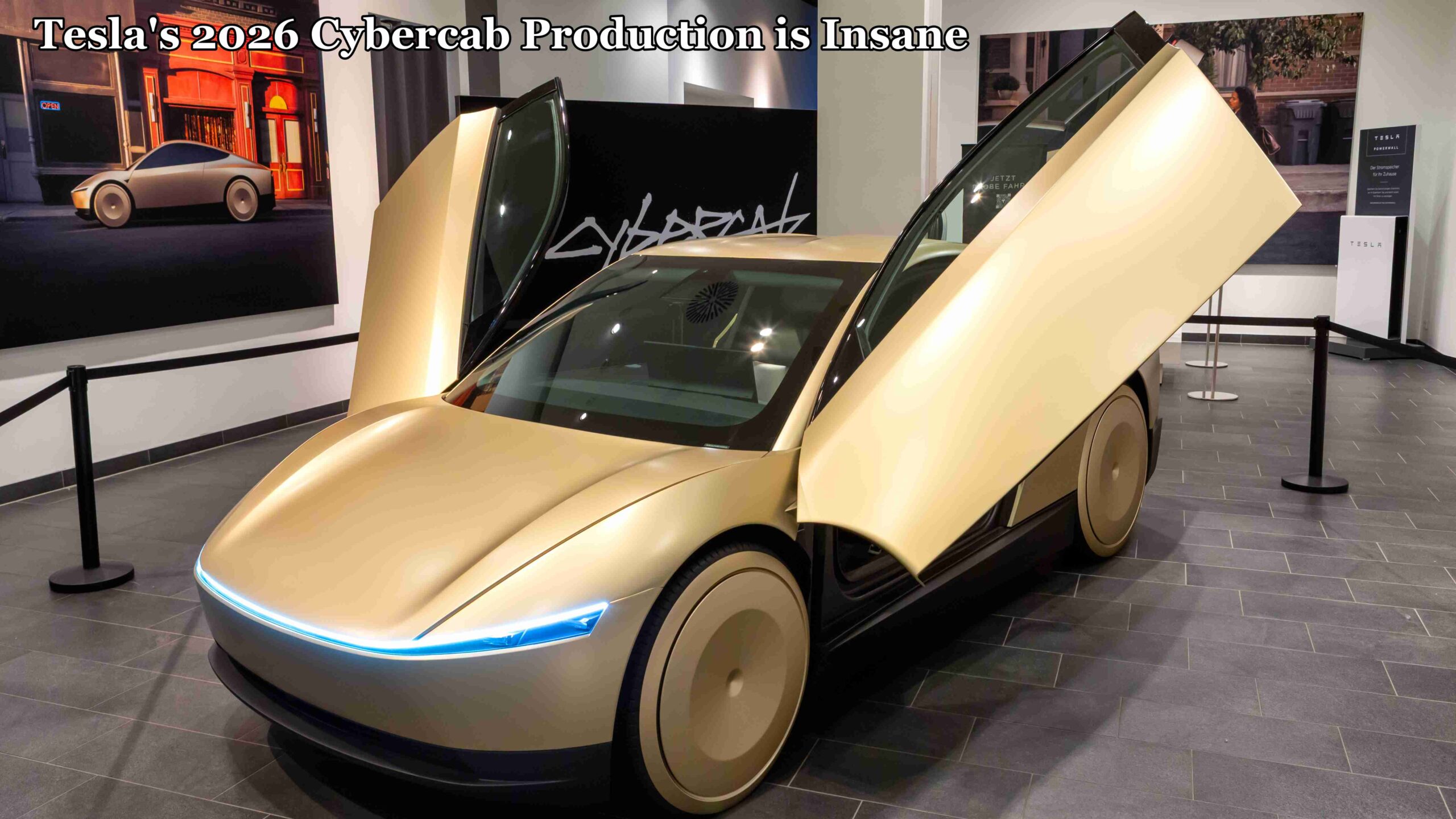
Tesla’s 2026 Cybercab: The world of autonomous transportation and human-machine integration is evolving at an astonishing pace. What once felt like distant science fiction is rapidly becoming part of everyday reality. Across multiple industries—automotive, infrastructure, artificial intelligence, and neuroscience—there is a clear convergence happening. At the center of this transformation is Tesla and its expanding ecosystem of innovation.
From the massive production lines at Giga Texas to underground transportation systems in Las Vegas, and even breakthroughs in brain-computer interfaces, the scale and speed of progress are unprecedented. These developments are no longer experimental—they are operational, scalable, and increasingly accessible.
This blog explores how Tesla’s Cybercab production, robotaxi deployment, infrastructure expansion, AI hardware advancements, and Neuralink innovations are collectively reshaping the future.
The Dawn of the Cybercab: From Concept to Reality
Mass Production Has Officially Begun
One of the clearest signs that autonomous vehicles are entering the mainstream is the activity observed at Tesla’s Giga Texas facility. Recent footage reveals a major milestone: the presence of fully autonomous Cybercabs ready for deployment.
Unlike earlier prototypes, these vehicles represent a finalized design intended for real-world usage at scale. The shift from experimentation to production is not theoretical—it is happening now.
The Shift to “No Controls” Design
Perhaps the most groundbreaking aspect of these Cybercabs is their complete lack of traditional driving controls.
- No steering wheel
- No pedals
- No mirrors
This radical design signals total confidence in Tesla’s Full Self-Driving (FSD) system. Earlier test models included temporary manual controls for safety and engineering validation. Those are now gone.
This transition suggests Tesla has entered the final validation and crash-testing phase, where design decisions are locked and regulatory processes begin.
Parallel Production Strategy
Tesla is executing a highly strategic rollout by operating two production streams simultaneously:
1. Validation Units
- Equipped with manual controls
- Used for real-world testing and data collection
- Help refine hardware and software systems
2. Production Units
- Fully autonomous
- Built for the Robotaxi network
- Designed for commercial deployment
This dual-track approach allows Tesla to accelerate development without compromising safety or performance.
Robotaxi Expansion: Dallas and Houston Lead the Way
Unsupervised Autonomy Goes Live
While Cybercab hardware progresses toward mass production, Tesla has already begun deploying its autonomous software in real-world environments.
In a bold and confident move, Tesla launched robotaxi services in Dallas and Houston—without any human supervision.
This means:
- No safety drivers
- No in-car monitors
- Fully autonomous operation from day one
This level of deployment marks a historic milestone in the autonomous vehicle industry.
Safety and Performance Metrics
Internal data from Tesla indicates that as of early 2026:
- The unsupervised fleet has reported zero incidents
- Performance surpasses major competitors in similar environments
These results are crucial in building public trust and regulatory approval.
Affordable Transportation: A New Economic Model
Early pricing data from robotaxi rides reveals a compelling advantage:
- A 2.25-mile trip costs approximately $6.15
- This is roughly 56% cheaper than competing services
Although availability is still limited and wait times can exceed 20 minutes, Tesla’s current focus is clearly on reliability over rapid scaling.
This pricing model hints at a future where transportation becomes significantly more affordable and accessible.
Infrastructure Matters: The Boring Company’s Vegas Loop
Reinventing Urban Mobility
Autonomous vehicles alone cannot solve traffic congestion. Tesla’s broader vision includes infrastructure designed specifically for efficient, high-speed transport.
The Boring Company’s Vegas Loop is a key part of this vision.
Major Developments in Las Vegas
Several important milestones have recently been achieved:
Airport Tunnel Expansion
- A second tunnel toward the airport is now complete
- Construction crews are actively finishing entrance structures
Westgate Station Near Completion
- Expected to open soon
- Represents a shift from event-based transport to daily city commuting
Cost and Efficiency Advantages
Early users of the Vegas Loop report:
- Significantly lower costs compared to traditional ride services
- Faster travel times due to zero traffic interference
- A smoother and more predictable commuting experience
This system demonstrates how underground transit can complement autonomous vehicles, creating a seamless mobility network.
Expansion Beyond Las Vegas
The concept is already spreading beyond Nevada.
Projects like private tunnel systems connecting hotels and campuses are in development. These localized networks could redefine how people move within large properties, cities, and business hubs.
Neuralink: Bridging the Gap Between Mind and Machine
The Vision Behind “Blindsight”
While Tesla focuses on moving people physically, Neuralink is working on enabling movement within the human brain itself.
One of its most ambitious projects is “Blindsight”—a system designed to restore vision for the blind.
The goal is to translate digital visual input into signals the brain can interpret as sight.
Strategic Leadership and Talent
To achieve this, Neuralink has strengthened its leadership team by hiring experts in:
- machine learning
- computer vision
- neural interface design
These capabilities are essential for building systems that can replicate human sensory experiences.
Real-World Progress and Trials
Neuralink has already demonstrated promising results:
- Patients with paralysis are using thought-to-speech technology
- Users can communicate in real-time without physical movement
- Early visual signal experiments (phosphine patterns) show potential for artificial vision
These developments indicate that Neuralink is moving from theory into practical, life-changing applications.
AI Hardware Breakthrough: The AI5 Chip
What “Tape Out” Means
Tesla recently confirmed the completion of the AI5 chip design phase—known as “tape out.”
This means:
- The design is finalized
- Manufacturing is ready to begin
- Deployment timelines are now predictable
Performance Expectations
The AI5 chip is expected to deliver:
- Multiple times the compute power of its predecessor
- Increased memory capacity
- Enhanced efficiency for real-time processing
This is critical for autonomous driving, where decisions must be made instantly and accurately.
Future Deployment Timeline
- Expected rollout: Late 2026 to 2027
- Will power next-generation Cybercabs
- Will support Tesla’s AI supercomputing infrastructure
The AI5 chip is not just an upgrade—it is a foundational component of Tesla’s long-term autonomy strategy.
A Human Touch: The Story Behind SpaceX’s Mascot
Asteroid the Shiba Inu
Amid all the technological advancements, one story stands out for its emotional depth.
SpaceX has officially adopted Asteroid, a Shiba Inu mascot designed by a young space enthusiast.
A Legacy That Lives On
The mascot was created by a 15-year-old who dreamed of contributing to space exploration. Despite her passing due to illness, her creation became part of a real mission.
Asteroid served as a zero-gravity indicator during a spaceflight and has now been immortalized as SpaceX’s official mascot.
Symbolism and Inspiration
This story highlights an important truth: behind every technological breakthrough are human stories, dreams, and legacies.
It serves as a reminder that innovation is not just about machines—it’s about people.
The Convergence of Technologies
A Unified Ecosystem
What makes these developments truly remarkable is how interconnected they are:
- Cybercabs provide autonomous transportation
- Robotaxis redefine urban mobility economics
- Vegas Loop supports infrastructure scalability
- Neuralink expands human capability
- AI5 chips power everything behind the scenes
This is not a collection of isolated innovations—it is a unified ecosystem designed to transform how humans live, move, and interact with technology.
From Prototype to Everyday Utility
The most important shift happening right now is the transition from:
- Experimental prototypes
→ Real-world deployment
Autonomous cars are no longer being tested—they are being used. Neural interfaces are no longer theoretical—they are helping patients.
What This Means for the Future
Transportation Will Become Autonomous and Affordable
As robotaxi networks scale, transportation costs are expected to drop dramatically. Car ownership may become optional rather than essential.
Cities Will Be Redesigned Around Efficiency
Infrastructure like underground loops could reduce congestion and improve urban planning.
Humans Will Augment Their Capabilities
With technologies like Neuralink, the line between human and machine will continue to blur.
AI Will Power Everything
From vehicles to healthcare, AI will become the backbone of modern life.
Final Thoughts: The Future Is Already Here
The rapid pace of innovation across Tesla’s ecosystem signals one undeniable truth: the future is not coming—it is already being built.
At Giga Texas, vehicles without steering wheels are rolling off production lines. In major cities, autonomous cars are transporting passengers without human intervention. Underground tunnels are redefining urban mobility. Neural implants are enabling communication and potentially restoring vision.
This is more than technological progress—it is a transformation of society itself.
For individuals and professionals, adapting to this new reality is essential. Understanding and integrating AI-driven tools into everyday workflows will be key to staying relevant in a rapidly evolving world.
The next decade will not just be about innovation—it will be about adoption at scale.
And if current trends are any indication, Tesla is leading that charge in a way that is, quite simply, insane.
FAQs
1. What is Tesla’s Cybercab?
The Cybercab is Tesla’s fully autonomous vehicle designed specifically for the robotaxi network, operating without steering wheels, pedals, or human drivers.
2. Does the Cybercab really have no steering wheel?
Yes, the latest Cybercab models are built with no manual controls, meaning no steering wheel, pedals, or mirrors, relying entirely on Full Self-Driving (FSD) technology.
3. When will Cybercab production start at scale?
Tesla has already begun early production at Giga Texas, with mass-scale deployment expected between 2026 and 2027.
4. What is Tesla’s robotaxi service?
Tesla’s robotaxi service is a ride-hailing platform using fully autonomous vehicles that operate without human drivers, offering a more affordable transportation option.
5. Where is Tesla’s robotaxi service currently available?
As of now, Tesla has launched unsupervised robotaxi services in Dallas and Houston, with plans to expand to more cities.
6. Are Tesla robotaxis safe?
According to Tesla’s internal data, the unsupervised fleet has reported zero incidents, making it highly competitive in terms of safety and reliability.
7. How much does a Tesla robotaxi ride cost?
Early data shows a 2.25-mile ride costing around $6.15, which is approximately 56% cheaper than traditional ride services.
8. What is the Vegas Loop by The Boring Company?
The Vegas Loop is an underground transportation system developed by The Boring Company to provide fast, traffic-free travel across Las Vegas.
9. How does the Vegas Loop benefit commuters?
It offers lower costs, reduced travel time, and a smooth commuting experience without traffic congestion.
10. What is Neuralink’s “Blindsight” project?
Blindsight is a Neuralink initiative aimed at restoring vision by converting digital signals into patterns the brain can interpret as sight.
11. Can Neuralink help paralyzed patients communicate?
Yes, Neuralink has demonstrated thought-to-speech technology, allowing patients with paralysis to communicate in real-time using brain signals.
12. What is Tesla’s AI5 chip?
The AI5 chip is Tesla’s next-generation AI hardware, designed to deliver significantly higher compute power, memory, and efficiency for autonomous systems.
13. When will the AI5 chip be released?
The AI5 chip is expected to be deployed between late 2026 and 2027, powering future Cybercabs and AI systems.
14. What is the significance of “tape out” in chip design?
“Tape out” means the chip design is finalized and ready for manufacturing, marking a critical milestone in hardware development.
15. What does Tesla’s ecosystem mean for the future?
Tesla’s ecosystem combines autonomous vehicles, AI, infrastructure, and neural technology to create a fully integrated future where transportation and human capabilities are significantly enhanced.
Read More:
- Tesla (TSLA) Q1 2026 earnings results: beat on EPS and revenues
- Tesla isn’t joking about building Optimus at an industrial scale: Here we go
- Tesla confirmed HW3 can’t do Unsupervised FSD but there’s more to the story
- Elon Musk’s last manually driven Tesla will do something no other production car will do
- What Tesla’s $25B Terafab Super Chip Factory Could Really Look Like? Inside Tour Here
1 thought on “Tesla’s 2026 Cybercab Production is Insane”