
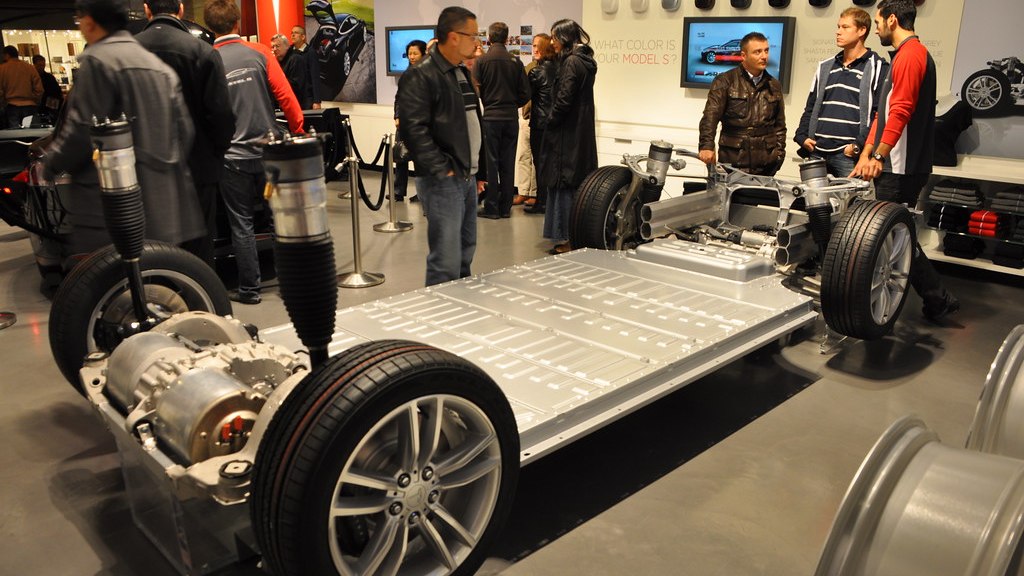
CATL’s 12,000 Wh/kg Battery May Be Tesla’s Next Big Leap: The electric vehicle industry has spent years battling one fundamental limitation: battery technology. While electric vehicles (EVs) have become faster, smarter, and more efficient, their performance has remained constrained by the energy density of modern battery cells. Compared to traditional gasoline-powered vehicles, EVs still carry large, heavy battery packs that add weight, increase costs, and limit driving range.
Now, a potential breakthrough could change everything.
Contemporary Amperex Technology Co. Limited (CATL), the world’s largest EV battery manufacturer, has officially turned its attention toward Lithium-Air (Li-Air) battery technology, a revolutionary chemistry that could deliver a theoretical energy density of up to 12,000 Wh/kg. That figure is remarkably close to gasoline’s energy density of approximately 13,000 Wh/kg, potentially placing electric vehicles on equal footing with internal combustion engine (ICE) vehicles for the first time in history.
If successfully commercialized, Lithium-Air batteries could dramatically transform EVs, electric trucks, autonomous vehicles, and even electric aviation. More importantly, they may become the catalyst for Tesla’s next major leap forward.
Why Current EV Batteries Are Holding Back the Industry
Today’s premium electric vehicles primarily rely on Lithium-Ion batteries, which typically achieve energy densities between 250 and 270 Wh/kg. While these batteries have enabled the rapid growth of the EV market, they still carry significant limitations.
Traditional lithium-ion cells use heavy transition metals such as:
- Nickel
- Cobalt
- Manganese
These materials act as hosts for lithium ions during charging and discharging. Although necessary for battery operation, they contribute substantial weight without directly generating energy.
Even the much-anticipated solid-state batteries, considered the next evolutionary step in battery technology, are expected to reach around 500 Wh/kg. While impressive, that still falls far short of gasoline’s energy density.
This gap explains why EV manufacturers continue searching for a more radical solution.
What Is a Lithium-Air “Breathing Battery”?
The term “breathing battery” comes from the unique way Lithium-Air batteries operate.
Unlike conventional batteries that store all necessary reactants internally, Lithium-Air systems utilize oxygen from the surrounding atmosphere as part of the energy-generation process.
How Traditional Lithium-Ion Batteries Work
In standard lithium-ion batteries:
- Lithium ions move between electrodes.
- Heavy metal cathodes store these ions.
- Energy is generated through electrochemical reactions.
While effective, this design requires significant amounts of inactive structural material that adds weight.
How Lithium-Air Batteries Work
Lithium-Air batteries eliminate much of this dead weight.
Instead, they use:
- Pure lithium metal
- Atmospheric oxygen
- Lightweight internal structures
Because oxygen is drawn directly from the air rather than stored inside the battery pack, the system becomes dramatically lighter and more energy dense.
This “breathing” mechanism is what gives Lithium-Air batteries their extraordinary theoretical potential.
Comparing Battery Energy Density
The difference between existing battery technologies and Lithium-Air chemistry is staggering.
Current Battery Technologies
Commercial Lithium-Ion Batteries
- 250–270 Wh/kg
Solid-State Batteries
- Approximately 500 Wh/kg
Advanced Lithium-Air Prototypes
Laboratory Lithium-Air Cells
- Around 1,200 Wh/kg
Theoretical Lithium-Air Potential
Lithium-Air Maximum Energy Density
- Up to 12,000 Wh/kg
At the theoretical limit, Lithium-Air batteries approach the energy density of gasoline, something battery researchers once considered impossible.
The Biggest Challenge: Why Lithium-Air Batteries Were Considered Impossible
For decades, Lithium-Air technology existed mostly as an academic concept.
Researchers understood its immense theoretical advantages, but practical implementation remained elusive due to several major problems.
Extreme Moisture Sensitivity
Lithium metal reacts aggressively with water vapor. Even minimal moisture exposure can degrade battery performance and shorten lifespan.
Carbon Dioxide Contamination
Atmospheric CO₂ can interfere with battery chemistry, creating unwanted byproducts that reduce efficiency and damage internal components.
Rapid Catalyst Degradation
The catalysts responsible for facilitating electrochemical reactions often deteriorate quickly, limiting battery longevity.
Poor Cycle Life
Earlier Lithium-Air cells frequently failed after only a handful of charge-discharge cycles, making commercial deployment unrealistic.
These challenges kept the technology trapped in laboratories for decades.
Recent Breakthroughs Are Changing Everything
The story began to change dramatically during the past few years.
2024: A Major Research Milestone
A collaborative team involving:
- University of Illinois Chicago
- Argonne National Laboratory
- California State University Northridge
successfully developed a Lithium-Air battery capable of operating for more than 700 charging cycles under realistic conditions.
This achievement represented a major step toward practical deployment.
2025: Reaching 1,200 Wh/kg
Researchers at:
- Argonne National Laboratory
- Illinois Institute of Technology
pushed the technology even further.
Their prototype achieved:
- 1,200 Wh/kg energy density
- Nearly 1,000 charging cycles
- Stable room-temperature operation
This performance is more than four times greater than today’s premium EV battery packs.
For the first time, Lithium-Air technology began transitioning from theoretical possibility to commercial reality.
CATL’s Long-Term Battery Strategy
CATL’s move toward Lithium-Air technology is not an isolated experiment.
Instead, it forms part of a carefully planned, multi-decade battery roadmap.
Phase 1: Sodium-Ion Batteries for Mass Adoption
CATL is aggressively scaling Sodium-Ion (Na-Ion) batteries as a low-cost alternative for entry-level EVs.
Benefits include:
- Lower material costs
- Reduced dependence on lithium supply chains
- Improved affordability
The company has already validated this technology in production vehicles and plans large-scale deployment.
Phase 2: Solid-State Batteries for Premium EVs
Solid-state batteries are expected to serve premium vehicles by offering:
- Improved safety
- Higher energy density
- Faster charging
- Better packaging efficiency
These batteries are likely to dominate the high-performance EV market during the late 2020s.
Phase 3: Lithium-Air Batteries Beyond 2030
The ultimate goal is the commercialization of Lithium-Air batteries.
This technology could eliminate many of the physical constraints that currently limit electric transportation.
Applications may extend beyond automobiles into:
- Heavy trucking
- Aerospace
- Aviation
- Autonomous mobility systems
Why the Tesla Semi Could Benefit the Most
While passenger vehicles would certainly gain from higher energy density, the greatest impact may occur within the commercial freight industry.
The Weight Problem in Electric Trucking
Electric trucks require enormous battery packs.
Industry estimates suggest the Tesla Semi may need approximately 1 MWh of battery capacity to achieve a range of around 500 miles (800 kilometers).
Such packs add several tons of weight.
This creates a major disadvantage:
Every pound devoted to batteries is a pound unavailable for cargo.
How Lithium-Air Changes the Equation
A 1,200 Wh/kg Lithium-Air battery could reduce battery mass by approximately 75% while delivering the same energy capacity.
This creates several transformative advantages.
Increased Cargo Capacity
Less battery weight means more space and payload capacity for freight.
Dramatically Longer Range
Using the same battery weight as today’s systems could extend operating range to approximately:
1,500–2,000 kilometers per charge
Lower Operating Costs
Longer range and greater payload capacity improve profitability for fleet operators.
This could finally allow electric trucks to compete directly with diesel-powered freight vehicles on long-haul routes.
Transforming Tesla’s Robotaxi Network
Tesla’s planned autonomous ride-hailing platform could also experience significant benefits.
Fleet Utilization Is Everything
For robotaxi networks, profitability depends heavily on vehicle utilization.
When a vehicle is charging, it generates no revenue.
Lithium-Air Could Enable Near-Continuous Operation
With a high-density battery pack, future autonomous vehicles could:
- Travel more than 1,000 kilometers on a single charge
- Operate for nearly an entire day
- Reduce reliance on fast-charging infrastructure
The result would be:
- More passenger trips
- Higher revenue per vehicle
- Smaller fleet requirements
This efficiency boost could dramatically improve the economics of autonomous transportation.
How Lithium-Air Could Rescue the Cybertruck’s Towing Range
One of the biggest challenges facing electric pickup trucks is towing.
Why Towing Reduces EV Range
Heavy trailers increase:
- Vehicle weight
- Aerodynamic drag
- Energy consumption
As a result, towing can reduce an EV’s range by 50% or more.
Lithium-Air Offers Two Solutions
Option 1: Keep Battery Weight Constant
Tesla could maintain current battery pack sizes while dramatically increasing towing range.
Drivers would gain greater confidence during long-distance hauling.
Option 2: Reduce Battery Size
Tesla could shrink the battery pack, lowering vehicle weight and manufacturing costs while preserving existing range targets.
Either approach would significantly improve the Cybertruck’s practicality.
Why Model 3 and Model Y Owners Will Need to Wait
Despite its enormous promise, Lithium-Air technology will not immediately appear in mass-market vehicles.
The Cost Barrier
Early production will involve:
- Expensive materials
- Specialized manufacturing environments
- Limited production volume
This makes deployment in affordable vehicles economically challenging.
The Typical Technology Adoption Curve
Historically, advanced battery technologies debut in premium segments before moving downstream.
Likely early candidates include:
- Tesla Roadster
- Luxury EVs
- Commercial fleets
- Aerospace platforms
Mass-market vehicles such as the Model 3 and Model Y will likely continue relying on:
- Lithium Iron Phosphate (LFP)
- Conventional Lithium-Ion
- Future solid-state batteries
for many years.
Electric Aviation: The Ultimate Destination
Perhaps the most exciting application lies beyond the road.
The Energy Density Challenge in Flight
Electric aviation has struggled because batteries are simply too heavy.
Aircraft require extraordinary power-to-weight ratios to achieve practical performance.
Why Lithium-Air Could Change Aviation
A battery delivering more than 1,200 Wh/kg could finally provide sufficient energy density for:
- Electric aircraft
- Regional air mobility
- eVTOL vehicles
- Urban air taxis
Many experts view Lithium-Air as one of the few battery technologies capable of making large-scale electric flight commercially viable.
Could Lithium-Air Batteries End the Era of Fossil Fuels?
For years, electric vehicles have been viewed as an alternative to gasoline-powered transportation.
That perception may soon change.
If CATL and other researchers successfully commercialize Lithium-Air batteries after 2030, EVs could achieve:
- 1,600+ kilometer driving ranges
- Significantly lighter vehicle designs
- Faster fleet operations
- Lower transportation costs
- Practical electric aviation
At that point, the competitive advantage of fossil fuels could largely disappear.
Final Thoughts
CATL’s commitment to Lithium-Air battery technology signals one of the most important developments in the future of energy storage. With a theoretical energy density of 12,000 Wh/kg, Lithium-Air batteries offer the possibility of matching gasoline while retaining all the advantages of electric powertrains.
Although significant engineering challenges remain, recent breakthroughs have demonstrated that the technology is moving steadily toward commercial viability. If these advancements continue, the Tesla Semi, Cybertruck, Robotaxi fleet, Roadster, and even future electric aircraft could all benefit from a battery chemistry that was once considered impossible.
The electric vehicle revolution has always been limited by battery performance. Lithium-Air technology may finally remove that limitation. And if CATL succeeds in bringing this breakthrough to market, Tesla’s next big leap could arrive not from a new vehicle, but from a battery that literally breathes.
FAQs
1. What is CATL’s 12,000 Wh/kg battery?
CATL’s proposed Lithium-Air (Li-Air) battery has a theoretical energy density of up to 12,000 Wh/kg, making it one of the most promising next-generation battery technologies. This energy density is close to that of gasoline, potentially revolutionizing electric vehicles and energy storage.
2. What is a Lithium-Air battery?
A Lithium-Air battery is an advanced battery chemistry that uses lithium metal and oxygen from the surrounding air to generate electricity. Because it utilizes atmospheric oxygen instead of storing all reactants internally, it can achieve significantly higher energy density than conventional lithium-ion batteries.
3. Why is it called a “breathing battery”?
Lithium-Air batteries are often called “breathing batteries” because they draw oxygen directly from the atmosphere during operation. This unique design reduces the need for heavy internal components and increases energy storage capacity.
4. How does a Lithium-Air battery compare to traditional lithium-ion batteries?
Current lithium-ion batteries typically offer 250–270 Wh/kg, while advanced Lithium-Air prototypes have already reached around 1,200 Wh/kg. The theoretical limit of Lithium-Air technology is approximately 12,000 Wh/kg, making it vastly more energy-dense.
5. Can Lithium-Air batteries match the energy density of gasoline?
Yes. Gasoline has an energy density of roughly 13,000 Wh/kg, while Lithium-Air batteries have a theoretical limit of around 12,000 Wh/kg. This means they could eventually provide energy storage levels similar to fossil fuels.
6. Why haven’t Lithium-Air batteries been commercialized yet?
Lithium-Air batteries face several technical challenges, including moisture sensitivity, carbon dioxide contamination, catalyst degradation, and limited cycle life. Researchers are actively working to overcome these obstacles before large-scale commercialization becomes possible.
7. What recent breakthroughs have been achieved in Lithium-Air technology?
Recent research has demonstrated Lithium-Air cells capable of operating for 700 to 1,000 charging cycles while achieving energy densities of approximately 1,200 Wh/kg, marking a significant step toward real-world deployment.
8. How could Lithium-Air batteries improve EV driving range?
Because of their extremely high energy density, Lithium-Air batteries could enable electric vehicles to travel 1,600 kilometers (1,000 miles) or more on a single charge, effectively eliminating range anxiety.
9. Why could the Tesla Semi benefit the most from Lithium-Air batteries?
The Tesla Semi requires a massive battery pack to achieve long-distance hauling capability. A Lithium-Air battery could significantly reduce battery weight, increase cargo capacity, and potentially extend driving range to 1,500–2,000 kilometers per charge.
10. How would Lithium-Air batteries affect freight and logistics?
Lighter batteries would allow trucking companies to carry more cargo while reducing operating costs. This could make electric trucks more competitive than traditional diesel trucks on long-haul routes.
11. Could Lithium-Air batteries improve Tesla’s Robotaxi network?
Yes. Higher energy density would allow autonomous vehicles to operate longer between charges, increasing vehicle utilization, reducing downtime, and improving overall fleet profitability.
12. How would Lithium-Air technology help the Cybertruck?
Lithium-Air batteries could either dramatically increase towing range or allow Tesla to reduce battery size and vehicle weight while maintaining the same driving range, making the Cybertruck more practical and efficient.
13. Will the Tesla Model 3 and Model Y get Lithium-Air batteries soon?
Probably not. Early Lithium-Air batteries will likely be expensive and difficult to manufacture at scale. Mass-market vehicles such as the Model 3 and Model Y are expected to continue using LFP, lithium-ion, and future solid-state batteries for the foreseeable future.
14. What is CATL’s long-term battery strategy?
CATL’s roadmap focuses on three major technologies:
- Sodium-Ion batteries for affordable EVs.
- Solid-State batteries for premium electric vehicles.
- Lithium-Air batteries for long-range transportation, heavy logistics, and future aerospace applications.
15. Could Lithium-Air batteries enable electric aviation?
Many experts believe Lithium-Air batteries could become one of the few battery technologies capable of providing the power-to-weight ratio needed for practical electric aircraft, eVTOLs, and urban air mobility solutions.
16. When could Lithium-Air batteries reach commercial production?
Most industry observers expect commercial Lithium-Air battery deployment to occur after 2030, once technical challenges are resolved and manufacturing processes mature.
17. Could Lithium-Air batteries make internal combustion engines obsolete?
If Lithium-Air batteries achieve their theoretical potential, they could deliver longer range, lower operating costs, lighter vehicles, and greater efficiency than gasoline-powered vehicles. In that scenario, internal combustion engines may struggle to remain competitive in many transportation sectors.
Read More:
- Tesla pushes back against unfair reporting of accidents
- SpaceX’s newest Starmind will make earth data centers obsolete
- Tesla Cybertruck is officially the safest pickup, IIHS says
- Tesla and driver sued by family of woman killed in Texas crash: what we know
- Elon Musk Reveals 5s Giga Press INSANE Speed
1 thought on “CATL’s 12,000 Wh/kg Battery May Be Tesla’s Next Big Leap”