
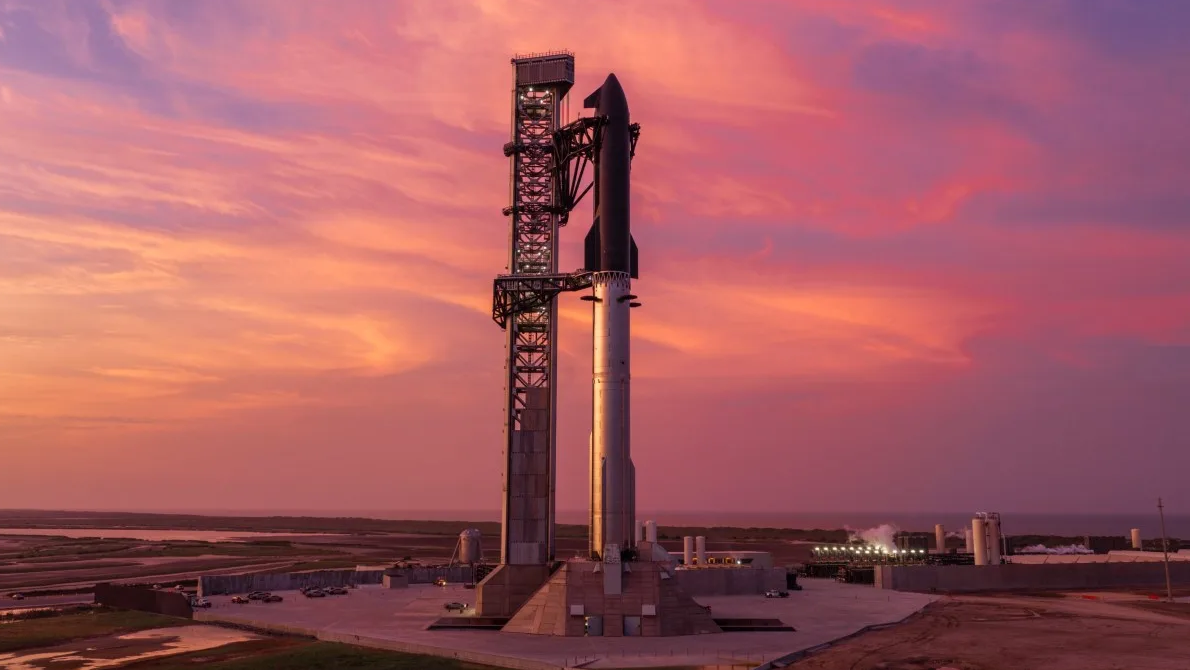
SpaceX Unexpected Cancel Catching Ship for Flight 14! S41 Full Engine Fire Test DONE: SpaceX’s Starship program has reached another important stage at Starbase, Texas, as Ship 41 (S41) successfully completed a full six-engine static fire test. The milestone comes as SpaceX prepares for Flight 14, a mission expected to push Starship into a more demanding phase of its development.
The latest test is particularly significant because S41 fired all six of its Raptor engines simultaneously, providing engineers with valuable data before the spacecraft moves toward final flight preparations. At the same time, SpaceX appears to be taking a more cautious approach to one of Starship’s most anticipated milestones: the Mechazilla tower catch.
Rather than attempting to catch the upper stage during Flight 14, Elon Musk has indicated that the maneuver could be delayed by several months. The decision highlights SpaceX’s strategy of prioritizing orbital performance, payload deployment, and controlled reentry before attempting another complex recovery operation.
S41 Completes Full Six-Engine Static Fire
On August 20, SpaceX conducted a major static fire test of Ship 41 at Starbase. Unlike the earlier single-engine test, this firing involved all six engines installed on the spacecraft, including both Sea-Level and Vacuum Raptor engines.
The test was designed to simulate demanding conditions that S41 will encounter during its upcoming mission.
Key Details of the S41 Test
Before ignition, SpaceX loaded the vehicle with liquid oxygen (LOX) and a larger quantity of liquid methane than was used during the previous single-engine test. This allowed the propulsion system to demonstrate sustained fuel delivery to all six engines.
The combined engine output was estimated to exceed 1,700 metric tons of thrust, creating a massive exhaust plume beneath the vehicle. Starbase’s water-deluge and flame-trench systems were used to manage the extreme heat, sound, and pressure generated during the firing.
The test reportedly lasted nearly one minute, making it an important verification of the vehicle’s propulsion and control systems.
Engineers can use data from such a test to evaluate:
- Raptor engine performance
- Propellant flow and management
- Engine gimballing
- Thrust-vector control
- Thermal and structural loads
- Long-duration engine operation
- Systems required for orbital flight and reentry
Successfully completing this test puts S41 closer to becoming a flight-ready spacecraft.
What Happens to Ship 41 After the Static Fire?
Following the static fire, S41 is expected to return to Mega Bay 2 for additional processing. The spacecraft will need to undergo inspections and receive remaining flight hardware before it can be integrated for Flight 14.
One of the most important upcoming steps is the installation of the Starlink V3 payload and the vehicle’s Flight Termination System (FTS).
The Starlink payload makes Flight 14 particularly important because the mission is expected to demonstrate operational payload deployment while simultaneously expanding Starship’s orbital capabilities.
Booster 21 Also Moves Toward Flight
Ship 41 is not the only major piece of hardware progressing at Starbase. Booster 21 (B21) has also advanced through its testing campaign, including cryogenic proof testing.
Its next major milestone is expected to be a full 33-Raptor static fire on the Orbital Launch Mount.
A successful booster test would provide another critical confirmation before SpaceX commits the vehicle to Flight 14 operations.
New Transport Hardware Could Support Future Starship Operations
Another interesting development at Starbase is the appearance of a new piece of equipment known as the Booster Horizontal Aft Frame Rev 1, Serial 1.
The hardware could represent an evolution in SpaceX’s transportation strategy.
Starship boosters are generally handled vertically around the Starbase production and launch facilities. However, long-distance transportation creates different engineering challenges. A horizontal transport configuration could potentially make it easier to move large booster hardware by road or barge.
This could become increasingly important as SpaceX expands Starship operations beyond Texas, particularly toward Kennedy Space Center in Florida.
The ability to safely transport Starship hardware between production and launch locations will become increasingly important if SpaceX aims for a high launch cadence and rapid reuse.
Why Is SpaceX Delaying the Ship Catch?
The biggest surprise surrounding Flight 14 may be the decision not to attempt a tower catch of the upper stage.
The Mechazilla system is designed to use large mechanical arms, commonly called “chopsticks,” to capture a returning Starship near the launch tower. Successfully catching the ship would be a major step toward SpaceX’s goal of making Starship fully and rapidly reusable.
However, Flight 14 is expected to introduce challenges that make a catch considerably more complicated.
1. True Orbital Reentry Will Be More Demanding
Earlier Starship missions followed suborbital trajectories. Flight 14 is expected to take a major step toward true orbital flight.
That means the spacecraft will experience a higher-energy reentry environment, resulting in significantly greater demands on the heat shield, vehicle structure, and flight-control systems.
SpaceX can gain valuable information by first attempting a controlled ocean splashdown rather than immediately committing to a tower catch.
2. Orbital Trajectories Create Additional Safety Challenges
Returning a spacecraft from orbit to a specific location is fundamentally different from guiding a vehicle through a relatively predictable suborbital trajectory.
An orbital Starship returning toward Texas would need to operate within carefully defined safety corridors. Its trajectory could also involve overflight considerations and regulatory requirements.
A controlled ocean landing therefore offers SpaceX an opportunity to test the spacecraft’s return capabilities without exposing critical launch infrastructure to unnecessary risk.
3. Propellant Must Be Prioritized for the Mission
Flight 14 is expected to have several important objectives, including orbital insertion and Starlink V3 deployment.
Every maneuver requires propellant. Using additional fuel for an aggressive return maneuver could reduce the margin available for other mission-critical operations.
SpaceX therefore appears to be prioritizing the primary objectives of the flight before attempting the more demanding recovery sequence.
Controlled Splashdown Could Be the Smarter Choice
Instead of catching S41 with Mechazilla, SpaceX can use Flight 14 to demonstrate a precision controlled splashdown.
This approach still provides valuable data about orbital reentry, attitude control, propulsion, navigation, and flight-path accuracy.
Most importantly, it reduces the risk to the launch tower and surrounding infrastructure.
If S41 successfully completes its mission and returns close to its intended ocean target, SpaceX will have gained critical information that can be applied to future catch attempts.
When Could the First Starship Catch Happen?
The delay does not mean SpaceX has abandoned the tower-catch strategy.
Instead, the catch could move to a subsequent Starship flight once the company has gathered more orbital reentry data.
A possible progression could look like this:
Flight 14: Orbital mission, Starlink V3 deployment, and controlled ocean splashdown.
Flight 15 or Flight 16: Potential upper-stage tower-catch attempt, depending on testing, regulatory approval, and vehicle readiness.
Later Flight: Potential first reuse of a recovered Starship upper stage.
Elon Musk has indicated that the first reflight of a recovered Starship upper stage could occur around the end of the year or early the following year, although SpaceX schedules remain subject to testing and regulatory milestones.
Conclusion: SpaceX Is Taking a Calculated Approach
The postponement of the Starship catch may initially look like a setback, but it could actually represent a measured engineering decision.
Flight 14 has ambitious goals of its own. Demonstrating orbital insertion, deploying operational Starlink V3 hardware, testing advanced propulsion operations, and surviving a higher-energy reentry would already make the mission a major milestone.
The successful S41 six-engine static fire suggests that Ship 41 is progressing through one of its most important preflight verification stages. With S41 moving toward final integration and Booster 21 continuing its own testing campaign, Starbase is rapidly approaching another major Starship launch attempt.
For SpaceX, the ultimate objective remains clear: build a spacecraft capable of launching, reaching orbit, returning, and flying again with minimal refurbishment.
The Mechazilla catch may have to wait, but the broader goal of rapid Starship reusability is still moving forward.
FAQs
1. What is Ship 41 (S41)?
Ship 41 (S41) is a Starship upper-stage vehicle being prepared by SpaceX for a future flight from Starbase, Texas. It has undergone major ground testing as part of its flight-readiness campaign.
2. What major test did S41 complete?
S41 successfully completed a full six-engine static fire test. The test involved firing all six of its Raptor engines simultaneously to evaluate propulsion and vehicle systems under demanding conditions.
3. How long did the S41 static fire last?
The full-engine firing lasted nearly one minute, providing engineers with valuable data on engine performance, propellant flow, thermal loads, and vehicle control.
4. How much thrust did S41 produce during the test?
The combined thrust was estimated to exceed 1,700 metric tons, generating an extremely powerful exhaust plume that was managed by Starbase’s water-deluge and flame-trench systems.
5. Why is the six-engine static fire important?
The test is an important preflight verification milestone because it allows SpaceX to evaluate the spacecraft’s engines and associated systems operating together before the vehicle attempts an orbital mission.
6. What is expected to happen to S41 after the static fire?
After post-test inspections, S41 is expected to undergo additional processing and final flight integration, including preparations for its payload and Flight Termination System.
7. What is Flight 14 expected to accomplish?
Flight 14 is expected to pursue several major objectives, including orbital insertion, Starlink V3 payload deployment, in-space propulsion operations, and controlled atmospheric reentry.
8. Will SpaceX catch S41 with the Mechazilla tower?
Based on the information provided, the upper-stage catch is not expected during Flight 14. Elon Musk indicated that the Starship catch could be delayed by several months while SpaceX gathers additional flight data.
9. Why is SpaceX delaying the Starship catch?
The delay is largely connected to the increased complexity of an orbital reentry. Flight 14 is expected to expose Starship to higher-energy conditions, while propellant requirements, trajectory constraints, safety considerations, and regulatory requirements add additional challenges.
10. What is the Mechazilla catch system?
Mechazilla is SpaceX’s launch-tower recovery system. Its large mechanical arms, commonly called “chopsticks,” are designed to capture returning Starship vehicles and Super Heavy boosters near the launch tower.
11. Why might Flight 14 use an ocean splashdown instead?
A controlled ocean splashdown would allow SpaceX to collect valuable information about orbital reentry and flight control without taking the additional risk of attempting a precision tower catch during the same mission.
12. What is Starlink V3?
Starlink V3 refers to a newer generation of SpaceX’s Starlink satellite hardware. Deploying operational Starlink payloads would make Flight 14 an important step toward Starship’s role as a high-capacity launch vehicle.
13. What is Booster 21 (B21)?
Booster 21 is a Super Heavy booster being processed at Starbase. It has undergone cryogenic proof testing and is expected to progress toward a 33-engine static fire as part of its preparation.
14. What is the new horizontal transport frame at Starbase?
The Booster Horizontal Aft Frame is a transport-related piece of hardware that could support horizontal handling of large booster components. Such equipment could become useful for transporting Starship hardware over longer distances, including potential movements between Texas and Florida.
15. When could SpaceX attempt its first Starship upper-stage reflight?
SpaceX has indicated that the first reflight of a recovered Starship upper stage could potentially occur around the end of the year or early the following year. The exact timing will depend on testing, recovery success, vehicle readiness, and regulatory approvals.
16. Does delaying the Flight 14 catch mean Starship development is slowing down?
No. Delaying the catch can be viewed as a risk-management decision rather than a retreat from Starship’s reusability goals. By prioritizing orbital performance, payload deployment, and controlled reentry first, SpaceX can gather critical data before attempting a more complex recovery maneuver. The long-term objective remains rapid and reliable Starship reusability.
Read More:
- Cybercab Robotaxi NEW Roll Out, Full Specs & Timeline UPDATE!
- Tesla Robotaxi gets a massive upgrade in Nevada
- Tesla Semi is officially headed to Europe
- Tesla will resolve massive China recall with stickers and a software update
- SpaceX Lit Single Engine Static Fire for Starship 41, Huh? China Landed 1st rocket Booster BUT
1 thought on “SpaceX Unexpected Cancel Catching Ship for Flight 14! S41 Full Engine Fire Test DONE”