
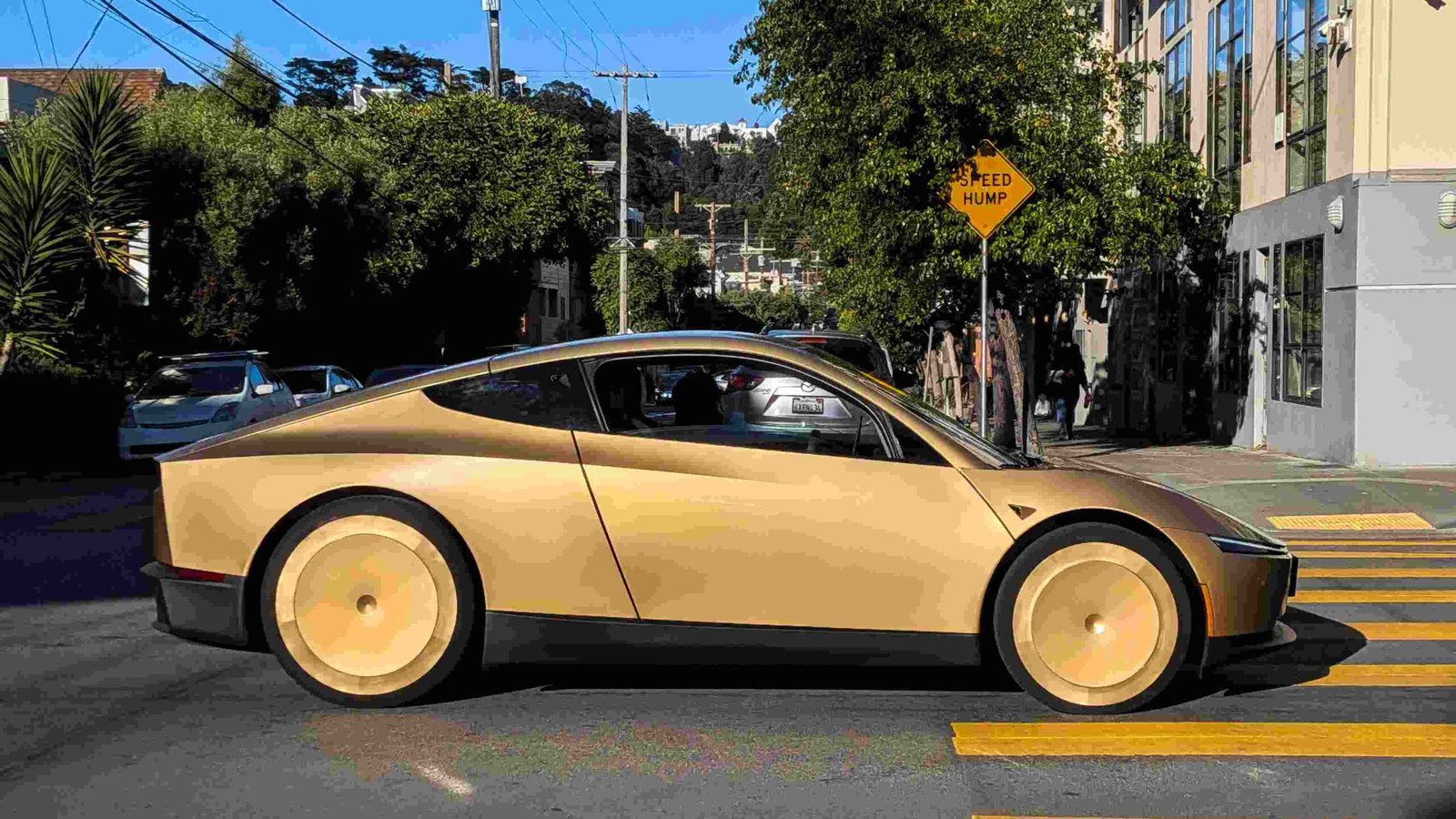
Cybercab Robotaxi NEW Roll Out, Full Specs & Timeline UPDATE!: The automotive industry is entering a transformative era, and Tesla’s Cybercab robotaxi could become one of the most significant developments in autonomous transportation. Designed from the ground up as a fully autonomous, two-seat electric vehicle, the Cybercab removes traditional driver controls such as the steering wheel, accelerator, and brake pedals.
Tesla’s approach is fundamentally different from conventional cars. Instead of building another electric vehicle that can also drive autonomously, the Cybercab is being developed specifically for robotaxi operations, with efficiency, low operating costs, and high fleet utilization at the center of its design.
As Tesla moves toward broader testing and commercial deployment, here is a detailed look at the Cybercab rollout timeline, specifications, autonomous driving technology, interior, business model, and challenges.
Tesla Cybercab Rollout Timeline
Tesla’s Cybercab program appears to be progressing from controlled testing toward wider real-world deployment. The strategy involves gradually increasing the level of passenger access while collecting autonomous-driving data and preparing emergency responders.
1. Public Road Testing
Tesla began testing Cybercab vehicles on public roads around its Gigafactory Texas facility. Employee testing represents an important stage because it allows Tesla to evaluate the vehicle in real traffic and different driving conditions.
The company has also worked with local emergency responders, including Austin officials, to establish procedures for situations involving an autonomous vehicle.
2. Employee Ride Testing
The next stage involves allowing employees to experience Cybercab rides as passengers. This provides Tesla with additional real-world information while keeping testing within a controlled group.
Employee rides can help identify issues involving passenger interaction, vehicle behavior, software performance, and emergency procedures before wider public access.
3. Paid Robotaxi Service
The ultimate goal is to integrate Cybercab vehicles into Tesla’s ride-hailing ecosystem. Once authorized, passengers could potentially use a Tesla app to request an autonomous ride without a human driver.
This represents the most important transition in the program: moving from vehicle testing to commercial robotaxi operations.
4. Expansion to Other Markets
Tesla has also been pursuing regulatory approvals for autonomous vehicle operations beyond Texas. Nevada, including the Las Vegas market, is particularly important because it could provide a major real-world environment for autonomous taxi services.
If Tesla can successfully scale Cybercab operations across multiple markets, the company could transform the vehicle from an experimental platform into a large autonomous transportation network.
Cybercab Full Specifications
Unlike performance-focused Tesla models, the Cybercab has been engineered primarily for efficiency and fleet economics.
| Specification | Reported/Estimated Figure |
|---|---|
| Motor | Front-mounted 3-phase AC permanent-magnet motor |
| Power Output | Approximately 219 hp |
| Curb Weight | Approximately 3,113 lb / 1,412 kg |
| GVWR | Approximately 3,730 lb |
| Payload | Approximately 617 lb |
| Battery Capacity | Approximately 47.6–48 kWh |
| Nominal Battery Voltage | Approximately 326V |
| Electrical Architecture | 48V low-voltage system |
| Unadjusted Efficiency | Approximately 165 Wh/mile |
| Unadjusted Test Range | Up to approximately 418 miles |
| Estimated Adjusted Range | Approximately 293 miles |
These figures illustrate the Cybercab’s central philosophy: less weight, less energy consumption, and lower operating costs.
Lightweight Design and 48V Architecture
One of the Cybercab’s biggest advantages could be its relatively low weight.
Because the vehicle does not require conventional driver controls, Tesla can eliminate components associated with a traditional cockpit. There is no conventional steering column, pedal assembly, or large instrument cluster.
The vehicle’s approximately 3,113-pound curb weight is especially notable for an electric vehicle.
Tesla’s 48-volt electrical architecture can also reduce the amount of copper and wiring required throughout the vehicle compared with older 12V architectures. For a vehicle expected to operate continuously as part of a commercial fleet, even small efficiency improvements can become financially significant.
A robotaxi could accumulate hundreds of thousands of miles during its operating life. Therefore, reducing energy consumption and maintenance requirements could have a major impact on the cost per mile.
Cybercab Autonomous Driving Technology
The most revolutionary aspect of the Cybercab is not its exterior design—it is the fact that the vehicle is intended to operate without a human driver.
Tesla plans to rely on its Full Self-Driving (FSD) technology and onboard computing platform to interpret the environment and control the vehicle.
Vision-Based Camera System
Tesla’s autonomous-driving strategy relies heavily on cameras and neural-network processing. The camera system collects information about roads, vehicles, pedestrians, traffic signals, lane markings, and other objects.
That visual information is processed onboard to determine what the vehicle should do next.
Next-Generation Computing
The Cybercab is expected to use an upgraded onboard computing platform capable of processing large amounts of visual data.
Higher computing performance is critical because an autonomous vehicle must continuously analyze its surroundings while simultaneously predicting potential hazards and planning a safe route.
FSD Neural Networks
Future versions of Tesla’s FSD software are expected to use increasingly large and sophisticated neural networks.
The objective is to improve the system’s ability to handle urban driving, unusual road situations, pedestrians, cyclists, construction zones, and other edge cases.
Remote Fleet Support
Autonomous fleets can also use remote human operators to provide assistance during unusual or emergency situations.
This does not necessarily mean a person manually drives every Cybercab. Instead, remote support can provide additional operational oversight when a vehicle encounters a situation that requires human assistance.
Cybercab Business Model and $30,000 Target
Tesla has discussed a Cybercab price target of around $30,000, which would make the vehicle substantially different from traditional robotaxi strategies.
The economics become particularly interesting when the vehicle is treated as a commercial asset rather than a personal car.
A privately owned vehicle may sit unused for most of the day. A robotaxi, however, could potentially operate for many hours, generating revenue across multiple passenger trips.
This creates the possibility of a business model based on high vehicle utilization, low energy consumption, autonomous operation, and reduced labor costs.
However, reaching those economics depends on Tesla achieving reliable unsupervised autonomy and obtaining regulatory approval in the markets where it wants to operate.
Tesla Cybercab vs. Existing Robotaxi Networks
Tesla faces significant competition in autonomous mobility.
Companies such as Waymo have already accumulated substantial experience operating driverless vehicles in commercial environments. Tesla therefore needs to demonstrate not just impressive technology, but reliable autonomous performance at scale.
The gap between supervised testing and fully unsupervised commercial operation remains one of the biggest challenges for Tesla.
The Cybercab’s two-seat configuration is another limitation. It works well for individual commuters and couples, but it is less practical for families, groups, or passengers carrying large amounts of luggage.
Tesla could potentially address these limitations through larger autonomous vehicles, including future high-capacity platforms.
Cybercab Interior and Passenger Experience
Inside, the Cybercab takes a minimalist approach.
Passengers interact primarily with a central touchscreen, which can provide navigation information, estimated arrival time, entertainment, climate controls, and other vehicle functions.
An emergency-stop function is also expected to give passengers an additional safety interface.
The cabin features two seats, creating a simple and spacious environment without the controls normally associated with a driver-operated vehicle.
Automated doors further reinforce the vehicle’s robotaxi concept. The goal is to make the entire journey—from entering the vehicle to reaching the destination—as automated as possible.
Major Challenges Ahead
Despite its potential, the Cybercab faces several major challenges.
First, autonomous driving safety must be demonstrated consistently in real-world conditions.
Second, regulatory authorities must approve commercial driverless operations in individual markets.
Third, Tesla needs to prove that its autonomous fleet can operate economically while maintaining high reliability and passenger safety.
Finally, public acceptance will be critical. Consumers may be comfortable using autonomous taxis for short trips, but widespread adoption will depend on trust, safety, convenience, and price.
Conclusion: A Major Test for Tesla’s Robotaxi Ambitions
The Tesla Cybercab represents a radical departure from traditional vehicle design. By removing the steering wheel and pedals, Tesla is betting that autonomous driving technology can become capable enough to completely replace the human driver.
Its lightweight construction, compact battery, 48V architecture, two-seat cabin, and robotaxi-focused design could create a highly efficient platform for urban transportation.
However, the biggest question is not whether Tesla can manufacture the Cybercab. The real test is whether Tesla can achieve safe, reliable, scalable, and commercially approved unsupervised driving.
If it succeeds, the Cybercab could become much more than another Tesla model. It could serve as the foundation of a large-scale autonomous ride-hailing network, potentially changing how people think about vehicle ownership and urban mobility.
For now, the Cybercab remains a make-or-break project for Tesla’s robotaxi ambitions. Its rollout, software development, regulatory progress, and real-world safety performance will determine whether this futuristic vehicle becomes a mainstream transportation solution or remains an ambitious experiment in autonomous driving.
FAQs
1. What is the Tesla Cybercab?
The Tesla Cybercab is a purpose-built autonomous electric robotaxi designed to transport passengers without a traditional human driver. Unlike conventional Tesla vehicles, it is designed without a steering wheel, accelerator pedal, or brake pedal.
2. How many passengers can the Cybercab carry?
The Cybercab is designed as a two-seat robotaxi, making it primarily suitable for individuals or small passenger trips rather than families or larger groups.
3. When will the Tesla Cybercab launch?
Tesla is progressing through testing and regulatory preparation before wider commercial deployment. The exact full-scale public launch date can depend on software readiness, production, and regulatory approvals in each market.
4. How will passengers book a Cybercab?
The planned model is to integrate Cybercabs with Tesla’s ride-hailing ecosystem, allowing passengers to request an autonomous ride through a Tesla application.
5. Does the Tesla Cybercab have a steering wheel?
No. The Cybercab is designed specifically for fully autonomous operation, so it does not use a conventional steering wheel or driver-operated pedals.
6. What is the expected range of the Cybercab?
Reported figures suggest a battery capacity of approximately 47.6–48 kWh, with an estimated adjusted range of around 293 miles. Actual range can vary depending on weather, traffic, speed, passenger load, and driving conditions.
7. How powerful is the Tesla Cybercab?
The Cybercab has been associated with a front-mounted permanent-magnet motor producing approximately 219 horsepower. Its design prioritizes efficiency and continuous urban operation rather than high-performance acceleration.
8. How much will the Cybercab cost?
Tesla has discussed a target price of approximately $30,000 for the Cybercab. Actual pricing, availability, taxes, and market-specific costs may vary when commercial production begins.
9. What technology allows the Cybercab to drive itself?
The Cybercab is expected to rely on Tesla’s Full Self-Driving (FSD) technology, camera-based perception, neural networks, and advanced onboard computing to navigate roads and make driving decisions.
10. Will a human monitor Cybercabs remotely?
Tesla has discussed the use of remote fleet operations and human assistance for situations where an autonomous vehicle may require additional support. Remote assistance is intended as an operational safety layer rather than a conventional driver sitting inside the vehicle.
11. Why does the Cybercab use a 48-volt electrical system?
A 48V electrical architecture can reduce wiring weight and improve electrical efficiency compared with traditional low-voltage vehicle systems. Lower weight is particularly valuable for a robotaxi because the vehicle may accumulate very high mileage during commercial operation.
12. How much does the Cybercab weigh?
The Cybercab has been associated with a curb weight of approximately 3,113 pounds (1,412 kg). Its relatively lightweight construction supports the vehicle’s efficiency-focused design.
13. Is the Cybercab suitable for airport trips?
The Cybercab could be useful for individual airport passengers, but its two-seat configuration and limited luggage capacity may make it less practical for families or groups traveling with multiple suitcases.
14. Who are Tesla’s main competitors in the robotaxi market?
Tesla competes with established autonomous mobility companies, particularly Waymo, which has significant experience operating driverless ride-hailing services. Tesla’s challenge is to demonstrate that its autonomous technology can achieve comparable reliability and scale.
15. Could the Cybercab change the future of transportation?
Yes. If Tesla achieves safe and reliable unsupervised autonomous driving at commercial scale, the Cybercab could significantly change urban transportation. High vehicle utilization, low energy consumption, and reduced dependence on human drivers could potentially lower the cost of individual trips and change how people view vehicle ownership.
Read More:
- Tesla Robotaxi gets a massive upgrade in Nevada
- Tesla Semi is officially headed to Europe
- Tesla will resolve massive China recall with stickers and a software update
- SpaceX Lit Single Engine Static Fire for Starship 41, Huh? China Landed 1st rocket Booster BUT
- 500 TESLA SEMI 2.0 DELIVERED! NEW PRICE & 4 BIG Upgrades Revealed
2 thoughts on “Cybercab Robotaxi NEW Roll Out, Full Specs & Timeline UPDATE!”