
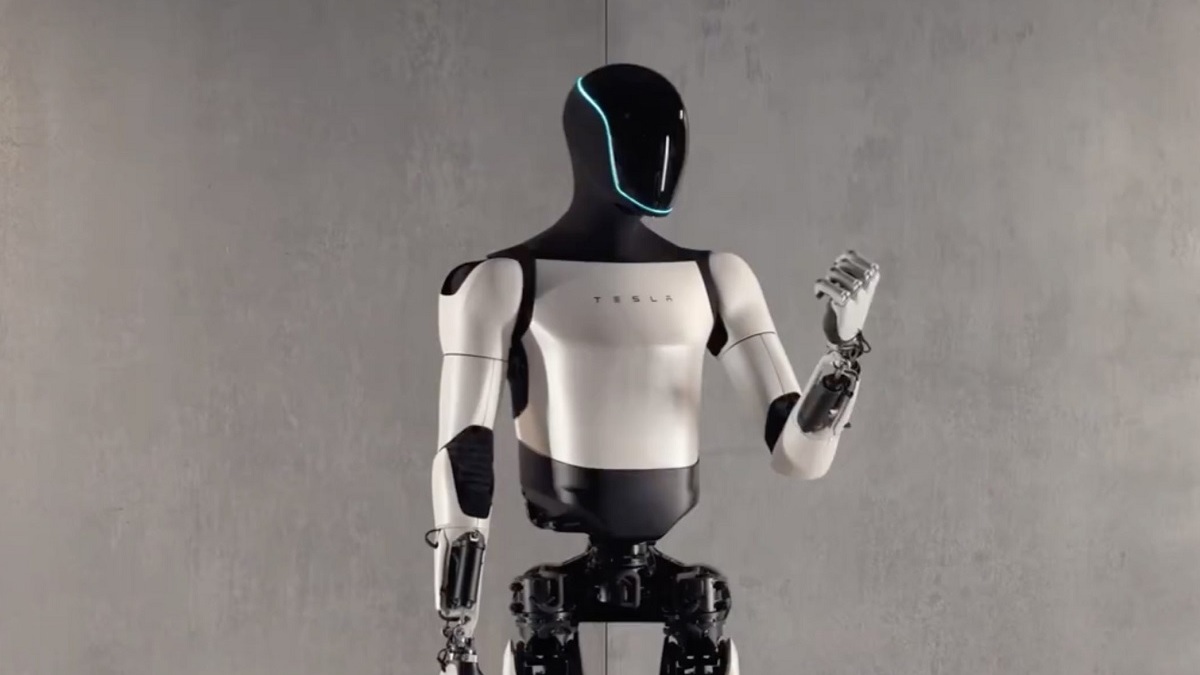
The global race to dominate the humanoid robotics industry is entering a new phase, and Tesla appears to be preparing a move that could completely redefine the market. While competitors are rushing to deploy robots into commercial pilot programs, Tesla is quietly focusing on something far more ambitious: building the world’s most scalable, intelligent, and autonomous humanoid robot ecosystem.
Recent patents, factory upgrades, AI hardware breakthroughs, and manufacturing developments suggest that Tesla Optimus Gen 3 could become the most advanced humanoid robot ever created. From revolutionary self-cleaning vision systems and energy-efficient biomechanics to custom AI processors and massive supercomputer training networks, Tesla’s strategy is radically different from every other robotics company.
In this article, we explore everything revealed so far about Tesla Bot Gen 3, the upcoming Optimus V2.5 upgrades, Tesla’s secret AI architecture, and why Elon Musk believes humanoid robots could become the company’s biggest business.
Tesla’s Humanoid Robot Strategy Is Different From Everyone Else
Most robotics companies are chasing early commercial deployments and pilot contracts. Tesla, however, is focusing on solving the foundational challenges that prevent humanoid robots from operating reliably in the real world.
Rather than selling limited numbers of expensive prototypes, Tesla is developing:
- Highly durable hardware
- Mass-production manufacturing systems
- Custom AI chips
- Advanced neural networks
- Large-scale data training infrastructure
This strategy mirrors Tesla’s approach with electric vehicles: solve the engineering challenges first, then scale production faster than competitors.
The result could be a humanoid robot capable of operating around the clock while becoming increasingly intelligent through continuous software updates.
The Revolutionary Biomimetic Eye System
Why Vision Is the Biggest Challenge for Humanoid Robots
For any humanoid robot, vision is everything.
Modern robots depend heavily on computer vision systems and neural networks to understand their environment. However, the real world presents constant challenges such as:
- Dust
- Oil residue
- Rain
- Mud
- Industrial debris
- Chemical contamination
Even a tiny obstruction on a camera lens can significantly reduce image quality and interfere with AI decision-making.
This becomes an even bigger issue because humanoid robots move relatively slowly.
Unlike autonomous vehicles that travel at high speeds and benefit from airflow cleaning camera surfaces, humanoid robots typically walk at only 1.2 to 1.5 meters per second.
At those speeds, aerodynamic cleaning is essentially impossible.
Tesla’s New Lens Cleaning Patent
A newly approved Tesla patent called “Lens Cleaning System” reveals how the company intends to solve this problem.
The design takes inspiration directly from the human eye.
Instead of relying on bulky external cleaning systems, Tesla has developed a compact spherical camera architecture featuring:
Intelligent Debris Detection
The robot constantly monitors image quality.
When the neural network detects:
- Reduced contrast
- Pixel obstruction
- Image distortion
the cleaning process activates automatically.
Microfluid Cleaning Channels
Tiny internal channels release precise amounts of:
- Water
- Alcohol solutions
- Surfactants
- Specialized cleaning agents
These substances dissolve contaminants without wasting resources.
Mechanical Eyelid Wiper
A miniature wiper functions similarly to a human eyelid.
The mechanism sweeps across the lens surface and removes:
- Dirt
- Dust
- Oil residue
- Insects
- Water droplets
Automatic Retraction
After cleaning, the wiper retracts into a hidden position, restoring a completely unobstructed field of view.
Why This Matters
This breakthrough dramatically improves operational reliability across several industries.
Manufacturing
Optimus can work in environments filled with:
- Metal dust
- Sparks
- Oil mist
- Industrial contaminants
without requiring constant maintenance.
Agriculture
Robots can continue operating during:
- Rainstorms
- Dust storms
- Muddy conditions
while maintaining accurate environmental awareness.
Search and Rescue
Emergency response operations often expose robots to debris and contamination.
Tesla’s system ensures the robot maintains clear vision even in disaster zones.
Home Applications
Domestic robots could clean kitchens, garages, and workshops without frequent manual lens cleaning.
This is a major step toward achieving true 24/7 robotic autonomy.
Optimus V2.5 Gets Major Mechanical Upgrades
Before Tesla launches Gen 3, the company appears to be implementing major improvements through Optimus V2.5.
These upgrades focus on:
- Stability
- Energy efficiency
- Durability
- Human-like movement
Battery Relocation Creates Better Balance
One of the biggest engineering changes involves moving the battery pack.
Earlier versions placed batteries inside the chest.
Tesla has now relocated the battery system into the pelvis.
This significantly lowers the robot’s center of gravity.
Benefits include:
- Better balance
- Reduced joint stress
- Improved walking efficiency
- Greater stability during lifting
The redesign reportedly reduces torso sway to just 1.5 centimeters, helping maintain stable camera imagery for AI systems.
The Four-Bar Linkage System
Tesla also redesigned critical joints using a four-bar linkage mechanism.
This engineering solution changes leverage dynamically depending on the robot’s movement.
During Heavy Lifting
The mechanism increases leverage, reducing motor strain.
During Walking
The system optimizes movement speed and efficiency.
The result is approximately 20% lower energy consumption while maintaining performance.
That improvement can significantly extend operating time from the robot’s 2.3 kWh battery pack.
High-Speed Torque Control
Tesla has reportedly implemented advanced torque control loops operating thousands of times per second.
These systems continuously monitor:
- Joint forces
- Ground contact
- Surface conditions
- Motor loads
If the robot encounters:
- Slippery floors
- Uneven terrain
- Unexpected obstacles
the system instantly adjusts balance and movement.
This allows Optimus to recover from disturbances much more naturally than previous generations.
Real-World Performance Improvements
The mechanical redesign unlocks new capabilities across both industrial and household applications.
Factory Work
Optimus can potentially handle components weighing up to 20 kilograms, including:
- Brake assemblies
- Metal parts
- Manufacturing equipment
The robot can dynamically shift its weight while maintaining stability.
Household Tasks
Improved tactile sensitivity allows the robot to safely perform delicate jobs such as:
- Loading dishwashers
- Folding laundry
- Organizing fragile items
- Cleaning furniture
This combination of strength and precision is essential for widespread adoption.
Tesla Is Playing a Different Game Than Its Competitors
At first glance, Tesla appears behind competitors in deployment numbers.
Several robotics companies already have commercial robots operating in industrial environments.
Current Industry Leaders
Figure AI
Figure robots have spent months operating in automotive manufacturing environments and processing large volumes of components.
Agility Robotics
Digit robots have completed extensive logistics deployments in warehouse environments.
Chinese Robotics Companies
Several Chinese manufacturers have already shipped thousands of humanoid robots and continue expanding rapidly.
Why Tesla Isn’t Concerned
Tesla’s goal isn’t to win early pilot programs.
The company is focused on creating a manufacturing machine capable of producing robots at automotive scale.
Reports suggest Tesla has reconfigured portions of its Fremont operations specifically for future Optimus production.
The objective is unprecedented.
Tesla ultimately wants to produce:
- Millions of robots annually
- Automotive-scale production volumes
- Dramatically lower unit costs
If successful, this strategy could overwhelm competitors through sheer manufacturing efficiency.
The AI5 Chip Could Change Everything
Perhaps the most important breakthrough inside Optimus Gen 3 is Tesla’s new AI5 processor.
This custom-designed silicon may become the robot’s biggest competitive advantage.
Massive AI Performance With Minimal Power
Humanoid robots face a major challenge:
They have limited battery capacity.
Power-hungry AI processors can quickly drain available energy.
Tesla’s AI5 chip reportedly delivers performance comparable to high-end AI hardware while consuming only around 250 watts.
This efficiency is achieved by removing unnecessary components and dedicating most of the chip to neural network processing.
The result is powerful onboard AI without sacrificing operational runtime.
Fully Local Intelligence
Many robotic systems still rely heavily on cloud computing.
That approach introduces:
- Latency
- Connectivity requirements
- Reliability concerns
Tesla is pursuing a different model.
Optimus Gen 3 is expected to process most intelligence locally.
This means the robot can:
- React instantly
- Operate offline
- Make decisions in real time
- Maintain functionality without cloud dependence
For industrial applications, this capability is critical.
Digital Optimus: Tesla’s Secret AI Architecture
Tesla is reportedly building a new AI framework known as Digital Optimus.
This architecture borrows heavily from lessons learned during development of Tesla’s Full Self-Driving system.
Instead of relying on traditional rule-based programming, the robot uses an end-to-end neural network.
How It Works
The system processes continuous video streams rather than isolated snapshots.
This allows the robot to understand:
- Movement
- Context
- Human actions
- Environmental changes
in a more natural way.
The result is a machine capable of learning behavior patterns much closer to human perception.
Tesla’s Biggest Advantage: The Data Engine
Hardware alone isn’t enough.
The true power behind Optimus may come from Tesla’s enormous data ecosystem.
Few companies possess access to comparable real-world training information.
Data Source #1: Tesla Vehicle Fleet
Tesla’s global fleet has generated billions of miles of driving data.
This information helps train:
- Vision systems
- Object recognition
- Environmental understanding
- Edge-case detection
The scale is unmatched in the robotics industry.
Data Source #2: Human Workers
Tesla can observe manufacturing processes inside its own factories.
The company captures valuable data regarding:
- Human motion
- Tool usage
- Manipulation techniques
- Workflow patterns
This information helps train robots to mimic human behavior.
Data Source #3: Internet Video Learning
Future AI systems may learn from publicly available instructional videos.
By analyzing demonstrations, robots can potentially acquire new manipulation skills without direct programming.
Data Source #4: Virtual Simulation Worlds
Tesla also trains robots inside simulated environments.
Digital versions of Optimus can practice tasks at accelerated speeds without damaging physical hardware.
This dramatically increases learning efficiency.
The Cortex Supercomputer Powers Everything
Training advanced humanoid AI requires extraordinary computing resources.
Tesla’s answer is the Cortex Supercomputer.
The system reportedly operates with massive GPU resources dedicated to:
- Optimus training
- Neural network development
- Simulation environments
- AI model optimization
The scale allows Tesla to process enormous quantities of training data continuously.
The Self-Improving Robot Network
Perhaps the most exciting aspect of Tesla’s long-term vision is the creation of a self-improving robotic ecosystem.
Here’s how it works:
Step 1
A robot encounters a new situation in the real world.
Step 2
The event is recorded and transmitted for analysis.
Step 3
Tesla’s AI systems train improved models.
Step 4
Updates are distributed to the entire robot fleet.
Every Optimus robot benefits from experiences collected by all other robots.
Over time, the network becomes smarter, safer, and more capable.
This creates a powerful feedback loop that competitors may struggle to match.
Final Thoughts: Why Optimus Gen 3 Could Transform Robotics
The upcoming Tesla Optimus Gen 3 represents far more than another humanoid robot.
Tesla is simultaneously advancing:
- Biomimetic vision systems
- Energy-efficient mechanical engineering
- Custom AI silicon
- End-to-end neural networks
- Massive supercomputer infrastructure
- Automotive-scale manufacturing
While competitors focus on short-term deployments, Tesla appears focused on building the foundation for global-scale robotic adoption.
If the company successfully combines AI5 hardware, Digital Optimus software, the Cortex training ecosystem, and high-volume production, Optimus Gen 3 could become the first humanoid robot capable of achieving widespread commercial and consumer adoption.
The race for humanoid robotics leadership is only beginning, but Tesla’s latest developments suggest that the company may be preparing one of the most disruptive technological launches of the decade.
FAQs
1. What is Tesla Bot Gen 3?
Tesla Bot Gen 3, also known as Optimus Gen 3, is Tesla’s next-generation humanoid robot designed for industrial, commercial, and household tasks. It is expected to feature major improvements in AI, mobility, battery efficiency, and autonomous decision-making.
2. What are the biggest upgrades in Tesla Optimus Gen 3?
The biggest upgrades include a self-cleaning biomimetic vision system, AI5 custom silicon chip, improved battery placement, four-bar linkage joints, enhanced balance control, and more advanced end-to-end AI capabilities.
3. How does the new self-cleaning eye system work?
Tesla’s patented lens-cleaning system uses microfluid channels, cleaning agents, and a miniature wiper mechanism that functions like a human eyelid. This allows the robot to maintain clear vision even in dusty, wet, or dirty environments.
4. Why did Tesla move the battery pack to the pelvis?
Moving the battery pack to the pelvis lowers the robot’s center of gravity, improving balance, stability, walking efficiency, and reducing stress on joints during movement and lifting tasks.
5. What is the AI5 chip in Tesla Optimus Gen 3?
The AI5 chip is Tesla’s custom-built AI processor designed to deliver powerful neural network performance while consuming significantly less power than traditional AI hardware, making it ideal for mobile humanoid robots.
6. Can Tesla Optimus Gen 3 operate without an internet connection?
Yes. Thanks to the AI5 chip and advanced onboard processing, Optimus Gen 3 is expected to perform many tasks locally without relying on constant cloud connectivity, enabling faster and more reliable decision-making.
7. What is Digital Optimus?
Digital Optimus is Tesla’s advanced AI software architecture that uses end-to-end neural networks to process continuous video streams and translate visual information directly into actions, similar to Tesla’s Full Self-Driving technology.
8. How long can Tesla Optimus work on a single charge?
While Tesla has not officially confirmed final runtime figures, reports suggest the robot’s optimized design and 2.3 kWh battery system could support operation through a standard work shift exceeding eight hours.
9. What types of jobs can Tesla Bot Gen 3 perform?
Tesla Optimus Gen 3 is expected to handle tasks such as:
- Manufacturing and assembly work
- Warehouse logistics
- Material handling
- Household chores
- Cleaning and maintenance
- Agricultural assistance
- Hazardous environment operations
10. How much weight can Tesla Optimus lift?
Current reports indicate that Optimus can handle loads of up to 20 kilograms (44 pounds) while maintaining balance and precision through advanced force-feedback systems.
11. How is Tesla different from other humanoid robot companies?
Unlike competitors focused on small-scale pilot programs, Tesla is building a complete ecosystem that combines mass production, custom AI chips, supercomputer training, software updates, and large-scale data collection to achieve global deployment.
12. What is Tesla’s Cortex Supercomputer?
The Cortex Supercomputer is Tesla’s large-scale AI training infrastructure used to process massive amounts of data from vehicles, factories, simulations, and robots. It helps improve the neural networks powering both Full Self-Driving and Optimus.
13. Will Tesla Optimus continue learning after deployment?
Yes. Optimus is expected to be part of a self-improving AI network where robots collect operational data, send it back for training, and receive improved capabilities through over-the-air software updates.
14. When will Tesla Optimus Gen 3 be released?
Tesla has not officially announced a release date for Optimus Gen 3. However, ongoing hardware developments, patent approvals, and factory preparations suggest the platform is moving closer to large-scale production.
15. Could Tesla Optimus Gen 3 change the future of robotics?
Many industry experts believe Optimus Gen 3 could be a major breakthrough because it combines advanced AI, scalable manufacturing, energy-efficient hardware, and continuous learning systems, potentially making humanoid robots practical for widespread industrial and consumer use.
Read More:
- Elon Musk revealed Why SpaceX Raptor 3 is Worse than Expected! New SpaceX Solution
- Tesla saves its passengers again – This time after a 300-foot cliff fall in Malibu
- Tesla plans ingenious improvement to one of its best features
- It Happened: Elon Musk Finally Unveiled the First Prototype of the Flying Tesla Car
- Blue Origin in Big Trouble after Test Failure, Can’t Launch in Artemis 2027! SpaceX to Save NASA
2 thoughts on “Tesla Bot Gen 3 Finally UPDATED, New AI Secret LEAKED”