
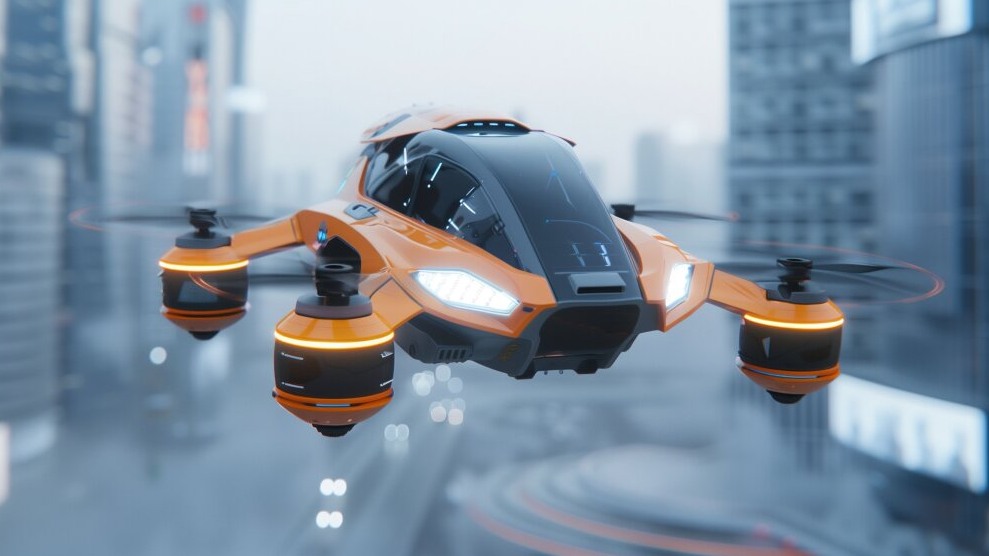
Elon Musk Finally Unveiled the First Prototype of the Flying Tesla Car: For more than a century, the idea of a flying car has represented humanity’s ultimate transportation dream. Science fiction movies, futuristic novels, and visionary inventors have all imagined a world where traffic jams disappear, highways become obsolete, and people travel through the sky as easily as they drive on roads today.
Now, that dream appears closer than ever.
Recent revelations surrounding Elon Musk, Tesla, and SpaceX have sparked worldwide excitement after reports emerged that Tesla has been secretly developing a revolutionary electric flying car under an internal initiative known as Project Skyline. While Tesla has yet to publicly reveal every detail, mounting evidence suggests that the company is building a fully autonomous electric vertical takeoff and landing (eVTOL) vehicle capable of both driving on roads and flying through urban airspace.
If successful, this breakthrough could fundamentally transform transportation, city planning, logistics, and even humanity’s future beyond Earth.
The Beginning of Tesla’s Flying Car Revolution
The speculation intensified when Elon Musk reportedly hinted during a private investor meeting that future vehicles should not merely avoid traffic congestion but completely bypass it.
At first, many observers dismissed the comments as another one of Musk’s ambitious jokes. However, a series of developments soon changed the conversation:
- Specialized aerospace hiring within Tesla
- Patent filings related to advanced flight technologies
- Supply-chain reports indicating new propulsion systems
- Collaboration between Tesla and SpaceX engineering teams
These developments have fueled growing belief that Tesla is actively building what could become the world’s first mass-market autonomous flying vehicle.
The project has reportedly been operating under the codename Project Skyline, a highly secretive initiative isolated from Tesla’s main automotive operations.
What Is Project Skyline?
Tesla’s Most Secretive Engineering Program
According to industry insiders, Project Skyline is not simply a concept study or experimental research division.
Instead, it functions as a dedicated engineering skunkworks team focused on developing a next-generation transportation platform capable of operating both on roads and in the air.
Unlike Tesla’s:
- Full Self-Driving (FSD)
- Optimus humanoid robots
- Vehicle manufacturing divisions
Project Skyline reportedly operates independently with strict confidentiality requirements.
Engineers assigned to the project are believed to work under expanded non-disclosure agreements and highly restricted information-sharing protocols.
The SpaceX Connection
Perhaps the most fascinating aspect of Project Skyline is its talent pool.
Reports suggest that numerous senior engineers have been transferred from SpaceX into the initiative.
These specialists previously worked on:
- Falcon 9 stabilization systems
- Precision thrust-vectoring technology
- Autonomous rocket landing software
- Thermal management systems
- Advanced propulsion engineering
This crossover is significant because such expertise is rarely required for conventional automobiles.
However, it becomes extremely valuable when designing a vehicle capable of controlled vertical flight.
The involvement of SpaceX personnel strongly reinforces long-standing rumors that Elon Musk has been pursuing a flying vehicle concept for years.
The Patent Trail Revealing Tesla’s Flying Ambitions
One of the strongest indicators supporting the flying Tesla theory comes from public patent filings.
Industry analysts have identified a noticeable increase in Tesla-related intellectual property filings across three key technological sectors.
1. Ultra-Lightweight Composite Materials
Flight demands an extraordinary balance between strength and weight.
Tesla appears to be researching advanced composite materials designed to:
- Reduce structural mass
- Improve aerodynamic efficiency
- Withstand flight stresses
- Enhance energy efficiency
These materials are far beyond what is necessary for traditional passenger vehicles.
2. Distributed Electric Propulsion Systems
Instead of using large helicopter-style rotors, Tesla’s patents describe systems involving numerous compact electric propulsion units.
Potential benefits include:
- Improved stability
- Reduced noise
- Greater safety
- Enhanced redundancy
- Better aerodynamic performance
This design philosophy aligns closely with modern eVTOL aircraft concepts.
3. Ultra-High Energy Density Batteries
Perhaps the most important area of innovation involves battery technology.
Tesla’s filings suggest significant advancements in battery chemistry aimed at dramatically increasing energy storage while reducing weight.
This breakthrough may be the key that finally makes consumer flying vehicles practical.
Solving the Biggest Problem: Battery Technology
Why Flying Cars Have Always Failed
For decades, flying car concepts have struggled with one unavoidable challenge:
Physics.
Vertical flight requires enormous amounts of energy.
Traditional lithium-ion batteries are simply too heavy relative to the energy they provide.
While they work well for electric vehicles on roads, they have historically lacked the energy density required for practical airborne transportation.
Tesla’s Potential Breakthrough
Industry experts believe Tesla may be approaching a solution through innovations derived from its 4680 battery cell program.
Combined with experimental battery chemistries such as:
- Solid-state batteries
- High-density lithium architectures
- Advanced thermal management systems
Tesla could potentially double current energy density levels.
If achieved, this milestone would dramatically improve the feasibility of electric aviation.
The result would be:
- Longer flight times
- Increased passenger capacity
- Better safety margins
- Lower operational costs
Most importantly, it would enable large-scale manufacturing rather than limited prototype production.
How Tesla Could Create the World’s First Autonomous Air Network
The Real Advantage Is Not the Hardware
Many people assume Tesla’s greatest strength lies in batteries or manufacturing.
In reality, Tesla’s biggest competitive advantage may be its artificial intelligence ecosystem.
Every day, millions of Tesla vehicles collect real-world driving data across countless environments.
This data includes:
- Road conditions
- Human behavior patterns
- Weather impacts
- Navigation challenges
- Obstacle recognition
The scale of this data collection network is unmatched.
Bringing Full Self-Driving to the Sky
Tesla could theoretically adapt its existing AI systems to aerial navigation.
Instead of relying on traditional aviation controls, flying Teslas may operate through an advanced autonomous network capable of:
- Route optimization
- Collision avoidance
- Dynamic weather adaptation
- Real-time traffic coordination
- Automated emergency responses
This approach could revolutionize urban air mobility.
A Decentralized AI Airspace
Rather than depending on conventional air traffic controllers, future flying Teslas may communicate directly with one another.
Imagine thousands of autonomous aircraft continuously exchanging information in real time.
Such a system could:
- Prevent collisions
- Reduce delays
- Improve efficiency
- Optimize flight paths
- Eliminate many forms of human error
The sky itself could become a giant intelligent transportation network.
The End of Traffic Congestion?
Unlocking the Third Dimension
Modern cities face an increasingly severe transportation crisis.
Urban populations continue to grow while available land remains limited.
Building new highways is expensive, time-consuming, and often impossible.
Flying vehicles offer a completely different solution.
Instead of expanding roads horizontally, transportation can move vertically.
A New Urban Reality
If Tesla successfully launches a practical flying car, cities could undergo dramatic changes.
Potential benefits include:
Faster Commutes
A journey that currently takes an hour by car could potentially be completed in minutes through direct aerial travel.
Expanded Housing Opportunities
People could live much farther from city centers without sacrificing convenience.
Reduced Infrastructure Costs
Governments may eventually invest less in road expansion projects and more in aerial mobility infrastructure.
Improved Logistics
Deliveries, emergency services, and regional transportation could become significantly more efficient.
The economic impact could be enormous.
How Flying Tesla Cars Could Transform Real Estate
Transportation has always influenced property values.
Homes closer to major employment centers generally command higher prices due to reduced commute times.
Flying vehicles could disrupt this long-established relationship.
The Collapse of Distance Barriers
If aerial transportation enables workers to travel across metropolitan regions in ten minutes, proximity to downtown areas becomes far less important.
This could lead to:
- Growth of suburban communities
- Increased rural development
- Redistribution of population density
- New economic opportunities outside major cities
The entire geography of urban living could change.
The Regulatory Challenges Ahead
Despite the excitement, major obstacles remain.
Building the vehicle itself may be easier than obtaining approval for widespread deployment.
FAA and Global Aviation Authorities
Airspace is one of the most heavily regulated environments on Earth.
Every commercial flight currently requires extensive oversight and coordination.
Introducing thousands of autonomous flying cars creates unprecedented challenges.
Key Regulatory Questions
System Reliability
How will flying Teslas respond to:
- Power failures
- Sensor malfunctions
- Battery issues
- Software errors
Authorities will demand extensive safety validation.
Cybersecurity
Autonomous aircraft connected to digital networks must be protected from:
- Hacking attempts
- Malware
- Signal interference
- Cyber warfare threats
Security standards will need to be extraordinarily robust.
Airspace Management
Governments must establish entirely new frameworks for low-altitude urban air mobility.
Current aviation systems were not designed for millions of consumer-operated flying vehicles.
The Noise Problem
One often overlooked challenge is acoustic pollution.
Even small drones produce noticeable noise.
Now imagine thousands of flying vehicles operating over a city every day.
Without proper engineering, noise could become a major public concern.
Tesla’s Potential Solution
Rumors suggest Tesla is investigating highly shrouded propulsion systems designed to minimize sound emissions.
Advanced electric propulsion may eventually allow flying vehicles to operate much more quietly than helicopters.
If successful, this innovation could remove one of the largest barriers to public acceptance.
The Risk of Technological Inequality
Not everyone is convinced that flying cars will immediately benefit society as a whole.
The Luxury Vehicle Phase
Analysts estimate early flying Tesla models could cost between $300,000 and $500,000.
At those prices, ownership would be limited primarily to:
- Wealthy individuals
- Corporations
- Premium transportation providers
This raises concerns about a future where affluent citizens literally fly above traffic while others remain stuck on crowded roads.
Tesla’s Historical Pattern
However, Tesla has followed a similar strategy before.
The company began with expensive vehicles such as the Roadster before eventually introducing more affordable options like:
Many experts believe Project Skyline could follow the same trajectory.
Initial premium offerings may help fund future mass-market versions.
Beyond Earth: The Hidden Mars Connection
Why Elon Musk Might Be Building More Than a Flying Car
To fully understand Project Skyline, it is important to examine Elon Musk’s broader vision.
Musk has repeatedly stated that his ultimate goal is making humanity a multi-planetary species.
Mars colonization remains the central mission driving much of SpaceX’s innovation.
Transportation Challenges on Mars
Mars presents unique obstacles:
- No road infrastructure
- Extreme terrain
- Thin atmosphere
- Vast distances between settlements
Traditional vehicles may struggle to provide efficient transportation across the Martian surface.
A Dual-Purpose Technology Platform
An autonomous electric aerial vehicle could solve many of these challenges.
The same technologies developed for Earth could eventually support:
- Martian logistics
- Scientific exploration
- Personnel transportation
- Autonomous cargo delivery
In this sense, Project Skyline may be far more than a consumer transportation project.
It could represent an early step toward building the transportation systems of future extraterrestrial civilizations.
Could Tesla Really Deliver a Flying Car?
Skeptics remain cautious, and for good reason.
Flying cars have been promised for decades.
Many ambitious projects have failed due to:
- Technical limitations
- Regulatory barriers
- Economic challenges
- Safety concerns
However, Tesla enters this field with unique advantages:
- World-class battery expertise
- Massive AI infrastructure
- Gigafactory-scale manufacturing
- SpaceX aerospace knowledge
- Significant financial resources
No previous company has combined all these capabilities under one ecosystem.
That combination makes Tesla’s effort fundamentally different from many earlier flying car projects.
The Future of Transportation Has Arrived
The unveiling of Tesla’s flying car prototype marks a potentially historic moment in transportation history.
Whether Project Skyline launches in two years or ten, the implications are profound.
A successful flying Tesla would reshape:
- Personal mobility
- Urban planning
- Logistics networks
- Real estate markets
- Global infrastructure
- Space exploration
For decades, flying cars belonged to science fiction.
Today, they are becoming an engineering reality.
As Tesla and SpaceX continue pushing the boundaries of innovation, the question is no longer whether the future will arrive.
The real question is how quickly humanity will adapt when the skies become the next great transportation network.
The age of the Flying Tesla may have finally begun.
FAQs
1. What is the Flying Tesla Car?
The Flying Tesla Car is a rumored electric vertical takeoff and landing (eVTOL) vehicle reportedly being developed under Tesla’s secretive Project Skyline initiative. It is designed to function as both a road vehicle and an autonomous aerial transportation platform.
2. Has Elon Musk officially unveiled a Flying Tesla prototype?
While reports and industry leaks have fueled speculation, Tesla has not yet publicly revealed complete technical specifications. However, growing evidence from patents, hiring trends, and insider reports suggests that advanced development is underway.
3. What is Project Skyline?
Project Skyline is the reported codename for Tesla’s confidential flying vehicle program. The project is believed to involve engineers from both Tesla and SpaceX working on next-generation transportation technologies.
4. How would the Flying Tesla Car work?
The vehicle is expected to use electric vertical takeoff and landing (eVTOL) technology, allowing it to lift off vertically like a helicopter and transition into forward flight while remaining fully electric and autonomous.
5. Will the Flying Tesla Car be fully autonomous?
According to reports, Tesla plans to integrate its advanced Full Self-Driving (FSD) artificial intelligence system into aerial transportation, potentially allowing the vehicle to operate without a human pilot.
6. What battery technology could power the Flying Tesla?
Industry analysts believe Tesla may use advanced versions of its 4680 battery cells, potentially combined with solid-state or ultra-high-energy-density battery technologies to achieve practical flight performance.
7. How fast could a Flying Tesla travel?
Although official performance figures have not been released, experts estimate that future eVTOL vehicles could reach speeds between 150 and 250 mph (240–400 km/h) depending on design and regulations.
8. How would Flying Tesla vehicles avoid collisions?
Tesla could use a combination of AI-powered navigation, sensors, cameras, and real-time vehicle-to-vehicle communication to create a decentralized aerial traffic management system.
9. Would a Flying Tesla eliminate traffic congestion?
Flying vehicles have the potential to significantly reduce road congestion by utilizing low-altitude air corridors, allowing commuters to bypass traditional traffic routes entirely.
10. How much could a Flying Tesla cost?
Early estimates suggest the first-generation Flying Tesla could cost between $300,000 and $500,000, making it a premium product before potentially becoming more affordable through large-scale manufacturing.
11. Will Flying Tesla vehicles be noisy?
Tesla is reportedly exploring advanced propulsion technologies and enclosed electric thrust systems designed to reduce noise levels compared to conventional helicopters.
12. What are the biggest challenges facing Flying Tesla development?
Major challenges include:
- Battery energy density
- Regulatory approvals
- Airspace management
- Cybersecurity concerns
- Public safety requirements
- Noise reduction technologies
13. Could Flying Tesla cars replace helicopters?
In many urban transportation scenarios, a Flying Tesla could offer a quieter, cleaner, and more autonomous alternative to traditional helicopters, particularly for short-distance travel.
14. When could Flying Tesla cars become available?
There is currently no official release date. Industry experts believe commercial deployment could still be several years away due to extensive testing and regulatory requirements.
15. How could Flying Tesla cars impact cities?
Flying vehicles could transform urban environments by reducing commute times, expanding residential options, improving logistics, and reshaping infrastructure planning for future smart cities.
16. Why is SpaceX involved in the Flying Tesla project?
Reports indicate that several aerospace engineers from SpaceX have contributed expertise in propulsion systems, stabilization technology, and autonomous flight controls, helping Tesla develop advanced aerial mobility solutions that may also support future Mars transportation systems.
Read More:
- Blue Origin in Big Trouble after Test Failure, Can’t Launch in Artemis 2027! SpaceX to Save NASA
- Elon Musk strikes down reports on SpaceX IPO rumors
- Tesla Full Self-Driving expansion in Europe continues with new addition
- New Tesla Battery Technology! Tesla Model 2: 5,000-cycle LFP, 90% after 10 years, 9min cell rejected
- Tesla Semi 90% Of New Electric Truck Orders, Never Seen Specs
2 thoughts on “It Happened: Elon Musk Finally Unveiled the First Prototype of the Flying Tesla Car”