
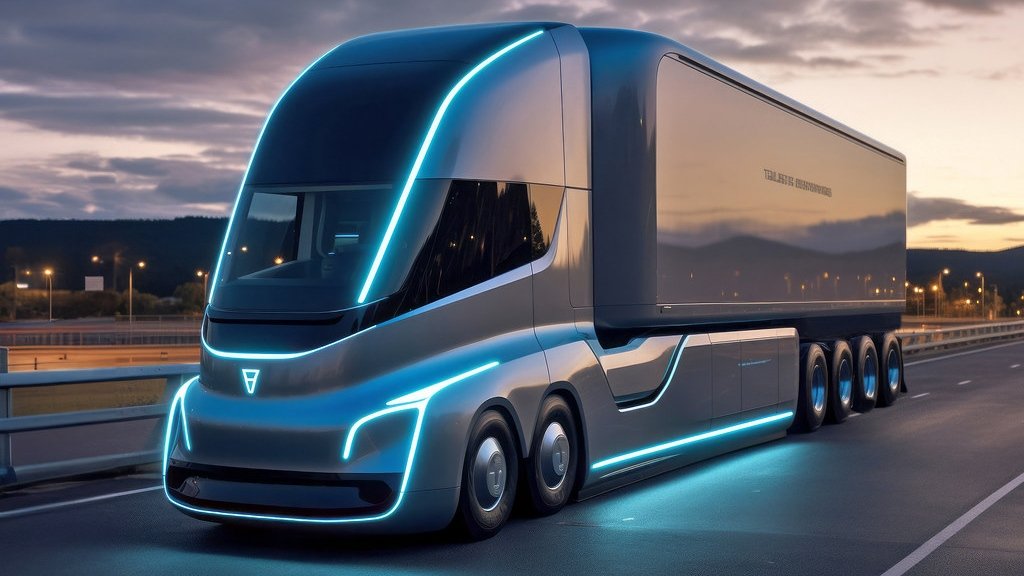
INSANE 95% Uptime! Tesla Semi 2.0 Is Ready For 2027: The commercial trucking industry is entering a major transformation. For more than a century, diesel-powered internal combustion engines have dominated freight transportation, but electric Class 8 trucks are challenging that status quo with lower energy costs, simplified maintenance, and increasingly capable charging infrastructure.
At the center of this shift is the Tesla Semi 2.0, Tesla’s next-generation heavy-duty electric truck. While early critics questioned whether battery-electric trucks could handle demanding regional and long-haul freight operations, real-world fleet deployments are providing increasingly important data on operating costs, uptime, range, charging, and performance.
The result is a compelling argument: the electrification of trucking may be driven as much by business economics as by environmental goals.
The Economics Behind Electric Trucking
For commercial fleets, the most important metric is Total Cost of Ownership (TCO). A truck traveling 100,000 miles or more each year can generate enormous fuel, maintenance, and downtime expenses.
Tesla Semi vs. Diesel Operating Costs
In high-cost markets, diesel fuel can represent one of the largest variable expenses for trucking companies. A diesel Class 8 truck achieving approximately 6 miles per gallon at $7 per gallon would spend roughly $1.17 per mile on fuel alone.
Electric trucks can potentially operate at dramatically lower energy costs, depending on electricity rates and charging conditions. Using an illustrative energy cost of $0.15 per mile, an electric truck could save more than $100,000 annually in energy expenses when traveling 100,000 miles.
For a 100-truck fleet, the theoretical annual difference could reach millions of dollars.
Actual savings will vary based on electricity prices, diesel prices, vehicle efficiency, payload, route conditions, charging infrastructure, and utilization. Nevertheless, the potential TCO advantage is one of the strongest reasons fleet operators are investigating electric trucks.
Less Mechanical Complexity Means Lower Maintenance
Fuel savings are only part of the equation. Diesel trucks contain numerous mechanical and emissions-control systems that require regular maintenance.
The Diesel Maintenance Burden
A conventional diesel tractor may require:
- Engine oil and filter changes
- Transmission servicing
- Diesel Exhaust Fluid (DEF)
- Diesel Particulate Filter (DPF) maintenance
- Exhaust Gas Recirculation (EGR) servicing
- Turbocharger repairs
- Frequent friction-brake replacement
An electric powertrain eliminates many of these components.
Regenerative Braking Adds Another Advantage
The Tesla Semi’s electric motors can use regenerative braking to recover kinetic energy during deceleration. Instead of converting all braking energy into heat through friction brakes, regenerative braking can return a portion of that energy to the battery.
This is particularly useful for urban and regional freight routes involving frequent acceleration and braking.
Less mechanical complexity can also mean fewer components requiring service and potentially less downtime over the vehicle’s operating life.
95% Uptime Could Change Fleet Economics
One of the biggest concerns surrounding electric commercial vehicles is reliability. A truck that cannot operate is not generating revenue, regardless of how efficient it is.
Fleet operators therefore pay close attention to vehicle uptime.
Tesla Semi deployments have generated significant real-world operating data, with Tesla reporting substantial accumulated fleet mileage and high availability figures. Claims around approximately 95% fleet uptime are particularly significant because even small improvements in availability can have a meaningful impact on fleet productivity.
For logistics companies, uptime translates directly into:
More miles. More deliveries. Better asset utilization.
However, fleet performance can vary considerably by operating environment, vehicle age, maintenance practices, and infrastructure availability. Large-scale commercial deployment will provide a more comprehensive picture of long-term reliability.
Megawatt Charging Could Solve the Long-Haul Problem
Battery-electric trucks face one major challenge that passenger EVs don’t experience to the same degree: time is money.
A freight truck cannot spend hours charging if its schedule requires continuous operation.
Charging During Mandatory Driver Rest
This is where high-power charging becomes particularly important.
Under U.S. federal Hours of Service rules, commercial drivers have mandatory rest requirements, including a 30-minute break after eight cumulative hours of driving. Long-haul electric trucking can potentially use these legally required rest periods for charging.
Tesla’s Megacharger technology is designed around extremely high charging power, potentially allowing substantial range to be added during a driver’s scheduled break.
If charging and driver rest can occur simultaneously, charging doesn’t necessarily have to create additional downtime.
That could become one of the most important pieces of the electric long-haul trucking equation.
Charging Infrastructure Is the Next Big Challenge
Vehicles alone cannot electrify freight transportation. Trucking companies also need dependable charging infrastructure.
Tesla and other charging providers are pursuing high-power charging corridors along major freight routes. Interstate highways such as I-5 and I-10 are particularly important because they connect major distribution centers, ports, industrial regions, and population centers.
Depot charging will remain crucial for regional fleets, while highway megawatt charging could enable longer routes.
The ultimate objective is a connected network where electric trucks can travel between major freight hubs without making charging an operational bottleneck.
Battery Swapping Offers Another Solution
Megawatt charging isn’t the industry’s only approach.
Battery swapping is another potential solution, particularly for highly predictable commercial routes. Instead of waiting for a battery to recharge, a depleted pack can theoretically be replaced with a fully charged one within minutes.
This approach has attracted attention in parts of the international heavy-duty vehicle market.
For fixed routes such as ports, mining operations, and hub-to-hub logistics, swapping could provide extremely high vehicle utilization.
Tesla’s strategy, however, has focused primarily on integrated battery architecture and high-power charging rather than widespread battery swapping.
Can the Tesla Semi Handle Heavy Loads and Steep Grades?
Another important question is performance under maximum load.
A fully loaded Class 8 truck can weigh up to 80,000 pounds in many U.S. operations. Mountain grades therefore represent a serious test of any powertrain.
Electric motors have a major inherent advantage: instant torque delivery.
Unlike a conventional diesel powertrain that relies on multiple gears and shifting strategies, electric drive motors can deliver strong torque from very low rotational speeds.
On steep grades, this can provide smooth and predictable acceleration.
Regenerative braking also becomes valuable on descents, allowing the truck to recover some energy while reducing dependence on friction brakes.
Thermal management remains critical, however. Sustained high-power operation requires effective cooling for the battery, motors, and associated electronics.
The Biggest Barrier May Be Upfront Cost
Despite the potential operating advantages, electric trucks face a significant obstacle: initial capital expenditure.
Large logistics companies can more easily afford expensive vehicles, depot chargers, electrical upgrades, and fleet-management systems.
Small carriers and independent owner-operators may not have the same financial flexibility.
Why Financing Will Matter
The transition could therefore depend heavily on:
- Commercial leasing programs
- Fleet financing
- Government incentives
- Public charging networks
- Utility partnerships
- Shared charging infrastructure
Without these mechanisms, electric trucking could initially favor large enterprise fleets over smaller operators.
Tesla Semi 2.0 and the Future of Freight
The future of heavy-duty transportation is unlikely to be determined by a single specification such as range or horsepower.
Instead, the winning technology will need to deliver low operating costs, high uptime, fast charging, reliable performance, and predictable fleet economics.
The Tesla Semi 2.0 represents an important step toward that future. Its potential advantages include an efficient electric powertrain, regenerative braking, reduced mechanical complexity, and compatibility with increasingly powerful charging infrastructure.
As production expands and commercial charging corridors mature, electric Class 8 trucks could move from limited fleet trials toward much broader adoption.
The most important shift is that the conversation is no longer simply about whether electric trucks can work.
It is increasingly about whether diesel trucks can remain economically competitive as electricity, battery technology, charging infrastructure, and fleet utilization continue to improve.
For the global freight industry, that could be the beginning of one of the biggest transportation transformations in generations.
FAQs
1. What is the Tesla Semi 2.0?
The Tesla Semi 2.0 is Tesla’s next-generation electric Class 8 truck designed for commercial freight transportation. It is intended to provide lower operating costs, reduced maintenance requirements, and high-performance electric power for regional and long-haul trucking.
2. Is the Tesla Semi ready for 2027?
Tesla is working toward expanding Semi production and commercial deployment. 2027 is an important target period for Tesla Semi expansion, although exact production volumes, delivery schedules, and regional availability can change.
3. How much does it cost to operate a Tesla Semi per mile?
Operating costs depend on electricity prices, charging efficiency, route conditions, payload, and vehicle utilization. An estimated $0.15 per mile in energy costs has been cited for certain operating scenarios, potentially making the Tesla Semi substantially cheaper to fuel than a diesel truck.
4. How much can a Tesla Semi save compared with a diesel truck?
The potential savings can be significant. If an electric Semi uses approximately $0.15 per mile in energy compared with around $1.17 per mile for diesel fuel under a high-diesel-price scenario, the difference could approach $1 per mile before considering maintenance and other operating expenses.
5. Does the Tesla Semi really have 95% uptime?
Fleet deployments have reported uptime figures around 95% in certain operating environments. Actual uptime can vary depending on vehicle condition, route, charging infrastructure, maintenance, weather, and fleet-management practices.
6. How much maintenance does the Tesla Semi require?
The Tesla Semi’s electric powertrain eliminates many components found in conventional diesel trucks. It does not require traditional engine oil changes, diesel exhaust fluid, DPF servicing, or conventional multi-speed transmission maintenance, potentially reducing routine maintenance requirements.
7. Can the Tesla Semi handle an 80,000-pound load?
The Tesla Semi is designed for Class 8 heavy-duty freight applications and is engineered to operate at high gross vehicle weights. Actual legal payload and gross weight depend on regulations, configuration, and operating conditions.
8. Can the Tesla Semi climb steep mountain grades?
Yes. Electric motors can provide instant torque, which is particularly useful when moving heavy loads uphill. The truck’s thermal-management system is also important for maintaining performance during sustained high-power climbs.
9. How fast can the Tesla Semi charge?
Charging speed depends on the charging system, battery state, temperature, and available electrical power. Tesla’s Megacharger technology is designed to deliver extremely high charging power and add substantial range during relatively short charging sessions.
10. Can the Tesla Semi charge during a driver’s mandatory break?
That is one of the major advantages of high-power charging for long-haul trucking. Under U.S. federal Hours of Service rules, drivers have mandatory rest requirements. Charging during scheduled rest periods can potentially reduce the additional downtime associated with electric vehicle charging.
11. What is a Megacharger?
A Megacharger is a high-power charging system designed specifically for heavy-duty electric vehicles such as the Tesla Semi. It is intended to provide much more charging power than typical passenger-car charging systems.
12. Will Tesla build charging stations for the Semi?
Tesla is developing high-power commercial charging infrastructure to support electric freight operations. Strategic charging corridors and depot-based charging are expected to play an important role in enabling long-distance electric trucking.
13. Is battery swapping better than fast charging for trucks?
Battery swapping can offer extremely fast replenishment because a depleted battery is replaced with a charged one. However, it requires standardized removable battery systems and dedicated swapping infrastructure. Megawatt charging avoids the need for battery replacement but requires substantial electrical capacity.
14. What are the biggest challenges facing the Tesla Semi?
The major challenges include upfront vehicle cost, charging infrastructure, grid capacity, battery production, long-distance route coverage, and financing for smaller trucking companies. Large fleets may be better positioned to absorb these initial investments.
15. Can small trucking companies afford the Tesla Semi?
The answer will depend heavily on the purchase price, financing options, incentives, and charging costs. Leasing, commercial financing, government incentives, and shared charging networks could make electric trucks more accessible to smaller carriers and independent operators.
16. Will electric trucks replace diesel trucks?
Electric trucks are unlikely to replace every diesel truck immediately. However, as battery technology, charging infrastructure, manufacturing capacity, and fleet economics improve, electric trucks could capture an increasing share of regional and long-haul freight operations. The biggest driver may ultimately be lower total cost of ownership rather than environmental benefits alone.
Read More:
- Starship Ship 40 Recovery in a Bad Situation, Can’t Bring It Back Home! What Comes Next
- Major Tesla Bot Gen 3 Production UPDATE
- The Boring Company’s newest tunnel vehicle runs on Tesla parts and no one is driving it
- Elon Musk Reveals NEW Mars Timeline
- Elon Musk’s Terafab UPDATE Finally OutChip Entire The World